
As an Amazon Associate, I earn from qualifying purchases. This means I may earn a commission if you purchase through links on this page — at no extra cost to you.
The wall above the toilet is the most awkward wall in the house. It is narrow, it gets splashed, it sits behind a fixture nobody wants to stare at, and it is the first wall a bathroom guest actually looks at. That combination is why so many above-toilet displays fail: they treat the wall like any other wall, hang something pretty at the wrong height, and watch it warp, fall, or crowd the room. Treat this wall as its own problem — measure it, respect the moisture, choose for the space — and it becomes the easiest wall in the bathroom to get right.
Measure First, Then Choose
Measure three things before choosing anything. First, the width of the wall from side to side — most above-toilet walls are narrower than they look once the tank and trim are accounted for. Second, the clearance from the top of the tank to the ceiling, and from the tank to the bottom of anything you hang. Third, the splash zone: the area directly above and beside the tank that catches water from flushing, hand washing, and cleaning.
These measurements decide everything else. A shelf deeper than about eight inches over a standard tank crowds the person using the toilet. Art hung lower than about a foot above the tank gets bumped and splashed. A cabinet wider than the wall looks built-in in the wrong way — it overhangs the trim and makes the room feel smaller. Write the measurements down and shop against them, not against a photo of someone else’s bathroom.
What Survives a Bathroom
Moisture is the filter every above-toilet choice must pass. Raw wood warps, unsealed paper curls, and unprotected prints spot. That does not rule out wood or paper — it rules out unprotected wood and paper. Sealed wood, framed prints behind glass, metal, ceramic, and glass itself all survive a bathroom fine. What fails is the unsealed version: an open print taped to the wall, a raw wood shelf with no finish, a canvas with no frame in a windowless bathroom.
Ventilation decides how strict you need to be. A bathroom with a working fan and a window forgives more than a windowless room where steam lingers. If your mirror fogs and stays fogged, choose sealed and wipeable for everything above the toilet, and skip anything that absorbs moisture. If the room dries quickly, a sealed wood shelf and framed prints are safe. When in doubt, choose the sealed option — the cost difference is small and the replacement cost is not.
Shelves Done Right
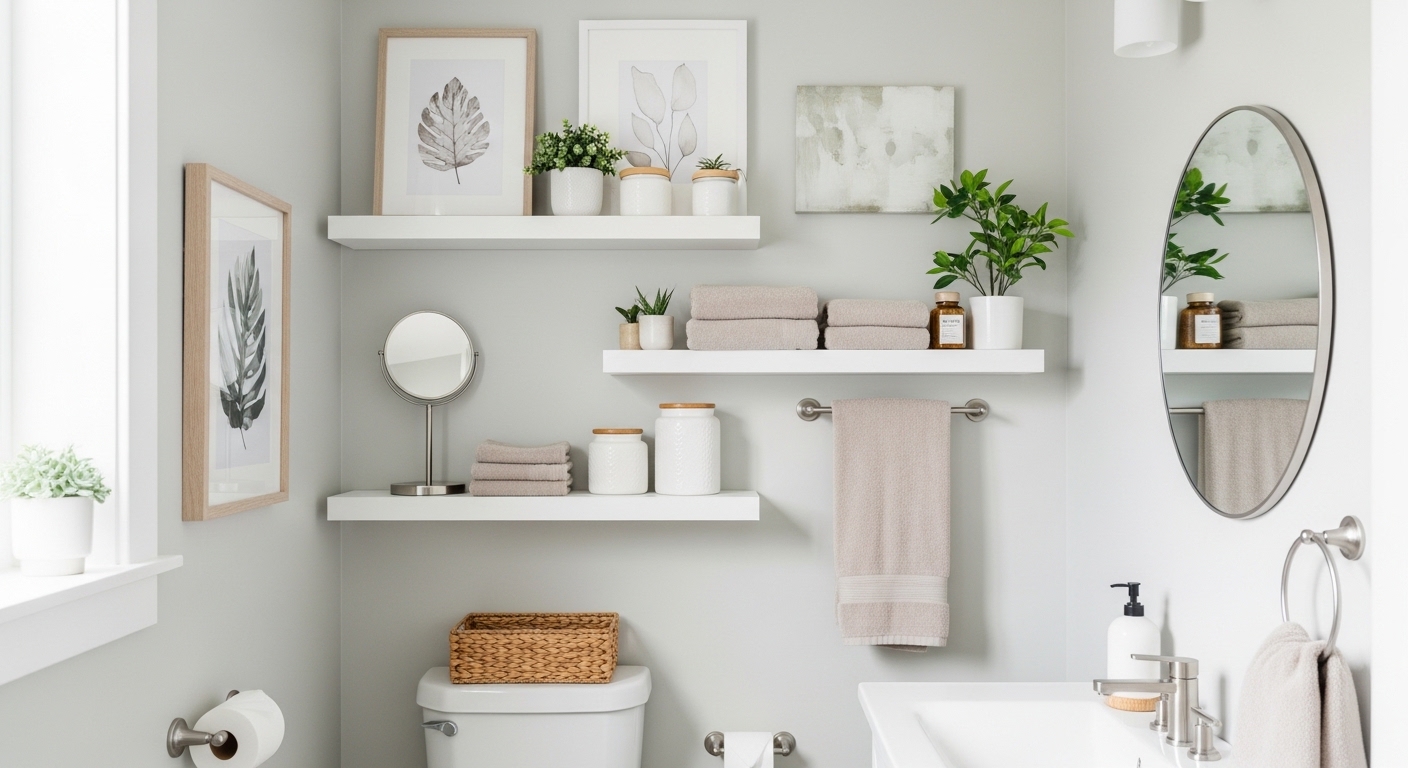
A floating shelf above the toilet works when it is shallow, level, and honestly fixed. Shallow matters most: a shelf that projects too far forces anyone using the toilet to lean forward, and anything stored on it ends up at forehead height. Keep shelf depth modest, keep the bottom shelf high enough to clear the tank lid — you need to lift that lid someday — and fix into studs or rated anchors, not adhesive alone, for anything that will hold weight.
What goes on the shelf matters as much as the shelf itself. Rolled hand towels, a small plant that tolerates humidity, a closed basket for spares — these earn their place. Open bottles, tall vases, and stacks of loose items do not: they fall, they collect dust and spray, and they turn a shelf into a clutter ledge. One shelf with three calm objects beats three shelves crowded with everything the bathroom owns. Leave empty space on purpose; the empty space is what makes the shelf look styled instead of stored.
🛒 Shop This Look:
Art and Prints Above the Toilet
Art above the toilet works when it is framed, sealed, and sized to the wall. A framed print behind glass handles steam and splashes; an unframed canvas absorbs them. Size by the wall width, not by the art you happen to own: a piece spanning roughly two-thirds of the wall width looks proportioned, while a tiny print centered over a wide tank looks lost and a piece wider than the tank looks like it belongs elsewhere.
Subject matters in a small room. Calm, simple subjects — a botanical print, a quiet landscape, a single abstract shape — suit a bathroom better than busy scenes that compete with tile, towels, and fixtures. Minimalist art is a natural fit here because it adds interest without adding visual noise. If you like word art, choose one short print rather than a cluster; the popular minimalist quote prints guide covers sizing and framing choices that keep word art calm instead of shouty. Hang art at a height where its center sits near standing eye level, and keep it out of the direct splash line above the tank.
Cabinets Versus Open Shelves
Choose closed storage when the bathroom is small, shared, or short on other storage. A shallow wall cabinet above the toilet hides toiletries, medicines, and cleaning supplies that would otherwise crowd every open surface, and it protects them from spray. Choose a cabinet no deeper than the tank is wide in profile, with doors that open without hitting a light fixture or mirror.
Choose open shelves when the bathroom already has enough closed storage and the goal is display, not storage. Open shelves show towels, plants, and one or two decorative objects — they do not hide clutter, so they punish overfilling. A workable compromise is one closed cabinet for supplies plus one open shelf for display, if the wall is wide enough for both without crowding. If the wall is narrow, pick one: a cabinet that stores well, or a shelf that displays well, not a cramped version of both.
Mirrors Above the Toilet
A mirror above the toilet can open a small bathroom, but only when it does not compete with the vanity mirror. One mirror per bathroom is usually enough for function; a second mirror works as decor when it is smaller, decorative in frame, and placed where it reflects something pleasant — a window, a plant, a lit wall — rather than reflecting the toilet itself back at the room.
Size the mirror to the wall, not to ambition. A mirror wider than the tank overwhelms the wall; a small round mirror centered above the tank adds light and shape without dominating. Hang it securely — mirrors are heavy, and a bathroom wall above a toilet is a bad place for a falling object. Fix into a stud or a rated anchor, use two hanging points for anything wide, and check that the mirror does not catch glare from the bathroom light at standing height.
Small Bathrooms
Small bathrooms reward one decision, not three. One shelf or one piece of art or one mirror — not all three stacked on the same narrow wall. When the wall is tight, go vertical: a single tall, narrow arrangement draws the eye up and leaves the sides of the wall alone, which makes the room feel taller instead of busier.
Light does more work than decor in a small bathroom. A light-colored frame, a mirror that catches the window, a small sconce or battery light near the display — these expand the room in a way no extra object can. If the bathroom has no window, keep the above-toilet display pale and simple, and let the wall color stay light. Dark, heavy pieces on the only free wall of a small windowless bathroom close the room in.
🛒 Shop This Look:
Renters: No Holes, No Regrets
Renters can still use the above-toilet wall, but the fixing has to be honest about tile and paint. Adhesive strips hold light frames on smooth painted walls, but they fail on textured tile and damp grout — test one strip in a hidden spot and check it after a steamy shower before trusting it with a framed print. A leaning mirror on the tank lid or a freestanding over-toilet shelf unit that stands on the floor avoids wall fixings entirely and moves out cleanly.
Over-toilet shelving units that straddle the tank are the renter’s best friend and worst temptation. They work when they are sized to the tank — legs clear of the plumbing, shelves level, depth modest. They fail when they are wider than the wall or loaded with heavy baskets, which makes the whole unit top-heavy in the smallest room of the house. Measure the tank and the wall before ordering, and anchor the unit to the wall if it will hold anything heavier than towels.
Cleaning and Maintenance
Above-toilet displays need a cleaning routine, not just a hanging day. Wipe shelves and frames weekly — spray and dust settle fast in a bathroom. Check brackets and anchors every few months; humidity loosens fixings over time, and a shelf that felt solid in January can wobble by summer. Swap towels and plants before they look tired, and keep one spare hand towel in the rotation so the display never shows a frayed edge.
Seasonal swaps keep the wall fresh without new spending. A dried stem in winter, a green cutting in summer, a different hand towel color — small changes that take minutes and stop the wall from going stale. When a print starts to spot or a frame finish bubbles, move it out of the bathroom rather than living with damage. A damaged piece above the toilet draws the eye more than an empty wall does.
Mistakes That Crowd the Wall
The first mistake is hanging too low. Art or shelves that start just above the tank lid get bumped, splashed, and stared at from inches away. Give the tank its clearance and let the display start higher, where it can be seen properly. The second mistake is overfilling: three shelves, each crowded, above a toilet in a small bathroom. One calm shelf beats three crowded ones every time.
The third mistake is ignoring the rest of the bathroom. An above-toilet display in a bright modern style fights a bathroom full of warm traditional fixtures, and vice versa. Match the frame finish to the faucet or mirror frame, match the palette to the towels, and let the display belong to the room it is in. For the room around the wall, explore more wall decor ideas for inspiration.
🛒 Shop This Look: