
As an Amazon Associate, I earn from qualifying purchases. This means I may earn a commission if you purchase through links on this page — at no extra cost to you.
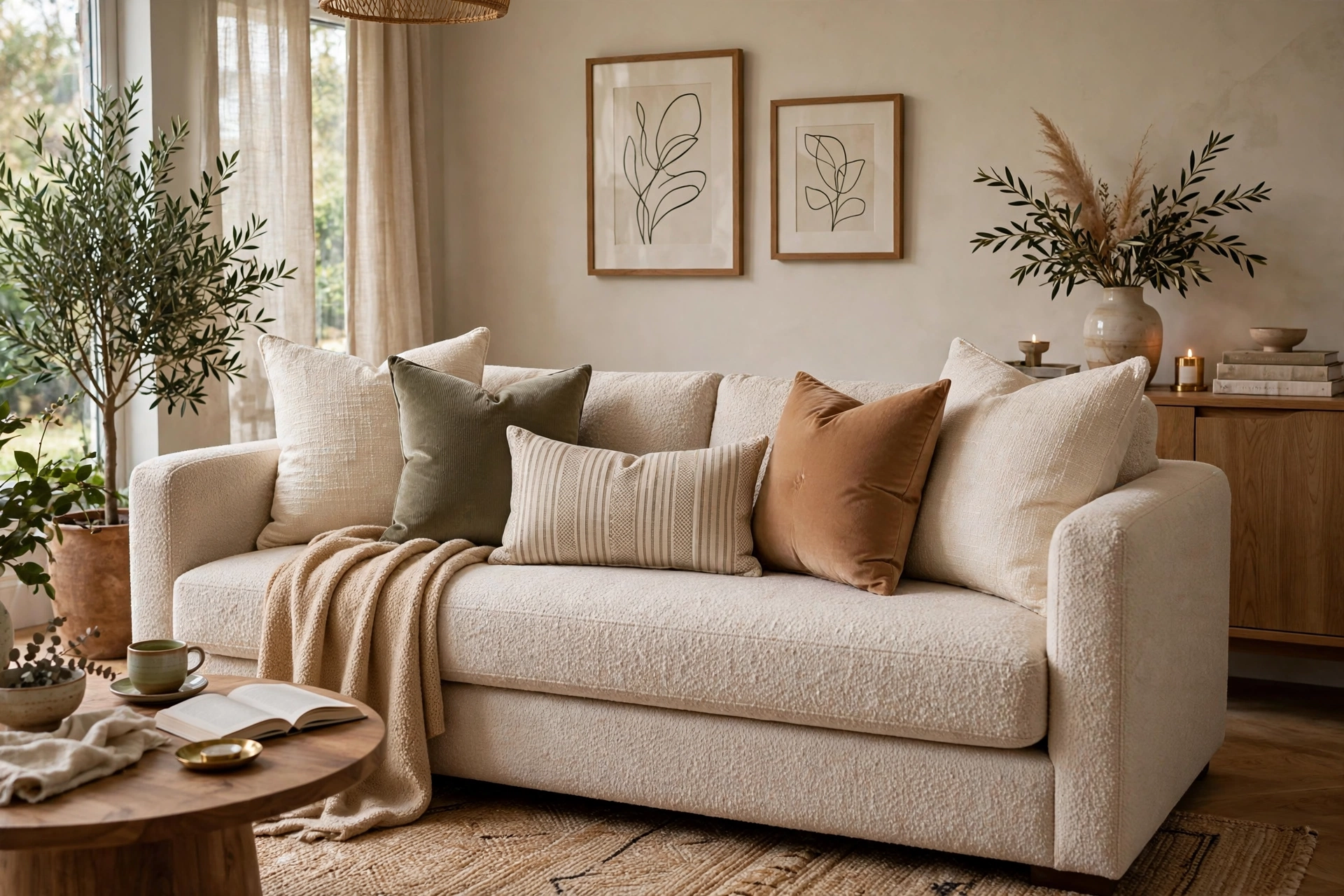
For a standard 84-inch sofa, five throw pillows is the designer sweet spot: two 20-inch squares in back, two 18-inch in front, and one lumbar in the center front. Loveseats need three; sectionals need five to seven. Odd numbers look intentional — even numbers look like they came with the sofa. Related: Pillows Should Be on a Bed.
The Formulas by Sofa Size
- Loveseat (60″): 3 pillows — two 18″ squares + one lumbar
- Apartment sofa (72″): 3–5 pillows — two 20″ + one or two smaller
- Standard sofa (84″): 5 pillows — two 20″, two 18″, one lumbar
- Deep/long sofa (96″+): 5–7 pillows — add an extra pair of 20″
- Sectional: 5–7 total — cluster at the corner and ends, not spread evenly
Size and Arrangement Rules
- Back layer largest: 20–22″ squares against the arms
- Front layer smaller: 18″ squares or 12×20″ lumbars
- Karate-chop the tops: a light chop down the center creates the designer dent (works on feather/down inserts)
- Mix textures: pair a nubby texture with a smooth one, a pattern with a solid
- One pattern max per cluster unless you’re confident mixing
The Insert Secret
Buy inserts 2 inches larger than the cover (a 20″ insert in an 18″ cover). This is the #1 difference between sad flat pillows and plump designer ones. Feather/down inserts look best; down-alternative is fine for allergies.
Color Formula
Pull one color from your rug, one from your art, and one neutral. Three colors across five pillows, varying the distribution — not every pillow needs every color.
Frequently Asked Questions
Can you have too many throw pillows?
Yes — if removing them to sit down feels like a chore, you have too many. Guests shouldn’t need to clear the sofa to use it.
What size throw pillows for a couch?
20″ squares for the back layer on standard sofas, 18″ for smaller sofas, 12×20″ lumbars for the front. Go bigger than you think — small pillows look lost on a full-size sofa.
Arrangement Patterns That Always Work
Beyond the basic formula, these specific layouts suit different sofa styles:
The Classic Layered (5 pillows)
Two 20-inch squares upright against each arm, two 18-inch squares angled slightly inward in front of them, one 12×20 lumbar centered in front. This is the showroom standard because the descending sizes create a natural pyramid that the eye reads as intentional from across the room.
The Relaxed Asymmetric (3–4 pillows)
Cluster all pillows at one end: a 22-inch square, an 18-inch square, and a lumbar leaning together. Leave the other end clear for actual lounging. This suits modern, lived-in rooms and sectionals where one end is the “pretty” end and the other is for feet-up real life.
The Symmetric Formal (4–6 pillows)
Mirror identical pairs on each end with a single statement pillow centered. Works in traditional rooms and on sofas that face a formal focal point like a fireplace. The symmetry reads as tailored and deliberate.
The Corner Cluster (sectionals)
On an L-shaped sectional, concentrate pillows at the corner and taper toward the ends: three at the corner (large, medium, lumbar), one or two at each far end. Spreading them evenly along a sectional looks sparse and indecisive; clustering looks designed.
The Color Mixing System
Random pillow colors look random. Use one of these proven systems:
- The 60-30-10: 60% of pillows in the dominant neutral (matching the sofa family), 30% in a secondary color pulled from the rug or curtains, 10% in an accent — the bold pattern or vivid color that makes the arrangement memorable.
- Tone-on-tone: all pillows in shades of one color (creams, oatmeals, taupes). Texture does the work — mix linen, bouclé, velvet, and knit. This is the most foolproof elegant look and the easiest to live with long-term.
- The art pull: choose the largest art in the room, pull three colors from it, and distribute them across the pillows. The sofa and the art will look like they were planned together — because they were.
- Seasonal rotation: keep a neutral base set year-round and swap two accent pillows seasonally — warm rusts and mustards for fall, fresh greens for spring, airy blues for summer. Four stored pillows give you a new sofa look four times a year.
Pattern Mixing Without Fear
- Vary the scale: one large-scale pattern, one small-scale pattern, and the rest solids. Same-scale patterns fight; different scales harmonize.
- Share a color: patterns in completely different styles work together if they share at least one color. A floral and a stripe in the same navy look intentional; in clashing palettes they look accidental.
- One organic, one geometric: the classic pairing — a floral or botanical with a stripe, trellis, or geometric. The contrast of pattern types is what makes the mix interesting.
- Solids are the glue: in a five-pillow arrangement, at least two should be solid or subtly textured. They give the eye resting places between patterns.
Texture: The Secret Ingredient
Color gets the attention, but texture makes pillows look expensive. Combine at least three textures: something nubby (bouclé, chunky knit), something smooth (linen, cotton), something with sheen (velvet, silk). In a neutral palette, texture is the design — a cream bouclé next to a cream velvet next to cream linen reads as rich and layered, not boring. As a bonus, textured fabrics hide wear, pet hair, and wrinkles better than flat ones.
Shapes Beyond the Square
- Lumbar (12×20 or 14×24): the workhorse front pillow. Supports the lower back, breaks up rows of squares, and is the best shape for a bold pattern — the horizontal format shows it off.
- Round/bolster: one round pillow adds a shape surprise that keeps arrangements from looking boxy. Best as the single accent, not repeated.
- Oversized square (24–26 inch): on deep sofas, a 24-inch back pillow fills the depth and looks luxuriously plush. Standard 20-inch pillows can look lost on a 40-inch-deep sofa.
Insert Deep-Dive: The Plumpness Formula
- Size up 2 inches — the golden rule. A 20-inch insert in an 18-inch cover gives the full, structured look. Same-size inserts look deflated within weeks.
- Feather/down vs. down-alternative: real down gives the best karate-chop dent and molds to shape, but needs regular fluffing and triggers allergies. Quality down-alternative holds its shape longer with less maintenance — the practical choice for daily-use sofas.
- Fluffing routine: pick up each pillow, punch the center, smooth the corners out, and set it back. Thirty seconds per pillow, weekly, keeps the arrangement looking styled instead of slumped.
- When to replace inserts: if fluffing no longer restores shape, the fill has broken down. Inserts are cheap; replace them rather than the covers. Annual replacement for daily-use pillows is normal.
Pillow Mistakes to Avoid
- All pillows the same size: creates a flat, monotonous row. Vary by at least 2 inches between layers.
- Matching the sofa exactly: pillows in the identical fabric as the sofa disappear. Contrast at least in texture, ideally in color.
- Too many to sit down: the practical limit — if using the sofa requires relocating an armful of pillows, remove one or two. The sofa is for sitting first.
- Ignoring the back cushions: pillows should complement, not fight, the sofa’s own back cushions. On a sofa with patterned back cushions, go solid on the throws.
- Forgetting the other side: in open-plan rooms, the back of the sofa is visible — the pillow arrangement should look intentional from behind too, which means no messy gaps or visible tags.
Pillow Care: Washing, Fluffing, and Storage
- Read the cover label first. Cotton and polyester covers usually machine-wash cold; linen often prefers gentle; velvet and silk are dry-clean or spot-clean only. Wash covers inside-out in a mesh bag to protect texture and closures.
- Inserts need care too. Down/feather inserts can be machine-washed (front-loader only — agitators tear baffles) and tumble-dried with dryer balls to restore loft. Foam inserts spot-clean only. Down-alternative inserts usually machine-wash fine.
- The weekly fluff: beyond the quick punch-and-smooth, once a month take inserts out of covers, shake vigorously, and let them air for an hour. Compressed fill rebounds with air and agitation — neglect is what kills loft permanently.
- Sun as a refresher: an hour of indirect sunlight deodorizes inserts naturally. Direct harsh sun fades covers — keep covers on for sun sessions, or air inserts in shade.
- Storing seasonal sets: wash covers before storing, store inserts uncompressed (never vacuum-seal down — it damages the fill), and use breathable cotton storage bags, not plastic, to prevent mustiness. Cedar blocks deter moths without chemicals.
Pillows Beyond the Sofa
The formulas transfer to every seat in the house:
- Armchairs: one lumbar or one 18-inch square. A single pillow, not a pair — chairs are for sitting, and one pillow preserves that.
- Beds: sleeping pillows against the headboard, then two 20-inch euros, then two standards, then one or two accent pillows in front. The sofa’s layered logic, scaled up. Stop before the pile requires a staging area on the floor each night.
- Benches and window seats: a row of lumbars in varied patterns, or three squares slightly overlapping. Long low seating wants horizontal shapes.
- Outdoor sofas: same counts and arrangements, but solution-dyed acrylic covers and quick-dry inserts. Bring them in during storms regardless of what the tag claims — UV and standing water age even outdoor fabrics.
- Dining benches: two or three lumbars for back comfort. Dining pillows take food abuse, so washable covers are mandatory, not optional.
Budget Strategy: Looking Expensive for Less
- Splurge on inserts, save on covers. A $25 feather insert in a $15 cover looks better than a $5 insert in a $40 cover. Plumpness reads as quality from across the room; the cover’s price tag does not.
- Buy covers, not pillows. Sets of quality inserts plus rotating seasonal covers cost less over time than buying complete new pillows each refresh.
- Thrift the texture: secondhand stores yield wool, linen, and knit covers for a few dollars — wash hot, and they are indistinguishable from new.
- DIY the simple ones: a straight-seam square cover is a beginner sewing project (two squares, three seams, one zipper). Custom sizes and exact fabric matches for the cost of material.
🛒 Shop This Look:
🛒 Shop This Look:
- Living Room Ideas Hub
- Bedding Sets Guide
- Throw Pillow Arrangements
🛒 Shop This Look:



