
As an Amazon Associate, I earn from qualifying purchases. This means I may earn a commission if you purchase through links on this page — at no extra cost to you.
A dark kitchen is rarely a window problem — it is a lighting problem. Most dark kitchens have a single ceiling fixture trying to do the work of four light sources, dark finishes absorbing what little light exists, and task zones sitting in the cook’s own shadow. These seven fixes address the actual causes, roughly in order of impact per dollar, and together they transform even a windowless galley.
Fix 1: Add Under-Cabinet Lighting (The Single Biggest Fix)
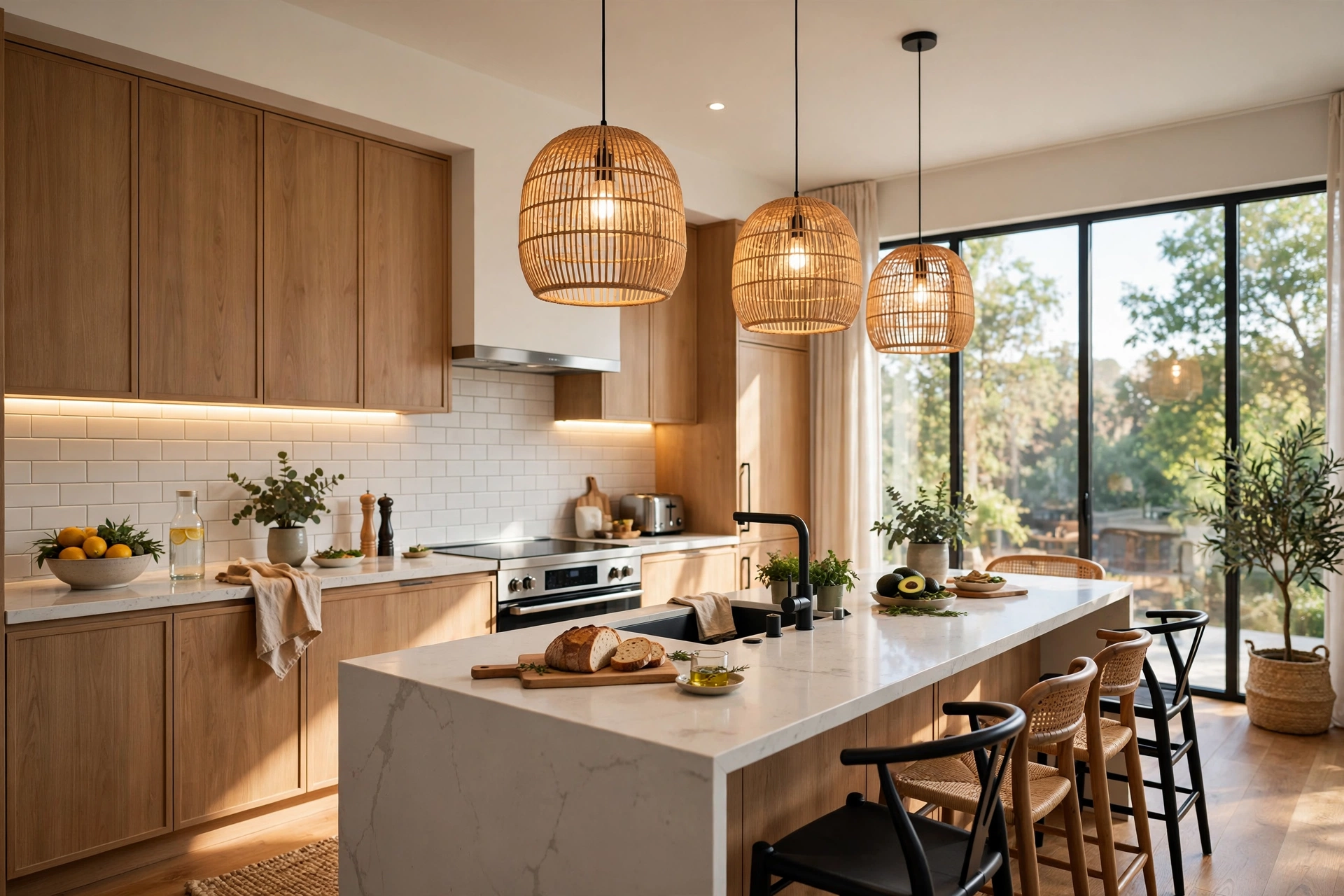
If you do one thing, do this. Under-cabinet lights put illumination exactly where work happens — on the counters — instead of on top of your head where your body blocks it. The before/after is the most dramatic of any fix here: counters go from cave-dark to brightly workable, and the kitchen gains a warm glow that makes the whole room feel larger.
- Choose LED strips or pucks in warm white (2700–3000K). Cool white makes food look unappetizing and the kitchen feel clinical.
- Mount toward the front of the cabinet underside, not against the wall — front mounting washes the full counter depth evenly; back mounting leaves the front edge in shadow.
- Plug-in strips are renter-friendly and install in minutes; hardwired versions are cleaner for owned homes. Battery pucks work for short runs but eat batteries — reserve them for inside glass cabinets.
- Put them on a separate switch or smart plug from the overhead so you can run counter lighting alone in the evening — the ambiance upgrade is enormous.
Fix 2: Replace the Single Overhead With Layered Light
One central fixture — especially a flush-mount with an opaque cover or, worse, a bare bulb — creates harsh downlight with dark corners. The fix is layers:
- Keep an overhead for ambient, but choose one with a diffuser or multiple bulbs that spread light, and put it on a dimmer. Bright-when-cooking, soft-when-dining.
- Add pendants over the island or sink — they bring light down to task height and add the jewelry factor that makes a kitchen feel designed. Hang 30–36 inches above the counter.
- The 3-source minimum: every kitchen needs ambient (overhead), task (under-cabinet + pendants), and ideally accent (in-cabinet, toe-kick, or above-cabinet glow). One source will always leave a dark kitchen dark.
Fix 3: Stop Cooking in Your Own Shadow
Stand at your prep zone and look at the counter: if your body blocks the overhead light, you are working in shadow — the most common and most fixable darkness in kitchens. Solutions beyond under-cabinet lights:
- Aim task light at the work surface, not at you. Under-cabinet strips and pendants in front of (not behind) the cook solve this by geometry.
- Add a light inside deep pantry cabinets — battery motion-sensor lights that trigger when the door opens turn black-hole pantries into usable storage.
- Light the sink zone specifically. A pendant or recessed light centered over the sink (not behind the cook) makes dishwashing dramatically less gloomy.
Fix 4: Bounce the Light You Have
Dark finishes — espresso cabinets, black counters, dark tile — absorb light instead of reflecting it. You do not need to replace them; you need to add reflectors:
- Lighten the backsplash. A glossy light backsplash (subway tile, light stone) bounces under-cabinet light back into the room instead of absorbing it. In rentals, peel-and-stick light tile over dark tile achieves this reversibly.
- Gloss where it counts: satin or semi-gloss paint on walls and ceiling reflects measurably more light than flat. A bright-white ceiling in flat finish plus light walls in eggshell is the highest-reflectance practical combo.
- Under-cabinet light + glossy backsplash is a multiplier — the strip lights the tile, the tile throws it back. Either fix alone helps; together they transform.
- Stainless appliances and light small appliances reflect; black ones absorb. When replacing, lighter finishes brighten — but do not replace working appliances just for this; the lighting fixes matter more.
Fix 5: Maximize the Window You Have (or Fake One)
- Clear the window completely: no clutter on the sill, no heavy valance, no grimy blinds half-closed. A bare window with a simple shade transmits dramatically more light than a dressed one.
- Clean it. Kitchen windows accumulate a grease film that can cut light significantly. Degrease inside and out — the cheapest brightness upgrade available.
- Mirror or glossy tile opposite the window throws daylight deeper into the room. A large mirror on the wall facing the window doubles the perceived window.
- No window at all? A daylight-mimicking LED panel (5000K, high CRI) on the darkest wall simulates one — it will not fool anyone, but it lifts the gloom measurably. Better: warm the whole kitchen’s lighting scheme so the windowless space feels intentionally cozy rather than accidentally dark.
Fix 6: Fix the Bulbs (Color Temperature and Brightness)
Many dark kitchens are not under-lit — they are wrong-lit. Audit every bulb:
- Color temperature: 2700–3000K (warm white) everywhere in the kitchen. Mixed temperatures (a cool-white overhead with warm pendants) look chaotic and feel institutional. Replace every bulb to one temperature.
- Brightness: kitchens need more lumens than living rooms — aim for generous total output across all sources rather than one blazing fixture. Multiple moderate sources beat one harsh one.
- CRI 90+: color rendering index matters enormously where food is concerned — low-CRI light makes everything look grey-brown. High-CRI bulbs cost little more and transform how the kitchen looks.
- Dimmers on everything: a dark kitchen at full blast is still unpleasant. Dimmers let you tune each layer — bright for prep, low for evening.
Fix 7: Address the Architecture (When Lighting Is Not Enough)
Sometimes the darkness is structural: a kitchen walled off from the living room’s windows, a soffit eating the ceiling height, dark wood paneling from a previous decade.
- Remove or cut down a soffit if it is not hiding structural elements or ductwork — the reclaimed 12 inches of ceiling height plus room for taller cabinets changes the kitchen’s whole proportion. (Confirm with a contractor what is inside first.)
- A pass-through or widened cased opening to an adjacent bright room borrows light and sightlines without a full open-plan renovation.
- Glass-front cabinet doors (or removing a pair of upper doors entirely for open shelving) let interior cabinet lighting spill out and reduce the visual weight of a wall of dark wood.
- Paint the dark wood: the nuclear option that works — painted cabinets in a light color reflect light instead of absorbing it. Proper prep (degrease, sand, prime, two topcoats) is non-negotiable for durability.
The Weekend Action Plan
In order, for maximum visible change per hour:
- Hour 1: degrease and clean the window, clear the sill, remove anything blocking light.
- Hour 2: audit and replace every bulb — one warm temperature, high CRI, adequate brightness.
- Hours 3–4: install under-cabinet LED strips on every run of wall cabinets.
- Remaining time: add the pendant over the sink or island, put dimmers on the overheads, and add the mirror or light backsplash accents.
A dark kitchen is a solvable problem, not a character trait. Light it in layers, bounce what you have, fix the bulbs — and cook in a kitchen that finally feels like the heart of the home instead of its basement.
Hiring an Electrician: What to Know
Several of these fixes (new circuits, hardwired pendants, dimmer installs on old wiring) are electrician jobs. Hiring well matters:
- Get the scope right: bundle all electrical work into one visit — the per-visit minimum means five small jobs cost barely more than one. List everything: pendants, dimmers, under-cabinet hardwiring, pantry lights.
- Ask about LED compatibility: a good electrician will confirm your chosen dimmers and bulbs play nicely together — flicker and buzz are compatibility problems, not bulb defects, and they are preventable with the right pairing.
- Older homes need assessment: knob-and-tube or aluminum wiring, ungrounded boxes, and undersized panels change what is possible and what it costs. An honest electrician tells you before starting, not mid-job.
- Permits for new circuits: adding circuits or moving boxes usually requires a permit and inspection — this protects you, not just the bureaucracy. Unpermitted electrical work complicates insurance claims and home sales.
Dark Kitchen, Bright Future: The Priority Ladder
If the full list is overwhelming, climb the ladder one rung at a time — each step delivers visible improvement on its own:
- Clean and clear — window degreased, sill cleared, blocking items moved. Free, immediate.
- Fix the bulbs — one warm temperature, high CRI, right brightness everywhere. The cheapest real upgrade.
- Under-cabinet lighting — the task-light transformation. The single purchase with the biggest impact.
- Layer the overheads — dimmers, then pendants where they serve a zone. The ambiance transformation.
- Bounce and reflect — light backsplash accents, mirror placement, glossier paint at the next repaint. The multiplier.
- Structural changes — soffits, openings, cabinet painting. Only if the ladder’s lower rungs were not enough.
Most dark kitchens are fixed by rung three. The kitchen was never actually dark — it was just lit like an afterthought. Treat light as the design material it is, and the room finally works as hard as you do in it.
🛒 Shop This Look:
🛒 Shop This Look:
🛒 Shop This Look:



