
As an Amazon Associate, I earn from qualifying purchases. This means I may earn a commission if you purchase through links on this page — at no extra cost to you.
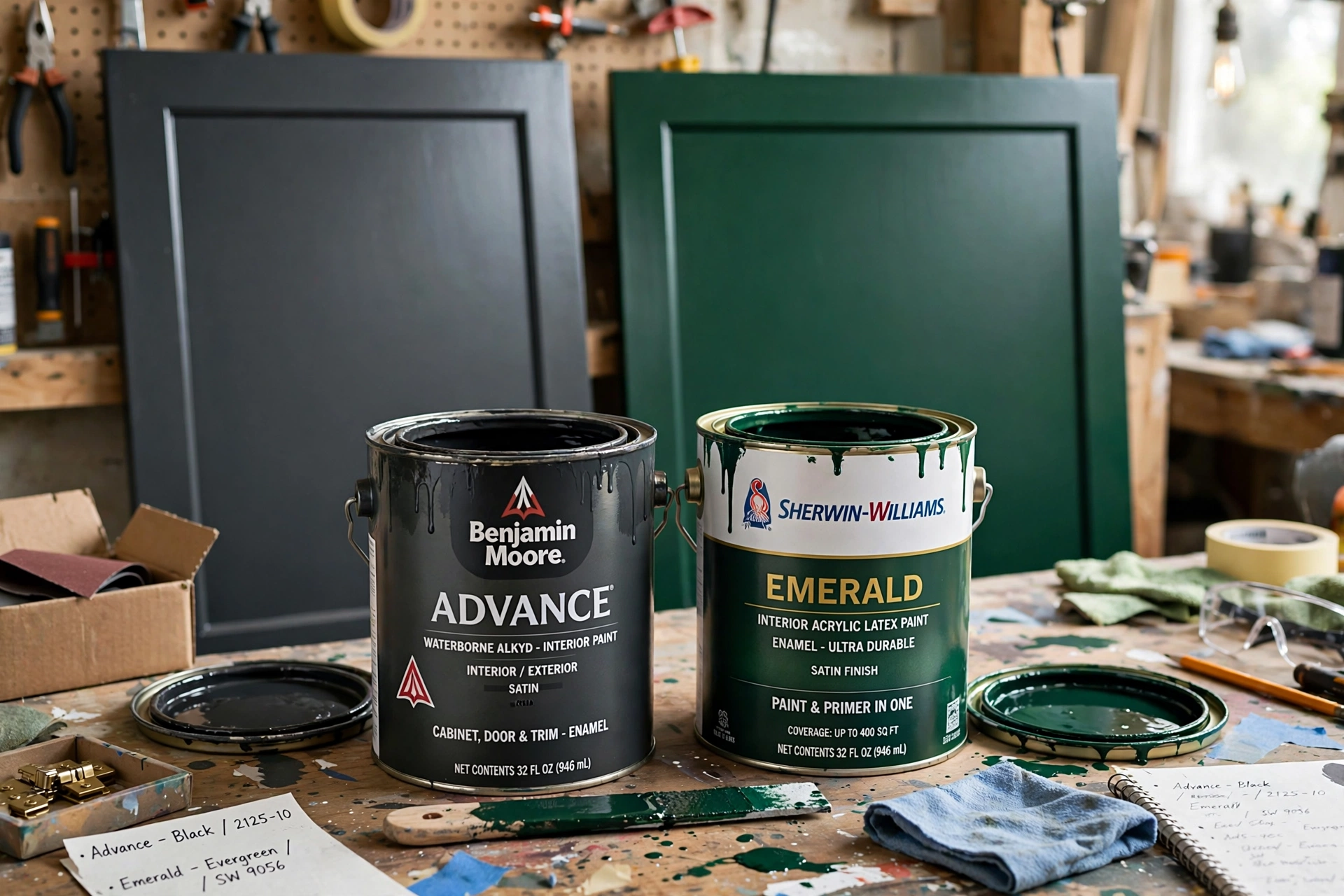
Benjamin Moore Advance and Sherwin-Williams Emerald Urethane Trim Enamel are the two most recommended paints for kitchen cabinets — and choosing between them comes down to how you paint. For most DIYers, Emerald Urethane wins on speed: it recoats in 4 hours versus Advance’s 16, so you can finish a kitchen in a weekend. For the smoothest hand-brushed finish, Advance’s waterborne alkyd formula self-levels slightly better. Both cure to a hard, scrubbable enamel; pick Emerald for speed and Advance for flow.
Head-to-Head Comparison Table
| Specification | Benjamin Moore Advance | Sherwin-Williams Emerald Urethane |
|---|---|---|
| Resin type | Water-reducible alkyd | Urethane-modified alkyd |
| Typical price per gallon | $78–$89 | $85–$115 (list $130.49; frequent sales) |
| Dry to touch (77°F, 50% RH) | 4–6 hours | 1–2 hours |
| Recoat time | 16 hours | 4 hours |
| Recommended coats | 1–2 | 2 |
| Coverage | 400–500 sq ft/gal | 350–400 sq ft/gal |
| Application | Brush, roller, spray (1500–2500 PSI) | Brush, roller, spray (2000 PSI, .013–.017 tip) |
| Cleanup | Soap and water | Soap and water |
| VOC | Low VOC (Gennex colorants) | <50 g/L |
| Interior/exterior | Interior only | Interior and exterior |
| Full cure | ~30 days | ~30 days |
Specs per manufacturer technical data sheets. Prices are U.S. street prices and vary by retailer, region, and promotions.
Application Deep Dive
Brushing: where Advance shines
Advance was formulated to behave like a traditional oil-based alkyd: it stays open (workable) longer, which lets brush marks melt away as the paint levels. If you’re hand-brushing cabinet doors and drawer fronts with a quality synthetic brush, Advance is famously forgiving — painters consistently report it lays down glass-smooth with minimal technique. The trade-off is patience: at 4–6 hours to touch and 16 hours to recoat, a two-coat job realistically spans three days.
Spraying: both excel, Emerald is faster
Sprayed through an airless or HVLP setup, both products produce a near-factory finish. Advance sprays at 1500–2500 PSI; Emerald Urethane at 2000 PSI with a .013–.017 tip and needs no reduction. Because Emerald recoats in 4 hours, a sprayed kitchen can get primer plus two topcoats in a single long day — a meaningful advantage for pros on a schedule and DIYers borrowing a sprayer for a weekend.
Rolling
Both can be rolled on cabinet boxes and face frames with a 1/4-inch nap microfiber or mohair cover (Purdy White Dove is the commonly recommended cover for Emerald). Advance’s longer open time helps rolled sections blend into brushed edges. Neither product is ideal for rolling large flat door panels if you want a flawless look — spraying or brushing is better there.
Coats and coverage
Advance lists 1–2 coats at 400–500 sq ft per gallon; in practice, two coats over primer is the standard for cabinets, especially when changing color. Emerald specifies 2 coats at 350–400 sq ft per gallon. Budget roughly one gallon of either product per 8–10 average cabinet doors (both sides), plus primer.
Cure time: the part everyone underestimates
Both paints feel dry long before they’re hard. Advance’s alkyd resins continue crosslinking for about 30 days; Emerald’s urethane-modified formula also needs roughly 30 days for full hardness. During the first 2–4 weeks, treat freshly painted cabinets gently: avoid stacking dishes, slamming doors, and aggressive cleaning. Emerald does reach handling hardness faster in the first week, which is one reason pros favor it for client work.
Durability: What the Specs and Professionals Say
A note on honesty: we did not run laboratory abrasion tests. What follows is drawn from manufacturer technical data and aggregated professional and homeowner feedback.
🛒 Shop This Look:
- Hardness: Both cure to a hard enamel film that resists chipping better than standard latex wall paint. Emerald’s urethane modification is specifically engineered for “frequently cleaned and used areas,” per Sherwin-Williams’ product literature. Advance’s alkyd cure is the traditional benchmark for furniture-quality hardness.
- Moisture and grease: Both handle kitchen humidity and cooking grease well once fully cured, provided surfaces were properly degreased (TSP substitute or deglosser) and primed first. Most adhesion failures reported by users trace back to skipping prep, not to the topcoat.
- Yellowing: Emerald is marketed as resisting yellowing compared to traditional oil-based coatings. Advance uses Gennex waterborne colorants and is low-VOC even after tinting; whites hold their color well in real-world use.
- Scrubbability: Both are scrubbable once cured. Satin is the most popular sheen for cabinets; semi-gloss is tougher but shows flaws.
- Common complaints: For Emerald, users most often cite its thick texture (it can drag if over-brushed) and the need to respect dry times in humidity — “it feels dry but is still soft underneath,” as one reviewer put it. For Advance, the overwhelming complaint is the 16-hour recoat wait stretching projects across many days.
Price Breakdown
Per-gallon street pricing (U.S., before tax; sales change this frequently):
- Benjamin Moore Advance: roughly $78–$89 per gallon (independent BM retailers; benjaminmoore.com lists tinted gallons around $88.99).
- Sherwin-Williams Emerald Urethane Trim Enamel: list price $130.49, but Sherwin-Williams runs 30–40% off sales regularly, bringing it to roughly $85–$115 per gallon. With a contractor or PaintPerks account, it’s often cheaper still.
For a typical 10×10 kitchen (about 20 doors/drawer fronts plus boxes), expect 2–3 gallons of topcoat plus 1–2 gallons of primer regardless of brand — so the paint cost difference between the two is usually under $60 for the whole project. Don’t choose on price alone; choose on schedule and application method.
Don’t forget: bonding primer (e.g., BIN Shellac or STIX), sandpaper, tack cloths, and brushes add roughly $60–$100 to a DIY cabinet job.
Which Should You Choose?
Choose Benjamin Moore Advance if…
- You’re hand-brushing and want maximum self-leveling with minimal brush marks.
- You have a flexible timeline and don’t mind 16-hour recoat waits.
- You prefer buying from independent paint retailers with knowledgeable staff.
- You want the traditional alkyd feel that many old-school painters trust.
Choose Sherwin-Williams Emerald Urethane if…
- You want the fastest project: 4-hour recoat means primer + two coats in a weekend.
- You’re spraying — it atomizes beautifully and builds fast.
- You need exterior-rated durability (it works for exterior doors and shutters too).
- You shop Sherwin-Williams sales or have a contractor account for pricing.
The professional consensus
Among painting contractors, Emerald Urethane has become the default recommendation for cabinets in recent years — primarily for its speed and early hardness, which matter when a client’s kitchen is out of commission. Advance retains a loyal following among fine-finish painters who brush everything by hand and judge a paint by how it levels. For a DIY homeowner, either product will dramatically outperform standard wall paint; the deciding factors are honestly your patience and your Sherwin-Williams sale calendar.
Prep Checklist: What to Do Before the First Coat
Professionals agree that cabinet paint failures are almost always prep failures, not paint failures. Both Advance and Emerald Urethane demand the same rigorous prep — budget a full day for it on an average kitchen.
Degrease Thoroughly
Kitchen cabinets accumulate years of cooking grease, even when they look clean. Wipe every surface with a TSP substitute or liquid deglosser, then rinse and let dry. Paint will not bond to grease — this is the step most skipped and most regretted.
Remove Doors and Label Everything
Take doors and drawer fronts off and paint them horizontally on sawhorses or a drying rack — this prevents drips and sags. As you remove each piece, label it with painter’s tape noting its location and hardware position (“upper-left-2, hinge top”). Reassembly without labels is a puzzle you don’t want.
Scuff-Sand and Dust
Sand all surfaces with 150–220 grit to degloss — you’re creating tooth for the primer, not removing the old finish. After sanding, vacuum every surface, then wipe with a tack cloth. Dust nibs trapped under enamel are visible forever.
🛒 Shop This Look:
Prime With a Bonding Primer
Use a dedicated bonding primer like BIN Shellac or STIX, not regular wall primer. Shellac-based primers block tannin bleed on oak and seal stains; synthetic bonding primers grip slick surfaces like laminate. One coat is usually enough, sanded lightly once dry. Skipping primer is the single fastest way to get peeling cabinets within a year.
Frequently Asked Questions
Can I use regular wall paint on kitchen cabinets?
You can, but you shouldn’t expect it to last. Wall paints (even premium ones) cure softer and scuff more easily. Cabinet-specific enamels like Advance and Emerald Urethane are formulated for hardness, adhesion, and repeated cleaning — the three things cabinet finishes must survive.
Do I need to sand before using Advance or Emerald?
Yes — at minimum, scuff-sand with 150–220 grit to degloss, then clean thoroughly. Both products adhere best to a dull, clean, dry surface over a bonding primer. Skipping sanding is the most common cause of peeling, regardless of which topcoat you choose.
Which is better for oak cabinets with heavy grain?
Either works, but grain filling matters more than brand: use a grain filler or high-build primer and sand between coats if you want a smooth modern look. Emerald’s slightly thicker build can help bridge minor grain; Advance’s leveling gives a smoother final surface over filled grain.
Can I paint cabinets without removing the doors?
You can paint boxes in place, but doors and drawer fronts should come off and be painted horizontally (on sawhorses or a drying rack) to avoid drips and get an even finish. Label every door and its hardware location as you remove them.
How long before I can use my kitchen normally?
Light use after 7 days; full cure takes about 30 days for both products. Reinstall hardware gently, avoid stacking items inside cabinets for the first two weeks, and clean only with a soft damp cloth (no harsh chemicals) during the first month.
By Ella Knight
🛒 Shop This Look:



