
As an Amazon Associate, I earn from qualifying purchases. This means I may earn a commission if you purchase through links on this page — at no extra cost to you.
A Christmas tree looks simple in photos: lights glowing, ribbon looping neatly, ornaments spaced just right. In real life, it is easy to end up with a bare patch at the back, ribbon that fights you at every branch, and favourite ornaments left over because there was nowhere sensible to put them. The difference is rarely taste. It is order. Decorate in the right sequence and each layer supports the next, so the tree looks balanced long before you hang the last bauble.
This guide walks you through that order, then explores the theme directions shaping Christmas 2026, ribbon techniques that stay put, and simple placement rules of thumb you can adapt to any tree.
Start With a Theme, Even a Loose One
Before opening a storage box, decide on a loose direction. It can be a palette of two or three colours, a mood such as cosy and traditional, or one material you repeat, like wood, glass, or velvet ribbon. That decision makes later choices easier: holding an ornament, you can ask whether it fits instead of guessing. Then sort everything, grouping ornaments by size and colour, untangling lights, and setting aside anything broken.
Step-by-Step: The Decorating Order That Works
1. Fluff and Shape the Branches
Fluffing makes the biggest difference, especially on an artificial tree compressed in a box for months. Work bottom up and inside out, fanning each tip outwards and slightly upwards so tips do not sit in a flat row. Step back often and look for dark holes where you can see through to the trunk; tease a couple of tips into those gaps. On a real tree, skip heavy shaping, but rotate it so its fullest side faces the room and trim only the odd stray branch.
2. Add the Lights
Lights go on first, because weaving them through branches is nearly impossible once ornaments are in the way. Start at the bottom near the trunk and work upwards, pushing the strand slightly into the tree and back out towards the tips. That in-and-out movement gives depth, so the glow seems to come from inside the tree. Check every bulb works before you start, keep the plug near your power source, and fix dull patches while they are easy to reach.
3. Add Ribbon or Garland
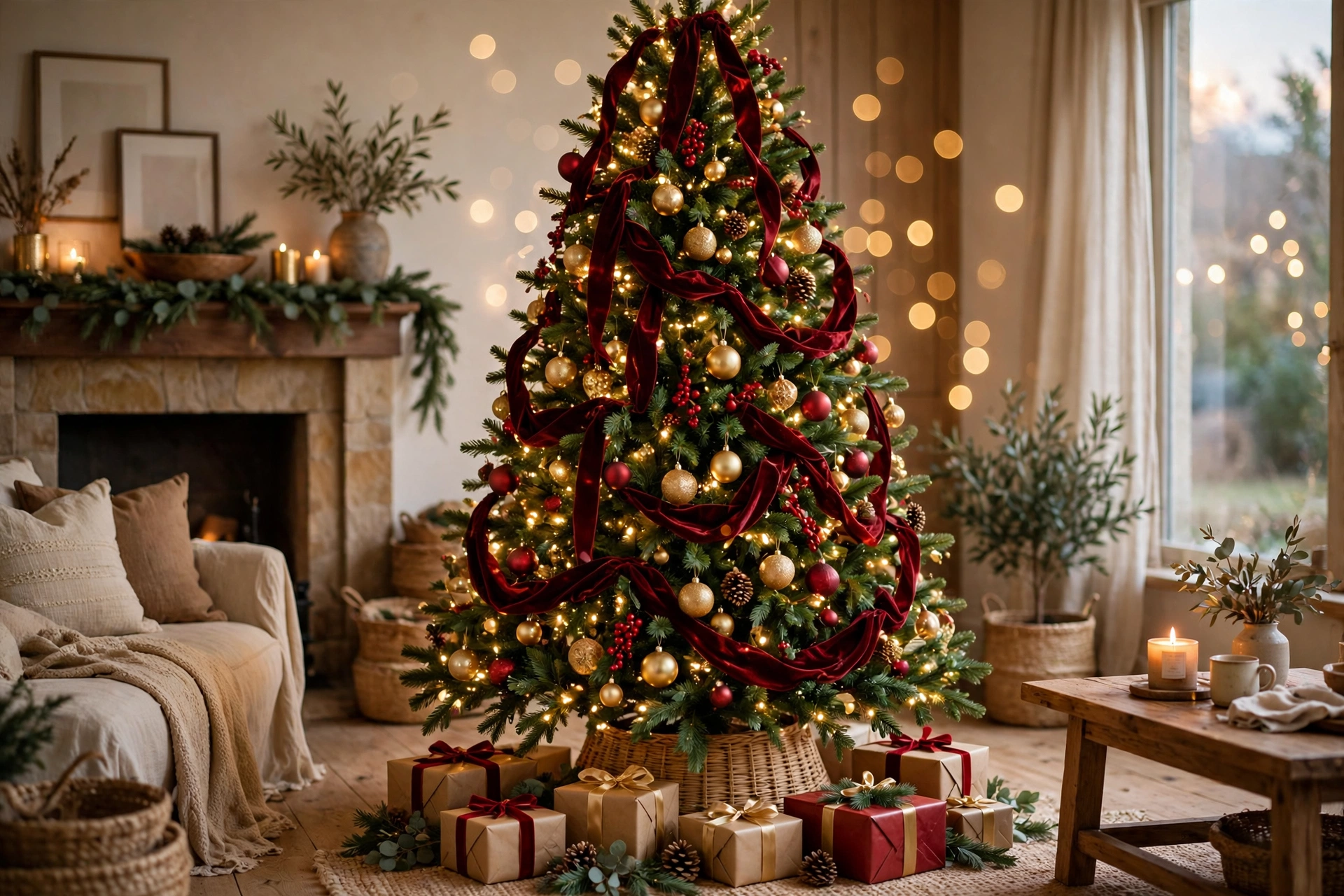
Ribbon is the next layer, far easier to tuck and adjust while branches are bare. Choose one main style and commit to it rather than mixing competing patterns. Work top down, anchoring it at the back, and let it settle into the branches instead of wrapping tightly around the outside. Detailed techniques follow below; for now, remember the sequence: ribbon before ornaments, always.
4. Hang the Large Ornaments First
Your biggest ornaments set the structure. Hang them first, spaced evenly around and up the tree, tucking some slightly deeper rather than placing them all on outer tips. Pieces placed deep create depth and stop everything looking surface-hung. Turn each so its best side faces out, and vary heights so they do not form a neat horizontal ring.
5. Fill In With Medium and Small Ornaments
Fill gaps with medium ornaments, then finish with the smallest pieces. This is where colour balance comes together: if one side feels heavy on a colour, move pieces rather than adding more. Sentimental ornaments deserve eye-level, front-facing spots; plainer fillers can work quietly at the back.
🛒 Shop This Look:
6. Add the Topper
Fit the topper last among the decorations, so you can judge its scale against the finished tree. A star, angel, bow, or cluster of picks can all work; proportion matters most, as a tiny topper disappears on a tall tree while an oversized one looks top-heavy. Secure it firmly so it sits straight. If it leans, floral wire hidden at the back usually solves it.
7. Finish With the Skirt or Collar
The final layer sits at the base. A skirt, collar, basket, or folded throw hides the stand, catches falling needles, and anchors the tree visually. Fabric skirts feel soft and traditional; collars and baskets give a cleaner, structured edge. Smooth it out as presents collect underneath, and the tree looks finished rather than simply decorated.
Christmas Tree Themes for 2026
Jewel Tones
Deep emerald, sapphire, ruby, and amethyst create a rich evening glow that suits warm lights. Share the colours evenly around the tree instead of clustering them, and add a metallic, usually gold, to tie them together. Velvet ribbon and glass ornaments carry this look especially well. For more ways to use these colours around the room, see these jewel tone Christmas decor ideas.
Heritage and Tartan
This direction leans into tradition: tartan and plaid ribbon, deep reds and greens, warm wood, and classic shapes such as bells, stars, and pinecones. Keep the palette tight, repeat the plaid in your tree skirt or a nearby cushion, and let warm lighting do the rest. It is forgiving for mixing older family ornaments, whose small differences in age and finish add to the collected feeling.
Pink Christmas
Pink ranges from soft blush to confident fuchsia and pairs surprisingly well with gold, cream, or silver. Balance is everything: mix pink with plenty of neutrals so it reads intentional rather than overwhelming, and repeat the shade in at least two places, such as ribbon and baubles. These pink Christmas decor ideas show how to carry the palette beyond the tree.
Maximalist Bows and Tinsel
Joyful and deliberately abundant, this look layers oversized bows along the branches, tinsel catching the light, garlands, and ornaments in generous numbers. Keep it curated rather than chaotic through repetition: pick two or three elements, such as bows, tinsel, and one bold colour, and repeat them consistently instead of adding a little of everything.
Natural and Rustic
A natural tree celebrates texture: pinecones, wooden beads, dried orange slices, burlap or linen ribbon, and ornaments in clay, wood, and woven materials. The palette stays close to the tree itself, in browns, creams, soft greens, and touches of cranberry red. It suits real trees particularly well and builds gradually from handmade and gathered pieces.
Monochrome
A single-colour tree, all white and silver, all gold, or all green on green, looks calm and striking, but only if you vary texture and finish. Mix matte, glossy, and glittered versions of your colour, combine smooth baubles with ribbed or faceted ones, and layer ribbon in a slightly different tone. Without variety a one-colour tree falls flat; with it, the effect is elegant and modern.
Short on space? No theme here requires a huge tree. A slim or tabletop tree can carry any of them, and these small space Christmas decor ideas help you scale the rest of the room to match.
Ribbon Techniques That Stay Put
Ribbon misbehaves when draped hopefully over branches like tinsel. These approaches give it structure.
🛒 Shop This Look:
- The cascade: Cut ribbon into separate lengths. Tuck each length in near the top, let it flow down in a gentle S-curve, and tuck it in again at two or three points. Separate pieces are easier to control and look fuller than one long piece.
- The loop and tuck: Push generous loops into the branches, pinching and tucking as you work down. The branches hold the loops, creating soft billows that stay put.
- The vertical drop: Run ribbon straight down in several evenly spaced columns. This suits slim trees and modern themes, and makes a tree appear taller.
Wired ribbon is far easier than unwired, because its edges hold shape while you arrange them. Cut ends at an angle or into a swallowtail notch for a finished look, and cut generously: you can trim later, but you cannot add length back.
Ornament Placement: Simple Rules of Thumb
There is no exact formula, but rough counts help you judge whether you have enough ornaments. As a general rule of thumb, plan on roughly 10 to 15 ornaments per foot of tree height for a lightly decorated look, and 20 or more per foot for a full, layered look. A six-foot tree might therefore carry between 60 and 120 ornaments, depending on their size and how full you like it. Treat these numbers as a starting point, not a target: large ornaments take more visual space, so you need fewer; small ones can be added generously.
Placement matters more than quantity. Spread large pieces first, distribute colours evenly before placing duplicates side by side, and reserve some ornaments for inner branches to build depth. If a section looks sparse, move pieces from an overcrowded area before adding more.
Real vs Artificial Trees: Decorating Notes
Real trees bring fragrance and natural, slightly irregular branches that suit rustic and heritage themes. They need a sturdy stand with water, regular topping up, and patience, because softer branches may droop under heavy ornaments. Save heavy pieces for stronger lower branches and keep ribbon and garlands lighter.
Artificial trees offer symmetry and branches you can bend to hold ornaments where you want them. They reward thorough fluffing, and ribbon sits predictably on their consistent branches. Pre-lit versions save time but give less control over light placement, so check the glow is even first.
Storage Tips for Next Year
- Photograph your finished tree before undecorating; next year it is your fastest reminder of what worked.
- Wrap fragile ornaments individually in tissue or soft cloth, in divided boxes or sturdy containers with padding between layers.
- Wind lights and ribbon around cardboard or a reel, so you are not untangling them next December.
- Label boxes by contents and order of use, lights and ribbon first.
- Store everything cool and dry, away from heat that can damage finishes and adhesives.
FAQ
How many ornaments do I need for a six-foot tree?
As a rule of thumb, between 60 and 120 ornaments ranges from lightly decorated to full, depending on size and taste. Start with what you own, hang the largest first, and judge from across the room before deciding you need more.
Should ribbon go on before or after ornaments?
Before. Ribbon is easier to tuck and adjust on bare branches, and ornaments hung afterwards sit neatly around it. Lights go on before ribbon, so the order is lights, ribbon, then ornaments.
How do I stop my tree looking bare at the back?
A tree in a corner needs less at the back, but leaving it empty makes the sides look thin too. Use your plainest fillers there, hang some pieces deeper for depth, and check for gaps as you go.
Can I mix two themes on one tree?
Yes, if they share a colour, material, or mood, as heritage tartan does with natural wood. Make one theme the lead and let the second appear in smaller touches, so the tree reads as one idea.
Conclusion
A well-decorated tree is mostly a well-ordered one. Fluff first, light second, ribbon third, then let large ornaments set the structure before smaller pieces fill in. Choose a theme that suits your home, even loosely, use placement counts as a guide rather than a rule, and step back often to see the tree as your guests will. Your 2026 tree will then look beautiful on the first evening and hold together, visually and literally, all season.
🛒 Shop This Look:




2 thoughts on “Christmas Tree Decorating Ideas 2026: Themes, Ribbon, Ornaments and Finishing Touches”
Comments are closed.