
As an Amazon Associate, I earn from qualifying purchases. This means I may earn a commission if you purchase through links on this page — at no extra cost to you.
Couples with different bedroom styles can find common ground by agreeing on a shared color palette first, then letting each person choose pieces within those boundaries. Start with neutral foundations — walls, bedding, and large furniture in whites, grays, or warm beiges — then give each partner one “personality zone” (like their nightstand or a reading corner) for self-expression. The 70/30 rule works well: 70% shared neutral base, 30% individual style mixed throughout.
Start With What You Agree On
Before debating styles, list what you both want from the bedroom: better sleep, more storage, a calmer feel. These shared goals become your decision filter. When you disagree on a specific piece, ask “does this serve our shared goals?” — it reframes the conversation from taste to function.
The Neutral Foundation Strategy
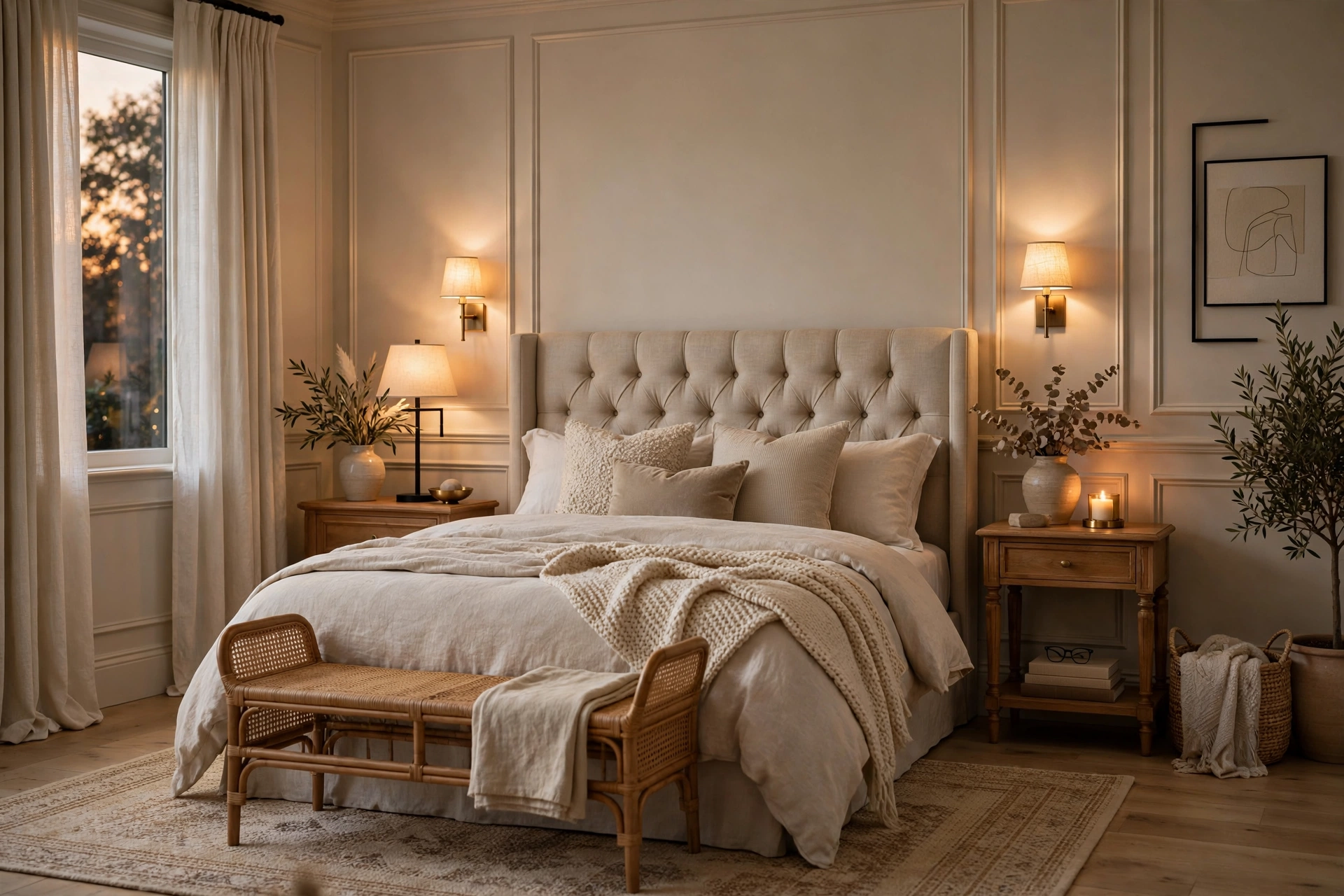
Paint walls a warm white or soft gray that works with both modern and traditional styles. Choose bedding in solid neutrals. Pick a simple bed frame — a clean-lined upholstered headboard bridges almost any style gap. These big-ticket items in neutral tones mean neither person’s style dominates.
Five Compromise Room Designs
1. Modern + Rustic: Warm Minimalism
Clean-lined furniture in warm wood tones, white bedding, black metal accents. She gets the cozy textures, he gets the clean lines.
2. Minimalist + Maximalist: Curated Simplicity
Keep surfaces clear but allow one bold gallery wall or a patterned rug. The maximalist gets color and pattern in contained doses.
3. Traditional + Contemporary: Transitional Blend
Classic furniture silhouettes in modern fabrics. A traditional tufted headboard in gray linen pleases both camps.
4. Bohemian + Industrial: Soft Edge
Black metal bed frame softened with layered textiles, plants, and warm lighting. Texture bridges the gap.
🛒 Shop This Look:
5. Masculine + Feminine: Balanced Neutrals
Charcoal, cream, and natural wood with touches of greenery. Neither frilly nor stark — just calm and collected.
Giving Each Person a Zone
Let each partner fully style their own nightstand — it’s a small area that satisfies the need for self-expression without disrupting the room. A reading chair in one corner can also reflect one person’s taste while the rest of the room stays neutral.
When to Call in a Tiebreaker
If you’re truly stuck, try this: each person picks their top three must-haves and bottom three deal-breakers. You’ll usually find the overlap is bigger than expected. And remember — the bedroom is for rest first, style second. Comfort is the one thing you should never compromise on.
How to Talk About Style Without Arguing
Most bedroom style fights are not really about style — they are about feeling unheard. A simple framework keeps the conversation productive. First, name the feeling, not the object. “I want the bedroom to feel calm when I walk in” works better than “I hate that dresser,” because feelings are negotiable and objects feel like personal attacks. Second, trade in specifics. Vague preferences (“something modern”) cause endless miscommunication; save phone photos of rooms you both like and compare them side by side to find the actual overlap. Third, separate the permanent from the changeable. Wall color, flooring, and large furniture are hard to undo — these deserve joint decisions. Throw pillows, art, and lamps are easy to swap — these are where personal taste gets free rein. Couples who argue over throw pillows are usually displacing anxiety about the expensive, permanent choices; settle those first and the small stuff gets easier.
Room-by-Room Compromise Guide
Walls: If one partner wants bold color and the other wants white, meet at a saturated neutral — deep sage, warm greige, or dusty blue all have personality without overwhelming. An accent wall behind the bed is the classic compromise: one bold wall, three calm ones. Removable wallpaper on that single wall lets the bold-color partner experiment with zero commitment.
Bedding: This is the highest-impact, lowest-cost compromise zone. Use neutral sheets and a neutral duvet cover as the shared base, then give each partner their own throw blanket in their preferred color or pattern, folded at the foot of the bed on their side. Matching pillow shams keep it cohesive; the individual throws add personality. It is symmetrical, fair, and genuinely looks designed.
Lighting: Style clashes often surface in lighting because lamps are so visible. The fix is matching scale and finish rather than matching style: two different lamp silhouettes in the same metal finish and similar height read as an intentional pair. Add dimmers everywhere — warm, dim light flatters every style and makes the bedroom feel restful regardless of decor.
Art: Take turns choosing, or choose together from a shared saved folder. Black-and-white photography, abstract landscapes, and architectural prints are the great unifiers — they carry visual interest without strong style associations. Frame everything identically; matching frames make even wildly different prints look like a curated collection.
Window treatments: Layer them. A neutral blackout shade or blind (the functional layer both partners need for sleep) plus curtains in a mutually agreed fabric. If you cannot agree on curtain fabric, solid linen in a warm white pleases almost everyone.
🛒 Shop This Look:
Three More Style Pairings
Scandinavian + Traditional: Keep the traditional partner’s classic furniture silhouettes but finish them in light woods and whites; add the Scandinavian partner’s clean textiles and minimal clutter. A traditional sleigh bed in whitewashed oak with crisp white bedding satisfies both.
Industrial + Modern Farmhouse: These two already share DNA — black metal, wood, and neutral textiles. Lean into the overlap: a black metal bed frame, reclaimed-wood nightstands, white bedding with a chunky knit throw. Add the farmhouse partner’s greenery and the industrial partner’s Edison-bulb lighting.
Eclectic + Minimalist: The hardest pairing, and the one that most needs the 70/30 rule. Give the minimalist 70 percent: clear surfaces, neutral walls, simple bed. Give the eclectic 30 percent in one concentrated dose — a vibrant gallery wall, a patterned rug, or a collection displayed on a single shelf. Contained maximalism reads as curated; scattered maximalism reads as clutter to a minimalist.
Small Upgrades That Satisfy Both Partners
When a full redesign is not on the table, these targeted changes resolve the most common complaints from both sides:
- New bedding set in a shared neutral: The fastest visual reset. Quality sheets and a fresh duvet cover change the room’s feel in an afternoon.
- Matching lampshades: If your lamps clash, identical shades in a neutral fabric unify them instantly for very little money.
- A rug that bridges both styles: A flat-weave wool rug in a neutral pattern (subtle stripes, small-scale geometric) works under modern, traditional, and bohemian furniture alike.
- Decluttering together: Almost every couple agrees the bedroom has too much stuff even when they disagree on style. A joint declutter session is free, fast, and makes any style look better.
- One shared art piece: A large piece you choose together — perhaps a photograph from a trip — becomes the room’s emotional anchor and a daily reminder that the room belongs to both of you.
When You Still Cannot Agree
For genuinely deadlocked decisions, try alternating vetoes: each partner gets three vetoes to spend on the other’s proposals. Knowing vetoes are limited forces both people to save them for what truly matters — and most proposals survive because neither partner cares enough to spend one. Another approach is the two-week test: implement the bolder partner’s choice with the agreement that if either person still dislikes it after two weeks of living with it, it gets swapped for the safer option. In practice, the bolder choice usually wins people over — and when it does not, the agreement removes all resentment from the reversal.
Designing for Different Sleep Needs Within One Style
Style compromises fall apart when they ignore the functional differences between partners. The most common: one sleeps hot and one sleeps cold, one needs total darkness and one likes a nightlight, one reads in bed and one needs darkness to fall asleep. Solve these functionally and the style follows. Hot/cold sleepers: use separate top layers — a shared fitted sheet and flat sheet, then individual duvets or quilts in different weights. Choose duvet covers in the same color family but different fabrics (linen for the hot sleeper, flannel for the cold one); from across the room the bed looks unified. Different schedules: a small, warm-toned book light on the reader’s nightstand plus a contoured sleep mask for the other partner preserves both the late reader and the early sleeper without redecorating. One partner is sensitive to light: blackout curtains in a fabric you both like solve the problem invisibly — the style compromise is in the fabric choice, not in whether to have them.
The 30-Day Style Trial
When you cannot agree on a significant piece — a bold headboard, a patterned rug, a wall color — do not debate it in the abstract. Implement the bolder option temporarily and revisit in 30 days. Use removable wallpaper instead of paint, a rug with a good return policy, or a headboard you can resell. Living with a choice teaches you things showroom debates cannot: the bold green wall that seemed overwhelming in discussion often feels enveloping and cozy after a week, while the “safe” beige sometimes reveals itself as boring within days. Set the review date when you install it, and agree in advance that either partner can invoke the swap with no “I told you so.” Couples who use this system report that the trial usually settles the argument — and when it does not, the pre-agreed exit removes all sting from reversing the decision.
Blending Heirlooms and Inherited Pieces
Few things strain bedroom harmony like a beloved inherited piece one partner cherishes and the other considers an eyesore. The goal is honoring the attachment without surrendering the room. Reframe rather than remove: a traditional dark-wood dresser can be softened with modern hardware, styled with contemporary art above it, and flanked by streamlined lamps — the piece stays, but its context changes. Relocate with respect: if a piece truly cannot work in the bedroom, give it a place of honor elsewhere in the home rather than exiling it to storage; the issue is usually the bedroom’s limited visual real estate, not the piece itself. Set a one-heirloom rule per room: each partner gets one non-negotiable inherited or sentimental piece per room, displayed properly. Limits paradoxically reduce conflict — when everything is allowed, everything is debated; when each person has one protected choice, the rest becomes easy.
🛒 Shop This Look:



