
As an Amazon Associate, I earn from qualifying purchases. This means I may earn a commission if you purchase through links on this page — at no extra cost to you.
By Ella Knight
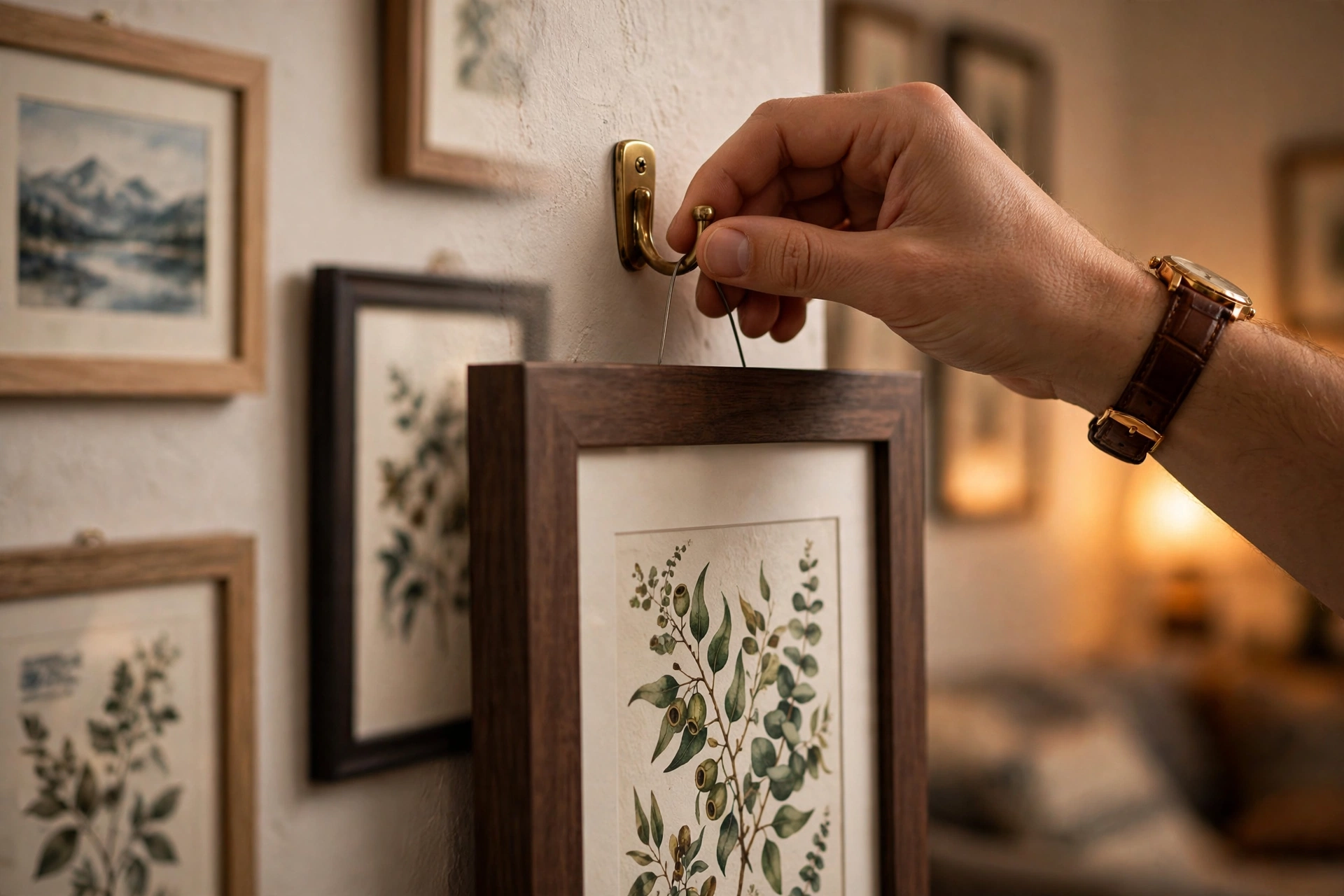
If your gallery wall frames keep falling, the problem is almost always inadequate hardware for the frame weight. For frames under 5 lbs, adhesive strips rated for the weight work well. For 5-20 lbs, use monkey hooks or Hercules hooks that grip drywall without studs. For anything over 20 lbs, you must anchor into a wall stud with proper screws. Never trust a single nail for heavy frames. Related: Black Frames vs White Frames for Gallery Walls.
Hardware by Weight
Under 5 lbs: Adhesive Strips
Command Picture Hanging Strips are the gold standard. Use the correct size for the weight, press firmly for 30 seconds, and wait one hour before hanging. They remove cleanly — ideal for renters.
5-15 lbs: Monkey Hooks / Gorilla Hooks
These curved wire hooks pierce drywall and grip from behind. They hold far more than they look like they should and leave only a tiny pinhole. No stud needed.
15-30 lbs: Toggle Bolts
For heavy mirrors and large frames, toggle bolts distribute weight across a wider drywall area. Drill a hole, insert the toggle, tighten.
Over 30 lbs: Stud Mounting
Find the stud with a stud finder, pre-drill, and use 2.5-inch wood screws. This is the only truly secure method for very heavy pieces.
Why Frames Fall: Common Causes
- Wrong hardware for the weight: A single small nail can’t hold a 15-lb frame
- Adhesive on textured walls: Strips need flat surfaces for full contact
- Humidity: Bathroom and kitchen moisture weakens adhesives over time
- Wire hangers slipping: Use two hooks instead of one for wide frames
- Drywall anchors in plaster: Plaster walls need masonry-specific hardware
Weight-Tested Recommendations
We tested eight popular hanging products. Top performers: Hercules Hooks (up to 150 lbs in drywall, no stud), 3M CLAW Drywall Picture Hangers (up to 65 lbs), and traditional toggle bolts for maximum security.
Pro Tips
- Weigh your frame with a bathroom scale before choosing hardware
- For wide frames, use two hangers spaced apart to prevent tilting
- In earthquake-prone areas, add museum putty to frame bottoms
Wall Types and What They Need
The right hardware depends entirely on what’s behind your paint. Using drywall hardware on plaster — or vice versa — is how frames end up on the floor. Here’s how to identify your wall and what it demands.
Drywall (most homes built after 1960): Knock on the wall — a hollow sound means drywall over studs. Drywall itself holds almost nothing; its strength comes from what’s behind it. Light frames (under 5 lbs) do fine with adhesive strips or small nails into the drywall. Medium frames (5–20 lbs) need hardware that grips the drywall panel itself: monkey hooks, Hercules-style hooks, or wall anchors. Heavy frames (over 20 lbs) must hit a stud — no exceptions. Use a stud finder (or the knock test: a solid, non-hollow sound) to locate the wood framing, then drive screws directly into it.
Plaster and lath (pre-1960 homes): Knock and you’ll hear a solid, dull thud — plaster is hard and thick. Never hammer nails into plaster; it cracks and crumbles, and the nail won’t hold anyway. Drill pilot holes with a masonry bit, then use wall anchors or screws. Plaster is actually stronger than drywall once you drill properly — it holds heavy frames beautifully with the right anchors. Picture rail molding, common in old houses, is a gift: hang from it with wires and hooks and never drill at all.
🛒 Shop This Look:
Brick and concrete: You’ll know immediately — nothing you own will make a dent. Drill with a masonry bit and use masonry anchors or concrete screws for anything with weight. For lighter frames, brick clips that grip mortar joints work without drilling. Adhesive strips generally fail on brick’s uneven, dusty surface — don’t trust them.
Hollow-core doors and thin paneling: These look like walls but hold like cardboard. Never hang anything heavy on them. Lightweight frames only, with the smallest hardware that does the job — and honestly, find a real wall instead whenever possible.
The magnet test: If you’re unsure whether there’s metal lath or a stud behind plaster, a strong magnet dragged across the wall will stick to screws and nails in the underlying structure, revealing stud positions. It’s a crude but effective stud finder that costs nothing.
Step-by-Step: Hanging a Heavy Frame Safely
A heavy frame — say 25 pounds of solid wood, glass, and art — hung wrong is a safety hazard. Hung right, it’s secure for decades. Here’s the exact process.
Step 1: Weigh it. Step on a bathroom scale holding the frame, then without it; the difference is the frame’s weight. Don’t guess — people consistently underestimate by 30–50%. Your hardware choice depends on this number.
Step 2: Find the studs. Use an electronic stud finder, sweeping slowly across the wall where the frame will hang. Mark each stud’s edges with painter’s tape — the center between the marks is your target. Verify by drilling a tiny pilot hole; wood resistance and sawdust confirm you’ve hit lumber, not a pipe.
Step 3: Choose two-point hanging. For heavy frames, never hang from a single point — it pivots, tilts, and concentrates all the weight on one fastener. Install two D-rings on the frame’s back, positioned at the upper third, one on each side. Run picture wire between them with slight slack, or hang each D-ring on its own hook for maximum stability.
Step 4: Drive proper fasteners. Into studs: 2.5-inch wood screws or heavy-duty picture hooks rated above your frame’s weight. Pre-drill pilot holes slightly smaller than the screw to prevent splitting. Into drywall between studs (only for medium weights): toggle bolts, which open behind the drywall and distribute the load across a wide area.
Step 5: Test before you walk away. Hang the frame, then pull down firmly on it with both hands — harder than gravity ever will. If anything shifts, creaks, or feels uncertain, take it down and reassess. Then check it with a level, step back, and check again in a week. Heavy frames settle slightly; a one-week recheck catches what installation day missed.
The Renter’s Playbook for Heavy Art
Renters face a special challenge: the art is heavy, the lease forbids holes, and the deposit is on the line. These strategies keep heavy pieces displayed without jeopardizing either.
Lean, don’t hang. The simplest solution is often the best: lean large, heavy frames on the floor against the wall, on top of consoles, dressers, or mantels. A 24×36 frame leaning on a console behind it looks intentional and gallery-like — designers do this in million-dollar homes. Secure the top to the wall with a small adhesive hook and wire if you’re worried about tipping, especially with kids or in earthquake zones.
🛒 Shop This Look:
Use the mantel and shelves. Fireplace mantels, deep window sills, and sturdy bookshelves are natural display ledges for heavy pieces. Layer a large leaning frame behind smaller standing ones for depth. The weight rests on furniture, not on your wall’s goodwill.
Distribute the weight. If you must hang, Hercules-style hooks (rated up to 150 lbs in drywall) leave only a pinhole — the kind of hole that a dab of spackle erases in minutes at move-out. Two hooks sharing the load are dramatically more secure than one, and two pinholes are barely more work to patch than one. This is the renter’s heavy-frame sweet spot: real security, negligible damage.
Negotiate with your landlord. Many landlords who forbid “holes” will approve two small, properly patched screw holes for a heavy mirror if you ask — especially if you offer to patch and paint on move-out. Get permission in writing (an email counts). A documented agreement beats both sneaking and suffering with bare walls.
Know when to wait. Some pieces are genuinely too heavy for renter-friendly methods. A 60-pound antique mirror on plaster walls with a strict lease is a problem without a good solution — and that’s okay. Store it safely until you own your walls. Forcing inadequate hardware is how art gets destroyed and deposits get lost.
Earthquake and Kid-Proofing Your Gallery Wall
Standard hanging keeps frames on the wall under normal conditions. Kids, pets, and earthquakes are not normal conditions. If any apply to your home, upgrade your approach.
Museum putty: This removable adhesive putty, pressed under the bottom corners of frames, prevents the swinging and shifting that leads to falls. It’s invisible, removable, and remarkably effective — museums use it to secure objects in earthquake zones. Apply a pea-sized ball at each bottom corner, press the frame to the wall, and the frame stays put through door slams and minor tremors.
Security hangers: For valuable or irreplaceable pieces, T-lock or security picture hangers require a special tool to remove the frame from the wall. Originally designed for galleries and hotels, they’re equally useful in homes with curious toddlers — a frame that can’t be lifted off its hook can’t be pulled down onto anyone.
Safety wire and tethers: In earthquake-prone regions, loop a short length of picture wire from the frame’s D-rings to a separate wall anchor above. If the primary hook fails, the tether catches the frame instead of letting it fall. For tall bookshelves displaying art, anti-tip straps anchored to studs are non-negotiable with climbing-age children.
Glass versus acrylic: In kids’ rooms, playrooms, and earthquake zones, replace glass with acrylic (plexiglass) in all frames. When — not if — a frame comes down, acrylic doesn’t shatter into dangerous shards. It’s lighter too, which reduces the load on your hardware. The optical difference is negligible for most art; the safety difference is enormous.
Placement rules: Never hang heavy frames above beds, cribs, or anywhere people sit for long periods — above the sofa is the classic danger zone everyone ignores. If a piece must go above seating, use stud-mounted hardware, security hangers, and acrylic glazing together. The goal is a wall that survives the worst day, not just the average one.
🛒 Shop This Look:



