
As an Amazon Associate, I earn from qualifying purchases. This means I may earn a commission if you purchase through links on this page — at no extra cost to you.
If you make home decor projects, you need the right glue — and hot glue, E6000, and super glue are the three most common choices, but they’re built for very different jobs. Hot glue is fast and forgiving, E6000 is flexible and permanent, and super glue is instant but brittle. Here’s how they compare so you pick the right one for every project.
The Three Adhesives at a Glance
Before the detailed comparison, here’s the quick version: reach for hot glue when you need speed and repositioning, E6000 when you need a permanent flexible bond on mixed materials, and super glue (cyanoacrylate) when you need an instant bond on small, hard, well-fitted parts.
How They Compare
Bond Strength
Hot glue creates a moderately strong bond that works well for porous materials like wood, paper, fabric, and foam. It doesn’t penetrate surfaces deeply — it sits on top and grips as it cools — so it’s weaker than the other two on smooth, hard materials like metal or glass.
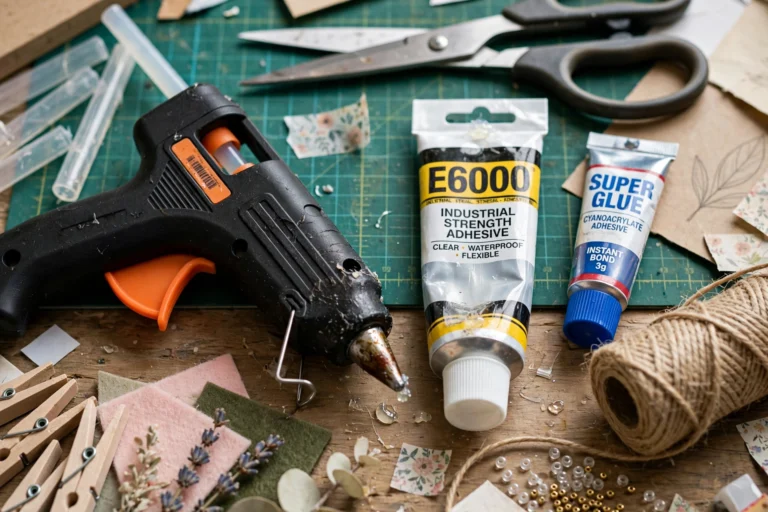
Surebonder Cordless Hot Glue Gun, High Temperature, Full Size, 60W (Specialty Series CL-800F)
Best for fast, repositionable bonds on porous materials like wood, paper, fabric, and foam.
E6000 is a industrial-strength adhesive with excellent bond strength across a huge range of materials: wood, metal, glass, fabric, ceramic, and many plastics. Its bond stays strong under vibration and stress because the cured adhesive remains slightly flexible instead of cracking.
E6000 230010 Craft Adhesive, 3.7 Fluid Ounces
Best for a permanent, flexible bond on mixed materials, including jewelry, glass decor, and outdoor decor.
Super glue forms an extremely strong bond very quickly on tight-fitting, non-porous parts — plastic to plastic, ceramic repairs, metal details. But the bond is brittle: it can shatter under impact, flexing, or shear forces, so it’s a poor choice for anything that bends or bears weight.
Gorilla Super Glue Gel XL, Clear, 25g (Pack of 1)
Best for an instant bond on small, hard, well-fitted parts, including broken ceramic and picture-frame joints.
Dry and Cure Time
- Hot glue: Sets in about 30–60 seconds as it cools, and reaches full hold within minutes. You can reposition briefly while it’s warm.
- E6000: Tacky within about 2–10 minutes (you can reposition during this window), sets in roughly 24 hours, and reaches full cure in 48–72 hours. It’s the slowest of the three — plan projects accordingly.
- Super glue: Bonds skin in seconds and sets parts in 10–60 seconds. Full strength develops in about 24 hours, but the join is usable almost immediately. No repositioning — once parts touch, they’re stuck.
Suitable Materials
- Hot glue: Best on porous materials — wood, paper, cardboard, fabric, felt, foam, ribbon. Struggles on metal, glass, smooth plastic, and anything that gets hot (it re-melts).
- E6000: Bonds almost anything to anything — wood, metal, glass, ceramic, fabric, vinyl, leather, rubber, and many plastics. A go-to for mixed-material projects like jewelry, ornaments, and embellished frames. Check the label for the specific plastics; it can damage styrofoam and some foams.
- Super glue: Excels on hard, close-fitting surfaces — ceramic, metal, hard plastic, glass, and stone. Works poorly on porous materials (it soaks in before bonding), fabric, and any joint with gaps, since it can’t bridge space.
Fumes and Safety
- Hot glue: Low fume concern, though cheap glue sticks can produce a mild odor. The main risk is burns — the glue and nozzle are hot enough to blister skin. Keep a bowl of cold water nearby and never touch fresh glue.
- E6000: Contains solvents and perchloroethylene, so it produces strong fumes. Use it in a well-ventilated area or outdoors, wear gloves, and keep it away from children and pets until fully cured. This is the adhesive to take most seriously on safety.
- Super glue: Irritating vapors — use in ventilated space and avoid breathing them directly. Bonds skin instantly; keep debonder or acetone (nail polish remover) nearby. Keep well away from eyes.
Removability
- Hot glue: The easiest to undo. Reheat with a heat gun or hair dryer, peel off while warm, and remove residue with rubbing alcohol. Great for temporary decor, holiday crafts, and anything you might redesign later.
- E6000: Very difficult to remove once cured. Acetone or heat can soften it, but on porous materials the bond is effectively permanent. Only use it where you want a forever join.
- Super glue: Removable with acetone (it dissolves cyanoacrylate), but acetone can damage surrounding finishes — test first. On skin, soak in warm soapy water rather than tearing apart.
Recommendation Table by Project Type
- Wreaths and garlands: Hot glue — fast, holds foliage and ribbon well, easy to redesign next season.
- Fabric wall art and textile projects: Hot glue for speed, or E6000 for heavier items that need a lasting hold.
- Jewelry and small embellishments: E6000 — flexible, permanent bond on mixed materials like metal, glass, and beads.
- Broken ceramic or porcelain decor: Super glue — instant, invisible bond on clean, tight breaks.
- Picture frames and trim repairs: Super glue for small tight joints; E6000 for heavier pieces.
- Wood decor and shelving brackets: Hot glue for craft-scale pieces; use real wood glue (not these three) for structural joints.
- Glass decor (vases, candle holders): E6000 — it bonds glass reliably and tolerates minor movement.
- Seasonal and holiday crafts: Hot glue — fast assembly and easy disassembly when the season ends.
- Kids’ craft projects: Low-temp hot glue sticks — safer to handle; keep E6000 and super glue away from children entirely.
- Outdoor decor: E6000 — it holds up to weather and temperature swings far better than hot glue, which softens in heat.
Common Mistakes to Avoid
- Using super glue on gaps: It can’t fill space — parts must fit tightly or the bond fails.
- Rushing E6000: Handling the piece before the 24-hour set time is the top reason E6000 projects fail. Clamp or rest the project and leave it alone.
- Hot glue outdoors: Summer heat re-melts hot glue. Outdoor decor needs E6000 or an outdoor-rated adhesive.
- Using super glue on porous materials: It wicks into wood and fabric without bonding — use hot glue or a proper wood/fabric glue instead.
- Ignoring ventilation with E6000: The fumes are genuinely harsh. Work near an open window or outside.
The real takeaway: no single glue does everything. Keep all three on hand, match the adhesive to the materials and the job, and give E6000 the cure time it needs. Your projects will last longer and look cleaner for it.
Surebonder Mini Dual Temperature Glue Gun, 20W (DT-200)
Best for hot glue projects where both low- and high-temperature use is useful, including wreaths, garlands, and temporary decor.
Which Glue for Which Project: A Quick Cheat Sheet
Still not sure which adhesive to grab? Here’s how the choice breaks down for common DIY decor projects. For wreaths, garlands, and anything involving fabric, ribbon, or dried florals, hot glue is the obvious pick — it’s fast, it grips porous materials well, and if you misplace a bow you can usually peel it off and redo it. For picture frames, wooden signs, and shadow boxes, E6000 gives you a permanent bond that won’t let go when the piece hangs on a wall for years; just clamp or tape the joint while it cures. For repairing ceramics, reattaching small metal hardware, or fixing a broken figurine, super glue’s instant bond on tight-fitting hard parts is unmatched — but don’t use it on anything that flexes or takes impact, because the brittle bond can snap. For glass projects like mosaic tiles or terrariums, E6000 is the safer choice since it stays slightly flexible and handles the smooth surface better than hot glue. And for kids’ crafts and anything temporary (holiday decor you’ll disassemble in January), hot glue wins on speed, low cost, and easy cleanup.
Surebonder Full Size Hot Glue Sticks, 50-Pack, Clear, Multi-Temp, 4-Inch x 0.43-Inch (DT-50)
Best for hot glue projects on porous materials like wood, paper, fabric, and foam.
Safety and Ventilation Tips for Each Adhesive
All three adhesives demand a little respect. E6000 contains solvents and has strong fumes — use it in a well-ventilated room or near an open window, and give it the full 24–72 hour cure time before bringing the finished piece into a bedroom or enclosed space. Super glue bonds skin instantly, so keep a bottle of acetone-based nail polish remover nearby for accidents (it dissolves the bond), avoid touching your eyes, and work with dry hands — moisture is what triggers the curing reaction. Hot glue’s danger is simpler: the glue and the gun tip are hot enough to burn. Keep a small bowl of cold water nearby when crafting, and never let children use a high-temp gun unsupervised; low-temp guns exist specifically for kids’ projects. With all three, read the label before starting — cure times, temperature limits, and surface warnings are printed there for a reason.
Surebonder 10W Ultra Low Temp Cool Shot Mini Glue Gun Kit with 12 Glue Sticks (KD-160F)
Best for low-temperature gluing, including kids’ craft projects where a cooler gun is safer.
Common Mistakes and How to Avoid Them
The number one mistake across all three glues is using too much. A thin, even layer bonds better than a thick blob, which takes longer to cure and can squeeze out messily. With super glue, more is actively worse — excess glue cures into a white, crusty residue around the joint. The second mistake is skipping surface prep: dust, grease, and old adhesive residue weaken every bond, so wipe surfaces with rubbing alcohol and let them dry before gluing. The third is impatience — hot glue users wiggle the joint before it sets, E6000 users hang the piece before the 24-hour cure, and super glue users skip clamping. Give each adhesive the time it needs. Finally, store your adhesives properly: cap super glue tightly (moisture in the air will cure it in the bottle), store E6000 upright at room temperature, and keep hot glue sticks dry and dust-free. A little care here means your glues actually work when you reach for them next month.
How to Remove Each Adhesive When Things Go Wrong
Every crafter eventually glues the wrong thing. Hot glue is the most forgiving: reheat it with a hair dryer to soften it, then peel or scrape it off — rubbing alcohol helps with residue on hard surfaces. For fabric, place a paper bag over the spot and press with a warm iron; the glue melts into the bag. E6000 is tougher: once cured, it’s essentially permanent. Your best bet is mechanical removal — carefully scrape with a craft knife or peel it away — and acetone can soften it on hard, non-porous surfaces (test first, as acetone damages many plastics and finishes). Prevention beats cure with E6000: tape off areas you don’t want glued and work over a protected surface. Super glue on skin dissolves with acetone-based nail polish remover and warm soapy water — soak, don’t rip. On hard surfaces, acetone softens it; on fabric, it’s usually permanent, so treat super glue near textiles with extreme caution. The lesson across all three: protect your work surface, keep acetone and rubbing alcohol in your craft kit, and when in doubt, test the bond on scrap first.
🛒 Shop This Look:
🛒 Shop This Look:
🛒 Shop This Look:



