
As an Amazon Associate, I earn from qualifying purchases. This means I may earn a commission if you purchase through links on this page — at no extra cost to you.
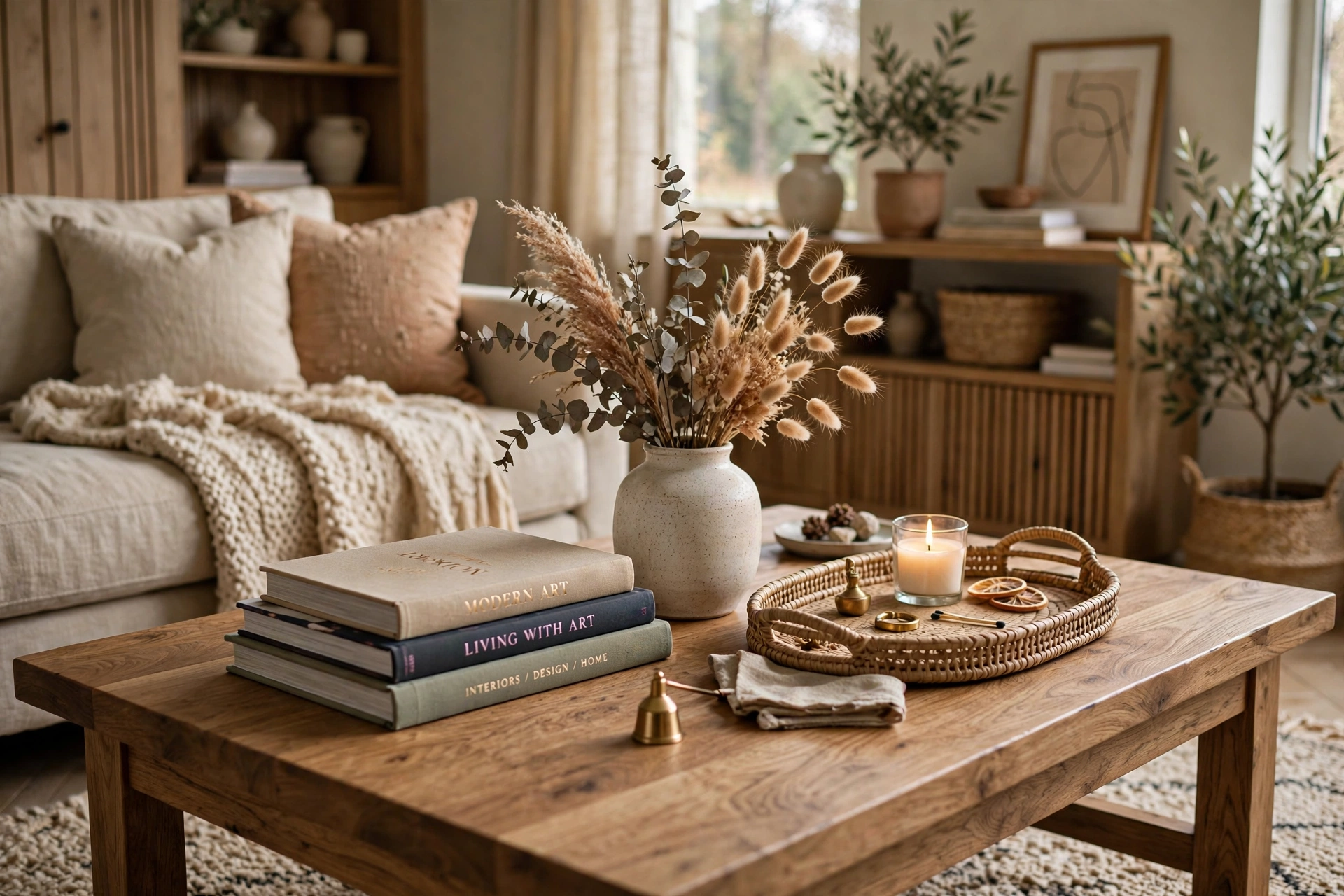
Styling a coffee table comes down to a simple formula: a tray or base to ground the arrangement, something tall (books, a vase), something organic (a plant or bowl), and breathing room. Three to five objects in varied heights — that’s the entire secret designers use.
Formula 1: The Classic Trio
Tray + stack of books + one sculptural object. The tray corrals everything visually; the books add height; the object (a bowl, knot sculpture, or small plant) adds personality. Works on any table shape.
Formula 2: The Book Lover
Two stacks of coffee-table books + one candle + one small plant. Vary the stack heights (2 books vs. 3). The candle adds warmth; the plant adds life. Best for rectangular tables.
Formula 3: The Minimalist
One large bowl + one book + empty space. A single oversized object makes a stronger statement than five small ones. The empty space is intentional — it reads as confidence. Best for small tables.
Formula 4: The Entertainer
Decorative box (hides remotes) + coasters + candle cluster + small floral. Everything has a job. The box keeps clutter invisible; coasters protect the surface; candles and flowers set the mood.
Formula 5: The Seasonal Rotator
One constant base (tray + books) + one seasonal swap. Change only the organic element: spring flowers, summer shells, fall branches, winter pinecones. Maximum freshness, minimum effort.
The Rules Behind the Formulas
- Odd numbers: groups of 3 or 5 look intentional; even numbers look staged.
- Varied heights: the tallest object should be roughly 1.5× the shortest. Flat arrangements look dull.
- The 50% rule: leave at least half the table surface clear — it’s still a functional table.
- Scale to the table: a 48″ table needs bigger objects than a 32″ one. Tiny objects on a big table look lost.
- Consider the view: style for seated eye level, not standing. Low arrangements preserve conversation sightlines.
What NOT to Put on a Coffee Table
- Anything you use daily but don’t want visible (mail, chargers) — use a lidded box
- Tiny scattered objects with no grouping (visual noise)
- Anything taller than 12 inches (blocks conversation)
- Delicate items at toddler height (learn from others’ mistakes)
Styling for Different Table Shapes
Table shape dictates arrangement geometry, and fighting the shape is why some styled tables look off despite nice objects. Rectangular tables — the most common — want linear arrangements: a tray or runner establishing a center line, with objects distributed along it. The classic trio (tray + book stack + sculptural object) works because it follows the table’s long axis. On long rectangular tables, consider two separate groupings with breathing room between them rather than one stretched arrangement — it reads as designed rather than scattered.
Square tables want a centered cluster, not a line. Build outward from a central anchor — a large bowl, a lidded box, or a plant — with smaller objects radiating around it. Odd numbers shine here: three or five objects in a loose cluster. Because square tables are viewed from all sides, check the arrangement from every seat — a composition that looks perfect from the sofa may look awkward from the armchair. Keep heights moderate all around since sightlines cross in every direction.
Round tables suit radial symmetry: a central object with smaller items arranged around it, or a single strong centerpiece with empty space around it. Round tables are the hardest to style badly and the easiest to style boringly — the circle forgives asymmetry but rewards a confident central anchor. Avoid lining objects up in rows on a round table; it fights the shape. Oval tables split the difference: treat them like rectangular tables but soften the arrangement with curves — a round tray on an oval table, organic shapes rather than rigid lines.
🛒 Shop This Look:
Glass-top tables add a visibility challenge: everything underneath shows, including the lower shelf’s contents and the floor below. Style the lower shelf as deliberately as the top (books, baskets, a folded throw), and choose top objects with attractive profiles from below — or use a tray to create a visual base that blocks the see-through effect. Ottoman coffee tables (upholstered) absolutely require a tray — without a stable surface, nothing sits safely. Choose a large, rigid tray that covers most of the ottoman’s top, and style on the tray as if it were the table.
Budget-Friendly Styling: The High-Low Mix
Designer-looking coffee tables are rarely expensive — they are curated. The high-low mix is the professional secret: one or two quality anchor pieces surrounded by inexpensive, personal, and found objects. The anchors worth spending on: a beautiful tray (it grounds everything and gets touched daily), one sculptural object with real presence (a stone bowl, a handmade ceramic vase, an interesting coffee table book), and good candles. Everything else can be thrifted, borrowed from nature, or repurposed.
Thrift stores and flea markets are goldmines for coffee table styling: brass candlesticks, interesting ceramics, vintage books with beautiful spines, small sculptures, and trays — all for a few dollars. The trick is editing: buy only pieces with good proportions and materials, and pass on anything damaged or fussy. Estate sales often yield the best coffee table books — large-format art, photography, and design books for a dollar or two that would cost $50 new. Stack them, and nobody knows the difference.
Nature provides the best free styling material. A branch in a vase, interesting stones, pinecones, dried grasses, shells, or a simple bowl of seasonal fruit all bring organic life that expensive objects cannot replicate. Rotate these with the seasons for a table that always feels fresh at zero cost. Your own bookshelves are another free resource — pull art and photography books you already own, stack them as risers and styling, and rotate them when you want change. The most stylish coffee tables look collected over time because they were — resist the urge to buy everything in one shopping trip.
Where not to skimp: anything with a flame (cheap candles tunnel, smoke, and smell bad — one good candle beats five cheap ones), and the tray if it is the foundation (a wobbly or flimsy tray undermines everything on it). Everywhere else, creativity beats budget. Some of the most photographed coffee tables in design magazines are styled primarily with books, plants, and found objects — proof that the eye, not the wallet, does the styling.
Kid- and Pet-Friendly Coffee Table Styling
Small children and enthusiastic pets do not end the possibility of a styled coffee table — they just change the material list. The first rule is unbreakable everything: wood, metal, stone, and sturdy ceramics replace glass, thin porcelain, and anything top-heavy. Anchor the arrangement with a heavy tray or a large lidded basket — weight is stability, and a weighted base survives bumps that would topple individual light objects. Museum putty (removable adhesive) under objects is the parent’s secret weapon: it keeps pieces in place through tail wags and toddler grabs but releases cleanly when you want to rearrange.
Height and placement become safety calculations. Keep the center of the table styled and the edges clear — little hands reach edges first. Avoid small objects that are choking hazards, anything with sharp corners at toddler head height, and candles (flameless LED candles give the glow without the burn risk). Plants should be non-toxic varieties only — many popular houseplants are toxic if chewed, so verify before placing within pet or toddler reach. Washable and wipeable surfaces matter: choose trays and objects that survive sticky fingers and can be wiped clean in seconds.
Storage-integrated styling serves double duty in family living rooms. A lidded decorative box on the table corrals remotes, coasters, and small toys while looking intentional — when the kids descend, everything tidies in seconds. A large basket beneath or beside the table holds throw blankets and toys, keeping the tabletop clear for actual use. Ottoman coffee tables are the family MVP: soft edges (no head-bump corners), hidden storage inside, and a tray on top for styling that lifts off when the surface needs to become a footrest or play space.
Accept the season of life honestly. The perfectly styled table of a child-free home will return — for now, aim for “styled and survivable” rather than magazine-perfect. One beautiful tray, a sturdy plant, a lidded box, and a stack of board books can look genuinely good while withstanding daily family life. And involve the kids: a rotating display of their artwork in a standing frame on the table gives them ownership and keeps little hands busy arranging rather than destroying.
Styling Around Real Life: Function First
The prettiest coffee table fails if it does not serve the household’s actual life — remotes, drinks, laptops, and feet all need a place. Start styling from function, not from a magazine photo. If the household drinks coffee at the table daily, coasters are non-negotiable — make them beautiful (stone, leather, or agate) and keep them accessible, not buried under decor. If remotes multiply, a lidded box or a dedicated tray section keeps them contained and findable. Design the styling around these realities and the table stays styled; design against them and the styling lasts a week.
🛒 Shop This Look:
Protect the surface as part of the styling. A tray under drinks and candles prevents rings and wax damage; felt pads under heavy objects prevent scratches; coasters under everything wet. For wood tables, this protection is preservation — water rings and heat marks are permanent on many finishes. For stone or glass, it is about avoiding the etched dull spots that ruin the look. Build protection into the aesthetic so it does not feel like an afterthought: a beautiful tray is both styling and armor.
Leave genuine usable space — the 50% rule exists because coffee tables are furniture, not shelves. Before finalizing an arrangement, mime the household’s real uses: set down a mug, open a laptop, put up feet (if that is the household’s habit — be honest). If the styling obstructs these, edit it down. A slightly sparser table that accommodates life looks better in practice than a dense, precious arrangement everyone works around resentfully. The best-styled coffee tables in real homes are the ones nobody has to think about using.
Plan for the table’s other jobs too. Board game night needs a clearable surface — design the styling to lift off in one tray. Households that eat in front of the TV need surfaces that wipe clean and objects that relocate easily. Laptop workers need a stable, clear zone. Modular styling — everything grouped on one or two trays that move as units — adapts to all of these in seconds. Rigidity is the enemy of real life; design the styling to move.
Seasonal Refreshes Without Buying Anything New
The secret to a coffee table that always feels fresh is rotation, not acquisition. Keep a small styling stash — a box or shelf of vases, candle holders, trays, books, and objects — and swap pieces seasonally. The same five objects rearranged read as entirely new; the human eye responds to change in composition more than change in inventory. Rotate quarterly, or whenever the table starts feeling invisible (a sign you have stopped seeing it, which means guests have too).
Seasonal organic material does the heavy lifting for free. Spring: flowering branches, forced bulbs, fresh greenery. Summer: shells, stones, a bowl of citrus, airy grasses. Fall: branches with turning leaves, pinecones, small pumpkins or gourds, dried wheat. Winter: evergreen sprigs, pinecones, candles (more of them — light matters in dark months), a bowl of ornaments. Each season’s material costs nothing or nearly nothing and transforms the table’s mood completely. The constant base — tray plus books — stays; only the organic layer changes.
Textile swaps refresh without new objects: drape a different throw over the table’s edge, swap the tray’s liner, or change candle colors with the season. Even rotating which books are on top of the stack changes the color story — pull the rust-colored art book forward in fall, the blue photography book in summer. Photograph your favorite arrangements when you land on them; the photos become a lookbook for future rotations and prevent the “I know I had this looking good once” frustration.
Holiday styling deserves restraint. A few well-chosen seasonal touches beat a full theme explosion — the coffee table is not a mantel. For Christmas, evergreen and candles suffice; for Halloween, one sculptural pumpkin beats five plastic ones. The goal is a nod to the season, not a department store display. And when the season passes, the quick rotation back to the everyday arrangement takes ten minutes — which is exactly why the stash-and-rotate system beats buying seasonal decor you then have to store.
Frequently Asked Questions
How many items should be on a coffee table?
Three to five, grouped — not scattered. Fewer, larger items beat many small ones.
Should a coffee table have a tray?
Not required, but a tray is the easiest way to make a random collection look styled. It creates a visual boundary that says “this is intentional.”
🛒 Shop This Look:



