
As an Amazon Associate, I earn from qualifying purchases. This means I may earn a commission if you purchase through links on this page — at no extra cost to you.
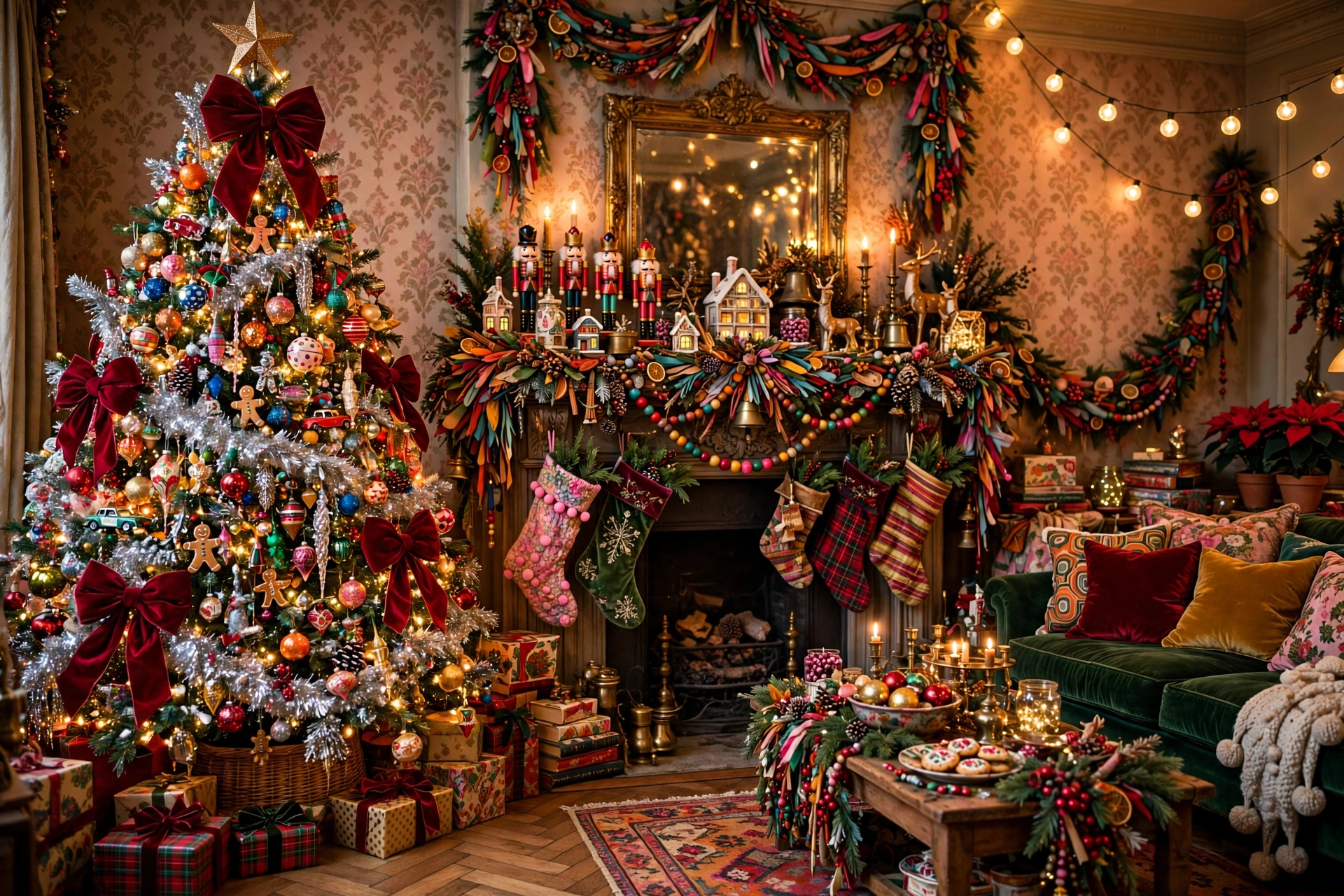
Some homes whisper Christmas. A maximalist home sings it, in harmony, with the volume turned up. Tinsel catching the light, bows the size of dinner plates, a tree so layered with ornaments that the branches underneath become a rumor — this is decorating for people who believe the holidays should feel like a celebration, not a showroom. If you have ever added one more ornament, stood back, and thought “still not enough,” this style was made for you.
The good news is that maximalist Christmas decor is not about buying everything in the shop. It is about layering what you love with intention — more texture, more color, more shine — arranged around a few simple rules so the result reads as joyful abundance instead of visual noise.
The Maximalist Mindset: Abundance With a Plan
Maximalism rests on three pleasures: layering, abundance, and nostalgia. Layering means nothing sits alone — a garland gets ribbon woven through it, the ribbon gets ornaments tucked into it, and the ornaments get a strand of beads for company. Abundance means repeating those layers across the whole room, so tree, mantel, doorway, and table speak to each other. Nostalgia is the emotional engine: the look deliberately echoes childhood Christmases and grandparents’ front rooms, where more always felt like love.
What separates curated maximalism from plain clutter is editing, and editing in this style does not mean owning less. It means choosing a framework and obeying it:
- One palette per room. Pick two or three colors plus one metal, and let everything you add belong to that family. Abundance within a palette looks lush; abundance across five palettes looks like a storage unit.
- Repetition is the glue. The same bow, ribbon, or ornament finish appearing on the tree, the wreath, and the staircase is what makes a room feel designed. Buy and place in multiples, not singletons.
- Vary scale and texture, not color. Mix velvet with glass, matte with glitter, oversized with delicate — contrast in finish gives your eyes the richness; contrast in color gives them a headache.
- Group, don’t scatter. Clusters of decorations with small breathing spaces between them read as displays. The same items spread evenly everywhere read as mess.
Hold those four rules and you can add almost endlessly. Break them and even a modest amount of decor starts to feel chaotic.
The Fully Loaded Tree: Tinsel, Bows, and Layers
The tree is the headline act of a maximalist Christmas, and the secret to a tree that looks professionally stuffed is order of operations. Work from the inside out and the bottom up: lights first, then tinsel or garland, then ribbon and bows, then ornaments in layers, then your finishing sparkle. For a refresher on the classic sequence, the step-by-step order in these Christmas tree decorating ideas pairs perfectly with the turned-up approach below.
Tinsel, done properly
Tinsel is the signature shimmer of the maximalist tree, and there are two honest ways to apply it. The traditional method is strand by strand: drape individual strands over branch tips, a few at a time, from inside the tree outward. It is slow, and it produces that dense, icy, vintage sparkle where the tree seems to glow from within. The faster method is the garland swag — loop a roping of tinsel in generous scallops around the tree, tucking it into the branches at each dip so it looks woven rather than draped on top.
🛒 Shop This Look:
A few safety and sanity notes belong with tinsel. Keep it well away from candles, fireplaces, and any heat source, and use it with LED lights rather than older hot-running bulbs. Households with cats, dogs, or small children should think twice about loose strand tinsel, since animals are drawn to eating it and it is not safe to ingest — garland-style tinsel, placed high, or tinsel-effect picks and sprays are the safer route. When the season ends, remove strand tinsel before storing the tree rather than leaving it tangled in the branches, and dispose of old tinsel instead of reusing shedding strands year after year.
Oversized bows as ornaments
The oversized bow is the maximalist’s favorite shortcut to drama. A bow made from wide wired ribbon, with long trailing tails, counts as decor all by itself, so a dozen placed around a tree does the visual work of far more fiddly pieces. Space the largest bows first, in a loose zigzag down the tree, and let the tails trail diagonally for movement. Match the ribbon to your garland so the repetition rule does its quiet work. One huge bow with streaming tails also makes a topper that feels festive rather than formal.
Ornament layering
A loaded tree is built in three passes. First, hang your largest ornaments deep inside the tree, near the trunk — this creates depth and stops the interior looking hollow. Second, place medium ornaments and themed pieces at mid-branch, stepping back every few minutes to check the balance. Third, finish with small, bright pieces at the branch tips, where they catch the most light. Cluster a few ornaments in tight groups of three instead of spacing everything with military precision; clusters make a tree look abundant rather than merely decorated. Fill remaining gaps with picks — berries, pinecones, glitter sprays — pushed in at angles.
Mantel, Staircase, and Tabletops
A maximalist room cannot have a quiet mantel. Build it the way you built the tree: a thick garland base (overlap two garlands if one looks thin), ribbon woven through in loops, ornaments and picks tucked into the greenery, and then height — candlesticks, lanterns, or a row of bottle-brush trees along the back. Let the garland spill generously over the ends of the mantel rather than cutting it off neatly; abundance loves a trailing edge. Stockings hang in front as one more layer of color and texture, not an afterthought.
The staircase is your second tree. A banister garland, swagged in deep scallops and secured at each newel post, can carry the same ribbon and bows as the tree so the two displays echo each other. Finish each newel post with an oversized bow or a cluster of ornaments.
Tabletops and shelves are where small vignettes shine. Group a tray with a candle, a bowl of spare ornaments, and one small figure or village house; repeat the formula, with variations, on the coffee table, sideboard, and entry console. Bowls of ornaments are the maximalist’s best friend — they use up extras, add a solid block of palette color, and take seconds to arrange.
Color Stories That Can Handle the Volume
Classic red, green, and gold. The traditional story, turned all the way up. Deep green foliage, true red ornaments and ribbon, and gold everywhere as the connecting metal. This palette forgives a lot of mixing — plaid ribbon, mercury glass, and vintage-style pieces all belong — and it is the easiest story to add to year after year because the colors never leave the shops.
Candy-bright. Hot pink, turquoise, lime, and cherry red on a white or flocked tree reads playful and modern, like a sweet shop window. This is where a maximalist tree meets the spirit of pink Christmas decor: lean into glossy finishes, lollipop and candy ornaments, and colored lights if you want the full effect. Keep the palette tight to four brights and repeat them relentlessly so it reads as a theme, not a spill.
🛒 Shop This Look:
Vintage mixed. The nostalgic story: jewel-toned baubles, striped vintage-style ornaments, tinsel in true silver, and pieces that look collected over decades rather than bought in one set. For a moodier version of the same direction, the burgundy and midnight-blue palette in Modern Heritage Christmas decor shows how to ground the abundance in rich, dark color. The trick is texture discipline: every piece can be a different shape, but keep finishes aged, shiny, and glassy rather than rustic or matte.
Lighting for Drama
Maximalist decor is built for the evening. Layer light the way you layered ornaments: warm white tree lights as the base (more strands than you think you need, wound into the tree’s interior as well as its surface), then candlelight — real candles in hurricanes on the mantel where they can be watched, flameless candles grouped on tabletops and stairs where they cannot. Add a moment of twinkling light in a doorway garland if your palette allows. Stand back at dusk, turn everything on, and fix any dark patch by moving an ornament, not by adding a new one.
Knowing When to Stop
Every maximalist room has a finishing point, and finding it is a skill. Stop adding when every surface in your plan has its layer and the palette still reads clearly from the doorway. Two reliable tests: the squint test — blur your eyes and look for holes or dark gaps rather than individual items — and the doorway test, where the room should look full and glowing from the entrance, not busy. If a new piece does not strengthen the palette, repeat a motif, or fill an actual gap, it belongs in the storage box as next year’s rotation. Restraint is not the opposite of abundance; it is the editing that lets abundance look intentional.
FAQ
How is maximalist Christmas different from just having a lot of decorations?
Intention. A maximalist room is built on one palette, repeated motifs, and layered groupings, so the volume feels designed. Decorations spread without a palette or repetition feel scattered, no matter how many there are. Following a few rules — palette, repetition, grouping, texture contrast — is what turns “a lot” into a look.
Is tinsel safe to use on a Christmas tree?
With sensible precautions, yes. Keep tinsel away from heat sources and open flames, pair it with LED lights, and supervise real candles elsewhere in the room. Homes with pets or small children are better served by tinsel garlands placed high, or tinsel-look picks and sprays, since loose strands are tempting and unsafe for animals to eat. Remove strand tinsel before storing an artificial tree so it does not tangle into the branches.
Can maximalist decor work in a small room?
It can, if you concentrate it. Choose one hero zone — the tree and the wall or mantel behind it — and decorate that area to full maximalist depth while keeping the rest of the room’s surfaces mostly clear. Depth in one place reads as drama; the same amount spread across every surface of a small room reads as crowding.
How do I stop a maximalist tree looking messy?
Decorate in the right order and in passes: lights, then garland or tinsel, then bows, then ornaments largest-and-deepest first, smallest-and-brightest last. Keep to your palette, repeat your bow and ribbon choices, and step back every few minutes to check balance from across the room. Most “messy” trees are simply missing the deep layer of large ornaments near the trunk, which leaves the outside looking jumbled and the inside hollow.
Conclusion
Maximalist Christmas decor is generosity made visible: a tree heavy with tinsel and bows, a mantel that spills, a staircase dressed like it is going somewhere wonderful. Build it on a tight palette, repeat your favorite motifs until the room rhymes, light it warmly, and edit with a clear eye — then stop, pour something warm, and enjoy the glow. More is more, as long as every “more” is there on purpose.
🛒 Shop This Look:



