
As an Amazon Associate, I earn from qualifying purchases. This means I may earn a commission if you purchase through links on this page — at no extra cost to you.
The Short Answer
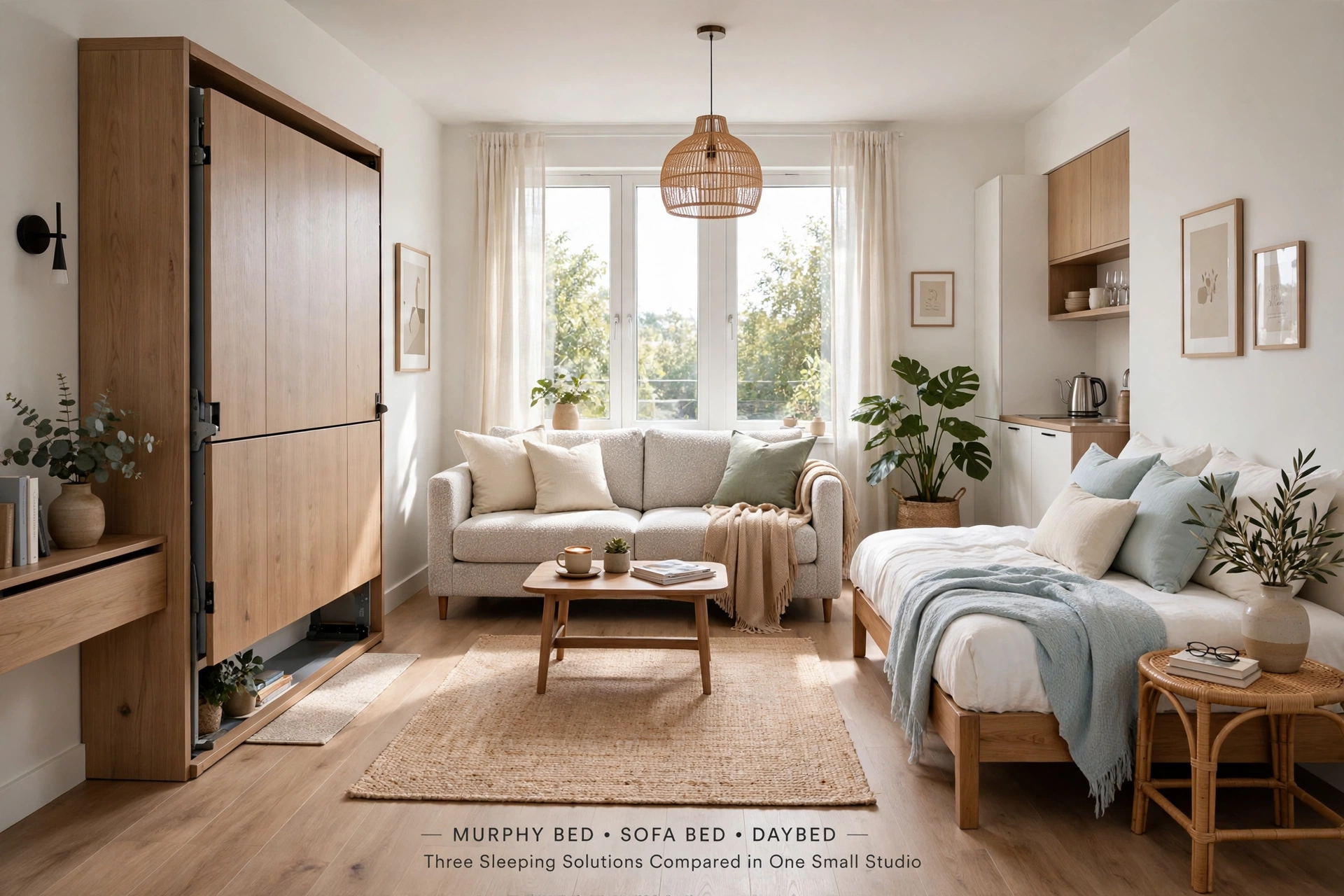
A murphy (wall) bed saves the most space: a queen murphy takes about 11 square feet folded, versus 22 for a sofa bed and 23 for a daybed — and returns that floor during the day. Best choice depends on use: sofa beds suit daily sitting plus occasional guests; daybeds suit permanent seating with a ready twin.
Murphy Bed vs Sofa Bed vs Daybed: Comparison Table
| Feature | Murphy (Wall) Bed | Sofa Bed / Sleeper Sofa | Daybed |
|---|---|---|---|
| Floor footprint, closed / as seating | ~11 sq ft (queen cabinet ~63″W × 24″D) | ~22 sq ft (sofa ~84″W × 38″D) | ~23 sq ft (twin ~80″L × 42″W) |
| Floor footprint, open / as bed | ~39 sq ft (queen ~63″W × 90″L) | ~52 sq ft (queen pull-out ~84″W × 90″L) | ~23 sq ft (unchanged; trundle adds ~14 sq ft when rolled out) |
| Clearance needed in front | ~7 ft of open floor to unfold | ~4–5 ft to pull out the mechanism | None (trundle needs ~3 ft on one side) |
| Mattress thickness | 10–12″ (real mattress) | 4–5″ (thin; better models use seat cushions) | 6–8″ twin (standard) |
| Sleep comfort | Excellent — like a regular bed | Fair to good; bars and thin pads are the weak point | Good for one; narrow for two |
| Daily usability | 2–3 min to fold/unfold; best for daily sleepers | 1–2 min to convert; best as daily sofa | Zero conversion; always both |
| Installation | Must anchor to wall studs; some need pro install | None — it is a sofa | None — assemble like a bed frame |
| Typical price range | $1,500–$4,000+ (DIY kits from ~$1,000) | $500–$2,000 | $200–$800 |
| Best for | Studios; daily sleeping in tiny spaces | Living rooms; occasional guests | Home offices/guest rooms; kids and teens |
Option Deep Dives
Murphy Beds: Maximum Space Recovery
A murphy bed pivots vertically into a cabinet, so the sleeping footprint exists only at night. A typical queen unit measures about 63 inches wide and 87 inches tall, projecting just 16 to 24 inches from the wall when closed — roughly the depth of a bookshelf. When open, it needs the full queen footprint (about 63 by 90 inches) plus walking room, so plan on seven feet of clear floor in front of the cabinet.
The decisive comfort advantage: a murphy takes a real 10- to 12-inch mattress, the same as a conventional bed. There is no folding mechanism under your back and no thin pad. For someone sleeping on it every night in a studio, that difference compounds fast.
The trade-offs are cost and installation. Quality queen murphy units from makers like Bestar typically run $1,500 to $4,000; DIY hardware kits (for example from Lori Wall Beds) start around $1,000 before lumber and mattress. Every unit must be lag-bolted into wall studs — this is non-negotiable, since a loaded murphy is several hundred pounds pivoting on its anchors. Renters should check lease terms before drilling, and anyone unsure about the install should hire it out.
Sofa Beds: Best Daily Seating, Compromise Sleeping
A sofa bed’s pitch is simple: it is a real couch 95% of the time and a bed when guests appear. A standard queen sleeper sofa occupies about 84 by 38 inches as seating — the same as any full-size couch — and extends to roughly 84 by 90 inches when the mechanism pulls out.
Sleep quality is the weak point of traditional pull-outs. The classic bar-and-canvas mechanism supports a 4- to 5-inch mattress, and after a few years the bars telegraph through. Two designs avoid this: European-style click-clack/futon mechanisms and models like the IKEA FRIHETEN (around $999), where the seat cushions themselves unfold into the sleeping surface. If guests will sleep on it more than a few nights a year, prioritize these bar-free designs and budget for a 2-inch memory-foam topper stored nearby.
On cost and convenience, sofa beds are the easy winner: $500 to $2,000, no installation, no wall damage, and genuine daily seating. For a living room that hosts guests a handful of times a year, that combination is hard to beat.
🛒 Shop This Look:
Daybeds: Zero-Effort Dual Purpose
A daybed is a twin bed (roughly 75 to 80 inches long, 38 to 42 inches deep) styled with a back and arms so it reads as a sofa by day. Add a trundle underneath and it sleeps two. There is no conversion at all — you sit on it, then you lie on it.
That simplicity is the whole appeal for home offices, kids’ rooms, and guest corners: the bed is always made, always available, and the trundle (about $100–200 extra) doubles capacity without any mechanism to break. Popular options like the Novogratz Her Majesty daybed (around $300–400) or IKEA’s HEMNES daybed with built-in drawers (around $300–400) hit the sweet spot of price and looks.
The limitation is size and identity. A twin is tight for two adults, and a daybed never fully reads as either a proper sofa or a proper bed. In a studio where the “couch” is a daybed, the room can feel like a bedroom that never quite becomes a living room.
Space Analysis: Real Measurements
To make the comparison concrete, here is what each option demands in a 10-by-12-foot room (120 sq ft):
- Murphy bed (queen), folded: ~11 sq ft — about 9% of the room. The remaining 109 sq ft is fully usable living space.
- Murphy bed (queen), open: ~39 sq ft — 33% of the room, but only while sleeping.
- Sofa bed (queen), as sofa: ~22 sq ft — 18% of the room, permanently occupied.
- Sofa bed (queen), open: ~52 sq ft — 43% of the room while guests sleep.
- Daybed (twin): ~23 sq ft — 19% of the room, permanently occupied, with no way to reclaim it.
The murphy’s advantage is not just the smaller closed footprint — it is that the footprint is temporary. Over a 16-hour waking day, a murphy returns roughly 28 square feet to the room compared with a sofa bed. In a 400-square-foot studio, that is 7% of your entire home, every day.
Comfort Comparison
For nightly sleeping, ranked best to worst: murphy bed > daybed > traditional sofa bed. The murphy wins because it uses a full-thickness real mattress. The daybed takes second because a standard 6- to 8-inch twin mattress on a solid platform sleeps fine for one person. The traditional pull-out sofa bed trails because of its thin mattress and support bars — though bar-free designs like the FRIHETEN close much of the gap.
For daily sitting, the ranking reverses: sofa bed > daybed > murphy bed (which offers no seating at all when folded). A proper sofa seat — sprung, cushioned, with back support — beats perching on a daybed’s edge, which is designed for lounging rather than upright sitting.
🛒 Shop This Look:
Verdict by Situation
- Studio apartment, sleeping there every night: Murphy bed. Nothing else returns the floor space, and the real mattress protects your back.
- One-bedroom with a living room, guests a few times a year: Sofa bed. You get genuine daily seating and the conversion hassle is rare.
- Home office or kid’s room doubling as guest space: Daybed with trundle. Zero effort, always ready, and the trundle covers the second guest.
- Tightest budget: Daybed ($200–800) beats a cheap sofa bed, whose mechanism will fail first.
- Renter who cannot drill into walls: Rule out the murphy unless your landlord approves anchors; choose between sofa bed and daybed.
- Two adults sleeping nightly in under 500 sq ft: Queen murphy bed — it is the only option that gives two people a real mattress without permanently surrendering a quarter of the home.
Frequently Asked Questions
Are murphy beds safe? Can they fall down?
A properly installed murphy bed — lag-bolted into studs with the manufacturer’s hardware — is extremely safe; the counterbalance mechanism means it stays where you put it. Nearly all failures trace to improper installation (drywall anchors instead of studs) or modified hardware. If you are not confident, pay for professional installation.
Can you use a regular mattress on a murphy bed?
Mostly yes, with two constraints: thickness (usually 10–12 inches max, so the unit closes) and weight (check the mechanism rating, commonly 60–90 lbs for the mattress). Strap systems or retainer bars keep bedding in place when vertical.
Do sofa beds ruin the sofa’s comfort as a couch?
On cheap pull-outs, yes — the mechanism makes the seat shallow and stiff. Better designs (bar-free mechanisms, or cushion-unfold models like the FRIHETEN) sit nearly as well as a standard sofa. Always sit-test before buying, and be wary of online-only models with no reviews addressing seat comfort.
Can two adults sleep comfortably on a daybed?
A standard twin daybed (38 inches wide) is tight for two adults — workable for a night, not for a week. For couples, a full-size daybed (54 inches wide) or a daybed plus trundle pushed together is the realistic minimum.
Which option adds the most resale or rental value?
A quality murphy bed installation can be a genuine selling point in small condos, since buyers immediately see the space math. Sofa beds and daybeds are viewed as ordinary furniture and add no special value.
By Ella Knight
🛒 Shop This Look:
- Bedroom Ideas — our complete hub
- Living Room Ideas
- Best Sofas Under $1000




1 thought on “Murphy Bed vs Sofa Bed vs Daybed: Which Saves the Most Space?”
Comments are closed.