
As an Amazon Associate, I earn from qualifying purchases. This means I may earn a commission if you purchase through links on this page — at no extra cost to you.
Small space decorating isn’t about making compromises — it’s about making smarter choices. The best small homes feel intentional, not cramped. The secrets: multifunctional furniture, vertical storage, light colors, mirrors strategically placed, and ruthless editing. Every item must earn its square footage. This guide covers the principles and specific tactics that make tiny homes live large.
Core Principles
1. Every Piece Must Multitask
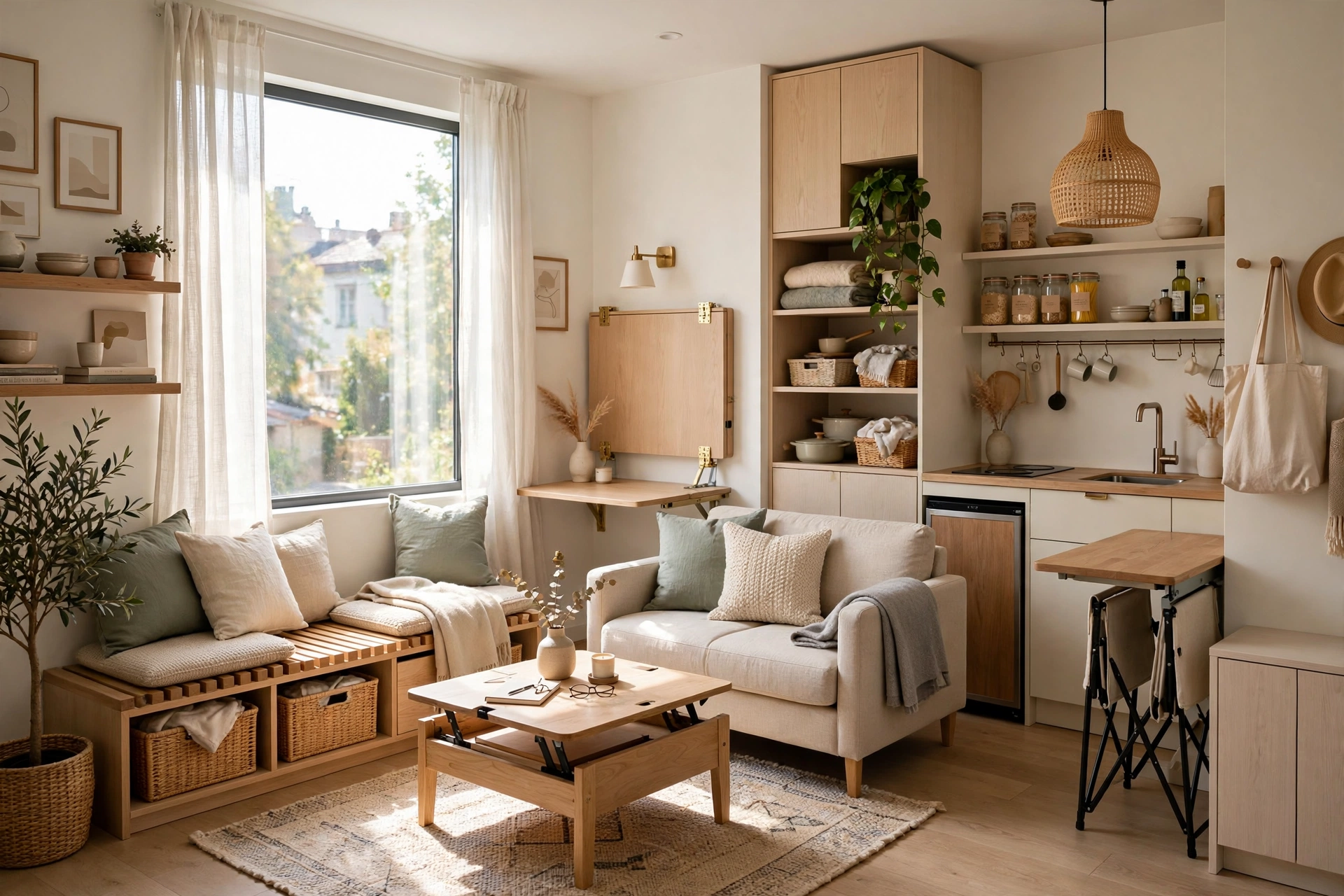
In a small space, single-purpose furniture is a luxury you can’t afford. A coffee table should have storage. An ottoman should open. A dining table should fold. A sofa should pull out for guests. Before buying anything, ask: “What else can this do?”
2. Go Vertical
Floor space is limited; wall space isn’t. Tall bookshelves, wall-mounted desks, hanging pot racks, and floor-to-ceiling curtains all exploit vertical real estate. The eye travels up, making ceilings feel higher and rooms feel larger.
3. Light Colors Expand
White, light gray, pale beige — light colors reflect light and make walls recede. This doesn’t mean boring: add color through textiles, art, and accessories that can be changed easily. Keep the permanent elements (walls, large furniture) light.
4. Mirrors Double Space
A large mirror opposite a window doubles natural light and creates the illusion of depth. Lean a floor mirror against the wall (no installation needed). Mirrored closet doors serve double duty. Even small mirrors on gallery walls bounce light around.
5. Edit Ruthlessly
Small spaces amplify clutter. If you haven’t used it in 6 months, it goes. Every visible surface should be 50% clear minimum. Storage isn’t the solution to clutter — owning less is.
Room-by-Room Strategies
Small Living Room
- Sofa: Loveseat instead of full sofa. Or a chaise that seats two without the bulk.
- Tables: Nesting tables (tuck away when not needed) instead of a large coffee table. C-table that slides over the sofa arm.
- Storage: Ottoman with hidden storage. Media console with closed cabinets (hides clutter).
- Layout: Float furniture slightly away from walls to create breathing room. Counterintuitive but effective.
Small Bedroom
- Bed: Platform bed with built-in drawers. Or loft bed with desk/dresser underneath (great for studios).
- Nightstands: Wall-mounted shelves instead of bulky tables. Or a single shared narrow console.
- Closet: Double hanging rods (doubles capacity). Over-door organizers. Vacuum bags for off-season.
- Colors: Monochromatic bedding (all white or all beige) makes the bed recede visually.
Small Kitchen
- Vertical: Magnetic knife strip, hanging pot rack, wall-mounted spice racks.
- Foldable: Drop-leaf table, folding chairs that hang on the wall.
- Inside cabinets: Door-mounted organizers, tiered shelf inserts, lazy Susans.
- Countertops: Keep 70% clear. Appliances you don’t use daily live in cabinets.
Small Bathroom
- Over-toilet storage: Shelving unit or cabinet exploits dead space.
- Shower caddy: Hanging organizer instead of bottles on the tub edge.
- Mirror cabinet: Medicine cabinet with mirror front — storage + reflection.
- Light colors: White tile, light paint. Dark bathrooms feel like caves.
Studio Apartment Zoning
Studios need visual separation between sleep, work, and living areas. Without walls, use these dividers:
- Rugs: Different rugs define different zones. Living area rug vs. bedroom area rug.
- Bookshelf divider: Open-backed bookshelf divides space while allowing light through.
- Curtain: Ceiling-mounted curtain track with heavy drapes. Close for sleep, open for living.
- Furniture arrangement: Sofa with its back to the bed creates a psychological divide.
- Lighting: Different lighting in each zone (bright task light for work, warm lamp for bedroom) signals different functions.
Storage Hacks
- Behind doors: Over-door organizers on every door (bedroom, bathroom, closet, pantry).
- Under furniture: Under-bed bins, under-sofa storage, under-cabinet hooks.
- Above: Top of wardrobes, above kitchen cabinets, high shelves for rarely-used items.
- Inside: Cabinet door organizers, drawer dividers, shelf risers that double vertical space.
- Multipurpose: Storage ottoman, bench with cubbies, coffee table with lift-top (reveals storage + becomes desk).
What Not to Do
- Dark walls. Unless you have abundant natural light, dark colors shrink small spaces.
- Oversized furniture. Measure everything. A sofa that’s 6 inches too deep can ruin a small living room layout.
- Too many small decor items. Five tiny objects look cluttered; one medium object looks intentional.
- Blocking windows. Never place tall furniture in front of windows. Natural light is your best asset.
- Ignoring vertical space. If your walls are bare above 5 feet, you’re wasting 30% of your room.
Color and Pattern Strategy for Small Spaces
Color choices have an outsized impact in small rooms — every wall is close to you, so every color decision is felt. The goal is depth and interest without visual heaviness.
The 60-30-10 Rule, Adapted
The classic interior design ratio still applies: 60% dominant color (walls, large furniture), 30% secondary (curtains, rugs, bedding), 10% accent (pillows, art, accessories). In small spaces, keep the 60% light and neutral — white, warm white, pale gray, light beige. Put your personality in the 30% and 10%, which are cheaper and easier to change when tastes evolve.
Using Dark Colors Without Shrinking the Room
Dark walls aren’t forbidden in small spaces — they’re just situational. A dark accent wall works when the room has abundant natural light and the other walls stay light. Dark colors also work beautifully in small rooms meant to feel cozy rather than airy: reading nooks, powder rooms, and bedrooms can all go moody. The mistake is painting all four walls of a dim small room dark — that’s what creates the cave effect.
🛒 Shop This Look:
Pattern Scale: Go Bigger Than You Think
Counterintuitively, large-scale patterns often work better in small rooms than small busy ones. A big bold floral or wide stripe reads as one confident gesture; a tiny fussy print reads as visual noise that makes walls feel closer. If you love pattern, use it in one place — curtains or one accent wall — and keep everything else quiet.
Vertical Patterns Add Height
Vertical stripes, tall bookcases, floor-to-ceiling curtains, and vertically-oriented art all draw the eye upward, making ceilings feel higher. Even subtle vertical texture — like beadboard or grasscloth wallpaper — creates this effect. In rooms with standard 8-foot ceilings, this trick alone can make the space feel a foot taller.
Lighting That Expands Small Rooms
Lighting is the most underrated small-space tool. A well-lit small room feels open and inviting; a poorly lit one feels like a closet regardless of its actual size.
Layer Three Types of Light
- Ambient: Overall illumination — ceiling fixture, recessed lights. In small rooms, a flush-mount or semi-flush fixture keeps headroom clear. Dimmer switches are worth installing; bright overhead light at full blast makes small rooms feel harsh.
- Task: Focused light where you work and read — a desk lamp, a reading lamp by the chair. Every functional zone needs its own task light so you’re not relying on one overhead.
- Accent: Small lights that add depth — LED strips on shelves, a picture light on art, candles. Accent lighting creates visual layers that make a room feel larger than its footprint.
Space-Saving Fixture Choices
Floor lamps eat precious floor space. Wall-mounted sconces beside the bed free up nightstand surfaces entirely. Plug-in sconces need no electrician — just a nearby outlet and a cord cover. Under-cabinet LED strips in the kitchen add task lighting without consuming an inch of counter. In the bathroom, a lighted mirror combines two functions in one.
Color Temperature Matters
Use warm white bulbs (2700–3000K) in living and sleeping areas — they flatter skin tones and make small rooms feel cozy rather than clinical. Cooler light (3500–4000K) suits kitchens and bathrooms where you need to see clearly. Mixing temperatures in one small open space looks disjointed, so pick one temperature per zone and stay consistent.
Maximize What You Have
No fixture competes with daylight. Keep window treatments light and minimal — sheer curtains or simple roller shades rather than heavy drapes. Clean your windows; dirty glass noticeably reduces light. And place that large mirror opposite the window, as covered above — it’s the closest thing to a free second window.
The 15-Minute Daily Reset
Small spaces show clutter instantly. A large living room absorbs a stray jacket; a studio apartment broadcasts it. The solution isn’t perfectionism — it’s a short daily routine that prevents accumulation.
- Clear all flat surfaces (5 minutes): Counters, tables, and desks collect everything. Return each item to its home. If an item has no home, that’s a storage problem to solve, not a tidying problem.
- One load of laundry or dishes (5 minutes of active time): In small homes, a single day’s dishes fills the sink and a day’s laundry fills the hamper. Daily small loads beat weekly marathons.
- Floors and entryway (5 minutes): Shoes to the rack, coats hung, a quick sweep of the highest-traffic area. The entryway sets the tone — if it’s chaotic, the whole home feels chaotic.
The one-in-one-out rule: For every new item that enters a small home, one leaves. This single habit prevents the slow creep that gradually overwhelms small spaces. It applies to clothes, kitchen gadgets, decor — everything.
Budget Breakdown: Small Space Makeover Under $500
You don’t need a renovation to transform a small space. Here’s where the money goes furthest:
| Upgrade | Typical Cost | Impact |
|---|---|---|
| Large mirror (floor or oversized wall) | $40–$80 | Highest — doubles light and perceived space |
| Fresh paint (one room, DIY) | $40–$60 | Very high — resets the entire feel |
| Lighting (sconces, LED strips, new shades) | $50–$100 | High — transforms evening ambiance |
| Storage (over-door organizers, bins, shelf risers) | $50–$100 | High — visible clutter disappears |
| Textiles (curtains, throw pillows, rug) | $60–$100 | Medium-high — adds warmth and style |
Total: roughly $240–$440. If your budget is even tighter, prioritize in this order: declutter (free), mirror, paint, lighting. Those four alone transform most small rooms.
🛒 Shop This Look:
Frequently Asked Questions
How do I make a small room look bigger?
Light colors, large mirror opposite window, furniture with visible legs (creates sense of floor space), vertical stripes or patterns (draw eye up), and minimal clutter. The single biggest impact: declutter ruthlessly.
What furniture works best in small spaces?
Pieces with multiple functions, visible legs (not bulky to the floor), light colors, and appropriate scale. Avoid oversized sectionals, bulky recliners, and large entertainment centers.
Can I have a dining table in a studio?
Yes — drop-leaf or folding table that seats 2 daily and expands for guests. Or a counter-height table that doubles as workspace. Wall-mounted fold-down tables are ideal for true micro-studios.
Can I use dark colors in a small space?
Yes, strategically. A dark accent wall works in rooms with good natural light, and dark colors suit small rooms meant to feel intimate — bedrooms, reading nooks, powder rooms. Keep the remaining walls light, use mirrors to bounce light, and ensure good artificial lighting for evenings. What doesn’t work is painting all four walls of a dim room dark — that shrinks the space visually.
How do I host guests in a tiny home?
Foldable and stackable seating is the answer — folding chairs that hang on a wall or stack in a closet, floor cushions stored in an ottoman, a drop-leaf table that expands from daily-two to party-of-six. Serve buffet-style from the kitchen counter so the table stays clear for seating. Guests remember the atmosphere, not the square footage: good lighting, music, and cleared surfaces matter more than space.
What’s the single biggest bang-for-buck upgrade?
A ruthless declutter (free) plus one large mirror ($40–$80). Together they cost almost nothing and transform a room more than any furniture purchase. After that, fresh paint and better lighting deliver the next biggest impact per dollar.
Should I use small furniture or normal-size furniture?
Right-sized, not tiny. Furniture that’s too small for the room looks like dollhouse furniture and actually emphasizes how small the space is. Choose normal-scale pieces in appropriate dimensions — a proper loveseat rather than a full sofa, a real dining table that happens to fold. One fewer piece of correctly-sized furniture beats three pieces of undersized furniture every time.
By Ella Knight
🛒 Shop This Look:
- Living Room Ideas — our complete hub
- Space-Saving Furniture
- Small-Space Storage




2 thoughts on “Small Space Decorating Guide: Big Style for Tiny Homes (2026)”
Comments are closed.