
As an Amazon Associate, I earn from qualifying purchases. This means I may earn a commission if you purchase through links on this page — at no extra cost to you.
A small dining area is not a reason to skip hosting Thanksgiving or Friendsgiving — it just means the table has to be planned a little more deliberately. In a small space, every inch of the table is prime real estate, and the secret to a setup that feels generous rather than cramped is simple: the table is for people, not for food storage. Once serving dishes live somewhere else, even a four-foot table can host a meal that feels abundant and leave your guests enough elbow room to actually enjoy it. Here is how, from the layout strategy down to the last gratitude card.
Start With the Strategy: Keep the Table for People, Not Food
The single most effective small-space move is to serve buffet-style from somewhere other than the table. Set up the food on a kitchen counter, a console table, or a bookshelf cleared for the evening. Guests fill their plates there and sit down to a table that holds only place settings, drinks, and decor. This one change removes the passing of heavy dishes, the reaching across candles, and the mid-meal shuffle every time someone wants more mashed potatoes.
Before you buy or borrow anything, look at the furniture you already own with fresh eyes. A console or entry table becomes a drinks station. A bench from an entryway becomes seating. A folding card table or a drop-leaf table opened for one night can become a temporary serving surface. Borrowed pieces do not need to match — a tablecloth over the serving surface ties everything together visually.
If your main table is a drop-leaf or extendable design, open it fully and plan the room around that footprint. Push other furniture flat against the walls, and relocate anything bulky — a floor plant, an accent chair nobody will sit in — to a bedroom for the evening. The goal is a clear walkway on at least one side of the table so guests can get in and out of their seats without a sideways shuffle. The same vertical thinking that works for decorating a small home at Christmas applies here too, as covered in these small-space Christmas decor ideas.
Space-Saving Centerpieces That Leave Room for Plates
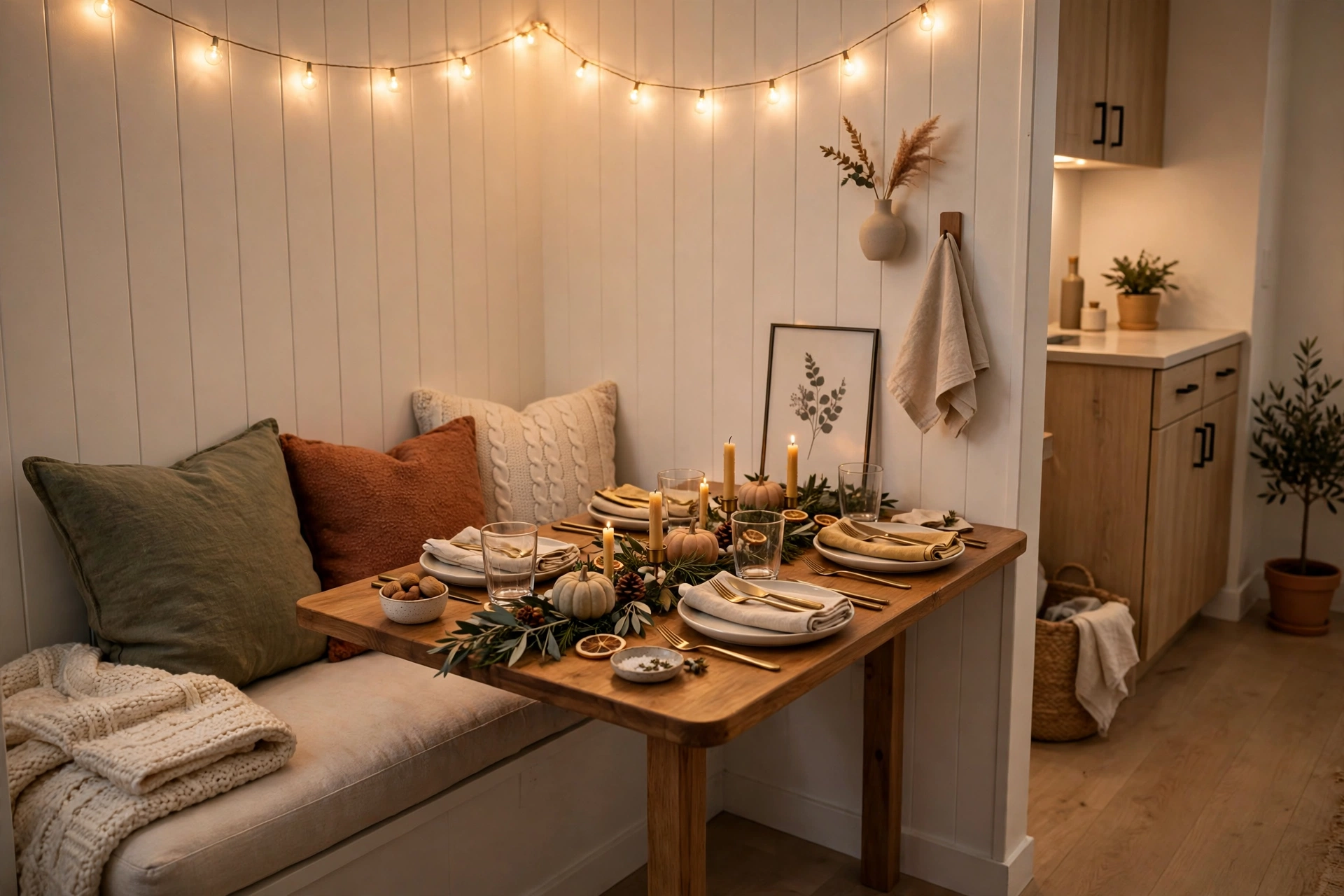
In a small setup, the centerpiece should be long, low, and narrow — decorating the middle of the table without competing with dinner plates. Think in terms of a single line down the center rather than a round arrangement. A fabric runner is the easiest foundation: it defines the decorative zone, so the table reads as styled even with very few objects on it.
Build a Single-Line Arrangement
Start with the runner, then add a row of small, repeated elements: votive candles in glass holders, miniature pumpkins, sprigs of eucalyptus or rosemary laid flat, and a scattering of unshelled nuts or cranberries between them. Repetition is what makes it look intentional. Three to five small groupings spaced evenly down the runner will read as one designed arrangement, while a single tall bouquet in the middle will only block sightlines. Keep everything below roughly eye level when seated, so guests can talk across the table without leaning around a vase.
Use Edible Decor That Gets Eaten
The smartest small-space centerpiece is one that disappears by dessert. A row of pears, apples, or clementines adds real color, takes almost no room, and can be eaten with the meal or sent home with guests. A loaf of crusty bread on a board or a cluster of pomegranates does the same double duty. For more centerpiece layouts that work on tables of every size, see these Thanksgiving table centerpiece ideas.
🛒 Shop This Look:
Seating More People Comfortably
Seating is where small-space hosting usually breaks down, so plan it before anything else. A bench along one side of the table is the classic solution: it typically fits one more person than individual chairs on the same side, tucks partly under the table when not in use, and gives the setup a relaxed, gathered feel. If you do not own a bench, a row of stools can do the same job for one night.
As a general rule of thumb, allow roughly 24 inches of table edge per person for comfortable dining — a little less can work for a casual Friendsgiving, but much less than that and elbows start colliding with glasses. Armless chairs take up noticeably less room, so move armchairs to the ends of the table, where there is naturally more space, or swap them out entirely. Mixing chair styles is fine; keeping seat heights roughly similar matters more than matching finishes.
Leave a clear serving path too. Guests need a route from table to kitchen that does not require three people to stand up every time someone goes for seconds. Angling the table, rather than centering it, sometimes buys you that path on one side while keeping the far side snug to the wall — just fill the wall-side seats first, since those guests are effectively seated for the duration.
Place Settings That Look Full-Size Without the Footprint
A small table does not need small-looking settings. The trick is to build upward instead of outward. Stack the salad plate on the dinner plate, fold the napkin on top, and the setting reads as layered and generous while using exactly one plate’s worth of space. Chargers look beautiful, but on a narrow table they are the first thing to cut — they add width to every setting without adding function.
Choose glassware with the same discipline. One glass per person at the table is enough if the drinks station holds the rest; guests can swap at the buffet. Stemless glasses sit lower and are more stable in a crowd. Keep flatware to what the menu actually needs — a fork, a knife, and a spoon only if dessert calls for it. Place cards add a finished feel and cost no space at all, and they quietly solve the where-do-I-sit question in a room where seating is tight.
Lighting and Coziness in a Small Room
Lighting does more for atmosphere than any decoration, and it takes up no table space at all. Overhead lights at full brightness flatten everything; dim them if you can, or turn them off and light the room from several low sources instead. A floor lamp in a corner and candlelight along the centerpiece will make a small room feel intimate rather than crowded.
Texture is the other half of coziness. A tablecloth or runner softens the table’s hard edges, cloth napkins feel more generous than paper ones, and a throw draped over the bench invites people to linger. Scent counts too, but keep it out of competition with the food: simmer spices on the stove earlier in the day rather than burning a strong candle during the meal.
Friendsgiving Touches That Make It Feel Special
Friendsgiving has one advantage over formal Thanksgiving: nobody expects tradition to be followed, so the small, personal touches carry the whole event. Potluck coordination is the backbone of most Friendsgiving meals in a small home, and a little organization keeps it from becoming four kinds of mashed potato. As host, claim the main dish and drinks, then share a simple list where guests sign up for categories — a vegetable side, a starch, a salad, a dessert, bread. Ask guests to bring dishes ready to serve, with their own serving spoon; in a small kitchen, you will not have spare platters or counter space to transfer anything.
🛒 Shop This Look:
The gratitude card is the touch guests remember. Place a blank card and a pen at each setting, and invite everyone to write one thing they are thankful for this year — a person, a moment, a small ridiculous thing that went right. Read them aloud during dessert, or string them on twine along a wall afterward as decoration. It costs almost nothing, takes up no room, and gives the gathering a shared moment that is not about the food. Handmade details like these are also where a budget stretches furthest — the approach in these DIY budget decor ideas applies just as well to a handmade place card in November as it does in December.
Cleanup and Storage in a Small Kitchen
Plan the ending before the beginning. In a small kitchen, the meal succeeds or fails on counter space, so clear every surface that is not actively needed, and set up a landing zone for dirty dishes — a large tray, a dish tub on a stool, or a section of counter kept empty for exactly this purpose. Fill one side of the sink with hot soapy water before guests arrive; glasses and flatware can soak while dessert happens, keeping piles from forming.
Work in waves. Serving dishes can be washed or loaded while coffee brews, and leftovers should go straight into containers rather than sitting in their serving bowls — stackable, square containers use refrigerator space far more efficiently than round ones, and labeling them with masking tape saves tomorrow’s guessing. The roasting pan can soak in the sink, and the table gets cleared in armfuls to the landing zone rather than piece by piece. Borrowed furniture goes back last, after the floor is clear.
FAQ
How many people can realistically fit at a small table?
Using the general guideline of about 24 inches of table edge per person, a 48-inch table seats four comfortably and six cozily with a bench on one side. If your guest list is bigger than your table, add a second folding table end-to-end, or seat some guests from lap trays in comfortable chairs.
What if there is no dining table at all?
A coffee table surrounded by floor cushions makes a surprisingly festive setup, and a kitchen counter can serve as a standing-height eating surface for part of the group. Folding tray tables or a desk can stand in for one night. Keep the food on the counter buffet, though — every improvised surface should be reserved for eating, not serving.
How do you keep a small room from feeling hot and crowded?
Cook as much as possible ahead of time so the oven is off before guests arrive, crack a window near the kitchen if the weather allows, and keep the drinks station away from the table so people naturally spread out instead of clustering in one warm spot.
What should the host ask potluck guests to bring?
Assign categories rather than specific dishes, ask for each dish to arrive ready to serve with its own serving utensil, and confirm oven needs in advance — a small oven cannot reheat four casseroles at once, so dishes that arrive hot or serve well at room temperature are easiest on the host.
Conclusion
A small space changes the logistics of Thanksgiving, not the warmth of it. Move the food to a buffet, keep the centerpiece low and in a single line, seat people on a bench where you can, build place settings upward instead of outward, and let lighting do the decorating. Add one personal touch — a gratitude card at each seat is enough — and plan your cleanup landing zone before the first guest arrives. Do those things, and your Friendsgiving will not feel like a compromise version of a bigger dinner. It will just feel like dinner, gathered close, exactly as it should be.
🛒 Shop This Look:



