
As an Amazon Associate, I earn from qualifying purchases. This means I may earn a commission if you purchase through links on this page — at no extra cost to you.
Thanksgiving guests form their first impression of your home long before they reach the dining table. It starts at the curb, continues up the walkway, and settles in during those first seconds inside the entryway. A warm welcome does not require a big porch or a matching set of decorations — just a few intentional layers: something beautiful at the door, something glowing at dusk, and something practical inside.
This guide walks through the whole arrival sequence — street, porch, door, entryway, hallway — so each space hands off smoothly to the next. Every idea is modular: do the door this year, the console next year, and build gradually.
Start by Planning the Welcome
Before buying or arranging anything, stand where your guests will stand. Walk to the street, look back at your house, then approach the door slowly. Whatever your eye lands on first — usually the front door — is your focal point, and it deserves the most effort. Everything else should support it, not compete with it.
Think in three layers. The first is what reads from a distance: the wreath, the door color, and large shapes flanking the door, such as planters or stacked crates. The second is what guests notice up close: texture and detail — a doormat’s weave, ribbon on the wreath, pumpkins at different heights. The third is light, which matters enormously in late November, when darkness falls before dinner is served.
Decide on a simple color story, too. Classic Thanksgiving palettes — rust, cream, sage, natural wood — flatter most exteriors and transition gracefully into Christmas. Pick two main colors and one accent, then run that palette from porch to console so the arrival feels connected.
Front Door and Wreath Ideas
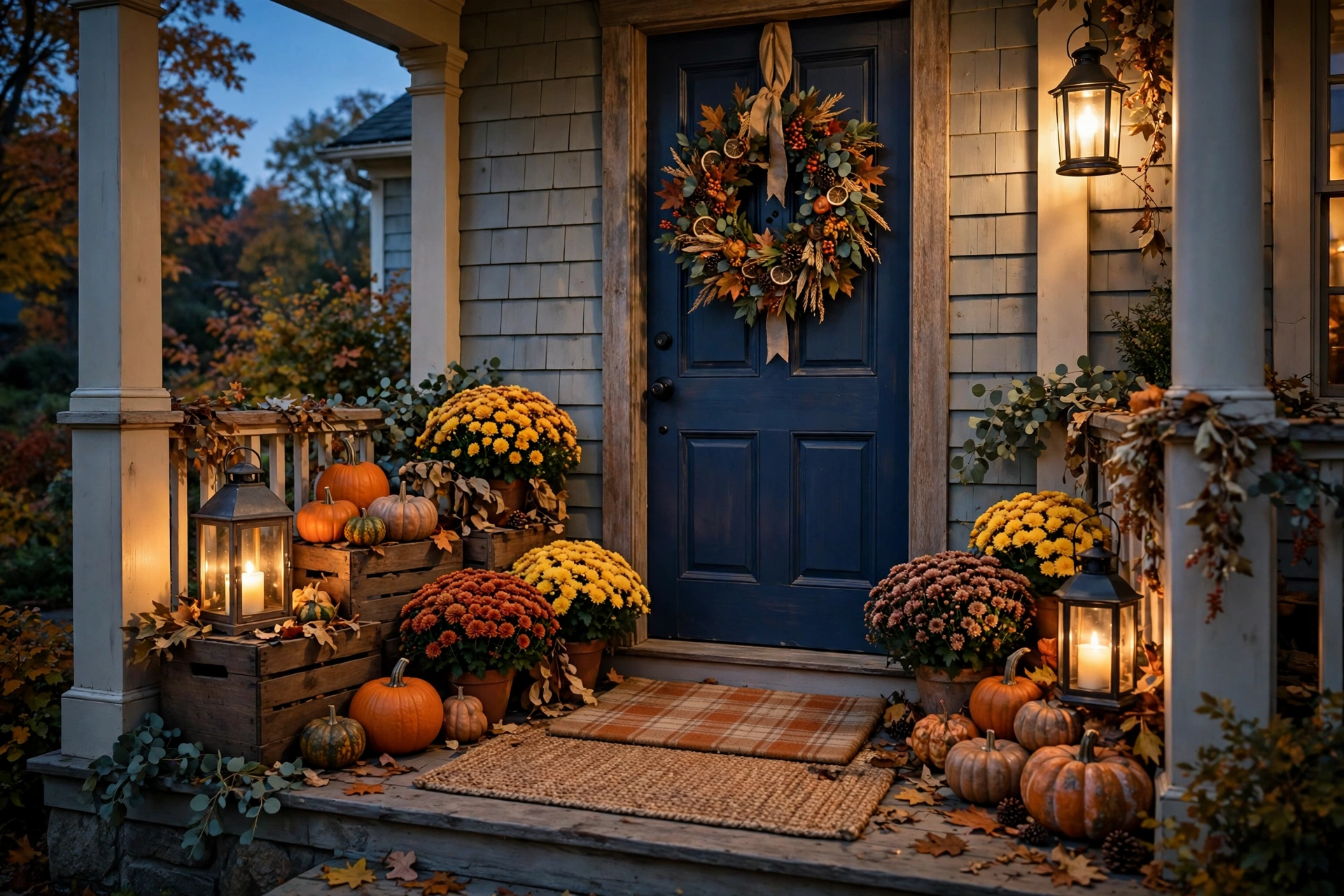
The wreath does the heaviest lifting in your whole display. For Thanksgiving, the strongest looks lean into autumn texture rather than overt holiday motifs: dried grasses, eucalyptus, miniature pumpkins, pinecones, wheat stems, and berries in rust, burgundy, or cream. A grapevine base keeps things rustic; a fuller base dressed with fall stems reads more polished. Scale matters — a small wreath gets swallowed by the door. Aim for one spanning roughly two-thirds the door’s width, hung at about eye level.
If you would rather make your own, our step-by-step guide to how to make a wreath for every season covers bases, wiring, and layering, and the same foundation can be re-dressed from fall into winter. Finish the wreath with a wide ribbon bow — burlap, velvet, or muted plaid — to hide the hook at the top.
Do not neglect the door itself: a quick wash and a polish of the handle and house numbers take minutes. Frame the door with garland only if proportions allow; on a narrow entry, one strong wreath beats a crowded doorway.
🛒 Shop This Look:
Porch Groupings That Actually Last Outdoors
The most inviting porches are arranged in groups, not scattered single items. The classic formula is a triangle — something tall, something medium, something low — clustered beside the door rather than spread in a line: a tall lantern or stack of two crates, mums beside it, and pumpkins of mixed sizes spilling down to the step. Repeat a smaller version on the other side if space allows; slight asymmetry looks more natural outdoors.
Pumpkins and mums, the workhorses
Pumpkins are the obvious anchor, and mixing varieties — classic orange, white, sage green, and the warty heirloom types — looks far more designed than a row of identical jack-o’-lantern pumpkins. Arrange them in odd numbers and vary heights with crates or a hay bale underneath. Real pumpkins hold up in cool weather but soften after hard frosts and freeze-thaw cycles, so check weekly and remove any going soft before they stain the porch. Faux pumpkins solve durability entirely and store for reuse, though they look best mixed with something living.
Chrysanthemums bring the color, but they need management: water deeply rather than often, shield them from harsh afternoon sun on a west-facing porch, and deadhead spent blooms. In very cold regions, potted mums fade after repeated hard freezes, so plan the grouping to still work once they are swapped for evergreen branches.
Lanterns, bales, crates, and the doormat
Lanterns earn their place twice — sculptural objects by day, light source at dusk. Black metal reads modern; wood or galvanized finishes lean farmhouse. Use flameless timer candles inside: they switch on before guests arrive, with no open flame near dry leaves or coat hems. Hay bales and crates add height and harvest feeling, but both absorb water, so keep them under the porch roof and off bare ground. Finally, the doormat: large enough that both feet land on it, layered over a bigger flatweave rug if you like the collected look — just check the stack does not make the door scrape.
Styling the Entryway Console
Inside the door, the console table is where the welcome becomes personal. Start by clearing it completely — the entryway collects mail, gloves, and clutter faster than any other surface. Rebuild it around three functions: a place to set things down, a bit of beauty at eye level, and soft light.
A mirror above the console is the hardest-working piece here: it reflects whatever light you have, gives guests a quick mirror check, and doubles the glow of any lamp nearby. Lean it against the wall if you change things seasonally. In front of it, place a tray — wooden, woven, or metal — that corrals keys and the small things that otherwise scatter; it reads as decor while keeping the surface tidy.
For the styling layer, borrow the language of your porch so inside and outside feel continuous: a small pumpkin or bowl of pinecones, a short stack of warm-toned books, and one piece of greenery. Eucalyptus stems, a small potted plant, or dried grasses in a crock all work, and none will wilt over a long holiday weekend like fresh flowers. For fragrance, choose a candle alternative — a reed diffuser or flameless candle — since a real flame is easily knocked in this high-traffic pass-through. Finish with a small lamp if space allows; lamplight at hip height is far more flattering than an overhead fixture.
Let the styling echo the dining room without duplicating it. If you are planning a full table scheme, our guide to Thanksgiving table centerpiece ideas shows how to carry the same colors and materials from the console through to the table.
Staircase and Hallway Touches
If your entryway opens onto a staircase or hallway, a light touch there extends the welcome deeper into the home. A simple garland along the banister — faux greenery threaded with dried orange slices, pinecones, or ribbon in your palette — is the classic move, and it takes less material than expected draped in gentle swags rather than wrapped around every baluster.
On the stairs, keep decor to the very edge of the bottom two steps, pushed fully aside, or skip it and let the banister carry the look. Hallways benefit most from restraint: a warm-toned runner, one piece of art swapped for something autumnal, and a small basket by the door. If your hall leads toward the living room, echo the mantel styling at the end of it; our fall mantel decor ideas use the same natural palette, so the rooms read as one story.
🛒 Shop This Look:
Lighting for Early-Dark Evenings
By Thanksgiving, most guests arrive after sunset, making lighting a design element rather than an afterthought. Layer it like the decor. Start with the porch light: a warm-toned bulb is dramatically more welcoming than a blue-white one, and cleaning the fixture’s glass helps more than most upgrades. Add lanterns with timer candles as the second layer, set for dusk. For a long or dark walkway, add a third — solar stake lights or warm outdoor bulbs along the rail, in the same warm tone.
Inside, mirror that warmth: console lamp on, overhead lights dimmed or off, a flameless candle carrying the glow down the hallway — a continuous path of warm light from street to living room.
Keep Walkways Safe and Clear
None of the charm matters if a guest trips carrying a casserole. Keep the path from sidewalk to door clear — groupings belong beside the door, never narrowing the walking route. Watch for easy-to-miss hazards: a curling doormat corner, a pumpkin rolled onto a step, extension cords crossing the path (route them along walls; tape down any unavoidable crossing), and wet leaves, which are slippery and worth a sweep before guests arrive. If early ice is possible, treat steps with ice melt in the afternoon. Turn the porch light on before the first arrival, and keep garland off the handrail’s gripping surface — decorate the balusters, not the rail guests hold.
Transition the Same Pieces to Christmas
The smartest Thanksgiving porches are secretly half of a Christmas porch. Once the holiday passes, you do not start over — you edit. Crates, lanterns, planters, and the mirror-and-tray setup inside stay exactly where they are. Remove only the explicitly autumn pieces: mums past their prime, themed signs, and remaining pumpkins.
Then shift the palette, not the structure. Trade the wreath’s fall ribbon for a red or plaid one, fill planters and crates with cut evergreen branches — often free from tree lots — and tuck in pinecones you already own plus red berries around the lanterns. Swap the doormat to a winter pattern, add ornaments to the console’s pinecone bowl, and replace the garland’s fall additions with ribbon and berries. Because your palette already used cream, sage, and natural wood, the red-and-green layer sits comfortably on top — most November pieces keep working through December.
FAQ
How early can you decorate the porch for Thanksgiving?
Early November is the sweet spot for most climates: mums and real pumpkins stay fresh for several weeks in cool weather. In warmer regions, wait until mid-month for the living pieces, or start with faux pumpkins and hardy greenery and add the real ones last.
What if there is no porch, just a front door?
Concentrate everything at the door: a generous wreath, one planter or lantern grouping, and a layered doormat. A single strong cluster reads as intentional and keeps a small stoop from feeling cluttered.
How do you keep porch decor from blowing away?
Weight is your friend: choose heavier lanterns and planters, fill crates from the bottom, and nestle pumpkins in groups so they brace each other. Set lighter items under the porch roof, out of the wind path, hang the wreath on a proper over-door hook rather than a suction cup, and bring fragile pieces inside on stormy nights.
Can the same entryway styling work for other fall gatherings?
Yes — the structure here (mirror, tray, greenery, warm light) is season-neutral. The Thanksgiving layer is only the interchangeable accents: pumpkins, fall ribbon, autumn stems. Swap those and the same entryway works for any fall weekend.
Conclusion
A warm Thanksgiving welcome is a sequence, not a shopping list: a clear focal point at the door, grouped and weather-aware pieces on the porch, honest attention to light and safety, and an entryway that helps guests settle. Choose the two or three sections that fit your home this year and do them well — the pieces you invest in now will carry straight through to Christmas with a change of ribbon and greenery.
🛒 Shop This Look:




1 thought on “Thanksgiving Entryway and Front Porch Decor Ideas: A Warm Welcome for Guests”
Comments are closed.