
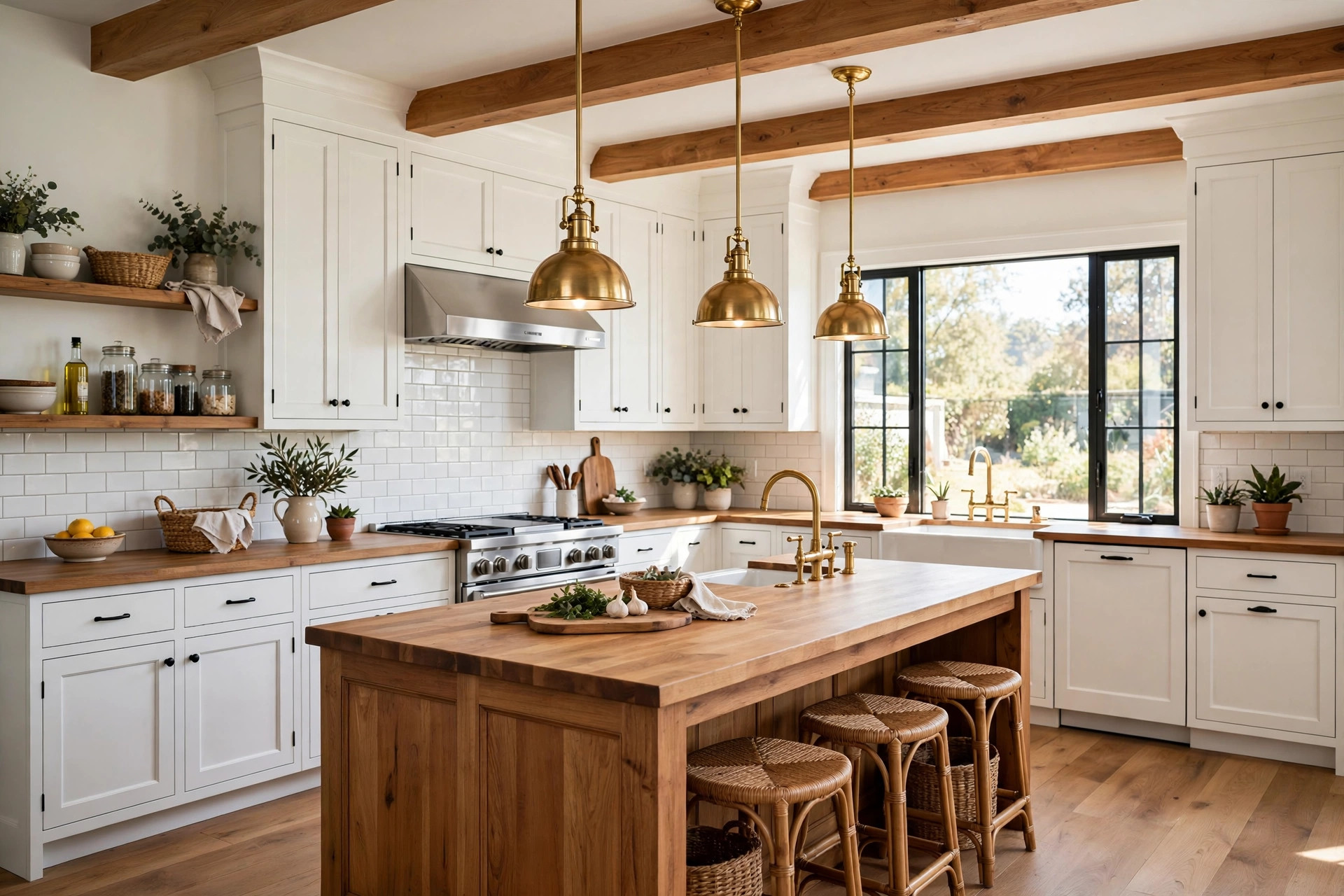
We styled the same 10×12 galley kitchen three ways — modern, farmhouse, and minimalist — to compare cost, effort, and visual impact. Modern cost $420 (sleek hardware, geometric rug, black accents), farmhouse cost $380 (woven textures, vintage finds, warm wood), and minimalist cost $290 (decluttering, white textiles, single plant).
All three took one weekend. The farmhouse style felt warmest, modern looked most polished, and minimalist made the space feel largest. Here’s the full breakdown with photos and receipts.
The Kitchen: Before
Our test kitchen: a 10×12 galley kitchen with white shaker cabinets, gray quartz counters, stainless appliances, and beige tile floors. Neutral enough to work with any style. Starting point: clean but characterless — the classic “builder basic.”
Style 1: Modern ($420)
The Vision
Clean lines, bold contrasts, intentional minimalism with edge. Think matte black, geometric patterns, and sculptural shapes.
What We Changed
- Matte black cabinet pulls (20 @ $3 each = $60)
- Geometric black-and-white runner rug ($45)
- Black pendant light over sink ($70)
- Set of 3 matte black canisters ($35)
- Black-framed abstract art print ($25)
- Black soap dispenser and dish brush set ($30)
- Concrete-look peel-and-stick backsplash accent ($80)
- Black and white striped dish towels, set of 4 ($25)
- Small black planter with snake plant ($25)
- Miscellaneous (Command strips, etc.): $25

Ravinte Black Cabinet Handles 20 Pack, 5 Inch, Matte Black
Best for the modern kitchen’s matte black cabinet pulls, for bold contrast against white cabinets.

Lahome Colette Checkered Easy Jute Runner Rug, 2×8, Checkerboard Black
Best for the modern kitchen’s geometric black-and-white runner rug, for bold pattern without clutter.

10 Strawberry Street Embossed Marquis Ceramic Kitchen Canister Set, Set of 3, Matte Black
Best for the modern kitchen’s set of 3 matte black canisters, for striking black accents.
The Result
Dramatic transformation. The black accents against white cabinets created striking contrast. The kitchen looked 5 years newer. The geometric rug added energy without clutter.
Pros & Cons
Pros: High impact, very on-trend, photographs beautifully.
Cons: Highest cost of the three. Black shows dust and fingerprints. Can feel cold without warm accents.
Style 2: Farmhouse ($380)
The Vision
Warm, collected, lived-in charm. Natural textures, vintage touches, and cozy layers.
What We Changed
- Oil-rubbed bronze cabinet pulls (20 @ $2.50 = $50)
- Woven jute runner rug ($40)
- Rattan pendant light shade ($55)
- Set of 3 ceramic crocks in cream ($40)
- Vintage-style “Gather” wooden sign ($20)
- Woven seagrass baskets, set of 3 ($35)
- Buffalo check dish towels, set of 4 ($20)
- Wooden cutting boards, set of 2 ($30)
- Trailing pothos plant in ceramic pot ($25)
- Antique brass soap dispenser ($25)
- Miscellaneous: $40

nuLOOM 2’6″ x 10′ Elfriede Jute & Cotton Hand Woven Area Rug, Natural
Best for the farmhouse kitchen’s woven jute runner, for natural texture and warmth.

HAIIQU Hanging Ceiling Lamp, Beige Coastal Wicker/Rattan Shade, 13.7″/17.7″
Best for the farmhouse kitchen’s rattan pendant light, for warm, cozy layers.
The Result
The warmest and most inviting of the three. The natural textures softened the modern cabinets beautifully. It felt like a kitchen in a magazine — approachable, not precious.
Pros & Cons
Pros: Warmest feel, most forgiving (hides imperfections), timeless appeal.
Cons: Can veer into “themed” if overdone. Woven textures collect dust. The sign was polarizing (we’d skip it next time).
Style 3: Minimalist ($290)
The Vision
Less is more. Clear surfaces, hidden storage, single focal point. Calm and airy.
What We Changed
- Decluttered ruthlessly ($0 — actually made $30 selling items)
- Brushed nickel slim cabinet pulls (20 @ $2 = $40)
- White low-pile washable runner ($35)
- Single large white ceramic vase ($30)
- Set of 3 white canisters ($30)
- White linen dish towels, set of 4 ($25)
- Single orchid in white pot ($35)
- Under-cabinet LED strips ($20)
- Clear acrylic tray for coffee station ($25)
- White soap dispenser ($15)
- Miscellaneous: $35

AXMOTUT COB LED Strip Light Warm White, 3000K Dimmable with RF Remote and UL Power Supply
Best for the minimalist kitchen’s under-cabinet lighting, for a calm, airy glow.
The Result
The kitchen felt 30% larger. The all-white palette with strategic lighting created an airy, spa-like calm. Every remaining item felt intentional.
Pros & Cons
Pros: Cheapest, made space feel biggest, easiest to maintain, timeless.
Cons: Can feel stark or cold. Requires discipline to maintain. Least personality of the three.
Head-to-Head Comparison
- Cost: Minimalist ($290) < Farmhouse ($380) < Modern ($420)
- Time: All took one weekend (12–16 hours)
- Visual impact: Modern (most dramatic) > Farmhouse > Minimalist
- Warmth: Farmhouse > Modern > Minimalist
- Space perception: Minimalist (largest feel) > Modern > Farmhouse
- Maintenance: Minimalist (easiest) > Modern > Farmhouse (most dusting)
What We Learned
All three styles worked in the same kitchen — proving that “good bones” matter more than specific decor. The biggest factor wasn’t style or budget, but intentionality. Each version succeeded because every item was chosen deliberately, not accumulated randomly.
If we had to pick one: farmhouse for livability, modern for wow factor, minimalist for small spaces.
— Ella Knight
How to Choose Your Kitchen Style: A Framework
Three styles, one kitchen — but which one is yours? Instead of picking from photos alone, run through these questions:
- How do you want the kitchen to feel at 7pm? Energized and sharp (modern), warm and gathered-around (farmhouse), calm and clear (minimalist). The evening feeling is the honest answer — mornings are rushed, but evenings reveal what you actually want from the space.
- What’s your clutter tolerance? Be brutally honest. Minimalist only works if you’ll maintain it; if your counters naturally accumulate life, farmhouse absorbs it gracefully and modern tolerates it poorly.
- How much upkeep will you actually do? Farmhouse textures (woven, wood, fabric) collect dust and need regular attention. Modern’s hard surfaces wipe clean but show every fingerprint. Minimalist needs the least cleaning but the most discipline.
- What are your kitchen’s fixed elements? Cabinet style, countertop, flooring, and appliance finish push toward certain styles. Warm wood floors lean farmhouse; gray quartz leans modern; white everything leans minimalist. Work with the fixed elements rather than fighting them.
- How long will you live with it? For a forever home, choose what you love regardless of trends. For a home you’ll sell in 3–5 years, lean toward the broadly appealing (modern or minimalist photograph best for listings).
What “Good Bones” Actually Means
The reason all three styles worked in the same kitchen comes down to good bones — the underlying qualities that let any style succeed:
- Decent proportions: the room isn’t awkwardly narrow or oddly shaped. Most standard kitchens qualify.
- Neutral fixed elements: white or wood cabinets, neutral counters and floors. Bold fixed elements (like cherry cabinets or patterned tile) lock you into compatible styles.
- Good natural light: or at least the potential for good artificial light. Light is what makes any style look intentional.
- Adequate storage: enough closed storage that the style layer (decor, textiles, accessories) is a choice, not a cover-up for clutter.
- Clean lines underneath: even “rustic” styles need clean architecture beneath the texture. Worn-out isn’t the same as character.
If your kitchen has good bones, style is just the outfit — changeable, personal, and low-stakes. If it doesn’t, address the bones first (paint, lighting, decluttering) before investing in style-layer decor. No amount of farmhouse signs fixes bad lighting.
Renter-Friendly Versions of Each Style
All three styles adapt to rentals — the principles are the same, the methods change:
- Renter modern: peel-and-stick backsplash in a geometric pattern, black adhesive cabinet pulls (or magnetic ones), a bold runner, black-framed art with removable strips, matte black accessories. No paint, no drilling.
- Renter farmhouse: woven textures (jute runner, seagrass baskets), wood cutting boards leaned as decor, linen textiles, trailing plants, warm-toned accessories. Farmhouse is the most renter-friendly style because it’s built on portable textures, not permanent changes.
- Renter minimalist: the easiest — declutter ruthlessly, corral remaining items on trays, switch to white/neutral textiles, add one plant. Minimalism is mostly subtraction, which rentals allow freely. Removable under-cabinet LED strips add the lighting layer.
Mixing Styles: The 80/20 Rule
You don’t have to pick one style with total purity. The approach designers actually use: 80% one style, 20% another.
A modern kitchen with farmhouse wood accents. A farmhouse kitchen with modern black fixtures. A minimalist kitchen with one warm vintage piece.
The 20% is what keeps a styled kitchen from feeling like a showroom — it’s the personal, unexpected element. The rule that keeps mixing from becoming chaos: keep the undertones and the quality level consistent. A modern kitchen with a rustic wood stool works; a modern kitchen with a rustic wood stool and farmhouse signs and vintage tins becomes farmhouse with modern cabinets.
Maintaining Each Style: The Honest Comparison
- Modern — weekly effort: medium. Hard surfaces wipe clean fast, but black and glass show dust, fingerprints, and water spots. A quick daily wipe of high-touch areas keeps it sharp. Deep clean: straightforward, no special care for textures.
- Farmhouse — weekly effort: highest. Woven textures trap dust, wood needs occasional oiling, textiles need laundering. The style hides everyday mess well (that’s its superpower) but needs regular dedicated maintenance sessions.
- Minimalist — weekly effort: lowest cleaning, highest discipline. Fewer items means faster cleaning, but the style collapses the moment clutter accumulates. The maintenance is behavioral, not physical: the 5-minute daily reset is non-negotiable.
Frequently Asked Questions
Which kitchen style is cheapest to achieve?
Minimalist — it’s primarily decluttering plus a few coordinated basics, and decluttering is free. Farmhouse comes next (thrifted wood, woven textures, and vintage finds are affordable). Modern tends to cost most because its impact depends on crisp, quality pieces rather than texture and layering.
Which kitchen style makes a small kitchen look bigger?
Minimalist, by a clear margin — clear surfaces, light palette, and minimal visual interruption maximize perceived space. Modern is second (clean lines, good contrast). Farmhouse’s layered textures, while warm, add visual density that can make small kitchens feel fuller.
Can I mix modern and farmhouse in one kitchen?
Yes — it’s one of the most popular combinations (often called “modern farmhouse”). The formula: farmhouse warmth (wood, texture) + modern restraint (clean lines, black accents, minimal clutter). Keep it 80/20 in either direction so the kitchen reads as intentional rather than undecided.
How often should I update my kitchen style?
The style layer (textiles, accessories, small decor) can refresh seasonally or yearly for very little money. The bigger investments (hardware, lighting, rugs) should last 5-10 years. If you’re restyling more often than that, the issue is usually that the base style wasn’t really yours — revisit the framework questions above.



