
As an Amazon Associate, I earn from qualifying purchases. This means I may earn a commission if you purchase through links on this page — at no extra cost to you.
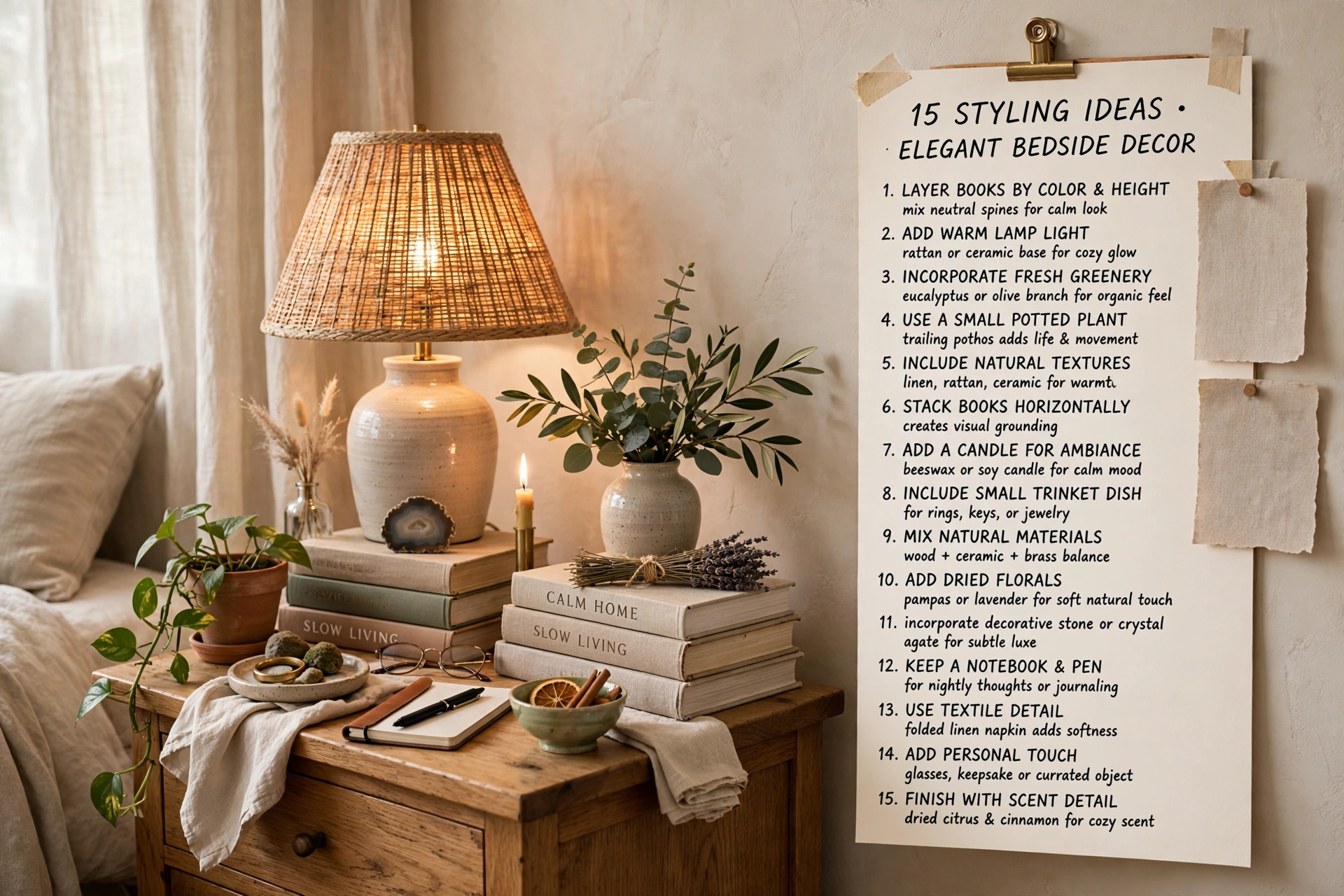
A well-styled nightstand needs just five things: a lamp for reading light, a small stack of 2–3 books, a candle or small plant for life, a dish or tray for jewelry and essentials, and one personal item like a framed photo. Beyond these basics, 15 styling ideas include adding a small vase with fresh flowers, a minimalist alarm clock, a carafe and glass for water, a scented diffuser, a piece of art leaned against the wall, a decorative box for hidden storage, a small sculpture, a stack of magazines tied with ribbon, a bud vase with a single stem, a framed quote, a small mirror, a tabletop clock, a woven basket underneath for extra storage, a piece of driftwood or stone, and a small lamp with a colored shade for personality.
The 5 Essentials
1. A Lamp
Every nightstand needs task lighting. Choose a lamp proportional to the table — the
shade’s bottom should be at eye level when you’re sitting up in bed.
Best for reading light at eye level beside the bed.
2. Books
A stack of 2–3 books adds height and personality. They don’t have to be currently reading — beautiful covers count as decor.
3. Something Living
A small plant, fresh flowers, or even a sprig of eucalyptus in a bud vase brings life to the vignette.
Hand-Made Blown Art Bud Glass Vase, Small Clear Decorative Single Stem Vase
Best for a single stem or a sprig of eucalyptus on the nightstand.
4. A Catch-All Tray
A small dish or tray corrals jewelry, lip balm, and other bedtime essentials. It keeps the surface looking tidy.
GORESE Square Nightstand Tray Perfume Organizer, Leather Decorative Tray, Cream White (9.3” x 9.3”)
Best for corralling jewelry, lip balm, and other bedtime essentials.
5. Something Personal
A framed photo, a souvenir from a trip, or a meaningful object. This is what makes it yours rather than a catalog.
10 More Ideas for Personality
Once you have the essentials, add one or two of these: a minimalist alarm clock (ditch the phone), a water carafe and glass, a reed diffuser, small-scale art leaned against the wall, a lidded box for hidden storage, a sculptural object, magazines tied with ribbon, a small round mirror, a woven basket on the lower shelf, or a lamp with an unexpected shade color.
Best for ditching the phone on the nightstand.
Bedside Water Carafe and Glass Set, Mfacoy 17 OZ Pitcher & 5 OZ Cup, Vintage Glass
Best for water by the bed overnight.
COCORRÍNA Reed Diffuser, Moroccan Amber, 6.7 Fl.oz, with Sticks & Preserved Baby’s Breath
Best for bedroom scent, including a seasonal refresh.
Styling Rules
Work in odd numbers (3 or 5 objects). Vary heights — tall lamp, medium books, small dish. Leave some empty space; a crowded nightstand feels chaotic. And keep the color palette to 2–3 colors that coordinate with your bedding.
Nightstand Styling by Bedroom Style
The five essentials work in any bedroom, but the details should speak your style’s language. In a modern or minimalist bedroom, less is more: a sculptural lamp with a clean shade, one stack of design books, and a single small object — a stone, a bud vase, a minimal clock. Negative space is part of the design, so resist the urge to fill every inch. In a farmhouse or rustic bedroom, lean into texture and warmth: a distressed wood or galvanized lamp, a small potted plant or cotton stems in a mason jar, a woven tray for essentials, and a framed family photo in a weathered frame.
For a boho or eclectic bedroom, layer freely: a patterned or rattan lamp, a small stack of travel books topped with a candle, a tiny plant in a colorful pot, crystals or collected objects, and art leaned casually against the wall. Boho styling forgives — even rewards — a little beautiful clutter. In a traditional bedroom, aim for symmetry and polish: matching lamps on both nightstands, a classic alarm clock, fresh flowers in a proper vase, and a silver or ceramic tray. Traditional styling loves pairs and shine. For a Scandinavian look, keep it light and functional: a simple white or wood lamp, one beautiful book, a small green plant, and nothing else. Every item should earn its place.
Styling a Small Nightstand
A tiny nightstand doesn’t mean skipping style — it means editing ruthlessly. Prioritize in this order: light (a lamp or wall sconce), then one personal item, then only what fits. Wall-mounted sconces or pendant lights are the small-nightstand superpower: they free the entire surface while giving you better reading light than most table lamps. If you can’t hardwire, plug-in sconces with cord covers work beautifully.
Go vertical with a small stack of books as a riser — it adds height without footprint and gives smaller items a stage. Choose a slim carafe instead of a bulky water bottle, a single bud vase instead of a full arrangement, and a wall-mounted or leaning mini frame instead of a chunky one. A small floating shelf above the nightstand can hold overflow (books, a clock) while the table surface stays clean. And consider the space underneath: a woven basket tucked below holds extra books or a throw without using an inch of tabletop.
Budget Nightstand Styling That Looks Expensive
A styled nightstand doesn’t require a big budget — it requires intention. Thrift stores are goldmines for the key pieces: brass candlesticks, ceramic vases, interesting frames, and hardcover books with beautiful spines often cost a few dollars each. A $5 thrifted vase with grocery-store eucalyptus looks more expensive than a $40 arrangement from a decor chain.
Repurpose what you own: a small bowl from the kitchen becomes a catch-all tray, a favorite coffee table book moves to the bedroom, a candle you received as a gift finally gets lit. For art, print a favorite photo in black and white (black-and-white prints look instantly more “designed”) and put it in a simple frame — or lean an unframed art print against the wall for a casual gallery feel. The most expensive-looking trick of all is editing: three well-chosen items on a clear surface look richer than ten crowded ones, and editing is free.
Nightstand Styling Mistakes to Avoid
The most common mistake is the charging-station explosion — a tangle of cables, a glowing phone, and a tablet stacked on top. It instantly ruins even the prettiest styling. Fix it with a small charging dock tucked in a drawer, a cable clip on the back of the nightstand, or at minimum, a pretty box that hides the tech clutter. The second mistake is scale: a lamp that’s too tall overwhelms a small table, while a tiny lamp gets lost on a large one. The lampshade’s bottom should sit roughly at eye level when you’re sitting up in bed.
Third, don’t let the nightstand become a storage dumping ground — old magazines, half-read mail, and random receipts belong elsewhere. Give everything a home: a lidded box for the miscellaneous, a basket below for books, a tray for the nightly essentials. Finally, remember that nightstands are usually seen in pairs. They don’t need to match exactly, but they should relate — same height, similar visual weight, or a shared color. Two wildly different nightstands make the whole bed wall feel off-balance.
Styling Two Nightstands That Don’t Match
Perfectly matched nightstands are the default, but mismatched pairs — done deliberately — look more collected and interesting. The trick is giving them something in common so the mismatch reads as intentional. Match their height within a couple of inches (height mismatch looks like a mistake; style mismatch looks like a choice). Then connect them with a shared element: same lamp style in different colors, matching frames with different photos, or one repeated material — both have wood tones, both have brass details, both are white.
A reliable formula: keep the functional items parallel (both sides get a lamp and a catch-all) but vary the decorative layer (different art, different plant, different book stack). This gives you symmetry where it matters (light, function) and personality where it’s fun (decor). What to avoid: two nightstands at wildly different heights, or styles that share nothing — a rustic crate and a mirrored glam table with no connecting thread just looks like you couldn’t decide. One shared thread is enough; two is plenty.
Nightstand Alternatives for Tight Spaces
Not every bedroom fits traditional nightstands, and the alternatives are often better. Floating shelves mounted at nightstand height give you a surface without a footprint — ideal beside beds pushed against walls or in narrow rooms. Wall-mounted cabinets or cubbies add concealed storage where a table can’t go. A small stool or side table works beautifully in casual and boho bedrooms — a wooden stool, a garden stool, or a petite round side table all do the job with more character than a boxy nightstand.
Ladder shelves leaning against the wall offer multiple tiers in a tiny footprint. A stack of beautiful books or a vintage suitcase makes a charming nightstand in eclectic rooms (just make sure it’s stable). And in the smallest bedrooms, skip the furniture entirely: a wall-mounted sconce for light plus a small floating shelf for the phone and book covers every real need. The nightstand’s job is a surface at the right height with light nearby — any object that does that honestly is a legitimate nightstand.
The Five-Minute Seasonal Refresh
Nightstands are the easiest surface in the bedroom to refresh, so use them as your seasonal lever. You don’t need new furniture — just rotate three things: the living element (fresh flowers in spring, a small pumpkin or dried stems in fall, eucalyptus in winter), the scent (a candle or diffuser in a seasonal fragrance), and one decorative object (swap the art print, change the book stack, rotate the photo). Five minutes, twice a year, and the bedroom feels renewed.
Keep a small “nightstand kit” in a closet — the alternate prints, the off-season candle, the spare bud vase — so refreshes don’t require shopping. And photograph your favorite arrangements before changing them; it’s surprisingly hard to recreate a vignette you loved once you’ve dismantled it. The best-styled nightstands aren’t static displays — they’re living surfaces that evolve slightly with the seasons while keeping their essential structure: light, something to read, something living, somewhere for the essentials, and something personal.
🛒 Shop This Look:
🛒 Shop This Look:
🛒 Shop This Look:



