
As an Amazon Associate, I earn from qualifying purchases. This means I may earn a commission if you purchase through links on this page — at no extra cost to you.
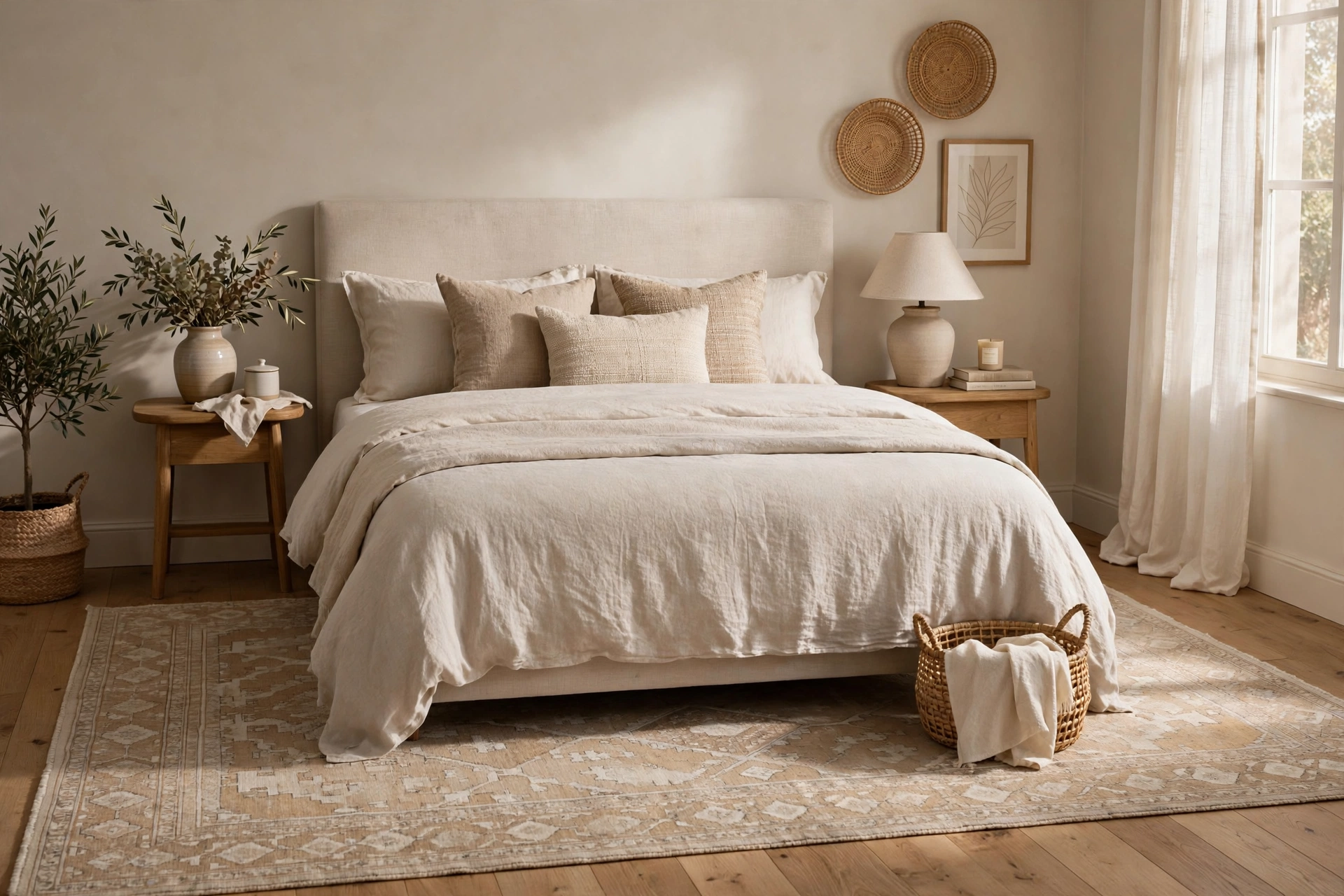
For a queen bed, choose a rug that is 8×10 feet for the standard layout — this allows the rug to extend 18–24 inches beyond each side of the bed and past the foot. If your room is smaller, a 6×9 foot rug works when placed under the bottom two-thirds of the bed. The key rule: the rug should be wide enough that you step onto soft rug (not cold floor) when getting out of bed on either side.
Rug Placement Options for Queen Beds
Option 1: Full Under-Bed (8×10 Rug)
The rug goes under the entire bed, extending 18–24 inches on each side and 18+ inches past the foot. Nightstands sit partially or fully on the rug. This is the most luxurious look and the most common designer choice.
Option 2: Bottom Two-Thirds (6×9 Rug)
The rug starts about a third of the way down from the headboard and extends past the foot of the bed. Nightstands sit on the bare floor. This saves money and works well in smaller rooms.
Option 3: Runners on Each Side
Two narrow runners (2.5×8 feet) on either side of the bed. Budget-friendly and easy to clean, though less visually anchored than a single large rug.
Rug Sizes for Other Bed Sizes
- Twin: 5×7 or 6×9 rug
- Full/Double: 6×9 or 8×10 rug
- Queen: 8×10 rug (ideal) or 6×9 (compact)
- King: 9×12 rug (ideal) or 8×10 (minimum)
- California King: 9×12 rug
Common Rug Sizing Mistakes
The biggest mistake is buying too small — a tiny rug floating under the bed looks lost and cheap. When in doubt, size up. Also avoid rugs with very high pile under beds with low clearance, and skip light-colored rugs if you have pets (or choose a washable one).
Material and Pile Considerations
Low-pile or flatweave rugs work best in bedrooms — they’re easy to vacuum and don’t trap as much dust. Wool is durable and naturally stain-resistant. If allergies are a concern, choose a low-VOC synthetic or washable cotton rug.
How to Measure Your Bedroom for the Perfect Rug
Guessing rug size from a product photo is how bedrooms end up with rugs that look like postage stamps. Ten minutes with a tape measure prevents it.
🛒 Shop This Look:
- Measure the bed footprint. A standard queen mattress is 60 × 80 inches, but measure your actual frame — headboards, footboards, and wide side rails add inches. Write down the full outside dimensions.
- Add 18–24 inches per side. This is the non-negotiable part: when you sit on the edge of the bed and swing your feet down, they should land on rug. Measure 18 inches out from each side of the frame and 18+ inches past the foot. Mark these points with painter’s tape on the floor.
- Check nightstand placement. Decide whether nightstands will sit on the rug (full under-bed layout) or on bare floor (two-thirds layout). If they sit on the rug, add their depth to your width measurement. A wobbly nightstand with two legs on rug and two off is worse than no rug at all.
- Verify walkway clearance. Leave at least 18 inches — ideally 24–36 inches — between the rug edge and the walls or other furniture. A rug that runs wall-to-wall reads as wall-to-wall carpet, not an area rug.
- Check the door swing. Open and close the bedroom door fully. If it catches on your taped outline, the rug is too big or too thick for that spot — low-pile rugs and thinner pads solve most door-clearance issues.
- Tape the full outline. Before ordering, tape the exact rug dimensions on the floor and live with it for a day. Walk around it, open drawers, sit on the bed. This rehearsal catches problems no measurement reveals.
Bedroom Layout Scenarios
Small bedroom (around 10 × 12 feet): An 8 × 10 rug will swallow the floor and leave no walkway. Use a 6 × 9 rug placed under the bottom two-thirds of the bed, starting about a third of the way down from the headboard. Nightstands sit on bare floor. You still get soft landings on both sides and past the foot without crowding the room.
Standard bedroom (around 12 × 14 feet): This is the 8 × 10 sweet spot. The rug goes fully under the bed with 18–24 inches extending on each side and past the foot. Front legs of nightstands rest on the rug; back legs may sit off — push nightstands fully onto the rug if the depth allows, since split placement wobbles.
Large master suite (14 × 16 feet and up): Size up to 9 × 12. The extra rug anchors a seating area or bench at the foot of the bed and prevents the bed from looking lost in a big room. Everything — bed, nightstands, bench — sits on the rug.
Bed against the wall or in a corner: Skip the full under-bed rug. Use a single runner (2.5 × 8 feet) along the exposed side, or a 4 × 6 rug beside the bed where you step out. One well-placed small rug beats a large rug bunched against a wall.
Guest room with two twins: Either one large 8 × 10 rug spanning under both beds (if they share a wall arrangement) or a 3 × 5 rug beside each bed. Guests notice cold floors more than hosts do.
Do Not Skip the Rug Pad
A rug pad under a bedroom rug is not optional equipment — it is what keeps the rug from wrinkling, bunching, and migrating every time you walk on it, and it adds the cushioning that makes the rug feel luxurious.
- Why it matters under beds especially: Bed legs concentrate enormous weight on four small points. Without a pad, the rug compresses unevenly, wrinkles form around the legs, and the rug slowly walks out from under the bed. A pad distributes the load.
- Felt pads add the most cushioning and are the best choice for bedrooms — that plush first step in the morning comes largely from the pad, not the rug. Choose 1/4 to 1/2 inch felt for maximum comfort.
- Felt-plus-rubber combination pads add grip on hard floors. Pure felt can slide on slick hardwood; the rubber side faces down. Avoid cheap PVC waffle pads, which can discolor floors over time and off-gas.
- Size the pad about an inch smaller than the rug on all sides so it does not peek out. Trim with scissors if needed.
- On carpet: skip the rubber; use a thin felt pad or no pad. Thick pads over carpet create a tripping ridge at the edge.
Choosing Rug Style for a Bedroom
Pattern scale: Large-scale patterns suit large rugs; a big medallion or oversized motif looks intentional on an 8 × 10. Small, busy patterns can look chaotic at bedroom-rug scale — from the doorway, they blur into visual noise. Solid or subtly textured rugs are the safest choice and let bedding be the star.
Color strategy: Pull one color from your bedding or curtains and echo it in the rug — not match it exactly, echo it. A rug two shades lighter or darker than your bedding creates depth. Very light rugs show every footprint; medium tones and patterns hide daily wear best.
🛒 Shop This Look:
Pile height: Low-pile or flatweave for easy vacuuming and door clearance; medium pile for comfort. Avoid high-pile shag under beds — it mats permanently under the bed legs, traps dust, and makes the rug nearly impossible to clean.
Materials: Wool is the durability champion — naturally stain-resistant, resilient under furniture, and soft. Wool blends offer similar benefits for less. Cotton flatweaves are affordable and washable but thin. Synthetics (polypropylene, nylon) resist stains and suit pet owners and kids. Natural fibers like jute and sisal look great but feel rough barefoot — layer a soft smaller rug over jute if you love the look.
Washable rugs have earned their popularity for good reason: pet accidents, kids, and coffee spills stop being crises. Check the washing instructions before buying — some “washable” rugs require commercial-size machines.
Mistakes Beyond Sizing
- The floating rug: A rug that does not touch any furniture looks adrift. At minimum, the front legs of the bed should be on the rug — ideally the whole bed.
- Ignoring door clearance: A beautiful thick rug that blocks the door gets folded back within a week. Measure the gap under the door before falling in love with high pile.
- Clashing undertones: A rug with warm beige undertones next to cool gray bedding will always look “off” even if both are neutral. Compare undertones in daylight before committing.
- Bed skirt plus rug bunching: A bed skirt that pools onto a thick rug creates a lumpy mess at the bed’s base. Either shorten the skirt or choose a lower-pile rug.
- Buying the rug before the bed: Bed frame dimensions vary enormously — platform beds, sleigh beds, and upholstered frames all change the footprint. Finalize the bed first, measure it, then buy the rug.
Rug FAQs
Should the rug go under the headboard? In the full under-bed layout, yes — the rug extends under the entire bed including beneath the headboard area. In the two-thirds layout, the rug starts partway down and the headboard zone stays on bare floor. Both are correct; it is a budget and room-size decision.
Can I layer rugs in a bedroom? Yes — a large natural-fiber rug (jute or sisal) as the base with a smaller soft rug on top where your feet land is a designer trick that adds texture and saves money versus one huge premium rug. Keep the top rug’s edges well inside the base rug.
How do I clean under a bed rug? Vacuum the exposed portions weekly. Twice a year, enlist help to shift the bed and vacuum the covered section and the pad. Washable rugs can go through the full wash cycle on schedule — another argument in their favor.
My rug keeps bunching up at the foot of the bed. Why? Almost always a missing or undersized pad, or a rug that is too light for its size. A proper felt pad, correctly sized, solves it. As a stopgap, rug tape on the corners helps.
Round rug under a queen bed? Generally no — round rugs fight the rectangle of the bed and leave awkward uncovered corners where feet land. Save round rugs for reading nooks and entryways.
🛒 Shop This Look:



