
As an Amazon Associate, I earn from qualifying purchases. This means I may earn a commission if you purchase through links on this page — at no extra cost to you.
In a small bedroom, the floor is prime real estate and the walls are free. That is the entire philosophy of wall storage: stop asking a few square meters of floor to do everything, and start using the walls that already surround the bed, the desk, and the door. Done well, wall storage frees the floor, clears the surfaces, and makes a small room feel larger. Done badly, it turns every wall into a crowded shelf and the room feels smaller than before. The difference is planning — what goes on the wall, where it goes, and how it is fixed there.
Audit First: What Actually Needs to Live on the Wall
Before you buy a single shelf, empty the surfaces the wall storage is supposed to replace. Pull everything off the nightstand, the dresser top, and the desk, and sort it into three piles: daily use, occasional use, and does not belong in the bedroom at all. The third pile is usually the largest, and removing it is the cheapest storage upgrade available — no shelf, however clever, compensates for keeping things in a room where they do not belong.
Daily-use items earn the best wall positions: beside the bed, at arm height, within reach without standing up. Occasional-use items earn higher or deeper positions: above the door, on top of a wardrobe, at the far end of a wall. If an item is used less than once a month, it probably belongs in another room entirely, not on prime bedroom wall space.
Count what remains before you shop. A wall plan built for ten books, a phone charger, and a water glass is a single shelf and a hook; a plan built for a library, a full skincare routine, and a work setup is a cabinet wall. Buying storage before counting guarantees either too little, which leaves clutter on the floor, or too much, which covers the walls in empty shelving.
Storage by Zone
The wall above the bed is the most visible and the most misused. It suits light, flat things — a shallow picture ledge, a slim shelf for books you are actually reading — and nothing heavy above a sleeping head. A cabinet above the bed feels looming and, if a fixing ever failed, would fall where you sleep. Keep this zone light, shallow, and securely fixed, and never hang anything heavy directly over pillows.
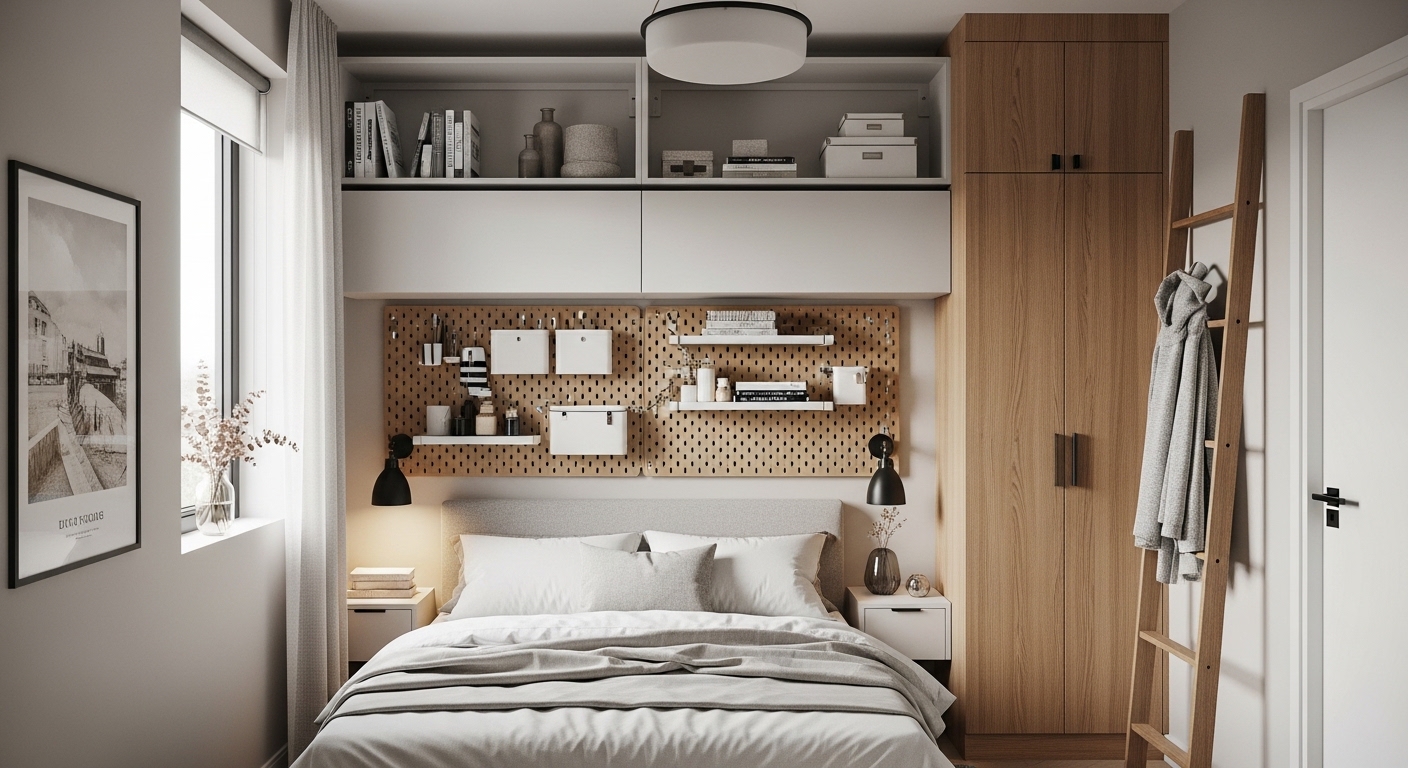
Beside the bed is the nightstand zone, and wall storage here replaces furniture rather than adding to it. A small wall-mounted shelf at mattress height, a hook for headphones, and a tiny ledge for a phone and water glass can eliminate a nightstand entirely, freeing a meaningful patch of floor in a room where every patch counts. Wall-mounted reading lights complete the swap: light without a lamp base eating surface space.
The door zone is the most overlooked. Over-door hooks and racks hold bags, robes, tomorrow’s clothes, and accessories without a single hole in the wall, and the narrow wall beside the door suits tall, slim shelving for shoes or folded items. The wall above the door, meanwhile, takes a shallow shelf for rarely used things — spare bedding, off-season clothes in labelled boxes — that would otherwise consume closet space.
Corners suit tall, narrow units that would waste a flat wall. A corner shelf tower or a ladder shelf tucked into a corner uses space that is awkward for furniture but perfect for vertical storage. The desk wall, finally, should hold only what the desk itself needs: a small shelf for references, a rail for supplies, a hook for headphones. Everything else on the desk wall is clutter that stares at you while you work.
🛒 Shop This Look:
Match the Load to the Wall
Wall storage fails most often at the fixing, not the furniture. A shelf that sags or an anchor that pulls out of the wall is usually a mismatch between the weight on the shelf and what the wall behind it can hold. Before loading any unit, sort your storage into heavy, medium, and light loads, and match each to the right fixing.
Heavy loads — a shelf full of hardcover books, a floating cabinet packed with linens, a full shoe organizer — belong on wall studs. Find studs with a stud finder or by tapping for the solid sound, and make sure at least one fixing per heavy unit bites into solid timber. If your walls are masonry, use the correct masonry anchor for the wall type rather than improvising with a wood screw.
Medium loads, like a pegboard of accessories or a basket of scarves, suit hollow-wall anchors such as toggle bolts, which spread the load behind the plasterboard. Light loads only — a single frame, a small plant, hooks for necklaces — should hang from adhesive strips, and only within the strip’s printed weight rating. Adhesive is wonderful for renters and terrible for anything heavy; respect the rating and the surface it is rated for, since strips that hold on smooth paint fail on textured walls.
Test before you trust. Load a new shelf gradually, check the fixings after a day and again after a week, and watch for the early warnings: a shelf that no longer sits level, an anchor that has crept outward, paint cracking around a fixing. Catching a failing fixing early means re-fixing one unit; catching it late means repairing a wall and replacing what fell.
Closed vs Open: Keeping Small Rooms Calm
Open shelving shows everything, and everything on show must be worth looking at. In a small bedroom, three open shelves of mixed belongings read as clutter however neatly they are arranged, because the eye has nowhere to rest. Closed storage — cabinets, boxes, baskets with lids — hides the variety and shows a single calm surface instead.
The practical rule is simple: open storage for things that are beautiful or used daily, closed storage for everything else. Books you love, a plant, a framed photo — open. Chargers, medicines, spare linens, the miscellaneous drawer contents — closed, in matching boxes or baskets that turn variety into one visual texture. Bohemian wall storage baskets show how baskets can make closed storage look intentional rather than hidden.
Color discipline helps more than people expect. Storage in one quiet color family — all natural wood, all white, all woven neutral — recedes into the wall. Storage in five different colors and materials becomes the room’s loudest feature. When you already own mismatched pieces, matching baskets or a coat of paint unifies them cheaply.
Renter-Friendly Options
Renters can use almost all of this guide without drilling. Over-door racks, leaning ladder shelves, adhesive hooks within their ratings, and freestanding tall units that merely touch the wall cover most bedroom storage needs. Tension rods between walls or inside a closet create hanging space for accessories without a single hole.
For the one or two things that truly need a fixing, adhesive strips rated for the load, used on smooth clean paint and left to cure for the full time on the packet, hold light and some medium loads reliably. Removable hooks fail most often because they were loaded immediately or stuck to dusty or textured paint — follow the packet, and they work as promised.
When you leave, adhesive removal matters as much as installation. Pull the tab slowly along the wall as directed, never outward, and clean any residue with warm soapy water. A wall returned clean is a deposit returned whole, which is the real reason renter-friendly storage pays off.
🛒 Shop This Look:
Nightstand Alternatives
The nightstand is the easiest furniture to eliminate in a small bedroom, and wall storage replaces it completely. A floating shelf at mattress height holds a book, a phone, and a water glass. A small wall pocket or hanging organizer beside the bed holds chargers and small essentials. A hook underneath the shelf holds headphones or a sleep mask.
Lighting completes the replacement. A wall-mounted reading light, or a plug-in sconce on a short cord, gives bedside light without a lamp base consuming the shelf you just freed. If wiring is not an option, a battery sconce with a remote gives the same effect with no electrician and no holes beyond two small screws or adhesive pads.
For couples, mirror the setup on both sides rather than sharing one shelf. Two small shelves, one per side, prevent the nightly negotiation over a single surface, and each person keeps their own essentials within reach without crossing the bed.
Mistakes That Crowd a Small Bedroom
Overloading one wall is the first mistake. A single wall covered floor to ceiling in shelving feels like a warehouse, however organized. Spread storage across two or three walls, leave at least one wall mostly bare, and let the room keep a resting place for the eye.
Blocking light and air is the second. Shelving across a window, or tall units flanking it so tightly that curtains cannot move, darkens the room and makes it feel smaller. Keep window walls clear or nearly so; daylight is worth more than any shelf.
Ignoring door swing and drawer clearance is the third. A shelf that blocks a door, a hook that catches a closet door, a unit that prevents a drawer from opening — all of these turn storage into an obstacle. Walk every door and drawer through its full range before fixing anything to the wall beside it.
Finally, do not store on the wall what you never use. Wall storage that holds forgotten things is decoration for clutter. If a shelf’s contents have not moved in six months, the shelf’s contents belong elsewhere, and the shelf itself may be better removed than refilled.
One Wall at a Time: A Weekend Plan
Do not try to redo every bedroom wall in one weekend. Pick the wall that bothers you most — usually the nightstand wall or the wall facing the bed — and finish it completely: audit, fixings, storage, and a check after a week of use. Living with one finished wall teaches you what works before you repeat it, and one calm wall changes how the whole room feels even while the other walls wait their turn.
The following weekend, do the second wall, applying what the first one taught you: which fixings held, which baskets actually got used, which shelf height felt right. Two weekends, two walls, and the room is transformed without a single chaotic day of drilling, dust, and half-finished shelves everywhere at once.
🛒 Shop This Look:



