
As an Amazon Associate, I earn from qualifying purchases. This means I may earn a commission if you purchase through links on this page — at no extra cost to you.
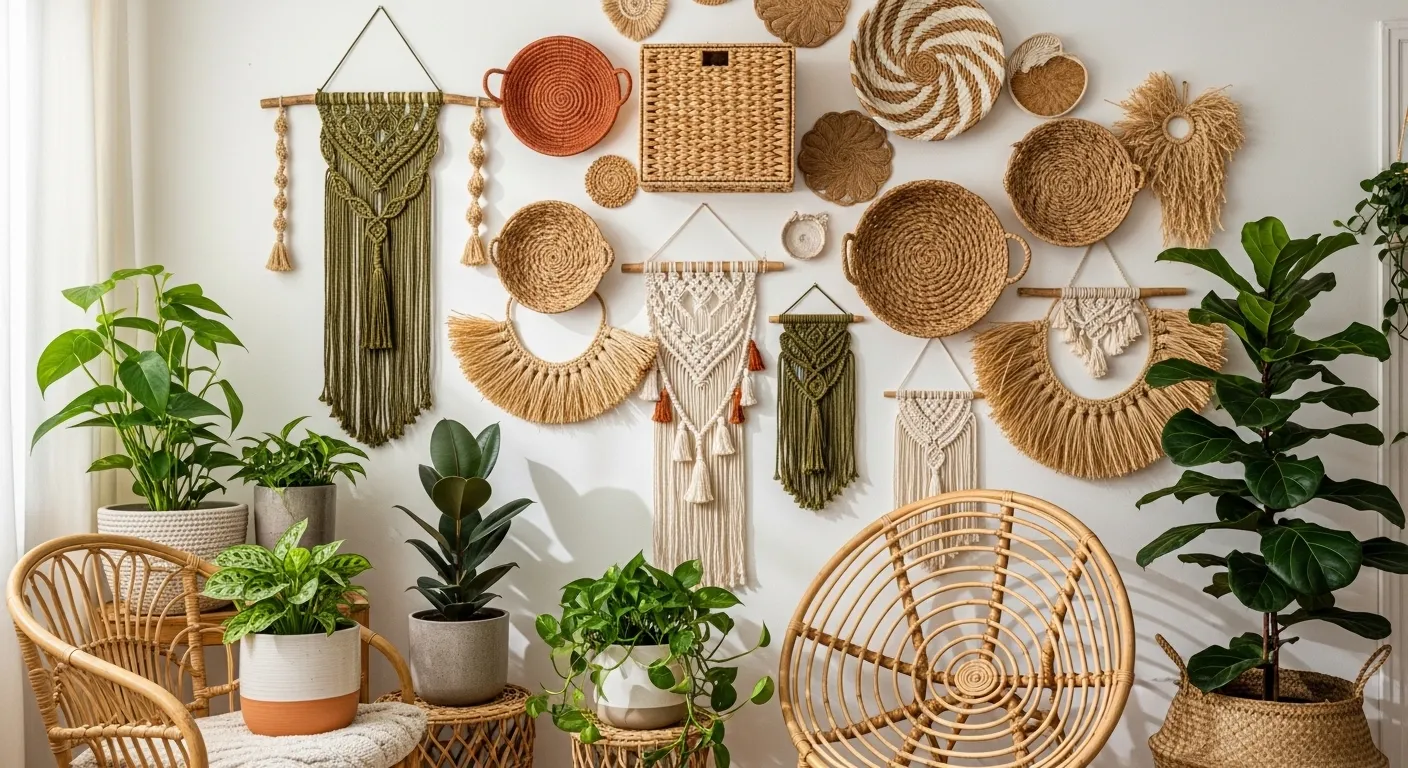
Woven baskets on a wall do two jobs at once: they store things, and they add texture that flat decor cannot. That double duty is why bohemian basket walls look effortless in photos — and why they so often fail at home, where a basket hung on a single nail sags, a bathroom basket grows musty, or a cluster that looked curated online reads as clutter on a real wall.
This guide treats baskets as storage first and decoration second: what each material holds, how to hang it so it stays up, what baskets should never carry, and how to arrange a cluster that looks intentional rather than accidental.
Basket Materials and What Each Holds
Seagrass baskets are the workhorse: sturdy, tightly woven, and forgiving of daily use. They hold towels, throws, magazines, and toys well, and their neutral tone suits most walls. They dislike constant dampness, so keep seagrass out of direct splash zones even though it looks at home in a bathroom.
Wicker and rattan are lighter and more open in weave, which makes them better for display — a rattan basket holding a trailing plant or a few rolled towels reads beautifully — and worse for small, heavy items that slip through the weave or strain it. Use wicker for light, visible contents, not for dense storage.
Macramé and cotton organizers are soft storage: pockets and pouches rather than rigid baskets. They suit small items — remotes, chargers, craft supplies, toiletries — and they hang flat against the wall, which makes them ideal for narrow spaces. They will not hold heavy items, and they show dust faster than rigid baskets, so plan on shaking them out regularly.
Rope baskets sit between rigid and soft: structured enough to hold shape, flexible enough to forgive a bump. They suit entryways and bedrooms, where they take keys, scarves, and small daily items without looking utilitarian.
🛒 Shop This Look:
Hanging Methods That Hold
How a basket hangs matters more than how it looks hanging. The method must match the loaded weight, not the empty basket — a basket that weighs nothing empty can weigh a great deal full of towels or books.
For light baskets — a plant, a few scarves, empty display baskets — adhesive hooks on a clean, smooth wall work, within the printed rating. For medium baskets — towels, throws, a basket of supplies — use a screw into a stud or a proper wall anchor; adhesive past its rating is a basket on the floor waiting to happen.
For heavy or high baskets, use two hanging points rather than one. Two hooks or a rail spread the load and stop the basket from rotating and sliding off a single point. A wall rail or peg rail is often the best answer for a basket cluster: it carries the weight, sets the spacing, and lets you rearrange baskets without new holes.
Test before trusting. Hang the basket, load it as it will actually be used, and leave it a day before deciding it holds. A mount that survives an empty basket and fails under towels has told you nothing useful.
Know the Limits: What Hanging Baskets Should Never Hold
Some things do not belong in a hanging basket no matter how sturdy the mount. Heavy items — books in quantity, full tool kits, anything you would hesitate to lift overhead — belong on a shelf or the floor, not on a wall hook. A falling basket of heavy items damages the wall, the floor, and whatever it lands on.
Wet items are the second exclusion. A basket of damp towels or swim gear drips onto the wall and floor and feeds mildew in natural fiber. Let wet things dry before they go into a basket, and keep baskets out of the splash zone entirely.
Sharp items, valuables, and anything a child could pull down should also stay out of hanging baskets. A basket at head height that a child can reach is an invitation to climb or pull, and a basket of scissors or a phone over a hard floor is a breakage waiting for a reason. Wall baskets are for soft, light, replaceable things — and that limit is what keeps them safe and good-looking.
Room by Room
In the entryway, baskets take what leaves the house: keys, sunglasses, dog leads, mail. A row of small baskets or a rail with hooks by the door clears surfaces without adding furniture. Keep entryway baskets shallow and visible — a deep basket by the door becomes a junk drawer on the wall.
In the bedroom, baskets hold the soft overflow: throws, scarves, reading material, chargers. A basket beside the bed replaces a nightstand drawer; a cluster above a dresser adds texture without crowding the surface. If bedroom walls are also doing decor duty, budget-friendly bedroom wall decor ideas show how baskets share a wall with art without either looking like an afterthought.
In the bathroom, baskets work only with moisture discipline. Rolled hand towels and toiletries in a basket away from the shower survive fine; a basket inside the splash zone or holding damp items will smell musty within weeks. Natural fiber and constant steam are a poor match — in a windowless, steamy bathroom, favor a basket that can be taken down and aired, or choose another material for that wall.
In the living room, baskets are mostly display with light storage: a plant, a throw, a few magazines. This is where clusters shine — a group of baskets at different sizes reads as art, provided the spacing is deliberate and the contents are quiet. A living-room basket stuffed with clutter reads as storage that lost its excuse.
In a reading corner, a basket for books and a throw turns a chair into a destination. Cozy reading nook wall decor ideas cover the lighting and seating that make the basket part of a nook rather than a lone wall accessory.
🛒 Shop This Look:
Making a Cluster Look Intentional
A basket cluster looks curated when three things agree: spacing, size rhythm, and restraint. Spacing should be even enough to read as a group — a hand’s width or so between baskets, adjusted by eye — not scattered so widely that each basket looks lost, nor packed so tightly that they merge into a mat.
Size rhythm means mixing sizes deliberately: one or two larger baskets as anchors, smaller ones around them, rather than a row of identical baskets that reads as inventory. Odd groupings — three, five — tend to look more natural than even rows, and mixing a flat basket with a deeper one adds depth without adding clutter.
Restraint is the hardest part. A cluster of five baskets with quiet contents looks designed; a cluster of twelve stuffed with everything you own looks like storage that ran out of rooms. If the cluster needs a twelfth basket, the room needs an edit first.
Mixing baskets with other wall decor works when the baskets stay the texture and something else — a mirror, a framed print — stays the focal point. Two focal points on one wall compete; one focal point and a supporting texture cooperate.
Caring for Natural Fiber Wall Storage
Natural fiber ages well when it stays dry and dusted. A regular shake-out or soft brush keeps dust from settling into the weave, and a dry cloth handles surface marks. Avoid soaking seagrass or wicker — water swells the fibers and leaves them misshapen when they dry, and repeated wetting feeds mildew.
Sun fades natural fiber over time, so a basket wall in direct sun will lighten unevenly. Rotating baskets occasionally, or keeping the sunniest basket as a display piece rather than a storage piece, slows the patchy fade. If a basket loses its shape, a light misting and reshaping by hand, followed by air drying away from direct heat, often restores it — but a basket that has been repeatedly soaked and dried is usually past saving, and replacing it beats fighting it.
Check mounts when you clean. A hook that has loosened, a rail that has shifted, or a basket that has stretched under load all announce themselves early if you look — and quietly fail if you do not.
Mistakes That Turn Baskets Into Clutter
Overloading is the first mistake, and it shows twice: the basket sags, and the wall reads as crowded. Underloading is the quiet second mistake — an empty basket on a wall looks like a container waiting for a purpose rather than decor.
Moisture is the third, especially in bathrooms, and the fourth is hanging heavy baskets on single adhesive hooks past their rating. The fifth is filling every wall: baskets on all four walls of a small room stop reading as bohemian and start reading as storage overflow. One basket wall, done well, beats four done hastily.
Starting Small: The Three-Basket Wall
If a full cluster feels like a leap, start with three baskets: one large anchor, one medium, one small, hung in a loose triangle with a hand’s width between them. Fill the large one with the room’s soft overflow — throws or towels — leave the medium one for daily small items, and let the small one hold a plant or stay empty as a visual breather. Live with the trio for a week before adding more. You will learn what the wall actually needs — a fourth basket, a mirror beside the group, or nothing at all — and the cluster will grow by decision rather than by accumulation.
The Short Version
Choose the material for what it will actually hold, hang for the loaded weight with two points where it matters, keep heavy, wet, sharp, and valuable things out of hanging baskets, and arrange clusters with even spacing, mixed sizes, and restraint. Baskets stored and hung on those rules give you the texture and the storage — without the sag, the mustiness, or the clutter.
🛒 Shop This Look: