
As an Amazon Associate, I earn from qualifying purchases. This means I may earn a commission if you purchase through links on this page — at no extra cost to you.
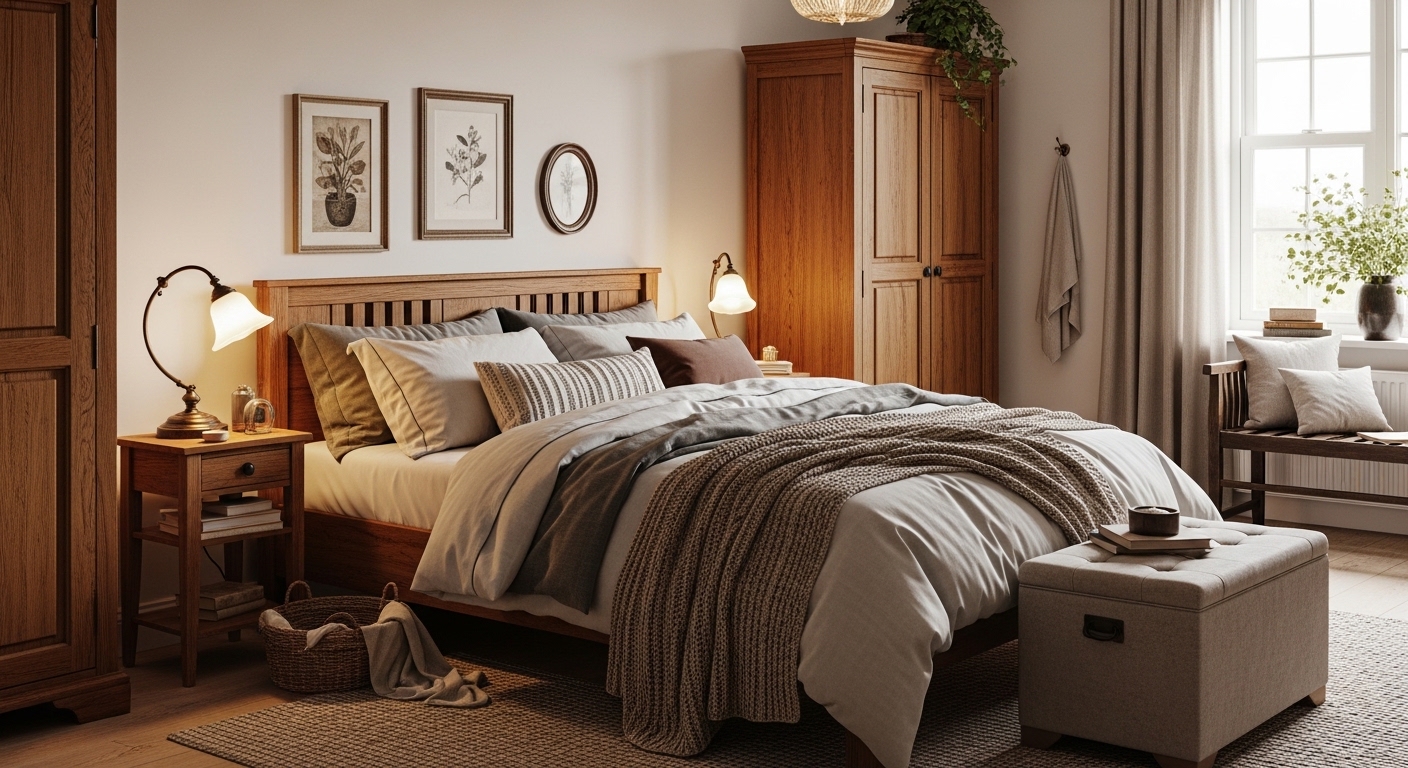
An Irish bedroom feels warm the way a kitchen feels warm when something is cooking: wood, wool, soft light, and nothing shouting. The style comes from materials that suit damp, cool climates, and from restraint with the symbols. A room with solid wood, layered wool, and warm lamplight reads Irish. A room covered in shamrocks and leprechauns reads like a souvenir shop, and nobody sleeps well in a souvenir shop.
What Irish warmth actually is
Irish traditional style is practical warmth. The old Irish bedroom was built around a solid bed, a wooden dresser, thick bedding, and a fire or a lamp — everything in it had a job. That practicality is the style’s best guide: every piece should earn its place by being useful or genuinely beautiful, preferably both. Decoration that serves neither purpose is clutter, and clutter is the enemy of warmth.
The palette follows the materials: warm wood tones, natural wool colors, cream and soft beige walls, muted greens drawn from the landscape rather than from a flag. Bright emerald green belongs on a sports jersey, not on a bedroom wall. The greens that work in this room are the quiet ones — sage, moss, olive — used as accents, not as statements.
Wood first: beds, dressers, wardrobes
Solid wood is the backbone of an Irish bedroom. A solid wooden bed frame, a wooden dresser with drawers that run smoothly, a wardrobe with paneled doors — these pieces carry the room’s weight and age gracefully. Pine is the traditional choice and the honest one: it dents and marks over time, and those marks become part of the room’s character. Harder woods cost more and mark less; either is fine, but veneer over particle board is not, because it chips at the edges and cannot be repaired the way solid wood can.
Mixing wood tones works when the tones stay in one warm family. A pine bed with an oak dresser looks collected; a pale ash bed with a near-black wardrobe looks accidental. If your furniture spans too wide a range, bridge it with mid-toned pieces — a wooden bench, a wooden tray, a framed print in a mid-wood frame — or refinish the outlier. Refinishing one piece is cheaper than replacing a roomful.
Check used wood furniture the way you would check a house: open every drawer, lean on every joint, look at the back. Drawers that stick, joints that wobble, and backs made of cardboard are signs to walk away. A solid older dresser with honest wear is a better buy than a new piece that only looks old.
Walls: warm neutrals, tested at night
Warm neutral walls — cream, soft beige, warm white, pale stone — are the right background for wood and wool. The undertone matters: a cream with a yellow base warms a cool room, while a cream with a gray base can turn cold in evening light. Irish bedrooms are used mostly in the evening, so test your wall color at night under lamplight, not just in daylight. A color that looks fresh at noon and muddy at night is the wrong color for this room.
One wall can carry a deeper tone — a muted sage, a warm taupe, a soft moss green behind the bed — but keep the other walls pale so the room does not feel small. Avoid feature walls in strong colors; they fight the wood and the textiles instead of supporting them. The walls in this style are a background, and backgrounds should be quiet.
Textiles: the layering formula
Irish comfort is layered textiles, and the formula is simple: a duvet in a washable cover, a quilt or coverlet folded across the middle, and a wool throw across the foot. Each layer adjusts independently as the night cools, which matters more than one very heavy blanket. Wool is the right throw material here — it breathes, so you stay warm without waking overheated, and it keeps its shape for years where synthetic fleece goes flat.
Make the bed so the layers look deliberate: duvet smooth and tucked at the foot, quilt folded back to show about a third of the bed, throw across the foot with even ends. Pillows follow the same discipline: sleeping pillows at the back, one pair of decorative cushions in front, and no more. A bed with seven cushions is a bed you have to dismantle every night, and nobody keeps that up.
Rugs on wooden floors
Wooden floors need rugs where feet land, not wall-to-wall coverage. The working placement is a rug under the lower two-thirds of the bed, extending out on both sides so you step onto wool in the morning. A rug that stops at the bed’s edge leaves a cold strip on each side and fails at its one job. In front of a dresser or a reading chair, a second smaller rug in the same family of colors ties the room together.
Choose traditional patterns in muted colors — a faded floral, a simple border, a quiet geometric — and avoid bright new rugs with high contrast. A loud rug dominates a room that should feel calm. Older-looking, lower-contrast rugs sit quietly under furniture and let the bedding and wood lead.
Windows: soft curtains and the window seat
Soft curtains in natural fabrics — linen, cotton, linen blends — suit Irish windows. Lined curtains matter in cold rooms: unlined linen looks beautiful and does little against a draft, while lined curtains noticeably cut the cold you feel walking past the window. Hang the rod near the ceiling and past the frame on both sides so the window looks larger and the curtains stack on the wall rather than over the glass.
A window seat with cushions is the classic Irish bedroom luxury, and it is worth doing properly if your window allows it. The seat needs a cushion deep enough to sit on comfortably — a thin decorative pad is not a seat — and a back cushion or two so you can lean back with a book. Storage beneath the seat, for out-of-season bedding or books, makes the seat earn its floor space. If your windows are too small or too high for a seat, a comfortable chair beside the window gives you the same pleasure with less carpentry.
Lighting: layers of warm light
One overhead light flattens an Irish bedroom. The room needs bedside lamps for reading, one soft ambient source, and optionally a light near the reading chair or window seat. Warm-toned bulbs matter more than expensive fixtures — cool white light makes wood look gray and wool look dull, while warm light makes both look rich. Put the main lights on dimmers if you can; the ability to lower the light in the evening is the cheapest way to make a bedroom feel cozy.
Bedside lamps should be tall enough that light falls on your book, not in your eyes — the shade’s lower edge roughly at shoulder height when you sit up in bed. Matching lamps look tidy, but two lamps in the same material family (both ceramic, both wood-based) look collected. Keep the lampshades simple; a fussy shade fights the room’s practical character.
The fireplace question, answered honestly
Many guides treat a fireplace as essential to an Irish bedroom. Most bedrooms do not have one, and adding a real one is a major renovation. If your room has a fireplace, make it the focus: a simple wooden mantel, a mirror or a quiet piece of art above it, and nothing competing beside it. If it does not, do not fake one with stick-on surrounds or electric inserts that pretend to be something they are not — a fake fireplace draws the eye and disappoints it at the same time.
What a fireplace actually gives a bedroom is a warm focal point and a gathering place for the eye. You can get both without one: a dresser with a mirror above it, a reading chair with a lamp beside it, or a window seat with a view all serve as focal points. Pick one, dress it simply, and let the rest of the room stay quiet.
Stone without a renovation
Stone elements suit Irish bedrooms, but full stone walls are a renovation most bedrooms do not need. The practical options are a stone-look treatment on one wall behind the bed, a stone top on a dresser or nightstand, or stone accessories — a heavy lamp base, a stone bowl, a slate tray. One stone element grounds the room; three or more make it feel like a garden.
Where stone does not belong is everywhere at once. Stone wallpaper on all four walls, stone cladding around every opening, and stone accessories on every surface turn a bedroom into a grotto. Restraint is what separates a traditional room from a themed one.
Celtic motifs: a little goes a long way
Celtic knotwork, traditional patterns, and Irish-made textiles can be beautiful in a bedroom — in small doses. One knotwork throw, one framed piece of traditional art, or one handwoven blanket is a genuine accent. A room full of knotwork on the bedding, the curtains, the rug, and the wall reads as a display, not a bedroom. The rule that works is the same as for tartan: one strong traditional piece, echoed quietly once, and nothing else competing.
Buy traditional textiles for quality, not for symbolism. A well-made wool throw in a simple pattern will outlast and out-please a cheap throw covered in symbols. If you buy Irish-made pieces, buy them because they are well made and you like looking at them — that is the honest reason, and it shows in how the room feels.
If you love this room’s warmth but want a slightly more rugged, classic version of it, look at the Scottish bedroom approach — darker wood, tartan instead of plain wool, the same layered textiles and warm light. The two styles share a skeleton: solid wood, wool, soft lamplight, and restraint. Seeing them side by side helps you decide which side of the line your room sits on: Irish warmth is softer and plainer, Scottish warmth is darker and more patterned. For the Scottish version, see Scottish bedroom ideas.
Small rooms and rented rooms
Small Irish bedrooms need the same ingredients in smaller doses: one solid wood piece (the bed frame), layered textiles, warm lamps, and pale walls. Skip the extra furniture — a small room with a bed, a dresser, and a chair feels warm; the same room with a bed, a dresser, a wardrobe, a desk, and a chair feels crowded. Storage must hide: under-bed boxes, a closed wardrobe, a dresser instead of open shelves.
Renters can get most of this style without changing anything permanent. Textiles, lamps, rugs, and art are all removable, and they carry most of the warmth. A landlord’s pale walls are already close to the right background; your job is the wood tones in furniture you own, the wool on the bed, and the warm light in the evening. Peel-and-stick treatments and freestanding furniture do the rest without risking a deposit.
Budget: where money shows
Spend first on what touches your body: bedding, the rug under your feet, and the bedside lamps. Cheap versions show immediately — thin bedding, a rug that slides, a lamp that glares. Save on wall art, decorative cushions, and small accessories, which can be found secondhand and swapped easily. A solid used dresser beats a new flat-pack one in this room, and older wool throws often have a softness new ones take years to develop.
Mistakes that break the warmth
The most common mistakes are symbol overload (too many shamrocks, too much knotwork), cold light (cool bulbs, one overhead fixture), and bare floors (no rug where feet land). The second group is matching-suite syndrome — a bedroom where every piece came from the same set looks like a showroom, not a home. Buy the bed first, then add pieces one at a time as you find ones you like.
Another mistake is confusing dark with warm. A room painted dark green with dark furniture and dim lighting feels gloomy, not cozy. Warmth comes from the combination of mid-toned wood, soft textiles, and warm light — not from darkness alone. If your room feels gloomy, add light before adding color.
A starter plan
Week one: wall color confirmed and lighting fixed — warm bulbs, bedside lamps, a dimmer if possible. Week two: bedding layers and the rug, sized to the bed. Week three: curtains, lined and hung high and wide, plus the window seat cushion if you have one. Week four: one traditional accent and the reading chair. Then stop and live with the room for a month. The pieces you still want after a month are the ones worth buying.
For more bedroom ideas in the same spirit, see more bedroom ideas.
🛒 Shop This Look:
That order matters because warmth in a bedroom is felt in the evening, in lamplight, under wool, on a rug that is warm underfoot. Get the light and the textiles right first and the room is already warm; the symbols and accessories only finish what those two started.
🛒 Shop This Look:
🛒 Shop This Look: