
As an Amazon Associate, I earn from qualifying purchases. This means I may earn a commission if you purchase through links on this page — at no extra cost to you.
An Italian bedroom feels elegant and romantic because of proportion and material, not because of gilt. The rooms that get this right have one beautiful bed, soft layered bedding, warm light, and a few well-chosen details — and they stop there. The rooms that get it wrong keep adding: another ornate frame, another chandelier, another gold accent, until romance turns into clutter.
What Italian style actually means in a bedroom
Italian bedroom design comes from classical proportion: symmetry around the bed, furniture with visible craftsmanship, fabrics that look soft to the touch, and colors drawn from plaster, stone, and old wood. It is not French, which is lighter and more ornamental, and it is not Mediterranean, which is brighter and more rustic. Italian rooms are warmer and more formal than both, but the formality is in the shapes — curved headboards, turned legs, arched mirrors — not in stiffness.
The test for any piece is whether it would still look right if you removed the gold. A well-shaped upholstered headboard looks elegant in plain linen. A poorly shaped one only looks acceptable because of its finish. Choose shape first, finish second, and the room will age well even as finishes go in and out of fashion.
The bed is the room
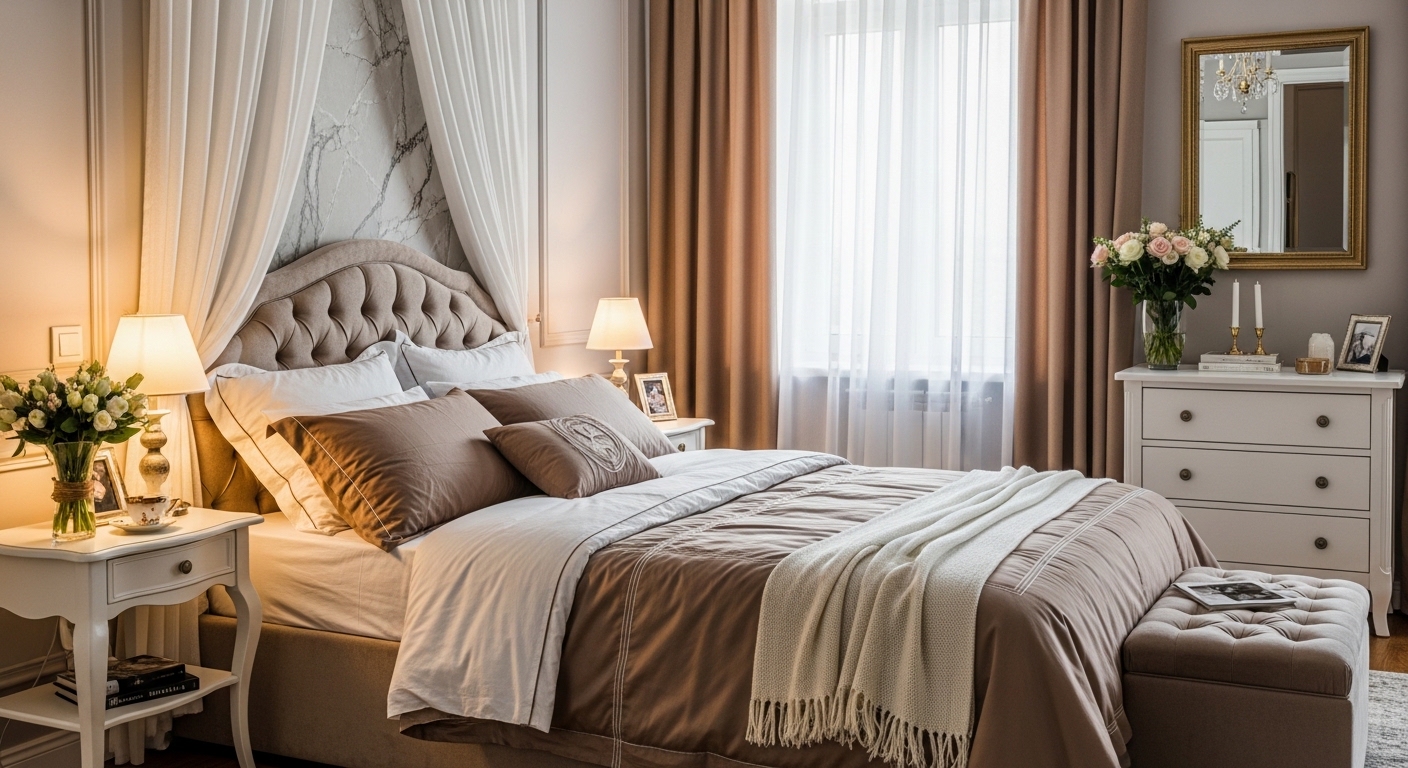
In an Italian bedroom, the bed carries the design. An upholstered headboard — tall, padded, in linen, velvet, or leather — sets the tone more than any other single piece. Size it to the room: the headboard should be roughly the width of the bed plus a little, and tall enough to read against the wall when you sit up, without touching the ceiling. A headboard that is too short looks like an afterthought; one that is too tall dominates a small room.
Canopy beds belong in this style, but only in rooms with the ceiling height to carry them — a canopy in a low room feels like a tent, not a luxury. If your ceilings are standard height, skip the canopy and put the money into the headboard and the bedding instead. The romance comes from the layers and the light, not from posts.
Bedding: layers of silk, linen, and cotton
Italian bedding is layered for touch as much as for warmth: a cotton sheet, a linen or cotton duvet cover, a lighter coverlet folded back, and a throw or a pair of cushions for color. Silk belongs as an accent — a silk cushion, a silk throw — not as the whole bed, because full silk bedding is slippery to sleep in and demanding to care for. Linen looks more relaxed and wrinkles gracefully; cotton stays crisp. Mixing the two gives you both textures without either one’s drawbacks.
Care is part of the decision, not an afterthought. Linen softens with washing and needs no ironing if you accept its texture. Velvet cushions need brushing and attract dust. Silk needs gentle washing and fades in direct sun. Choose the fabric you will actually maintain — a beautiful bed you dread making is a bed you will resent.
Wood furniture: classic, not matched
Classic wooden furniture — a dresser with curved fronts, nightstands with turned legs, a wardrobe with paneled doors — gives the room its structure. Dark wood reads formal and dramatic; mid-toned wood reads warmer and more relaxed. Either works, but mixing very dark and very pale wood in one room breaks the mood. Keep the wood tones within one family and let the bedding carry the color.
Avoid the full matching suite. A bedroom where every piece came from the same set looks like a showroom, and Italian style depends on pieces that look collected over time. A vintage dresser next to newer nightstands works when the hardware and the wood tone are in the same family. Swap mismatched knobs for simple brass or dark metal ones and unrelated pieces start to belong together.
Romantic wall colors
Romantic wall colors are warm and muted: warm white, soft plaster, pale rose, muted sage, warm beige. They flatter skin tones in lamplight, which is part of why the room feels romantic in the evening. Cold whites and cool grays fight the wood and the fabrics, making the room feel stark instead of soft. If your room has cool light from north-facing windows, lean warmer on the walls to compensate.
One wall can go deeper — a muted terracotta, a dusty rose, a warm taupe behind the bed — but the other walls should stay pale so the room keeps its airiness. Test the color at night under lamplight, not just in daylight, because that is when the room needs to feel romantic. A color that looks pretty at noon and muddy at night is the wrong color for a bedroom.
Light: chandeliers, sized right
A chandelier is the signature light of an Italian bedroom, but its size decides whether it looks elegant or absurd. The working rule is proportion: the chandelier’s diameter should relate to the room, not to your ambition. In a typical bedroom, a modest chandelier — smaller than you think — hung at a height that clears the tallest person’s head by a comfortable margin, looks right. An oversized chandelier in a small room reads as costume.
The chandelier should never be the only light. Layer it with bedside lamps for reading and, if the room allows, a small floor lamp near a chair. Every light in the room should be dimmable or at least warm-toned; a chandelier on full brightness with cool bulbs turns romance into interrogation. Crystal or glass drops catch lamplight beautifully, but they also catch dust — if you will not clean them, choose a simpler fixture with clean lines.
Mirrors: placement beats size
A decorative mirror earns its place by what it reflects. Opposite a window, it doubles daylight and makes the room feel larger. Above a dresser, it anchors the furniture and gives you a place to check yourself. Leaning against a wall in a corner, it mostly reflects the wall. Choose the placement first, then the mirror.
Scale follows the furniture beneath it: a mirror above a dresser should be narrower than the dresser, not wider, and hung so its center sits near eye level when you stand. An ornate gilt frame suits one mirror in the room; two ornate mirrors compete. If the dresser mirror is ornate, keep other mirrors in the room simple or skip them.
Windows: soft draperies, correct length
Soft draperies — full, lined, in linen or a linen blend — complete the Italian look at the window. Length is the decision that matters most: curtains that end at the sill look unfinished in a formal room, while curtains that puddle heavily on the floor collect dust and trip you in the dark. The reliable choice is floor-length, just kissing the floor, hung from a rod near the ceiling and extending past the frame so the window looks larger.
Sheers beneath the draperies give daytime privacy without blocking light, which matters in a bedroom you use during the day. If the room faces a busy street, the sheer layer is what lets you keep the draperies open and still feel private. Choose a sheer in warm white, not bright white, so it does not glare against warm walls.
Rugs: size rules that prevent regret
A plush rug under and around the bed is the fastest way to make an Italian bedroom feel luxurious underfoot. The size rule is simple: the rug should extend beyond the bed on both sides and at the foot, so you step onto rug, not bare floor, when you get up. A rug that only peeks out from under the bed looks like a mistake, and a rug so large it touches every wall makes the room feel carpeted rather than dressed.
Pile matters for maintenance. A deep plush rug feels wonderful and shows every footprint; a medium pile looks nearly as soft and recovers better. In a bedroom with pets or heavy traffic, choose the medium pile and spend the difference on a better pad underneath — the pad is what makes a rug feel luxurious and keeps it from sliding.
Art and accessories: one ornate piece per wall
Italian rooms reward restraint in accessories. One ornate piece per wall — a framed print, a carved mirror, a sculptural sconce — is enough. The second ornate piece on the same wall starts a competition, and the wall loses. Between the ornate pieces, leave plain wall. The empty space is what makes the ornate pieces read as special.
Vintage and antique accessories suit this room, but buy them for shape and condition, not for age alone. A chipped gilt frame, a stained marble top, or a wobbly chair does not become charming because it is old. Check joints, check the back, check for repairs, and walk away from pieces that need work you will not do. One good vintage piece beats three mediocre ones.
Small Italian bedrooms
Small rooms keep the same ingredients with less furniture. Keep the upholstered headboard and the layered bedding — those carry the style — and shrink everything else: one nightstand instead of two if space demands it, a wall-mounted lamp instead of a table lamp, a single mirror instead of two. What you must not shrink is the bed itself; a small bed in an Italian room reads as a compromise, while a full bed with fewer companions reads as a choice.
Color discipline matters more in small rooms. Keep the walls pale, the bedding mostly one family of color, and the accents to two or three pieces. A small room with five accent colors feels chaotic; the same room with one accent color repeated in the throw, the cushion, and the art feels calm and intentional.
Budget: where money shows
Spend first on the headboard, the bedding, and the lighting. These are the pieces you see and touch every day, and cheap versions show — a thin headboard that wobbles, bedding that pills, a chandelier that looks plastic. Save on wall art, decorative cushions, and small accessories, which can be found secondhand and changed with the seasons.
A good secondhand dresser or mirror is often better than a new one at the same price, because older pieces were built with heavier frames and real wood veneers. Check drawers for smooth running, check mirrors for foxing at the edges (a little is character, a lot is damage), and check gilt frames for flaking. A solid older piece with honest wear suits this room better than a new piece pretending to be old.
Mistakes that break the romance
The most common mistake is gilt overload — gold frames, gold lamps, gold hardware, gold trim, until the room glitters instead of glows. Pick one gold accent family and let the rest be wood, linen, and plaster. The second mistake is cold light: cool bulbs under a chandelier make the whole room feel like a hotel lobby. The third is the matching suite, which kills the collected character the style needs.
Another mistake is pattern overload: floral bedding, patterned curtains, patterned rug, patterned cushions. Italian rooms use pattern sparingly — one floral or damask, the rest solids and textures. If you love pattern, put it on the bedding and keep everything else quiet.
A starter plan
Week one: wall color and lighting — warm bulbs, a dimmer, the chandelier sized to the room. Week two: the headboard and the bedding layers. Week three: curtains, hung high and floor-length, with sheers beneath. Week four: the rug, sized to the bed, and one ornate accessory per wall. Then stop and live with the room for a month. The pieces you still want after a month are the ones worth buying.
For more bedroom ideas in the same spirit, see more bedroom ideas.
🛒 Shop This Look:
That order matters because romance in a bedroom is felt at night, under lamplight, in a bed that is comfortable to lie in. Get the light and the bed right first and the room is already romantic; the accessories only finish what those two started.
🛒 Shop This Look:
🛒 Shop This Look:



