
As an Amazon Associate, I earn from qualifying purchases. This means I may earn a commission if you purchase through links on this page — at no extra cost to you.
Kids room wall art has a harder job than any other art in the house. It has to be safe enough for a room where children climb, throw, and pull things off walls. It has to suit a child who will outgrow it, sometimes within a year. And it has to survive being changed, because a room that cannot change becomes a room the child stops liking. The best approach is not to pick the cutest art you can find. It is to build a system: safe fixing, art that can grow, and display methods that let pieces change without new holes in the wall every time.
Safety first, before style
Safety decides what can go on a kids room wall before taste gets a vote. Anything hung above a bed, a changing table, or a play area needs fixing rated above its loaded weight, fixed into solid material or a rated anchor, and tested with a firm pull. Heavy frames need two fixing points, because a single point lets a frame swing and work loose, and a frame that falls onto a bed is a real hazard. Keep heavy pieces away from directly above beds and cots entirely when you can; a light print above a bed is charming, a heavy framed mirror above a bed is a risk not worth taking.
Glazing is a safety choice too. Real glass looks crisp, but in a room where balls fly and climbers climb, acrylic glazing is the sensible default: it is lighter, it does not shatter into sharp pieces, and the slight difference in clarity is invisible to a child. Avoid glass in low-hung pieces within reach of toddlers, and avoid any wall art with small detachable parts, dangling cords, or sharp corners at toddler height. Cords from hanging pieces should be out of reach or eliminated entirely, because anything looped at cot height is a hazard regardless of how decorative it looks.
Height is part of safety as well. Art hung low enough for a toddler to grab will be grabbed. That does not mean all art must go high; it means low art should be soft, light, and unbreakable, such as fabric pieces or foam-backed prints, while framed pieces stay above grab height until the child is old enough to understand that wall art stays on the wall.
Choose by age, not by trend
The right art for a kids room depends far more on the child’s age than on current trends, and trends are the fastest way to a room that dates. For babies and toddlers, high-contrast, simple shapes at a height they can see from a cot or the floor work best. The art is mostly for the adults in the room at this stage, so choose pieces you enjoy looking at, because you will be the one spending time with them.
For young children, roughly preschool through early school age, art should invite looking and talking: animals, maps, letters, scenes with things to spot and name. This is the age where personalized pieces, such as a name print or a handprint display, mean the most, because the child recognizes themselves in the room. Keep the palette cheerful but not chaotic; a wall full of clashing bright colors overstimulates a room meant for both play and sleep.
For older children and teenagers, the room becomes theirs, and the art should follow their interests rather than a theme imposed on them. This is where abstract prints, photography, posters, and art they made themselves belong. A teenager’s room decorated entirely in a toddler theme is a room they will resent, so plan the transition early: choose frames and display systems that can carry new art without redecorating the whole wall.
Art that grows with the child
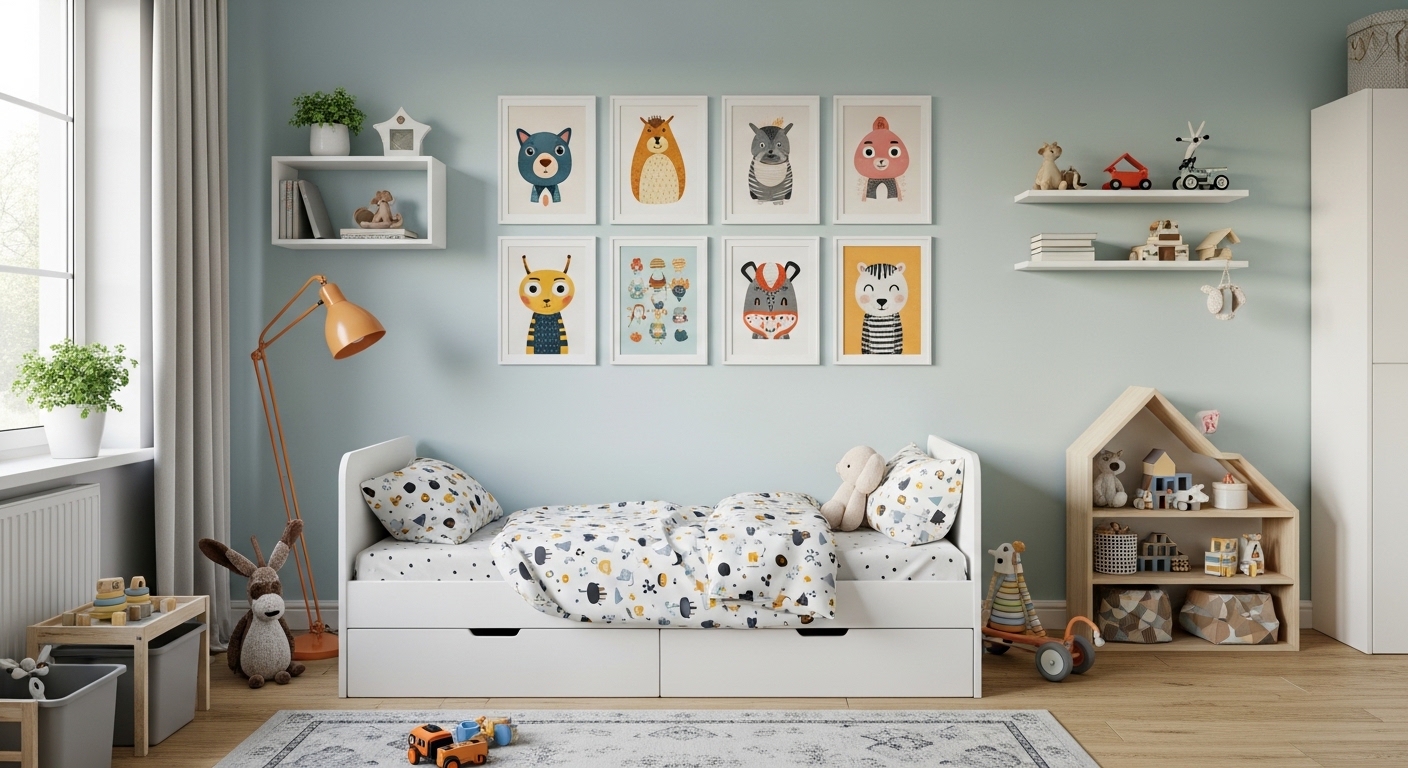
The most economical idea in kids room decor is also the simplest: buy the frames once, change the art inside them. A set of matching frames in a neutral finish can carry alphabet prints for a toddler, animal prints for a young child, and abstract or photographic prints for a teenager, with nothing but the inserts changing. The wall keeps its structure while the content grows, and the room never needs a full redecoration to keep up with the child.
Choose frame sizes that suit many kinds of art, not one specific print. Standard sizes are easier to fill at every age, because prints, posters, and school art all come in standard sizes. Avoid highly themed frames, such as frames shaped like animals or covered in a cartoon pattern, because they lock the wall into one age. Plain frames grow; themed frames date.
Display systems grow even better than frames. A picture ledge lets you swap prints by leaning new ones in front of old ones, with no new holes. A wire with clips lets a child curate their own rotating display. A clipboard wall lets school art go up the day it comes home and come down when the next piece arrives. These systems make change part of the design instead of damage to the wall, which is exactly what a kids room needs.
🛒 Shop This Look:
Printables as the flexible option
Printable art is the most flexible option for a kids room, because it is cheap to replace when tastes change and easy to size to the frames you already own. A printable that suits a five-year-old can be swapped for one that suits an eight-year-old for the cost of printing, not the cost of new framed art. That flexibility is worth more in a kids room than in any other room, because kids room tastes change faster than anywhere else in the house.
For younger children, look for printable collections made for kids rooms specifically, with subjects that invite looking and naming rather than just bright colors. The kids room printable art guide covers subjects, sizing, and printing choices for children’s spaces. For older children and teenagers, abstract and minimalist printables give the room a more grown-up feel without a grown-up price; the modern abstract printable guide covers how to choose abstract pieces that suit a room rather than overwhelming it.
Print quality matters for kids rooms because the art sits at close range and gets handled. Print on heavier matte paper rather than thin copy paper, so prints feel like real art and survive being swapped in and out of frames. If you print at home, use the matte or fine-art setting and let prints dry fully before framing, because damp prints stick to glazing. If you print at a shop, ask for matte laminate on pieces that will hang low, where little hands can reach them.
DIY and display systems
Art a child helped make belongs on the wall, and display systems make that easy without turning the wall into a scrapbook. A dedicated display wire or ledge for the child’s own work gives them ownership of part of the room, and because the display rotates, the wall never gets stuck with one piece past its moment. Rotate regularly: when a new piece goes up, an old piece comes down into a keepsake folder, so the display stays fresh and the wall stays calm.
DIY art projects also solve the budget problem honestly. Handprint art, painted canvases, and simple collages cost little and mean more to the child than anything bought, because the child made them. Keep DIY pieces in the same frames or on the same display system as the rest of the room’s art, rather than in a separate corner, so the child’s work reads as part of the room’s design instead of an afterthought.
One caution: do not fill every wall with the child’s work. A room where every surface is covered feels chaotic, and the child’s best pieces get lost in the crowd. Choose the strongest few pieces for display, rotate the rest, and keep at least one wall mostly bare so the room has visual rest.
Placement heights that work
Placement height in a kids room should follow the child’s eye level, not the adult standard. Art meant for the child to enjoy belongs at the child’s eye level when standing, which is much lower than adult eye level and changes as the child grows. A gallery hung at adult height in a young child’s room is decoration for adults, not for the child who lives there. If the art is for the child, hang it where the child can actually see it without craning.
Art above furniture follows the furniture, not the child. A piece above a bed, a desk, or a dresser should sit close enough to the furniture to read as part of that arrangement, not floating halfway to the ceiling. A gap of roughly a hand’s width to a little more between the furniture top and the frame bottom keeps the arrangement grounded. Above a bed, keep the piece light and well fixed, as noted in the safety section, and avoid anything heavy directly over where the child sleeps.
For gallery arrangements, keep the center of the group at the eye level of whoever uses the room most. In a shared family room that might be an adult; in a child’s bedroom it is the child. A gallery centered for an adult in a child’s room will always feel slightly wrong to the child, even if they cannot say why. Center for the room’s owner.
🛒 Shop This Look:
Renters and no-damage hanging
Renters decorating a kids room need hanging methods that hold through childhood use and come off cleanly at move-out. Adhesive strips and hooks suit light frames and printables well, but be honest about their limits: they hold light pieces reliably and heavy pieces unreliably, and a strip that fails above a bed is worse than no art at all. Test adhesive fixings with the real piece for several days before trusting them, and keep heavy pieces on proper anchors or off the wall entirely.
Leaning art is the renter’s best friend in a kids room. Large prints and canvases leaned on a dresser or a low shelf need no fixing at all, and they can be swapped as easily as framed pieces. Picture ledges mounted with a few small fixings give a whole display system for minimal wall damage, and the fixing holes from a ledge are far easier to fill at move-out than a dozen individual nail holes from a gallery.
Washi tape frames and clip systems offer a genuinely no-damage option for lightweight prints and children’s work. They suit the rotating-display idea perfectly, because changing the art means peeling tape, not patching holes. Keep tape-based displays to light paper pieces; they are not a substitute for proper fixing on anything with weight.
Mistakes that date a kids room fast
The fastest way to date a kids room is to theme it completely around one character, show, or trend. A room covered in one character’s merchandise looks perfect for about a year and then becomes a room the child has outgrown but cannot easily change, because every piece belongs to the same theme. Use themes as accents, one or two pieces, not as the whole room, so the room can evolve piece by piece.
The second mistake is hanging everything at adult height. Art the child cannot see is not the child’s art, and a room decorated only for adults will never feel like the child’s own space. Hang at least some pieces at the child’s level, and let the child choose at least one piece for their wall. Ownership matters more than coordination.
The third mistake is filling every wall. Kids rooms accumulate things naturally, and walls covered edge to edge leave no room for the child’s own work, new interests, or simple visual rest. Leave at least one wall mostly bare. That bare wall is not unfinished; it is the space the room grows into, and it keeps the decorated walls looking intentional instead of crowded.
🛒 Shop This Look:
A wall that keeps up
The test of kids room wall art is not how it looks on the day you hang it. It is how it looks in two years, when the child is older, taller, and interested in different things. A wall built on safe fixing, neutral frames, swappable prints, and a rotating display passes that test, because it changes with the child instead of fighting the change. Build the system once, and the art can keep up for years without another full redecoration.



