
As an Amazon Associate, I earn from qualifying purchases. This means I may earn a commission if you purchase through links on this page — at no extra cost to you.
A kids room wall should do two jobs at once: delight a child today and survive that same child for years. Printable art is unusually good at both, because it is cheap enough to replace as tastes change and sturdy enough — printed right and hung right — to last a whole childhood phase. The mistakes are predictable: art hung too high for the child to see, frames that shatter, themes that age out in months, and walls so covered that the room feels smaller. This guide fixes the order: safety first, age second, theme third, hanging last.
Safety First, Before Any Choosing
Fixing choice comes before style. Heavy framed prints need proper wall fixings rated above the frame’s weight, with two points for larger frames so they hang level and stay level. Adhesive strips suit light prints and rented walls, but respect their weight rating and test one strip before trusting a whole row. In rooms where children climb, play, or throw, acrylic glazing beats glass: it does not shatter if knocked off the wall. If a frame already has glass and you cannot replace it, hang it high enough that it cannot be reached from a bed, chair, or climbing route.
Placement height follows the child, not the adult. Art meant for the child should sit at the child’s eye level — low enough that a standing child can see it without tilting back. Art meant for the room’s overall look can sit higher. Mixing the two heights on one wall looks accidental, so decide per wall which job it does. A good arrangement often has one low row the child owns and one higher piece the room owns, separated clearly rather than interleaved.
Keep cords, strings, and dangling hangers out of reach of cots and beds. A print hung with a long wire or ribbon above a cot is a hazard, not a decoration. Use flush fixings for anything near a sleeping area, and keep small parts — pins, clips, tiny magnets — away from rooms used by toddlers, who mouth everything.
Choose by Age Band, Not by Birthday
Toddlers respond to bold shapes and high contrast: big animals, simple faces, strong colors, clear outlines. Detail is wasted on them and clutter overwhelms them. One or two large prints beat a gallery wall for a toddler’s room, because the room itself is already full of stimulation. Keep the palette cheerful but limited — three or four colors across the whole wall, not a rainbow per print.
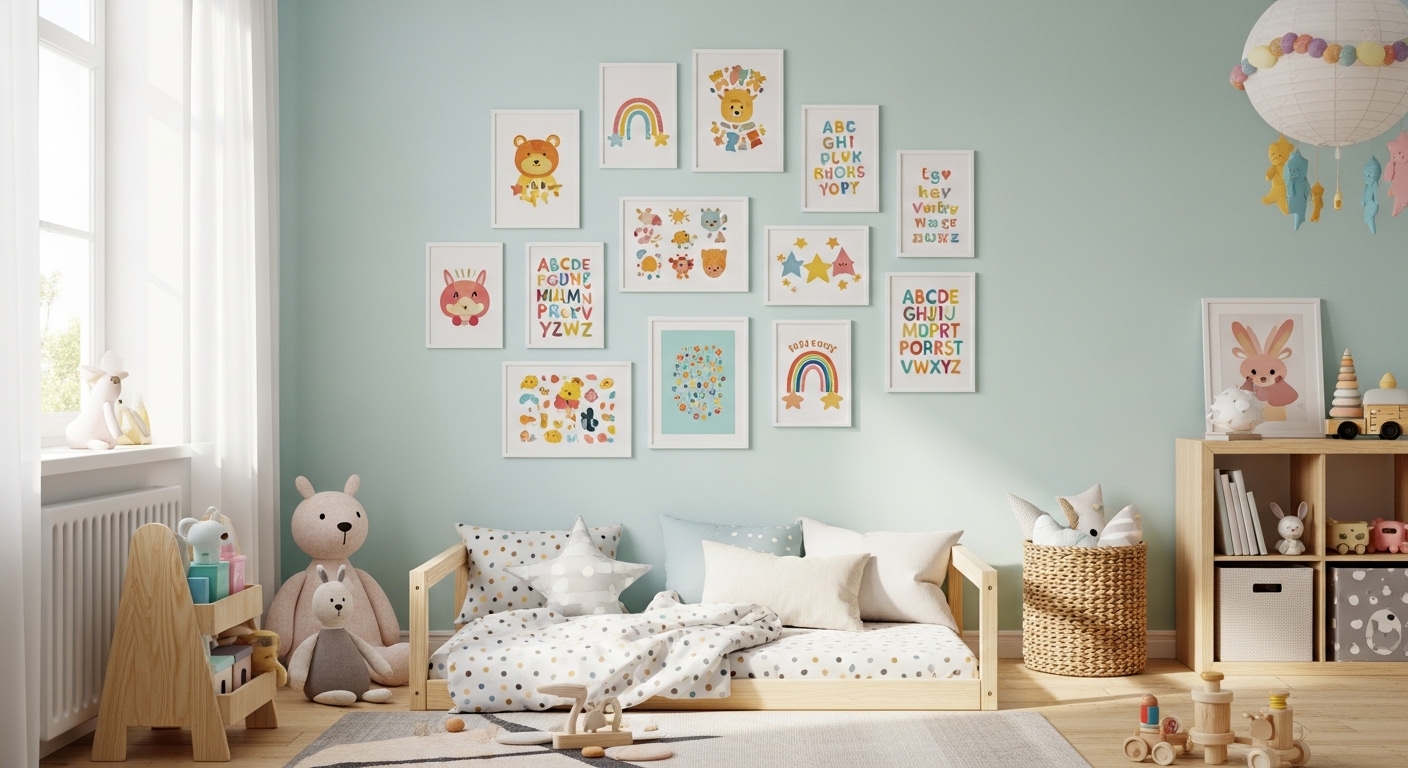
Early school children, roughly the years when reading starts, love recognition: letters, numbers, animals they can name, scenes they can describe. Alphabet prints work here, but choose ones where the letters are large and the pictures are unambiguous. A print that teaches while it decorates earns its place twice. This is also the age when children start choosing: let them pick between two or three prints you have already approved. Ownership makes them care for the wall instead of ignoring it.
Older children want identity: hobbies, teams, music, places, characters they follow. Their taste changes fast, which is exactly where printables shine — a print can be swapped in an afternoon when an interest changes, without the cost or waste of a framed poster. Give older children a display system they control, like a picture ledge or clip rail, so swapping is their job rather than a redecoration project. Kids room wall art covers choosing across these ages in more depth, including how art can grow with the child rather than being outgrown.
Themes That Last, and Themes That Date
Animal prints last because children love animals at every age — only the style changes. A toddler loves a big friendly bear. An older child loves a detailed fox or a realistic bird. Choosing animals as a theme lets you update the style without changing the wall’s character. Alphabet and number prints last through the early school years and then date quickly; plan them as a phase, not a permanent wall.
Rainbow and color-theme prints brighten a room instantly and suit small or dim rooms well, because they add color without adding objects. Their risk is noise: a rainbow print beside rainbow bedding beside rainbow toys is too much rainbow. If the room already has strong color, choose prints in fewer colors and let the room’s color come from one source, not five.
Travel and adventure themes — maps, mountains, vehicles, space — grow well because they feed imagination at many ages. A map print a toddler loves for its colors becomes a geography lesson for a schoolchild and a daydream for an older kid. Travel-inspired printable art suits kids rooms for exactly this reason, provided the style stays child-friendly rather than adult-minimal. Nature themes work the same way: botanical printable art in soft, friendly styles brings calm greenery into a kids room without feeling grown-up, and it pairs well with animal prints since both belong to the natural world.
Motivational quotes in kids rooms deserve the same test as quotes anywhere: read them aloud and check they survive repetition. Short, kind, concrete sentences work. Long aspirational slogans tire quickly and can feel like pressure. A quote a child can read and understand beats one that sounds impressive to adults.
🛒 Shop This Look:
Color That Brightens Without Shouting
Brightening a kids room is about light and contrast, not about maximum color. A pale wall with two or three bright prints looks brighter than a colorful wall covered in colorful prints, because the eye has somewhere to rest. If the room is dim, prefer prints with light backgrounds and strong simple shapes — they reflect what light exists rather than absorbing it. If the room is already bright, deeper colors and richer prints work fine.
Limit the wall’s palette the way you would for any room: one or two anchor colors repeated across prints, plus neutrals. Children’s rooms often accumulate color from toys, bedding, and books, so the wall should be the calmest color source in the room, not another competing one. When prints, bedding, and toys all shout, the room feels chaotic even when it is tidy.
White space is not wasted space in a kids room. A print with generous margins looks intentional and gives the eye rest. A wall covered edge to edge in prints — however cute each one is — reads as clutter, and clutter in a child’s room makes the room feel smaller and harder to play in.
Printing for Childhood: Sturdy, Wipeable, Replaceable
Print kids room art on heavier paper than you would for an adult room. Thicker stock resists curling in humid rooms, survives being touched, and looks deliberate rather than improvised. Matte paper suits kids rooms because it avoids glare from windows and lamps, and it takes fingerprints less visibly than glossy paper.
Consider wipeability for prints hung low, where hands reach. A print behind acrylic glazing wipes clean. An unframed print at toddler height will get touched, and that is fine if the print was cheap to replace. This is the real advantage of printables in kids rooms: the cost of replacement is low, so you do not have to police the wall. Print a spare copy of favorites and keep it in a drawer; when one gets damaged, swapping takes minutes.
Resolution matters more for large kids prints, because children stand close to walls. A file that looks fine on screen can turn soft at poster size, and a child standing inches away will notice. Print at a size the file can support crisply, or choose a simpler design with bold shapes that stays sharp at large sizes. Bold simple shapes forgive low resolution better than detailed illustrations.
Frames and Display Systems Children Can Live With
Frames in kids rooms should be light, secure, and shatter-safe. Lightweight frames with acrylic glazing are the safest default. Avoid heavy frames with glass at child height, and avoid frames with sharp corners at head height near beds. If you love a heavy frame, hang it high and out of reach, and let the low wall belong to lighter pieces.
Display systems beat fixed frames for growing children. A picture ledge lets prints lean safely and swap easily — no new holes each time tastes change. A clip rail or magnetic strip lets children change their own display, which builds ownership. A cork board or wire grid suits older children who collect cards, photos, and small art alongside prints. The system matters more than any single print, because the system is what survives three phases of taste.
Rotation is a feature, not a failure. Plan the wall so that changing prints is easy: ledges, clips, or a single low row that swaps seasonally. When a child outgrows a theme, the wall should change in an afternoon, not require a redecoration weekend. Keep retired prints in a folder — children enjoy looking back at what their walls used to hold.
🛒 Shop This Look:
Sizing and Placement Rules for Kids Rooms
Size follows the same proportion rules as adult rooms, adjusted for lower eye levels. A print above a bed or dresser should span roughly two-thirds of the furniture’s width. A single print on an empty wall needs to be large enough to hold it — at least two feet wide on a standard wall, larger on a wide wall. Small prints grouped tightly into one block work better than small prints scattered across a wall.
Height is where kids rooms differ most. For art the child owns, center it at the child’s standing eye level. For art the room owns, use adult eye level. Mark both heights on the wall with tape before drilling, and check them from the doorway — the arrangement should look deliberate from the entrance, not just from close up. Large-scale printable styling covers sizing and placement for big prints in more depth, including how a single large piece can anchor a child’s room without crowding it.
Leave growth room. A wall planned for a toddler will need different art in three years, but the fixings and ledges can stay. Place ledges and rails where they will work for older children too — slightly higher than toddler eye level, with room to add pieces — so the system grows even as the prints change.
Renters can hang kids art safely with adhesive strips rated above each print’s weight, tested one at a time. Picture ledges that rest on furniture rather than walls avoid holes entirely. Removable wall decals pair well with prints in rented kids rooms, since they add color without damage, but keep decals and prints in one visual family — mixing too many systems makes the wall look patched.
Small kids rooms need wall discipline most. One feature wall with art, and quiet walls elsewhere, keeps a small room feeling larger. Mirrors opposite windows add light without adding objects, which helps small rooms more than another print would. If the room is shared by two children, give each child one defined wall zone rather than mixing both children’s art across every wall — defined zones reduce arguments and look intentional.
Shared rooms also benefit from a neutral ground: one wall color both children accept, with each child’s prints providing the personality. The shared ground keeps the room calm; the personal zones keep it theirs.
Mistakes That Make Kids Walls Look Chaotic
Covering every wall is the first mistake. A child’s room needs quiet walls for rest and play. One feature wall, done well, beats four walls done busily.
Hanging everything at adult height is the second. Art the child cannot see properly might as well not exist. Lower the child’s art to the child’s eye level.
Glass at child height is the third. Acrylic glazing costs little more and removes the shatter risk entirely.
Too many colors is the fourth. When prints, bedding, and toys all compete, the room feels loud even when tidy. Let the wall be the calmest color source.
Freezing a theme is the fifth. A wall planned so it cannot change will date fast. Build a display system that swaps easily, and let the wall grow with the child.
🛒 Shop This Look:
A Quick Plan for Your Wall
Start with safety: fixings rated above the weight, acrylic glazing at child height, nothing dangling near cots or beds. Then choose by age band — bold and simple for toddlers, recognizable and readable for early school children, identity-driven and swappable for older kids. Pick a theme that lasts, limit the wall’s palette to one or two anchors plus neutrals, and print on heavy matte stock with a spare copy in a drawer. Hang the child’s art at the child’s eye level, the room’s art at adult height, and build a display system — ledge, rail, or clips — that lets the wall change in an afternoon. Done in that order, a kids room wall stops being a decorating project and becomes what it should be: a wall the child actually enjoys, that survives childhood, and that you do not have to police.
For more ideas in the same spirit, explore the wall decor ideas collection, which gathers the room-by-room guides this one builds on.



