
As an Amazon Associate, I earn from qualifying purchases. This means I may earn a commission if you purchase through links on this page — at no extra cost to you.
Reading is a rebellion now, against the feed, the notification, the infinite scroll. A reading nook is where that rebellion gets its headquarters. But a chair alone does not make a sanctuary; the walls do. They set the terms: this is a place where time slows down, where a book stays open, where nobody expects you to be reachable. Walls that say that clearly make the nook work. Walls that merely hold random decoration do not.
This guide builds nook walls in order: what makes a wall feel cozy, how to measure the nook, light first, shelves that serve reading, art and texture, style directions, small and rented nooks, and how to keep the place a reading place rather than a storage corner.
What Makes a Nook Wall Feel Cozy
Cozy is not a style label; it is a set of physical sensations. Enclosure first: a nook feels cozy when the walls come close enough to hold you without crowding you. A chair in the middle of an empty room does not feel like a nook, however comfortable the chair. A chair tucked into a corner, an alcove, or a bay, with walls on two or three sides, does.
Warmth second, and warmth here means visual warmth more than temperature: warm colors, wood tones, soft textures, and light that leans warm rather than stark. A white wall under cold light feels clinical; the same wall under warm light with a wooden shelf and a woven hanging feels sheltered. The wall color and the light color do more for coziness than any single decoration.
Texture third. Smooth, bare walls feel exposed. A woven hanging, a wooden shelf, a fabric pinboard, or a row of book spines all break up flat surfaces and give the eye something soft to rest on. Texture is especially important in a nook, because you sit close to the walls; at arm’s length, texture is something you feel as much as see.
Personal history fourth. A nook wall that holds books you have actually read, art you chose, and objects with a story feels like a sanctuary because it is one. A nook wall dressed entirely from a single shopping trip feels like a display, and displays do not invite sitting. Let the wall accumulate slowly, from reading itself, and it will feel personal without trying.
Measure the Nook
Measure the chair first, then the walls. A reading chair with room to stretch legs, a side table within arm’s reach, and clearance to stand up without shuffling sideways: that footprint is the nook. Everything the walls hold must serve that footprint, not fight it.
Note the wall inventory: which walls exist, their widths and heights, and what already lives on them, windows, radiators, doors. A nook in a corner has two walls; a nook in an alcove has three; a nook in an open room may have only one wall behind the chair. The number of walls decides how much the walls can carry. One wall must do everything, so it needs discipline. Three walls can share the jobs: one for shelves, one for art, one left quiet.
Measure reach, not just size. Books and a drink belong within arm’s reach of the seated position, roughly an arm’s length from the chair’s side. Art belongs where the seated reader sees it without turning: the wall opposite the chair, or the wall to the side at eye level when seated, which is lower than standing eye level. Measure eye level from the chair, not from standing height: seated eye level sits roughly 42 to 48 inches from the floor for most adults, and art centered there feels right from the chair even if it looks low from the doorway.
Note the light sources and their direction before choosing anything. A window beside the chair gives reading light but also glare on pages at certain hours. A wall without a window needs a lamp or sconce planned before art, since art hung where the lamp must go will be moved later. Light first, art second, always in a nook.
Light First
Light is the nook’s most important wall decision, because reading depends on it and coziness follows it.
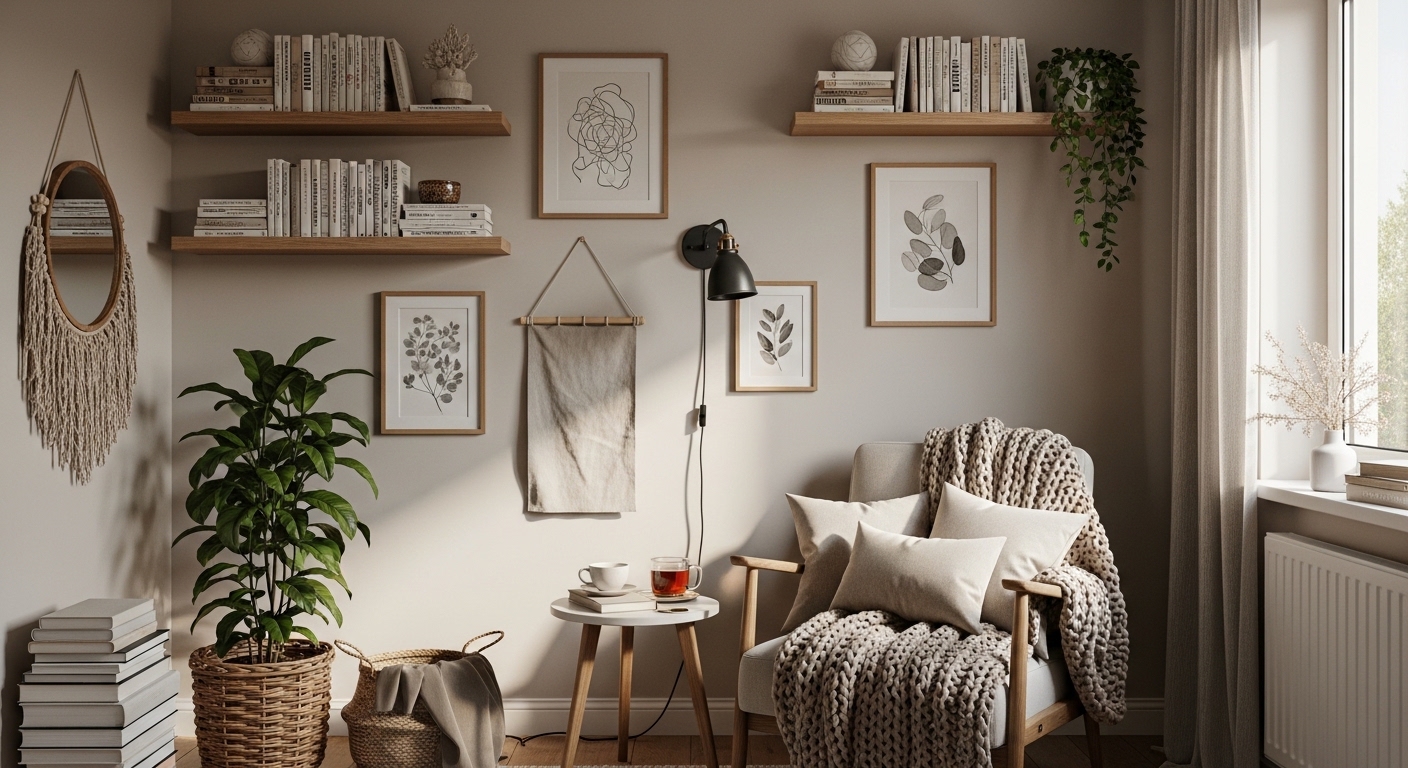
A wall-mounted sconce beside or above the chair frees the side table for books and a drink, and it puts light exactly where pages need it: from the side and slightly above, not from behind the reader’s head, which casts the reader’s own shadow on the page. Two sconces, one on each side of a wide chair, give even light and a symmetrical look. One sconce on the dominant-hand side suits a narrow nook.
A wall-mounted reading lamp, adjustable in angle and brightness, beats a fixed sconce for readers who switch between books, e-readers, and notebooks. An adjustable arm lets the light follow the page, not the other way around. Choose warm light for a nook: warm tones relax the eye and flatter wood and textile textures, while cold light feels like an office and fights the sanctuary mood.
Glare on pages is the failure to check. Glossy pages, e-reader screens, and tablets all reflect overhead light and window light. Sit in the chair with the book or device you actually read, and check for reflections from each light source at your usual reading time. Move the light, not the chair, when glare appears: a light moved six inches to the side often solves what a new lamp cannot.
Shadows matter too. A single light source creates hard shadows that tire the eyes over a long session. A second, softer light, a small shelf light, a candle-style LED on a ledge, or light borrowed from the room, softens the main light and makes long reading comfortable. The goal is a pool of warm light around the chair with gentle falloff, not a spotlight in a dark room.
For windowless nooks, light must do double duty: it must serve reading and replace daylight’s warmth. A warm sconce plus a small warm accent light, and wall colors in warm tones, keep a windowless nook from feeling like a cupboard. Mirrors help here, as the next sections explain.
🛒 Shop This Look:
Shelves That Serve Reading
Nook shelves should hold books first and decoration second. A shelf that holds only decoration in a reading nook is a missed opportunity; a shelf that holds books you are actually reading, or about to read, is the nook working.
Floating bookshelves above or beside the chair keep current books visible and reachable without a bookcase taking floor space. Mount them at seated arm’s reach, not at standing eye level: a shelf you must stand to reach will not be used during reading. Keep shelf depth shallow, so books sit with spines visible and nothing hides behind the front row.
A picture ledge serves a different purpose: rotation. A ledge holds framed prints leaning against the wall, and swapping a print takes seconds. One ledge in a nook, holding two or three frames, lets the wall change with seasons or moods without new holes. Rotate art the way you rotate books: keep a small stack of spare prints nearby, and swap when the mood changes.
A floating corner shelf suits corner nooks, where two walls meet and the corner itself is often wasted. A small triangular or short shelf in the corner holds a plant, a candle-style light, or a current book, and it turns dead space into the nook’s warmest corner. Keep corner shelves light: a heavy shelf in a corner is hard to fix safely and harder to dust.
Shelf styling for a nook follows one rule: books first, objects second, space third. A shelf crammed edge to edge with books feels like a library, which suits some readers and overwhelms others. A shelf with books, one small object, and a gap of empty space feels calm and invites the eye to rest. Leave at least one gap per shelf. Empty shelf space is not wasted space; it is where the nook breathes.
Art and Texture
Art in a nook should reward slow looking, since the reader sits with it for hours. Detailed, intricate pieces suit nooks better than bold, simple ones: a detailed illustration, a layered print, or a textile with visible weave gives the eye something to return to during reading breaks. Bold poster art, which reads instantly from across a room, has less to offer at arm’s length.
Scale follows the nook’s size. An oversized framed piece above a chair anchors a nook the way a headboard anchors a bed, and it works best when the wall is wide enough to leave breathing room around it, at least a few inches on each side. In a narrow nook, two smaller pieces stacked vertically suit the space better than one wide piece squeezed in. Vertical stacking also suits the seated eye, which travels up and down a narrow wall naturally.
Woven hangings and textiles are natural nook art: they add texture, soften sound, and warm a wall in a way paper cannot. A woven hanging above or beside the chair, a macramé piece, or a framed textile all suit the sanctuary mood. Keep textiles away from direct sun, which fades them, and away from radiators, which dry them out.
Mirrors earn a place in nooks for light, not vanity. A mirror opposite or beside a window doubles daylight and makes a small nook feel larger. A vintage mirror with a warm frame suits a cozy nook better than a stark modern one. Check glare from the seated position: a mirror that throws light onto pages is worse than no mirror. Angle it slightly, or move it to the wall beside rather than opposite the window.
Layered picture ledges combine art and rotation: two frames overlapped on a ledge, one larger behind and one smaller in front, create depth that a flat hang cannot. Layering suits nooks because the reader sits close enough to enjoy the depth. Keep layers to two frames; three or more turn to clutter at close range.
🛒 Shop This Look:
Style Directions
Three style directions suit reading nooks well, and each uses the walls differently.
Boho warmth leans on texture and layering: woven hangings, warm wood, plants, layered textiles, and art in warm earth tones. The walls carry a lot, but the pieces share a warm palette, so the result feels rich rather than chaotic. For the layering discipline behind this look, boho wall decor for small spaces works through layer order, from large pieces down to small, which is exactly the order a nook wall needs.
Vertical emphasis suits narrow nooks and tall walls: tall narrow art, vertical shelves, stripes or panels that draw the eye upward, and mirrors hung vertically. Vertical lines make a low or cramped nook feel taller, and they suit the seated reader, whose eye travels upward from the chair naturally. Vertical wall decor for small rooms covers columns, mirrors, and panels in detail, including when vertical emphasis does not work, which matters as much as when it does.
Minimal calm suits readers who find visual noise distracting: one large piece, one shelf, one light, and otherwise bare walls in a warm neutral. Minimal nooks depend entirely on the quality of the few pieces: one beautiful print, one well-made shelf, one warm light. If minimal appeals, spend the effort on those few pieces rather than filling the wall cheaply. A minimal wall with one mediocre piece feels empty; a minimal wall with one loved piece feels complete.
Whichever direction you choose, keep one palette across the wall. A nook wall with three competing color families feels restless, which is the opposite of sanctuary. One color family, carried through art, textiles, and shelf objects, holds the wall together even when styles mix.
Small Nooks and Rented Walls
A small nook needs stricter discipline, not fewer ideas. One wall does the work; the other walls stay quiet. Choose the wall the seated reader sees, and put the anchor piece and the light there. Leave the remaining walls mostly bare, which also makes the nook feel larger.
Leaning art suits small and rented nooks alike. A large frame leaned on a sideboard or a low shelf, rather than hung, needs no fixings and can move with the chair. Leaning art reads as intentional when the frame is large and the lean is stable; small frames leaned on surfaces read as clutter. One large leaning piece beats three small ones.
Adhesive options cover light frames and ledges, but the rule stays the same as elsewhere: adhesive fixings are for light items only, tested with a gentle pull before anything valuable hangs from them. A picture ledge on adhesive strips, holding two light frames, is a sound rented-nook solution. A heavy shelf on adhesive strips is not.
In a rented nook, use the walls you cannot change as a given and dress around them. A plain white rented wall suits minimal calm or boho warmth equally well; the style comes from what you lean, hang lightly, or place against it, not from repainting. A freestanding bookshelf against the wall, a leaning mirror, and a warm lamp can build a complete nook without touching the wall at all.
Keep It a Reading Place
A nook fails slowly, by accumulation. Books pile on the chair, chargers colonize the side table, mail lands on the shelf, and within months the reading place is a storage corner with a chair in it. The wall plan should fight that drift.
Give everything a wall home, and keep the homes visible. Current books live on the shelf, not on the chair. The charger lives on a small wall hook or a cable channel, not draped across the side table. Mail and paperwork live elsewhere entirely; a nook that holds mail stops feeling like a sanctuary the day mail arrives.
Rotation keeps the wall alive without accumulation. Swap one print on the ledge every few months, rotate the books on the shelf as you finish them, change a textile with the season. Rotation is maintenance, not redecoration: small, regular, and fast. A wall that changes slightly stays noticed; a wall that never changes becomes invisible, and an invisible wall stops contributing to the nook.
Dust the wall pieces monthly. Nook walls sit close to the reader, and dust on frames, shelves, and textiles is visible at arm’s length in a way it is not across a living room. A monthly wipe of frames and shelves, and a shake of textiles, keeps the nook feeling cared for. A dusty nook feels neglected, and a neglected nook does not invite sitting.
🛒 Shop This Look:
Mistakes to Avoid
The most common mistake is decorating before lighting. Art goes up, then the lamp arrives and must go somewhere awkward, or the sconce goes up and glares on pages because the art forced its position. Light first, art second, every time in a nook.
The second is hanging art at standing eye level in a room used sitting down. Art centered for a standing viewer floats above the seated reader’s eyeline and feels disconnected. Center nook art from the chair: sit down, look at the wall, and mark where your eyes naturally rest. That is the center.
The third is filling every wall. A nook with art on all four walls feels crowded, not cozy, especially at close range. Leave at least one wall mostly bare. Bare wall space in a nook is where the eye rests between pages, and resting matters as much as looking.
The fourth is choosing art for the room rather than for the reader. A print bought because it matches the sofa, or because it was on sale, will not survive the slow looking a nook demands. Choose art the reader actually wants to sit with for hours. If nobody in the house would choose it for themselves, it does not belong in the nook.
The fifth is letting the nook become storage. Books, chargers, mail, and clutter creep in because the nook is comfortable and out of the way. That comfort is exactly why it needs boundaries: everything has a wall home, mail lives elsewhere, and the chair stays clear. A chair piled with things is not a reading chair.
Work in this order and the nook mostly builds itself. First, define the footprint: chair, clearance, and reach. Second, plan light from the seated position, checking glare with the book you actually read. Third, put shelves where seated arms reach, holding current books first. Fourth, hang one anchor piece centered from the chair, and add texture around it. Fifth, choose a style direction and hold one palette across the wall. Sixth, answer small or rented constraints specifically rather than forcing the standard plan. Seventh, set the boundaries that keep the place a reading place: wall homes for everything, mail elsewhere, monthly dusting, and slow rotation. A nook built this way does what a nook should: it invites you to sit down, open a book, and stay.
For more wall ideas beyond the nook, explore more wall decor ideas for inspiration.



