
As an Amazon Associate, I earn from qualifying purchases. This means I may earn a commission if you purchase through links on this page — at no extra cost to you.
Bohemian style was never really about stuff. It was about a philosophy: that a home should look collected, not decorated; traveled, not shopped. In a small space, that philosophy is liberating, because you do not need much. You need the right things, layered with restraint. The problem is that boho is easy to love and hard to discipline, and a small room punishes indiscipline faster than a large one. Every extra texture, every additional pattern, every third hanging object takes a larger share of a small room’s visual budget. The goal of boho in a small space is not to fit as much boho as possible into the room. It is to choose the few boho elements that carry the most warmth and let the rest of the room breathe around them.
What Reads as Boho
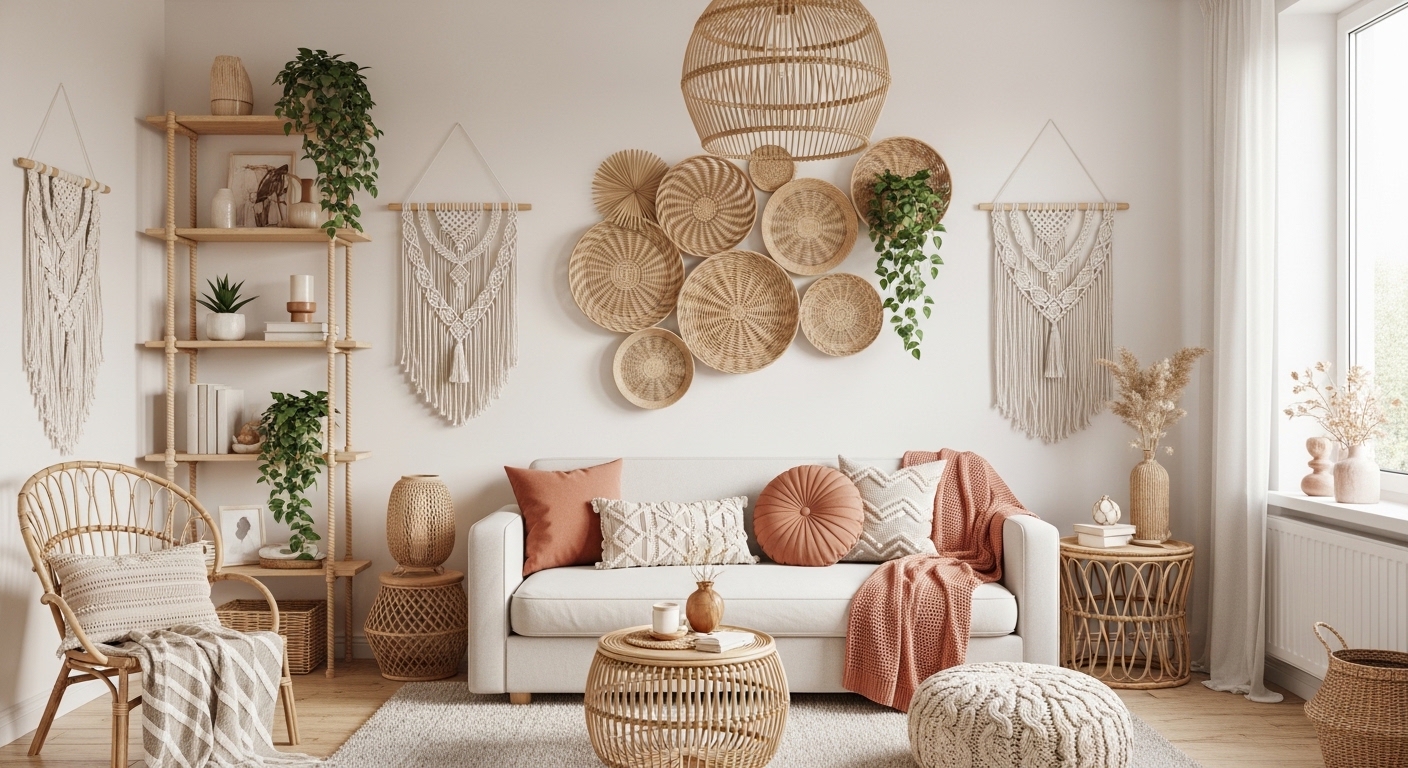
Boho reads as texture, warmth, and handmade feel, not as a checklist of objects. A room with a macrame hanging, woven baskets, and a rattan mirror reads as boho because the materials share a language: natural fibers, warm tones, visible craft. A room with the same objects in plastic and chrome does not read as boho, no matter how many of them there are. The material language matters more than the object count, and in a small room it matters most, because you have few objects and each one speaks loudly. Choose materials first, objects second. If a piece does not share the room’s material language, it will read as clutter even if you love it on its own.
Color is the second part of the boho language, and the small-space version of it is narrower than the large-room version. Warm neutrals, terracotta, ochre, sage, and dusty rose carry boho warmth without shrinking a room. Deep saturated color can work as an accent, one cushion, one throw, one frame, but a small room covered in saturated color feels smaller, because strong color advances toward the eye. The discipline is to let the neutrals do the volume work and the saturated colors do the accent work. A small room with warm neutral walls and three saturated accents feels boho and spacious. A small room with saturated walls and saturated everything feels like a tent, and tents are not restful.
Start With a Warm Ground
Every boho wall needs a ground: the wall color or the large textile that everything else sits against. The ground sets the temperature of the whole display, and getting it wrong makes everything hung on it look wrong too. A warm white, a soft plaster tone, or a pale warm neutral suits most small boho rooms, because it gives texture room to show without competing with it. A cool gray ground fights warm boho materials, making rattan look yellow and terracotta look orange in the wrong way. If you cannot paint, a large textile, a tapestry, a woven hanging, or a linen panel, can serve as the ground instead, giving the wall a warm field that smaller pieces can sit against.
The ground also sets the scale. One large ground piece, a tapestry or a big woven hanging, anchors a small wall better than five small pieces, because the eye reads one confident field where it reads five small pieces as clutter. Hang the ground piece first, at the height where its center sits near eye level, and let the smaller pieces arrange around it rather than competing with it. If the wall is very small, the ground piece may be all the wall needs. A small wall with one beautiful textile and breathing room around it is a complete boho statement. A small wall with one textile plus four more hangings is a wall that ran out of restraint.
Layer in Order: Large, Medium, Small
Layering is the boho skill that matters most in small spaces, and it has an order: large, then medium, then small. Large pieces first, the tapestry, the big mirror, the oversized basket, establish the composition’s bones. Medium pieces second, smaller baskets, framed prints, a shelf, fill the middle ground. Small pieces last, and only where the composition still asks for them: a tiny hanging, a bead strand, a small plant. The order matters because each layer refers to the one before it. Small pieces hung first, without large pieces to anchor them, look like debris. Large pieces hung after small ones are already up tend to crowd them out or force rearrangement.
The other half of layering is breathing room. Every layer needs gaps, and the gaps are part of the composition, not wasted space. A good check is to squint at the wall: if the pieces blur into one textured mass with no gaps, the layering has gone too far. If the pieces read as separate objects with space between them, the layering is working. In a small room, err toward fewer layers. Two well-chosen layers, large and medium, with generous gaps, read as richer than four layers crammed together, because the eye can actually see each layer instead of being overwhelmed by all of them at once.
🛒 Shop This Look:
Materials That Work Small
Not all boho materials behave the same in a small room. Macrame and woven textiles are the most forgiving, because they are light, flat against the wall, and add texture without demanding depth. Woven baskets are nearly as good, but they project from the wall, so they need a depth check: a basket that sticks out six inches in a narrow passage is a hazard, while the same basket on a wall you sit facing is a beautiful shadow-maker. Wood, rattan, and cane add warmth and structure, but they are heavier, so they need proper fixing into studs or anchors rated above the loaded weight, tested empty first.
Plants are the boho material most often chosen for the wrong reasons in small rooms. A trailing plant softens a wall beautifully, but it needs the light it will actually get and a watering plan that does not drip onto the pieces below. A plant that declines in a dark corner does not read as boho; it reads as neglect, and neglect is the opposite of the collected, cared-for feeling boho aims for. Choose the plant for the corner’s real light, and choose the container for the wall’s weight limit. Heavy ceramic planters on adhesive hooks are a predictable failure. Light planters, or planters on proper fixings, are the honest choice. For basket walls specifically, the guide to bohemian wall baskets covers hanging methods, weight, and arrangements that hold up over time.
Gallery Walls, Boho Style
A boho gallery wall differs from a standard gallery wall in one respect: it embraces mixed frames and mixed media, where a standard gallery often demands uniformity. Mixed frames suit boho because the style itself is about collection rather than matching sets. But mixed does not mean random. A boho gallery still needs a shared trait to hold it together: a warm palette, a consistent spacing, or a common material running through the frames. Without a shared trait, a mixed gallery reads as a yard sale, not a collection. The shared trait is what separates curated from chaotic, and in a small room the trait needs to be strong enough to read from across the room, because small rooms are always viewed from close range.
Spacing discipline matters more in a boho gallery than in a uniform one, precisely because the pieces vary. Consistent gaps, two to three inches for small pieces, more for large ones, give varied pieces a shared rhythm. A center line carried through the composition, or a strong anchor piece at the center, gives the eye a place to rest. And the stopping rule is stricter for boho galleries in small rooms: stop one piece before you think the wall is done. Boho galleries grow easily, one more basket, one more print, one more hanging, and each addition takes a larger share of a small wall. A gallery with breathing room looks collected. A gallery with no breathing room looks hoarded, and hoarded is not boho. For layout discipline, the guide to boho gallery walls covers layering order, spacing, and room suitability in more detail.
🛒 Shop This Look:
Plants and Light
Plants and boho belong together, but the pairing needs the same honesty about light as any plant advice. A trailing pothos or a hanging fern softens a boho wall and adds the living texture that makes the style feel real rather than staged. But plants need light, water, and a container that suits the wall, and a plant given none of these becomes a brown reminder of good intentions. Check the light at the wall itself, not the light in the room generally. A wall two feet from a window gets far less light than the window seat, and a wall across from a north window gets less than a wall beside it.
Hanging plants need a fixing plan that accounts for wet weight, not dry weight. A watered planter weighs substantially more than a dry one, and a fixing rated for the dry weight will fail on watering day. Plan for wet weight, test the fixing empty, and water over a sink or a tray, not over the pieces below. Artificial plants are an honest alternative for walls with no light at all, and the honest version of that advice is that good artificial plants read well at a distance and poorly up close. In a small room, where every wall is seen up close, a cheap artificial plant reads as cheap. If the wall has no light, a textile or a basket serves the boho purpose better than a plant that cannot live there.
Renters and Small Budgets
Renters can do boho well in small spaces, because the style’s best materials are also its lightest and least permanent. Textiles, baskets, and macrame hang from small fixings or adhesive hooks rated for their weight, and they leave small holes that are easy to repair. The honest limits still apply: adhesive holds light pieces well and fails predictably on heavy ones, on textured walls, and in humid rooms. Use adhesive only for pieces whose fall would not injure anyone or break anything valuable. For heavier pieces, a single well-placed fixing, properly repaired at move-out, is less damaging than a fallen frame.
Small budgets suit boho better than most styles, because the style values the handmade and the secondhand. A thrifted basket, a handmade hanging, a plant cutting in a jar, all read as boho precisely because they look collected rather than purchased as a set. The trap for small budgets is buying a matching boho set, which reads as a costume rather than a collection. One thrifted piece with a story beats five matching pieces from a single order, and the story does not need to be exotic. A basket from a flea market, a textile from a family member, a print from a local maker, these are the pieces that make a small boho room feel personal rather than staged. The budget rule is simple: buy fewer pieces, choose each one for the room, and let the room accumulate character over time rather than all at once.
Mistakes That Overwhelm Small Rooms
The most common boho mistake in a small room is too many textures. Texture is boho’s great strength, and it is also its great danger, because each texture demands visual attention. A wall with macrame, baskets, beads, fringe, and woven art has five textures competing, and the eye cannot rest on any of them. The discipline is to choose two or three textures per wall and let them repeat. Repetition reads as intention. Novelty on every piece reads as noise. The second mistake is clashing palettes: warm and cool tones mixed without a bridge color. A warm terracotta wall with cool blue accents can work if a neutral or a shared tone bridges them, but without a bridge, the wall looks like two rooms arguing.
The third mistake is covering every inch. Boho loves fullness, but a small room covered edge to edge in decor feels smaller, not cozier, because there is no empty space for the eye to rest. Leave breathing room, especially at the edges of a display and between layers. Empty wall is not anti-boho; it is what makes the boho pieces read as chosen rather than accumulated. The fourth mistake is ignoring the floor. A boho wall above a cluttered floor reads as part of the clutter. Clear the floor zone beneath a boho display, or ground it deliberately with a rug, a bench, or a plant that belongs to the composition.
🛒 Shop This Look:
A Small-Room Boho Plan
Start with the material language: choose two or three materials and a warm neutral ground. Hang the largest piece first, at eye level, and let it anchor the wall. Add medium pieces in layer order, checking spacing and breathing room as you go, and stop one piece before you think the wall is done. Check the wall from every normal viewing angle, because small rooms are seen from everywhere, and a display that works from only one angle is a stage set. Add plants only where the light and the fixing plan support them, and leave at least one wall in the room quiet. A small boho room succeeds when it feels collected, warm, and calm all at once. Calm is the test most boho rooms fail, and it is the test that matters most in a small space. Warmth without calm is clutter. Warmth with calm is boho, done right.