
As an Amazon Associate, I earn from qualifying purchases. This means I may earn a commission if you purchase through links on this page — at no extra cost to you.
A home gym wall has a job before it has a look. In a living room, a wall can simply be beautiful. In a gym, the wall holds equipment, carries a mirror, takes sweat and chalk dust, and sits in your eyeline while you work through a hard set. When the wall is planned around the workout first, the decoration almost takes care of itself. When it is decorated first, you end up moving posters to make room for a rack, or staring at a crooked frame while you try to hold form.
Start by deciding what the wall must do. Then choose pieces that do those jobs well. The result looks intentional because it is intentional, and it stays useful long after the novelty of a new room wears off.
Give the Wall a Job First
Every gym wall should answer four questions before anything is hung on it. What equipment needs to live on this wall? What do you need to see while you train? What can this wall surface survive? And where does the light fall at the time you actually work out?
Equipment first. Dumbbells, bands, jump ropes, mats, and foam rollers all need a home, and a wall rack or a set of sturdy hooks beats a pile in the corner every time. A wall that holds equipment keeps the floor clear, which matters more than it sounds: a clear floor is safer to move on and easier to clean, and it makes a small room feel larger. If you are still deciding what the room itself should contain, home gym ideas that make working out at home easier can help you settle the room before you dress the wall.
Visibility second. A mirror is not decoration in a gym; it is a training tool. It lets you check form, and it makes a small room feel less boxed in. A clock or timer you can read from anywhere in the room serves the same practical purpose. A whiteboard or chalkboard for tracking sessions is useful only if you will actually update it. Be honest about that. A board that never changes becomes wall clutter within a month.
Surface third. Gym walls get damp from sweat and humidity, scuffed by equipment, and dusty from chalk. Flat matte paint shows marks less than a high-gloss finish, and it is easier to touch up. If the wall is in a garage or basement, check for damp patches before hanging anything valuable on it. Art that cannot survive the room will not motivate anyone.
Light fourth. Note where the light falls during your usual training time. A mirror opposite a window doubles the light in the room, which is welcome in a dark basement. The same mirror facing a low sun will throw glare straight into your eyes mid-set. Stand where you train, look at the wall, and check for glare before you fix anything in place.
Measure the Wall and the Workout
Measure twice: once for the wall, once for the movement that happens in front of it. A wall that is six feet wide sounds generous until a rack, a mirror, and a set of shelves are all competing for it.
Start with clearance. Leave enough open floor in front of the wall for the widest movement you do there: a mat laid flat, a jump rope turning, a kettlebell swing. Mark the floor area with painter’s tape and live with it for a session or two before you hang anything. If you keep stepping on the tape, the layout is wrong.
Then map the wall by reach. Everyday items belong between hip and shoulder height, where you can grab them without stretching or crouching. Rarely used items can go higher. Nothing you lift while tired should live above shoulder height. Heavy items, like a loaded weight rack, belong low and fixed into structure, never high on adhesive hooks.
Mirror placement follows the same logic. A mirror should face the spot where you train, not the door or a blank corner. If you train facing the wall, the mirror goes on that wall at a height where you can see your full form, head to toe, from your usual training distance. If you train facing away from the wall, a mirror on the side wall may serve better. One well-placed mirror beats a wall of small mirrored tiles that break your reflection into pieces.
For a gallery-style arrangement of smaller pieces, the familiar rules still apply: keep the center of the arrangement around eye level, roughly 57 inches from the floor, and keep gaps between frames consistent, around two to three inches. The difference in a gym is that the arrangement must survive vibration. Frames hung on a wall that shakes every time a weight drops need secure fixings, not picture-hanging strips rated for light frames.
The Pieces That Earn Their Place
Once the jobs are clear, choose pieces that do them. A short list, chosen well, beats a wall crowded with every fitness idea at once.
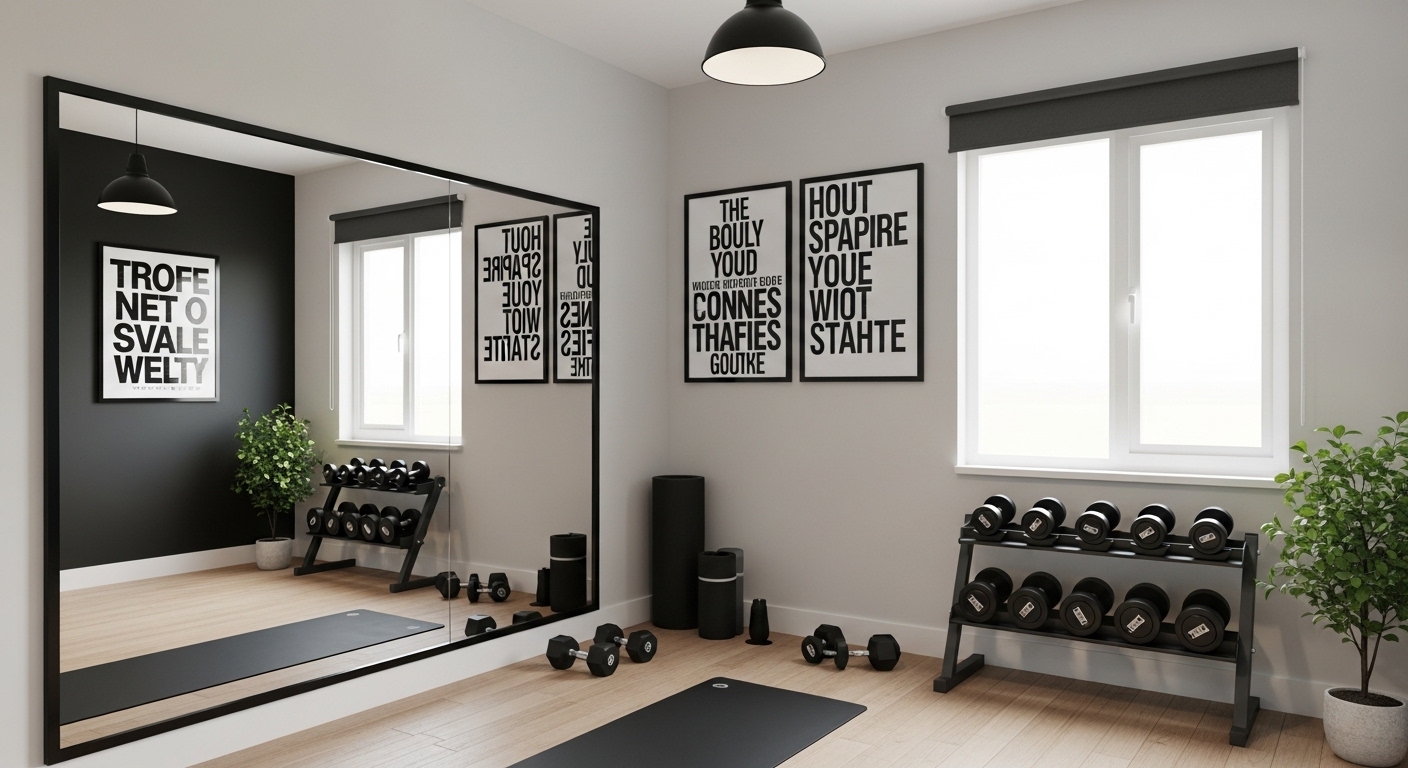
A full-length mirror is the single most useful gym wall piece. It serves form-checking and light, and it visually doubles the room. Choose a mirror with a solid frame and fix it properly; a leaning mirror in a room where weights move around is an accident waiting for a reason.
A wall-mounted rack or a row of sturdy hooks is next. Racks keep bands, ropes, and mats visible and reachable, which matters because equipment you cannot see is equipment you will not use. Group by use: bands together, ropes together, mats together. Label nothing; the grouping itself is the system.
A progress board earns its place only if tracking matters to you. A chalkboard with a weekly plan, a whiteboard with personal bests, or a simple framed sheet you update monthly all work. The format matters less than the habit. If you have never tracked a workout in your life, skip the board and hang one piece of art you actually like instead.
Floating shelves suit accessories: a small speaker, a towel stack, a water bottle station, a plant that tolerates neglect. Keep shelves shallow and high enough that nothing on them interferes with movement. A shelf at head height above a training area is a collision risk; the same shelf above a storage zone is fine.
A clock with a clear face, readable from across the room, rounds out the practical set. Timed intervals, rest periods, and session length all get easier when the time is visible without reaching for a phone.
🛒 Shop This Look:
Motivation That Survives Past January
Generic motivational posters have a short half-life. The first week they inspire; by the third month they are wallpaper. The problem is not motivation itself but borrowed motivation: someone else’s slogan, someone else’s athlete, someone else’s idea of discipline. It fades because it was never yours.
Personal markers last longer. A photo from a race you finished, a trail you hiked, or a sport you played carries a memory, and memories do not fade the way slogans do. One framed photo that means something beats a wall of ten generic quotes. If you have no such photo yet, a single piece of art in a style you genuinely like will do the same job: it makes the room feel like yours, which is the real point.
A progress display works when it records something real. A board with your own numbers, updated by hand, is a record of work done, not a promise. That distinction matters. Promises on walls (“no excuses”, “beast mode”) tend to turn into background noise or, worse, guilt on days you miss. A record simply tells the truth about what you did, and the truth is easier to live with.
Rotation helps too. Swap one piece every few months: a new photo, a different print, a changed board layout. A wall that changes slightly stays noticed; a wall that never changes becomes invisible. Keep a small rotation box with two or three spare pieces so swaps take minutes, not a shopping trip.
Finally, be careful with quantity. A gym wall crowded with quotes, decals, canvases, and collages reads as noise, and noise is the opposite of focus. Pick one anchor piece for the main wall, a functional set for the equipment wall, and leave the rest of the wall alone. Empty wall space is not wasted space; it is where the eye rests between efforts.
Light, Color, and Surface
Color in a gym should support energy without shouting. Very bright, saturated walls can feel exciting for a week and tiring after that, especially in a small room. A mid-tone neutral with one stronger accent wall, or a neutral room with colorful equipment and one bold piece of art, tends to last longer. If you love bold color, put it where you see it during rest, not where you stare during a hard set.
Light direction matters as much as color choice. A room with a north-facing window gets steady, even light that suits almost any color. A room with strong direct sun needs colors that will not glare and a mirror placed to avoid throwing that sun back at you. Test paint samples on the actual wall, at the time you train, before committing. A color that looks calm in a store looks different under gym lighting at six in the morning.
Surface choice is practical. Washable paint or a wipeable finish near equipment zones saves repainting later. Avoid textured wallpapers in a gym: they trap dust and chalk, and they are hard to clean. Smooth, washable surfaces win. If the room is a garage or basement, a moisture-resistant primer under the paint is worth the extra step.
One more light note: a strip of warm LED lighting behind a shelf or along the top of a mirror can make a windowless room feel far less like a cell. Keep the strip out of direct eyeline, aimed at the wall rather than at you, so it washes the wall with light instead of glaring.
🛒 Shop This Look:
Hang It Safely
Gym walls carry heavier loads than living room walls, and they vibrate. Hanging needs to match that reality.
Find the studs for anything heavy: a loaded rack, a large mirror, a wall-mounted bar. A stud finder is cheap and fast, and it removes the guesswork. For medium items on drywall, use anchors rated above the loaded weight of the item, not merely equal to it. For light frames, standard picture hooks are fine, but check them every few months, since vibration loosens fixings over time.
Use two fixing points for anything wide or heavy, even if one point seems strong enough. Two points share the load and stop the piece from tilting. For mirrors, a safety backing or a frame that contains the glass matters: if a mirror ever breaks, contained glass is far less dangerous than loose shards on a training floor.
Keep swing clearance in mind. Nothing sharp, glass, or heavy should hang where a jump rope, a band, or a swinging weight could strike it. Map the swing zones with tape before you hang, the same way you mapped the floor clearance. A beautiful mirror at rope height is a broken mirror waiting to happen.
Renters have good options that do not need drilling: freestanding mirror units, leaning shelves, adhesive hooks rated for light items only, and tension-mounted organizers. The rule stays the same: adhesive fixings are for light items, never for heavy racks or large mirrors, and every adhesive fixing should be tested with a gentle pull before anything valuable hangs from it.
A small gym, or a gym that shares a room with something else, needs stricter discipline, not fewer ideas. One wall does the work; the other walls stay quiet.
Choose the wall you face while training as the main wall, and put the mirror and the anchor piece there. Put equipment storage on the side wall, where it is reachable but out of the main sightline. Keep the wall behind you mostly empty: it is the wall a video call or a visitor sees, and a calm wall there makes the room feel larger.
In a shared room, use the wall to mark the gym zone without building a barrier. A distinct paint color on one wall, a rack that holds only gym gear, and a mat that lives rolled against that wall all say “this is the gym corner” without a divider. When the room changes use, the gym corner should be able to disappear: fold the mat, close the rack, and the wall reads as an ordinary wall again.
For very small spaces, fold the functions together. A mirror with a narrow shelf beneath it serves form-checking and storage in one unit. A board that holds both the weekly plan and a single photo serves tracking and motivation in one frame. Fewer objects, each doing two jobs, is the whole strategy for a small gym wall.
🛒 Shop This Look:
Mistakes That Make a Gym Wall Work Against You
The most common mistake is decorating before measuring. Posters go up, then the rack arrives and covers half of them, then the mirror goes somewhere awkward because the good spot is taken. Measure and map first, hang second.
The second is hanging everything at once. A wall filled in a single weekend usually ends up crowded and incoherent. Hang the functional pieces first, live with them for two weeks, then add one decorative piece at a time. The wall will tell you what it still needs.
The third is ignoring the floor. A wall plan that forgets floor clearance produces a room you cannot actually train in. Tape the floor zones before you hang anything.
The fourth is choosing fragility: glass frames at rope height, unsealed prints near a sweaty wall, a leaning mirror in a room full of moving weights. Every piece should be able to survive the room it lives in.
The fifth is letting the wall go stale. A progress board never updated, a poster faded by sun, a frame knocked crooked months ago: all of them quietly tell you the room is not cared for. A five-minute monthly check, straightening frames and wiping the mirror, keeps the wall honest.
A Simple Order of Work
Work in this order and the wall mostly plans itself. First, clear the wall completely and note its size, surface, and light at your training time. Second, tape the floor clearance zones and the swing zones. Third, fix the mirror and the equipment storage, since those are the functional core. Fourth, add one anchor piece that means something to you. Fifth, add the clock or timer. Sixth, live with it for two weeks before adding anything else. Seventh, set a monthly five-minute check for loose fixings, crooked frames, and a board that needs updating.
A gym wall built this way will not win a design award, and that is not the point. The point is a wall that helps you train: equipment where your hands expect it, a mirror where your eyes need it, one piece that reminds you why you started, and nothing in the way. That is a wall that keeps working long after the new-room excitement fades.
For more wall ideas beyond the gym, explore more wall decor ideas for inspiration.



