
As an Amazon Associate, I earn from qualifying purchases. This means I may earn a commission if you purchase through links on this page — at no extra cost to you.
A mudroom wall fails the same way every time: too few hooks for the coats, no plan for the shoes, and a bench that becomes a dumping ground because nobody decided what belongs where. The fix is not more storage. It is a wall planned around the household’s actual daily flow — who comes in, what they carry, where it goes, and how it dries. This guide works through auditing that flow, dividing the wall into zones, choosing systems that fit, and measuring so the result works for the smallest person in the house as well as the tallest.
Audit Before You Build
Count the household, then count the gear. How many people use the entry daily? How many coats, pairs of shoes, bags, hats, and scarves does each person actually rotate through in a week? What changes with the seasons — winter boots and heavy coats versus summer sandals and light jackets? And what else lands on the wall: keys, mail, dog leads, sports gear, school bags?
Write the answers down, because the audit decides the size of everything that follows. A two-person household with a dog needs a different wall than a five-person household with school bags and sports kits. A wall planned for the audit holds up. A wall planned from a photograph fills up in a month and stays messy, because the photograph’s household was not yours.
🛒 Shop This Look:
Zones: Drop, Coat, Shoe, Kid
Divide the wall into zones by job, not by furniture. The drop zone is the first thing you reach: keys, mail, sunglasses, a phone. It wants a small shelf or a magnetic board at hand height, not a deep cabinet — things that need grabbing on the way out must not live behind a door. The coat zone is hooks or a rail at a height each user can reach. The shoe zone is the floor and the first foot of wall: a bench to sit on, trays or cubbies below, and clearance for boots. The kid zone is a lower set of hooks and cubbies that children can use without help — a wall children cannot use becomes a wall adults tidy.
Zones can share furniture — a bench with hooks above it covers shoe and coat zones at once — but each zone still needs its own decision: what lives here, who uses it, and how much space it gets. A zone with no decision becomes the dumping ground.
Systems Compared
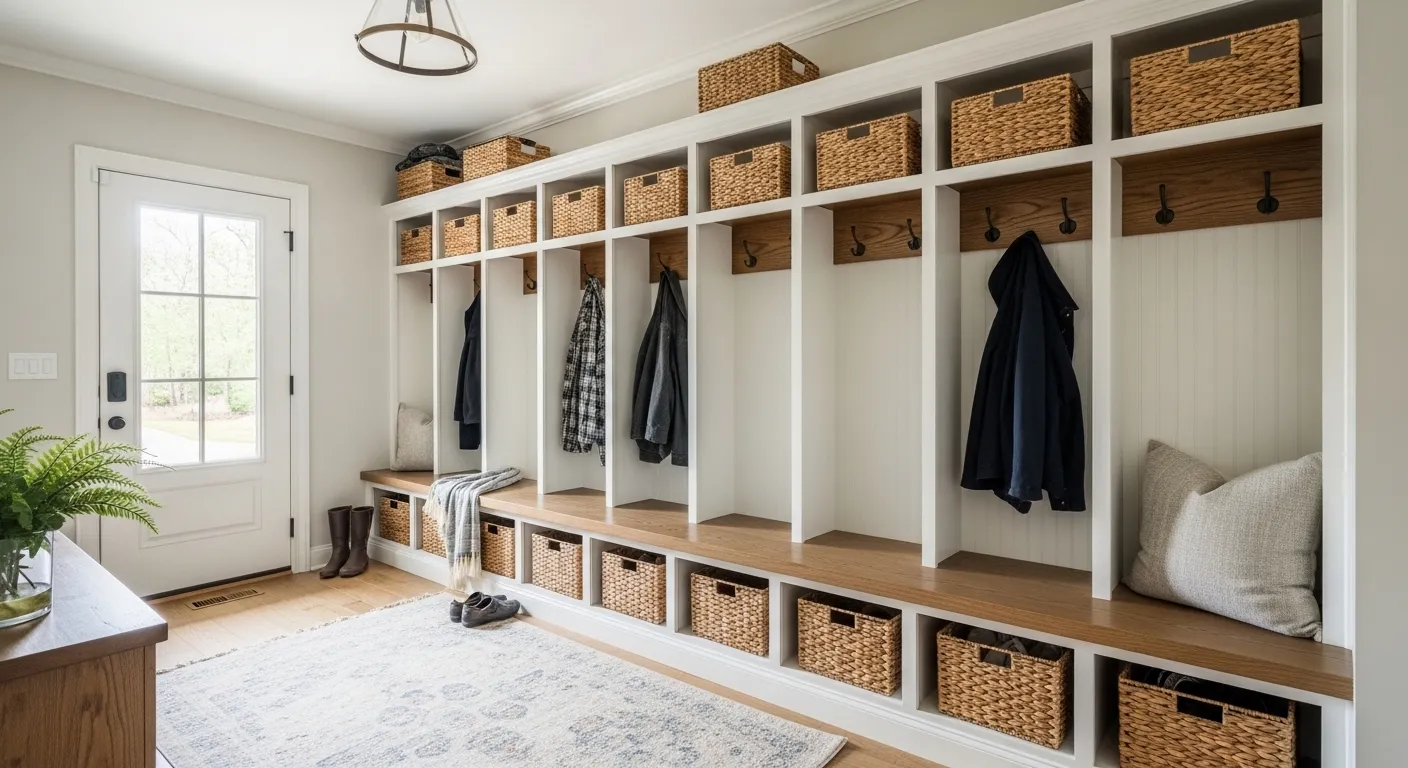
Bench with hooks. The workhorse. A bench to sit on, hooks above for coats, storage below for shoes. It suits almost every mudroom because it solves sitting, hanging, and shoe storage in one footprint. Bench depth should let an adult sit properly, not perch, and the hooks above must clear the seated person’s head.
Individual cubbies. One cubby per person, open or with a door, holding coat, bag, and shoes together. Cubbies end the “whose things are these” problem and suit families best. They need more wall width than hooks, so measure the household before committing — a cubby per person for six people is a wide wall.
Peg rails. A simple rail with pegs, mounted at one height for adults and a lower rail for children. Peg rails are cheap, flexible, and easy to extend, and they suit narrow walls where cubbies would crowd. Their weakness is visual: everything hangs visible, so they need the discipline of the zones to avoid looking like a coat sale.
Cabinets with open hook sections. Closed cabinets hide the mess; an open section at hand height keeps daily coats accessible. This combination suits entries visible from the living room, where a wall of open hooks would dominate the view. Keep daily items in the open section and seasonal or rarely used items behind doors.
Floating bench with baskets below. A wall-mounted bench keeps the floor clear for cleaning — a real advantage in a mudroom that sees mud — with baskets below for shoes. The bench must anchor into studs; a floating bench full of seated people and shoe baskets is a heavy load, and plasterboard alone will not carry it.
Grid panels and slim shelves. A grid panel with hooks and baskets adapts as needs change — move a hook, add a basket, hang a bag. Slim shelves with a hanging rail below suit the narrowest walls, where a bench would block the path. For the same adaptable-panel logic in other rooms, see the guide to magnetic wall storage, which covers boards and panels that reconfigure without new holes.
Lockers. Tall, narrow, one per person, with a door that closes. Lockers suit households that want the mess fully hidden and have the wall width for them. They cost more wall per person than hooks, so they suit larger mudrooms or entries where the wall is generous.
Measuring: Heights, Depths, Clearances
Hook height decides whether the wall gets used. Adult coat hooks sit at a height an adult reaches without stretching — roughly shoulder height for the household’s adults, adjusted if the household is notably tall or short. Children’s hooks sit where children can actually hang their own coats, not where adults wish they could — a hook a child cannot reach is a coat on the floor. If the household spans small children and tall adults, run two rails rather than compromising on one height nobody likes.
Bench height should let an adult sit and stand comfortably, and bench depth should hold a seated person without their knees hitting the wall storage below. Shoe clearance below the bench must fit the household’s tallest boots, not just sneakers — measure the winter boots, then add room. Leave clearance in front of the bench for standing and turning; a bench that blocks the entry path will be walked around, not used. And check the door swing: a wall of storage that collides with the entry door is a daily annoyance, not a solution.
Materials for Wet and Muddy Gear
Mudroom walls live with water, mud, and grit, so materials matter more here than in a bedroom. Favor wipeable surfaces for the wall behind hooks and below the bench — paint that wipes clean, or a panel that shrugs off splashes. Boot trays under the shoe zone catch the water that would otherwise soak the floor and the wall base. Ventilation matters too: gear that stays damp grows musty, so closed cabinets for wet coats need airflow, and shoes should dry before they go behind a door. For the same durability-first thinking in industrial-style storage, see the guide to industrial wall storage with wood and metal, which covers materials that survive hard daily use.
Hidden storage has a place here — out-of-season gear, cleaning supplies, the things nobody needs daily — but daily gear should stay visible and reachable. A cabinet that hides wet coats is a cabinet that grows musty. For concealed storage done right, see the guide to hidden wall storage ideas.
🛒 Shop This Look:
Small Mudrooms and No-Mudroom Entries
Not every home has a mudroom, and a hallway strip can do the same job at smaller scale. A slim bench or a row of hooks plus a shoe tray covers the essentials if the zones are respected: drop zone by the door, coat hooks at two heights, shoe tray below. Where even a bench will not fit, the door itself becomes storage — the guide to behind-the-door storage covers hooks, racks, and organizers that turn a door into a mudroom wall without touching the floor plan.
Small walls also benefit from vertical thinking: hooks up the wall’s height, a high shelf for out-of-season items, and a narrow vertical unit for shoes rather than a wide one. For vertical storage in general, see the guide to vertical wall storage — the same upward logic, applied to gear instead of plants. And do not neglect the wall’s look: a mudroom wall that is purely functional gets ignored and then messy, while a wall with one framed print or a small gallery keeps the entry feeling like part of the home. For small-scale wall display, the guide to small gallery wall ideas and the minimalist gallery wall guide both suit a narrow entry wall.
Seasonal Rotation and Maintenance
A mudroom wall needs a seasonal swap, twice a year. Winter gear — heavy coats, boots, hats, gloves — moves to the prime hooks and cubbies in autumn; summer gear moves to higher or closed storage. Without the swap, the wall carries two seasons at once and feels full in every season. The swap takes under an hour if the zones are clear, and it is the single best maintenance habit for the wall.
Weekly, the wall needs a two-minute reset: shoes back in their zone, coats on their hooks, the drop zone cleared of everything except what leaves the house daily. Monthly, wipe the wall behind the hooks and the bench, check hook anchors (heavy winter coats loosen fixings over time), and purge what nobody used all season. A wall with a maintenance habit stays organized. A wall without one fills up, no matter how well it was planned.
🛒 Shop This Look:
Mistakes That Fill the Wall Back Up
Hooks too high for the children who use them most. No shoe plan — coats get hooks, shoes get the floor, and the floor becomes the mudroom. Closed cabinets for wet gear that never dries. A bench too shallow to sit on, which becomes a shelf for bags. Ignoring the door swing, so storage and door fight daily. Planning for a photograph’s household instead of your own audit. And skipping the seasonal swap, so the wall carries winter and summer at once.
Get the audit, the zones, and the measurements right, and the mudroom wall does something rare: it makes leaving and coming home easier, every single day, without anyone having to think about it. That is the whole job of the wall — not to look organized in a photograph, but to stay organized on a wet Tuesday in February.



