
As an Amazon Associate, I earn from qualifying purchases. This means I may earn a commission if you purchase through links on this page — at no extra cost to you.
Warm white lighting (2700K–3000K) is better for bedrooms than cool white (4000K+) because it promotes relaxation and melatonin production, mimics the glow of sunset, and makes skin tones and wood finishes look more flattering. Cool white light is energizing and better suited to kitchens, bathrooms, and workspaces. In the bedroom, use warm white for all ambient and bedside lighting; reserve cool white only for task areas like a vanity or closet where color accuracy matters.
How Light Temperature Affects Sleep
Warm light (2700K) has minimal impact on melatonin, the hormone that makes you sleepy. Cool light (5000K+) suppresses melatonin significantly — it’s essentially telling your brain it’s noon. This is why sleep experts recommend warm lighting throughout the bedroom, especially in the 2 hours before bed.
Visual Comparison
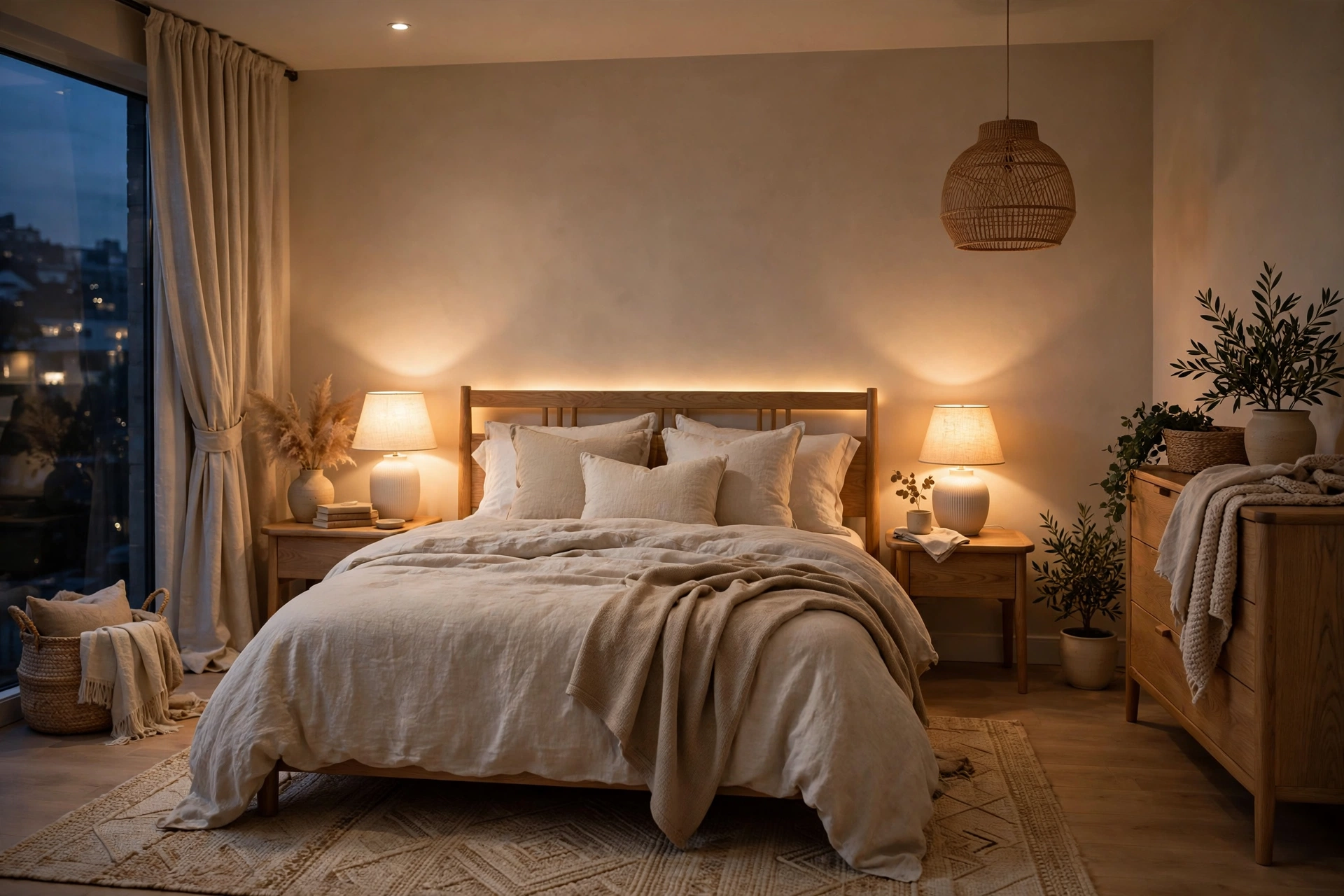
The same bedroom photographed under warm white looks cozy, intimate, and inviting — wood tones glow, whites look creamy, and shadows feel soft. Under cool white, the same room looks clinical, stark, and flat — whites look bluish, skin looks washed out, and the space feels more like an office than a retreat.
Where Each Works in the Bedroom
Use Warm White For:
- Overhead/ambient lighting
- Bedside lamps and sconces
- Accent lighting (LED strips, fairy lights)
- Any light used in the evening
Cool White Is OK For:
- Closet interiors (see clothing colors accurately)
- Vanity/makeup area (with high CRI bulbs)
- Reading nook (if used during daytime only)
Smart Bulb Solution
Tunable white smart bulbs (2700K–5000K) give you the best of both worlds — set them to cool white during the day for closet and vanity tasks, then automatically shift to warm white in the evening. Most major brands offer scheduling so this happens without you thinking about it.
What Color Temperature Actually Means
Color temperature, measured in Kelvin (K), describes the color of the light a bulb produces — not how hot the bulb gets. Lower numbers mean warmer, more amber light; higher numbers mean cooler, bluer light. The scale most relevant to homes runs from about 2200K (candlelight amber) to 6500K (daylight blue).
- 2200K–2700K (warm white): The glow of incandescent bulbs and sunset. Relaxing, flattering to skin, makes wood tones rich. The bedroom standard.
- 3000K (soft white): Slightly crisper than 2700K while still warm. A good compromise for bedrooms if 2700K feels too yellow to you.
- 3500K–4100K (neutral/cool white): Clean and alert. Works in kitchens, bathrooms, and offices — but feels clinical in a bedroom at night.
- 5000K–6500K (daylight): Bluish and energizing. Useful for task lighting, garages, and craft rooms. The worst choice for evening bedroom light — it’s the closest artificial equivalent to noon sun.
The number is printed on every bulb box. Look for “2700K” or “3000K” on the packaging — it’s usually near the brightness (lumens) rating. If you’re replacing bulbs and can’t remember what you had, 2700K is the safe bedroom default.
🛒 Shop This Look:
Beyond Warm vs. Cool: The Other Specs That Matter
Color temperature gets all the attention, but two other specs affect how your bedroom lighting looks and feels just as much.
CRI (Color Rendering Index): This 0–100 score measures how accurately a bulb reveals colors compared to natural light. Cheap LEDs often score in the low 80s, which makes everything look slightly off — skin looks sallow, bedding colors look muddy. Look for CRI 90+ for bedrooms; the difference is immediately visible, especially in the morning when you’re choosing clothes. High-CRI bulbs cost only slightly more and are worth it in every room you spend time in.
Brightness (lumens, not watts): Watts measure energy use; lumens measure actual light output. A bedroom needs roughly 10–20 lumens per square foot of ambient light — so a 150-square-foot bedroom wants 1,500–3,000 total lumens across all fixtures. Bedside reading lamps need about 400–800 lumens each at the bulb. When switching from incandescent to LED, ignore the “watt equivalent” marketing and check the lumens directly.
Dimmability: Not all LEDs dim, and non-dimmable LEDs on a dimmer switch will flicker or buzz. If your bedroom has dimmers (and it should — dimming is the cheapest ambiance upgrade there is), buy bulbs explicitly labeled dimmable and check the dimmer’s compatibility list. Dimming a warm white bulb also warms its color slightly — dimmed 2700K light shifts toward candlelight tones, which is exactly what you want in the evening.
Layering Bedroom Light: A Practical Guide
One overhead light — whatever its color temperature — can’t do the whole job. Bedrooms need three layers, each with its own role.
Layer 1: Ambient light. The general illumination — usually the ceiling fixture. Use warm white (2700K) here, on a dimmer if possible. The goal is soft, even light with no harsh shadows. A flush-mount with a fabric or frosted glass shade diffuses light better than an exposed-bulb fixture, which creates glare when you’re lying in bed looking up.
Layer 2: Task light. Bedside lamps or wall sconces for reading. Warm white (2700K–3000K) with 400–800 lumens, positioned so the light falls on your book, not in your partner’s eyes — the bottom of the shade should sit at about shoulder height when you’re sitting up in bed. Individual control matters: separate switches or smart bulbs let one person read while the other sleeps.
Layer 3: Accent light. The atmosphere layer — LED strips behind the headboard, fairy lights, a small lamp on the dresser. Keep these very warm (2200K–2700K) and dim. Accent lighting is what makes a bedroom feel like a retreat rather than just a room with a bed; it’s also the layer to leave on as a nightlight.
🛒 Shop This Look:
Putting it together: in the evening, the ideal bedroom scene is dimmed warm ambient light off or low, bedside lamps on for reading, and accent lights glowing. Three layers on separate controls give you a bedroom that adapts from bright morning closet-search to cozy evening wind-down without changing a single bulb.
Common Bedroom Lighting Mistakes
- Mixing color temperatures visibly. A 2700K bedside lamp next to a 5000K overhead creates a visual clash that makes the room feel unsettled. Keep all visible-together bulbs within the same temperature family — everything 2700K–3000K for evening spaces.
- The single overhead on full blast. Bright overhead light at 10 PM tells your brain it’s daytime. Put the overhead on a dimmer, or simply stop using it after dinner and rely on lamps.
- No light where you get dressed. Bedrooms need adequate light at the closet — this is the one legitimate bedroom use for cooler, brighter light. A 3500K–4000K high-CRI bulb inside or above the closet shows clothing colors accurately. Just keep it on a separate switch from the relaxing evening lights.
- Ignoring the switch placement. The best bedroom lighting setup fails if you have to get out of bed to turn it off. Bedside switches, smart bulbs with voice or app control, or a master switch by the door plus bedside lamp switches — plan the controls, not just the fixtures.
- Forgetting the hallway. A blazing cool-white hallway light that hits you on every nighttime bathroom trip ruins the warm cocoon. Put hallway and bathroom night-path lights on warm, dim settings — motion-sensor warm nightlights are ideal.
Frequently Asked Questions
Is 3000K or 2700K better for a bedroom?
Both work; it’s a matter of preference. 2700K is warmer and more relaxing — the classic cozy bedroom glow. 3000K is slightly crisper and can feel cleaner, especially in bedrooms with lots of white or gray. If you’re unsure, buy one of each, try them in your bedside lamp for a few evenings, and then commit to the winner for the whole room.
Can cool white light really affect my sleep?
Light exposure in the evening — particularly blue-rich light — can delay melatonin release and shift your body clock later. The effect is dose-dependent: a bright cool-white bathroom light for two minutes matters less than a cool-white bedroom you sit in for two hours before bed. The practical takeaway is to keep your evening bedroom environment warm and dim, whatever the exact biology.
Should all my bedroom bulbs be the same brand?
Not necessarily, but “2700K” from two different brands can look slightly different because of CRI and phosphor differences. For the most consistent look, buy the room’s main bulbs together from one product line. It’s a small detail that makes a visible difference when multiple lights are on at once.
Are smart bulbs worth it just for color temperature?
If your bedroom serves double duty — office by day, retreat by night — yes. Tunable white bulbs let you run cooler, brighter light for daytime tasks and shift to warm dim light in the evening automatically. If the bedroom is purely for sleep and rest, standard 2700K dimmable LEDs do the job for less money.
What about red or amber nightlights?
Amber or red nightlights (around 1800K–2200K, or true red) are the least disruptive option for middle-of-the-night bathroom trips — they provide enough visibility to navigate safely with minimal impact on sleepiness. A plug-in amber nightlight in the hallway and bathroom is a cheap upgrade with an outsized effect on sleep quality.
The one-change starting point: if your bedroom currently has mismatched or cool-white bulbs, the single highest-impact change is swapping every bulb you can see from bed to 2700K dimmable LEDs. It costs roughly $15–$30 for a typical bedroom (approximate), takes twenty minutes, and changes how the room feels every single evening. Do that first — then decide whether you want the fancier layers.
🛒 Shop This Look:



