
As an Amazon Associate, I earn from qualifying purchases. This means I may earn a commission if you purchase through links on this page — at no extra cost to you.
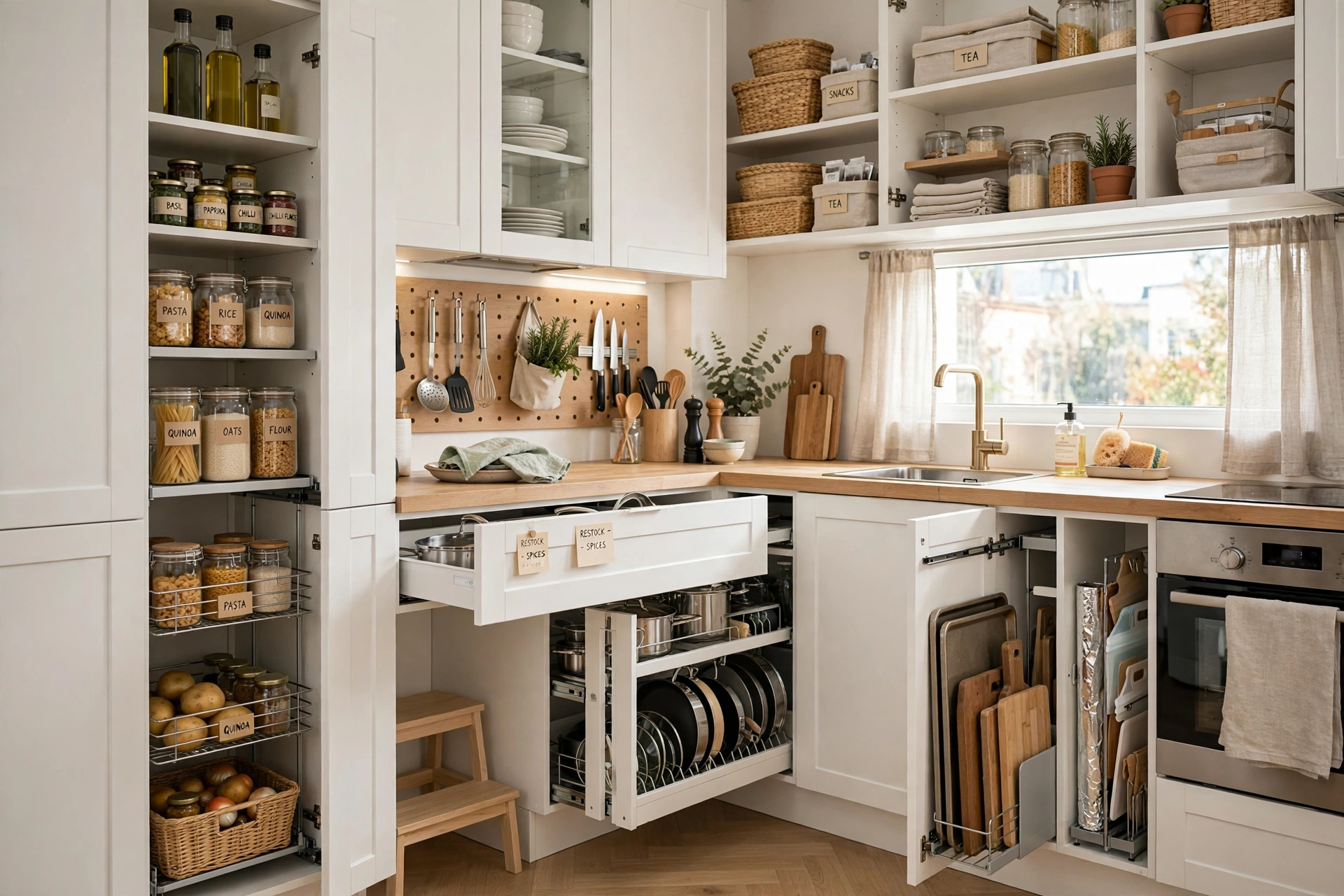
Solve small kitchen storage with magnetic strips, over-sink shelves, rolling carts, inside-cabinet organizers, and vertical wall storage. These 12 solutions add significant capacity without renovation. Related: How to Hide Ugly Kitchen Appliances.
Wall Solutions
1. Magnetic knife strip: Frees an entire drawer.
2. Wall-mounted spice racks: Gets jars off counters.
3. Pegboard: Customizable hanging for pots, utensils.
4. Over-sink shelf: Uses airspace above the sink.
Cabinet Solutions
5. Door-mounted organizers: Inside cabinet doors hold wraps, spices.
6. Stackable shelves: Doubles cabinet shelf capacity.
7. Pull-out organizers: Access deep cabinet backs.
8. Tension rods: Divide for cutting boards and lids.
Freestanding Solutions
9. Rolling cart: Extra counter and storage on wheels.
10. Over-toilet-style shelf: Above-counter shelving unit.
11. Bar cart: Doubles as appliance garage.
12. Fold-down table: Wall-mounted prep/dining space.
Start Here: The 15-Minute Triage
Before adding storage, subtract the excess. Pull everything out of one cabinet or zone at a time and sort into keep, relocate, and donate. The duplication audit almost always finds the real problem: three spatulas, two colanders, a graveyard of mismatched lids, gadgets used once. Small kitchens do not need more storage as often as they need less stuff — every solution below works twice as well after a triage pass. Target: every daily item reachable without moving something else, every cabinet closing without a push.
Wall Solutions: Your Vertical Square Footage
1. Magnetic Knife Strip
A 12–18 inch magnetic strip on the backsplash or a side wall frees an entire drawer (or a full square foot of counter from a knife block) and keeps blades sharper than drawer storage — no rattling against other utensils. Mount at a height where the longest knife clears the counter below. Keep it away from the main prep splash zone; a quick wipe of the strip monthly prevents grease buildup on the magnets.
2. Wall-Mounted Spice Racks
Spices are the ultimate small-item clutter — 20+ tiny jars eating a full cabinet shelf. A wall-mounted rack (or the inside of a cabinet door, or magnetic tins on the fridge side) consolidates them into one visible, grabbable strip. Decant into uniform jars with labels on top (visible when you look down at a drawer-style rack) or on the front (for wall racks). Uniform jars tile the rack with zero wasted air.
3. Pegboard
A pegboard panel on any free wall section — beside the fridge, at the end of a cabinet run, inside a pantry door — is infinitely reconfigurable storage for pots, pans, utensils, and small baskets. Use metal hooks rated for the weight; cast iron needs the heavy-duty hooks, not the standard wire ones. Paint the pegboard the wall color for a built-in look or a bold accent for a design feature. Trace pot outlines in chalk on the board so everything has a designated home.
4. Over-Sink Shelf
The airspace above the sink is dead in most kitchens. A shelf spanning the window or wall above the sink holds dish soap, a small plant, and daily dishes on a drainer — items that otherwise colonize the counter around the sink. Keep it shallow (6–8 inches) so it does not loom over the faucet, and anchor into studs — a shelf of dishes is heavy.
Cabinet Solutions: Doubling What You Have
5. Door-Mounted Organizers
The inside of every cabinet door is 2–4 square feet of unused storage. Slim wire racks hold plastic wrap, foil, and spice packets; adhesive or screw-mounted hooks hold measuring cups. Under-sink doors are the prime target — a door-mounted caddy for sponges, brushes, and dishwasher pods clears the chaos under the sink. Keep door storage light; heavy items stress hinges and prevent doors from closing.
6. Stackable and Under-Shelf Inserts
Cabinet shelves are spaced for the tallest item, which wastes the air above everything else. Freestanding wire shelves create a second layer inside the cabinet — mugs below, bowls above. Under-shelf baskets slide onto the shelf itself for wraps and linens. Measure interior height before buying; an insert that is half an inch too tall is useless. This single category of product doubles functional cabinet capacity for the price of a pizza.
7. Pull-Out Organizers
Deep base cabinets bury items in the back — the average person uses only the front 12 inches. Pull-out drawers or sliding baskets bring the back to you. Full-extension pull-outs for pots, narrow pull-outs for the gap beside the stove (spices and oils where you cook), and pull-out trash/recycling to free the under-sink cabinet. For renters, freestanding sliding baskets achieve most of the benefit with no screws.
8. Tension Rods as Dividers
Spring-loaded tension rods wedged vertically inside cabinets create instant dividers for cutting boards, baking sheets, and lids — filed upright like books instead of stacked in an avalanche. They also work under the sink to hang spray bottles by their triggers, freeing the cabinet floor. No tools, no holes, fully adjustable.
Freestanding Solutions: Furniture That Stores
9. Rolling Cart
A slim rolling kitchen cart (IKEA-style three-tier or a butcher-block top version) is extra counter, extra storage, and extra serving space on wheels. Park it in a gap, roll it to the prep zone when cooking, roll it to the table for serving. The top tier at counter height extends your prep surface; the lower tiers hold appliances, produce, or pantry overflow. Locking casters keep it put when parked.
10. Over-Counter Shelving Unit
A freestanding shelf unit that straddles the counter (legs on the counter, shelves above) adds two or three layers of storage over existing counter space — mugs, spices, small plants — without any wall mounting. Ideal for renters and for the dead counter section beside the stove. Keep the footprint shallow so it does not eat the work surface below.
11. Bar Cart as Appliance Garage
A bar cart repurposed for the kitchen holds the coffee station, the toaster oven, or baking supplies — and rolls into a closet or corner when not needed. Unlike a fixed appliance garage, it disappears. Style the top tier; use the lower tiers for the ugly-but-necessary. This is the solution for the appliance collection that cannot live on the counter but gets used too often for deep cabinet storage.
12. Fold-Down Wall Table
A wall-mounted drop-leaf table gives you a dining spot and bonus prep surface that folds to 4 inches deep when not in use. Mount at standard table height (30 inches) on any free wall section, even a narrow one — a 24×36 inch leaf seats two. Pair with stools that hang on wall hooks or fold flat. In a true one-person kitchen, this replaces the need for a table entirely.
Prioritizing: What to Do First
Not all twelve at once. Rank by impact-per-effort for your kitchen:
- Highest impact, lowest effort: stackable shelf inserts, tension-rod dividers, door-mounted organizers. An afternoon, minimal cost, transformative.
- High impact, moderate effort: magnetic knife strip, wall spice rack, over-sink shelf. Require mounting but reclaim entire zones.
- Situational stars: rolling cart (if you have a gap to park it), fold-down table (if you lack eating space), bar cart (if appliances are the problem).
Do tier one this weekend. Live with it for two weeks — the remaining pain points will tell you exactly which of the bigger solutions your kitchen actually needs, instead of guessing.
Maintaining the System: The Monthly 20-Minute Audit
Storage systems degrade through entropy — the slow accumulation of “just for now” items in wrong places. The monthly audit stops it:
- Open every cabinet and drawer (yes, all of them) and pull anything that does not belong in that zone. Return strays to their homes.
- Check the “one-touch” test: if retrieving or returning any daily item now requires moving something else, the zone needs rebalancing — something migrated in that should not have.
- Identify the new duplicate: every month, one category quietly doubles (this month it is water bottles; last month it was tote bags). Pick the worst offender and cull to the needed number.
- Wipe one zone: rotate through zones monthly — shelves, drawer, pantry section. Crumbs and sticky residue accumulate invisibly and make the system feel grimy.
- Retire the unused: anything not touched since the last audit that is not seasonal or emergency-only is a donate candidate. Be honest about the bread maker.
Twenty minutes monthly preserves the triage-day transformation indefinitely. Skip it for six months and you are back to square one — the audit is the system, not an accessory to it.
Small Kitchen Layout Principles
- The work triangle still rules: sink, stove, and fridge within a compact triangle (each leg 4–9 feet, total under 26 feet). In galley kitchens the triangle collapses to a line — keep the sequence logical: store → prep → cook → clean in order along the line.
- Landing space beside each appliance: 15 inches beside the stove, 18 inches beside the fridge, 24 inches beside the sink. Without landing space, hot pans and wet dishes have nowhere safe to go — this is a safety issue, not just convenience.
- Store at point of use, ruthlessly: everyday dishes near the dishwasher (unloading becomes a one-step task), pots near the stove, knives near prep, cleaning supplies under the sink. Every step saved is multiplied by hundreds of uses per year.
- Protect the prep zone: identify the largest uninterrupted counter section and defend it — no appliances, no decor, no mail. A small kitchen with one clear prep zone functions; one with the prep zone colonized does not, regardless of total counter footage.
🛒 Shop This Look:
🛒 Shop This Look:
🛒 Shop This Look:




1 thought on “Small Kitchen With No Storage? 12 Clever Solutions”
Comments are closed.