
As an Amazon Associate, I earn from qualifying purchases. This means I may earn a commission if you purchase through links on this page — at no extra cost to you.
Neither open shelves nor upper cabinets are universally better — the right choice depends on your cooking habits, storage needs, and tolerance for dusting. Open shelves cost 50–70% less than cabinets, make kitchens feel larger, and put everyday items within reach, but they demand constant curation and collect grease and dust. Upper cabinets hide clutter, protect dishes, and add resale value, but they can make small kitchens feel boxed in. Below is the full breakdown: costs, storage math, maintenance reality, and a verdict for every kitchen type. Related: Light vs Dark Kitchen Cabinets: Which Is Better for Resale.
Open Shelves vs Upper Cabinets: Comparison Table
| Factor | Open Shelves | Upper Cabinets |
|---|---|---|
| Cost (per linear foot, installed) | $50–$200 (floating wood shelves; brackets extra) | $200–$600+ (stock to semi-custom) |
| Cost for a 10-ft run | $500–$2,000 | $2,000–$6,000+ |
| Storage capacity | Lower — single row, no stacking above ~18″ | Higher — full-height interior, adjustable shelves |
| Accessibility | Excellent — everything visible and reachable | Good, but top shelves often become dead zones |
| Maintenance | High — dusting weekly, grease wipe-downs near stove | Low — occasional exterior wipe |
| Visual impact | Opens up the room; airy and modern | Can feel heavy; anchors the kitchen visually |
| Best for small kitchens | Yes — visually expands tight spaces | Sometimes — adds storage but closes in walls |
| Resale value | Neutral to slightly negative for traditional buyers | Positive — buyers expect cabinet storage |
| DIY difficulty | Easy — a weekend project with basic tools | Hard — usually requires professional install |
| Flexibility | High — restyle anytime, swap decor seasonally | Low — fixed boxes, fixed doors |
Open Shelves: The Deep Dive
Where Open Shelves Win
Cost is the headline advantage. A pair of 4-foot solid wood floating shelves with quality brackets costs $150–$400 total. The equivalent in stock upper cabinets runs $800–$2,000 installed. For a full kitchen wall, the savings can fund your entire appliance upgrade.
Small kitchens feel dramatically bigger. Removing upper cabinets opens sightlines and lets light travel. In galley kitchens and apartments under 100 square feet, designers consistently recommend shelves on at least one wall to prevent the “tunnel” effect.
Daily items stay within reach. If you cook every day, grabbing your olive oil, salt, and favorite mug without opening a door is genuinely more pleasant. Open shelves reward the way real cooks work — everything visible, nothing buried.
They force (healthy) minimalism. You can’t hide mismatched mugs behind a door, so you naturally edit down to pieces you actually like. Many shelf converts report owning fewer, better dishes within a year.
The Honest Downsides
Dust and grease are real. Anything within three feet of the stove develops a sticky film within weeks. Plan on wiping shelf surfaces weekly and washing displayed items monthly — or accept a patina of kitchen life.
Storage capacity drops 30–50%. A standard 36-inch upper cabinet with two adjustable shelves holds roughly twice what a single floating shelf of the same width holds. If you’re short on storage overall, shelves alone won’t cut it.
They demand curation. Open shelves are a display whether you want them to be or not. Chipped mugs, novelty glasses, and the blender you never use are all on stage. This is a lifestyle commitment, not just a design choice.
Earthquakes, kids, and cats. In seismic zones or homes with climbers (toddler or feline), unsecured items on open shelves are a hazard. Museum putty helps; cabinet doors help more.
Who Should Choose Open Shelves
Minimalists with curated dishware, daily cooks who value speed over storage, renters doing a reversible upgrade (shelves patch easily), and anyone with a small kitchen that feels cramped. Also ideal as a partial solution — more on the hybrid approach below.
Upper Cabinets: The Deep Dive
Where Cabinets Win
Maximum storage, zero judgment. Cabinets swallow the mismatched, the rarely-used, and the ugly-but-essential. A KitchenAid mixer, a stack of plastic containers, the fondue set from 2019 — all invisible behind a door.
Protection from the environment. Doors shield dishes from cooking grease, dust, and (in open-plan homes) general household grime. Your white plates stay white without weekly washing.
Resale value is measurably better. Real estate agents consistently report that buyers — especially families — want closed storage. An all-open-shelf kitchen can read as “not enough storage” to a buyer touring your home, even if it works fine for you. Related: Open vs Closed Storage in Small Homes.
Lighting and electrical integration. Under-cabinet lighting is the single best task lighting in a kitchen, and cabinets give you somewhere to mount it. They also hide outlets, wires, and the occasional less-than-perfect drywall.
The Honest Downsides
Cost is the big one. Even stock cabinets from IKEA ($100–$250 per linear foot installed) or Home Depot’s Hampton Bay line add up fast. Semi-custom runs $300–$600 per linear foot. A full wall of uppers can easily hit $4,000–$8,000.
🛒 Shop This Look:
They visually shrink small kitchens. A wall of boxes at eye level closes in the room. In kitchens under 120 square feet, full upper cabinets on every wall can feel oppressive.
Top shelves become dead zones. Anything above 72 inches requires a step stool, which means it becomes permanent storage for things you never touch. You’re paying for cubic footage you can’t comfortably use.
Doors need maintenance too. Hinges loosen, soft-close mechanisms fail, and painted cabinet doors chip — especially near the stove and sink. Budget $200–$500 over a decade for hardware repairs.
Who Should Choose Upper Cabinets
Families who need maximum hidden storage, anyone planning to sell within five years, cooks with extensive equipment (small appliances, specialty pans), and people who’d rather spend Saturday doing anything other than dusting shelves.
Cost Analysis: Real Numbers
Let’s price a standard 10-foot wall, two shelves high (or equivalent cabinet run):
Open shelves — budget route: Two 10-foot pine boards ($60), six heavy-duty brackets ($90), stain and polyurethane ($25), installation hardware ($15). DIY total: roughly $190. With a handyman installing: add $200–$300. Total: $190–$500.
Open shelves — premium route: Two 10-foot white oak floating shelves with hidden brackets ($400–$700), professional install ($300–$500). Total: $700–$1,200.
Upper cabinets — stock (IKEA SEKTION): Five 24-inch wall cabinets ($150–$250 each = $750–$1,250), doors and hardware ($400–$600), installation ($500–$1,000). Total: $1,650–$2,850.
Upper cabinets — semi-custom: $300–$500 per linear foot installed. Total for 10 feet: $3,000–$5,000.
The gap is stark: even premium floating shelves cost less than the cheapest cabinet option. If budget is the deciding factor, shelves win by a mile.
How to Style Open Shelves (So They Don’t Look Messy)
The difference between “Pinterest kitchen” and “cluttered mess” comes down to five rules:
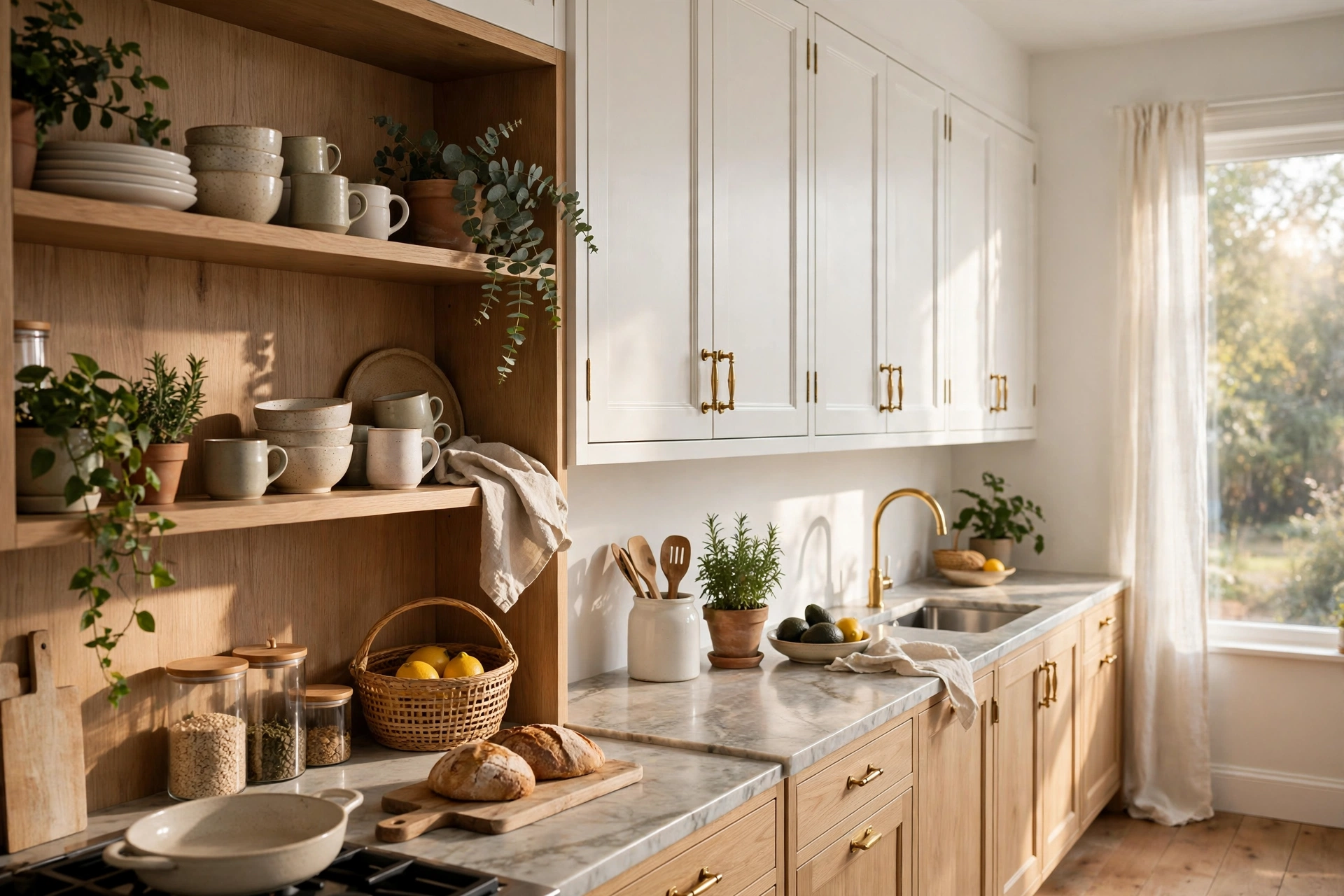
1. The 70/30 rule. 70% functional everyday items (plates, bowls, glasses you actually use), 30% decorative (a small plant, a framed print, a beautiful pitcher). All-decor shelves look staged; all-functional looks like a restaurant supply shelf.
2. Group by color, not by type. White dishes grouped together read as calm. The same dishes scattered among colorful mugs read as chaos. Pick a palette — whites and wood tones are foolproof — and stick to it.
3. Vary heights. Stack bowls, stand plates in a rack, lean a cutting board at the end. Flat rows of identical items look institutional.
4. Leave breathing room. Shelves should be 70–80% full, never 100%. Negative space is what separates “styled” from “stuffed.”
5. Anchor the ends. A trailing pothos plant on one end and a leaning art print on the other bookend the shelf and signal intentionality.
🛒 Shop This Look:
The Hybrid Approach: The Best of Both
The most practical kitchens mix both — and this is what most designers actually recommend:
Shelves near the cooking zone, cabinets elsewhere. Put open shelves beside the range for oils, spices, and daily dishes; keep cabinets on the remaining walls for bulk storage and small appliances.
The “one wall” rule. Dedicate a single focal wall to open shelves (often the wall with a window or the range wall) and use cabinets everywhere else. You get the airy look without sacrificing serious storage.
Glass-front cabinets as a middle ground. Glass doors give the display feel of open shelves with 80% less dusting. Add interior cabinet lighting and they look spectacular at night. Cost: roughly 15–25% more than solid-door cabinets.
The Verdict by Kitchen Type
Small galley kitchen (<100 sq ft): Open shelves on at least one wall. The visual space matters more than the storage here — supplement with a pantry cabinet or tall storage elsewhere.
Family kitchen with kids: Upper cabinets. You need the hidden storage, the durability, and the resale value. Add one short open shelf for display if you want the look.
Rental kitchen: Open shelves. They’re cheap, reversible, and landlords rarely object to a few bracket holes (which spackle easily). This is the highest-ROI rental upgrade in the kitchen.
Open-plan kitchen/living room: Hybrid. Shelves on the living-room-facing wall keep sightlines open; cabinets on the working walls handle storage. This is the designer-favorite configuration.
Forever home, avid cook: Upper cabinets with a single styled open shelf. You have the equipment to store and the years to enjoy it — prioritize function, add one shelf for joy.
Budget renovation (<$2,000 for the wall): Open shelves, no contest. The savings versus cabinets can fund new lighting, hardware, or a backsplash.
Frequently Asked Questions
Do open shelves collect a lot of grease?
Near the stove, yes — items within about three feet develop a film within two to four weeks. The fix is simple: keep only daily-use items near the range (they get washed constantly anyway) and put decorative pieces on shelves farther from cooking zones.
Can I replace upper cabinets with shelves in a rental?
Usually yes, with permission. Floating shelves require 4–8 bracket holes per shelf, which are easy to spackle and paint over when you move out. Store the original cabinet doors if you remove any — but most renters add shelves to empty wall space rather than removing existing cabinets.
How deep should open kitchen shelves be?
10–12 inches is the sweet spot. Standard dinner plates are 10–11 inches in diameter, so 12-inch shelves hold them comfortably. Go shallower (8 inches) for spice and glassware shelves; deeper than 12 inches wastes space and makes items hard to reach.
Will open shelves hurt my home’s resale value?
A full open-shelf kitchen can give some buyers pause, particularly families who need storage. The hybrid approach — shelves on one wall, cabinets elsewhere — gets the look without the resale risk. If selling soon, lean toward cabinets.
What’s the cheapest way to try open shelves?
A single 4-foot pine shelf with brackets costs under $50 in materials and takes an afternoon to install. Try it on one small wall section first — you’ll know within a month whether the lifestyle suits you before committing to a full wall.
By Ella Knight
🛒 Shop This Look:



