
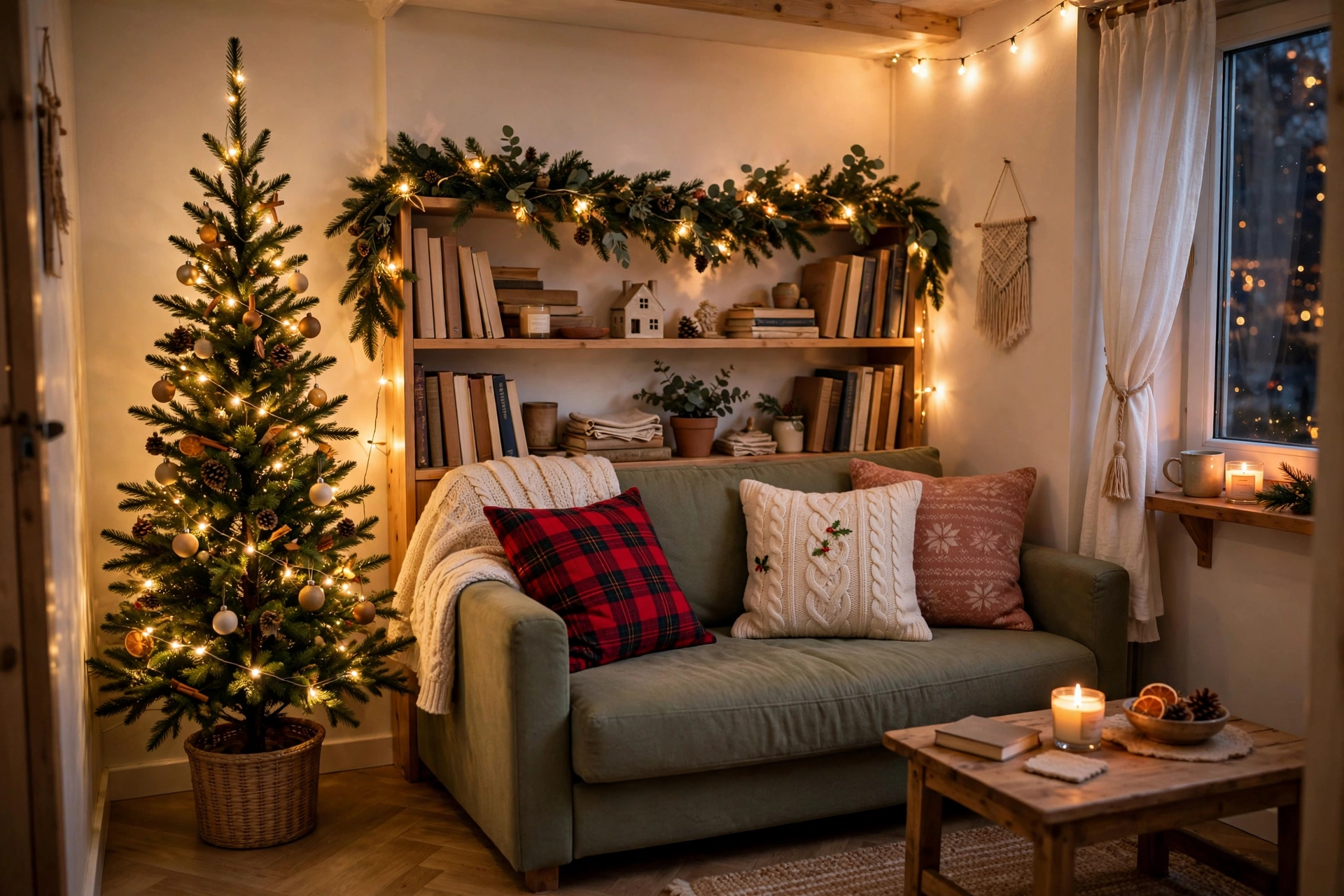
The holidays do not ask your living room to become a different room. They ask it to do its usual job a little better, for a few more people, for a few more hours at a time. Guests do not walk in and judge your sofa or whether your tree matches a theme. They notice whether they can walk in easily, sit down without shuffling furniture, put a drink down safely, and feel warm and welcome. That is the whole job of a guest-ready living room, and it is mostly about arrangement, not shopping. This guide keeps the focus on what you already own, and the welcome starts before the living room: our Thanksgiving Entryway ideas show how a clear, warm arrival sets the tone for the room that follows.
Start with the room you already have
Before moving anything, sit in every seat in the room, one after another, as a guest would. From each seat, look for the same three things: can you see the people you would be talking with, can you reach a surface for a drink, and can you get up without asking someone else to move? A seat that fails any of those tests is not really a guest seat yet, even if it looks comfortable from the doorway.
Most living rooms already have enough seating; the problem is that some of it faces the wrong way or is blocked by everyday things. Pull the main seating into a loose conversation shape, with chairs angled slightly toward each other, and leave a little space between pieces so people can slip past. If the room still feels stuck, the HomeisDecor Services page explains how a custom room plan can be put together for your own space.
Clear a path before you add anything seasonal
Holiday decorating often starts with adding things, but a guest-ready room starts with taking things away. Clear the walkway from the door to the main seating area: shoes, bags, chargers, and anything else that has drifted onto the floor. Then look for smaller obstacles, such as a low basket beside the sofa or a footstool that has wandered into the middle of the room. Walk the route carrying something in both hands, as if you were bringing in a tray of drinks. If you have to slow down or sidestep, the path is still too tight, and a coffee table that is close enough to reach, but not so close that knees bump it, will help the whole room feel easy.
Give everyone a real seat
Count the people who will be in the room at the busiest moment, then count the seats. A dining chair pulled in from the next room is a perfectly good guest seat, as long as it has a back and a place to lean. A pouffe or the edge of an ottoman can work for a short visit, but they are tiring over a long evening, so keep them as extra seats, not as the main seat for an older guest. Place extra chairs where they can join the conversation, angled in with a small table or stool beside them for a drink, rather than pushed against a wall facing the back of the sofa.
Give every seat a place for a drink
A guest holding a drink with nowhere to put it down will stay standing, or will balance the cup in a way that makes everyone nervous. Check each seat for a surface within easy reach: a side table, a stool, the end of a coffee table, a sturdy tray on an ottoman, or a wide windowsill. If a seat has no surface nearby, borrow one, such as a small stool or a side table moved from a bedroom. Put a coaster or a small tray on each surface, and clear every surface before guests arrive, leaving only the lamp or one small seasonal piece, so there is real space for cups and plates.
The first-evening guest test
Imagine the first ten minutes of the evening, from a guest’s point of view. The door opens, coats come off, greetings happen, and everyone moves into the living room. In those ten minutes, a guest forms a clear impression of the room, and it has very little to do with how many decorations are on display. They notice five things, in roughly this order: a clear walkway, a seat for everyone, a place to put a drink, warm light, and somewhere for coats and bags.
Start with the walkway and the seat. Guests arrive carrying coats and bags, and sometimes a dish to share, so they need to see where to go without pausing to work it out. A guest should then be able to sit down within a minute of arriving, in a seat that faces the room and is close enough to the conversation. The drink follows quickly: a cleared, steady surface close to the seat lets guests relax their hands and join in, instead of holding a cup and staying a little tense.
Warm light is the fourth thing guests notice, often without realising it. A room lit only from above feels flat and a little harsh, while a lamp on a side table or the soft glow of tree lights makes the room feel settled. Finally, guests need somewhere for coats and bags: a hook by the door, a chair near the entrance kept clear for coats, or a basket for bags stops the pile from landing on the sofa and taking up the very seats everyone needs. If those five things are in place, the room will pass the first-evening guest test, even if the tree is small and the decorations are simple.
Warm light, not more light
Holiday evenings are mostly evening, so lighting deserves as much thought as seating. The aim is warm, layered light at different heights, not one bright overhead light switched on and left on. Move a table lamp to a dark corner, switch on a floor lamp beside the main seating, and let the tree lights do some of the work. Check the room after dark, before guests arrive, and look for dark corners where a guest might feel isolated, and for bright spots where a bare bulb shines straight into someone’s eyes.
Use what you already own, in one calm place
The most restful holiday living rooms gather their seasonal pieces together instead of spreading them through every corner. Choose one focal point, usually the mantel, a sideboard, or the top of a low bookcase, and arrange your favourite pieces there. A garland, a few candles, and one or two objects you love will read as a considered display, while the same pieces scattered across the room can feel like clutter. Repeat one colour from the tree in a cushion cover, a throw, and a sprig of greenery on the mantel, borrow a throw or a lamp from another room, and take away one thing for every thing you add.
Guest-ready living-room fixes by time available
You do not need a whole weekend to make the living room ready for guests. The work is mostly rearranging, so use the time you have and stop when the room passes the guest test.
| Time available | What to focus on | Rearranging moves that help most |
|---|---|---|
| 15 minutes | Clear space and light | Clear the walkway and every surface, angle the main chairs toward each other, switch on a lamp and the tree lights, and put a clear spot for coats by the door. |
| 1 hour | Seating and surfaces | Bring in an extra chair and a small side table, give every seat a place for a drink, move a lamp to the darkest corner, and gather seasonal pieces onto one shelf or mantel. |
| Weekend | Layout and light | Try a new layout for the main seating, move the tree or the largest chair so the walkway is wider, and plan the coat, bag, and drink spots before the first guest arrives. |
Make coats, bags, and the rest of the evening easy
A guest-ready living room is not only about the living room. Guests will use the bathroom during the evening, and the small touches in our Guest Bathroom ideas for holiday visitors help the whole visit feel considered. The same thinking carries into the bedroom for anyone staying overnight, as our Holiday Guest Room ideas show, where a clear surface, a lamp, and a place for luggage make an overnight stay feel easy. Back in the living room, keep a basket by the sofa for extra throws, a tray on the coffee table for the remote controls, and a little space by the door for coats to be collected, with the hallway light left on so nobody has to search for their bag in the dark.
A room that is ready, not redecorated
A guest-ready living room does not need new furniture, a new colour scheme, or a new theme. It needs a clear walkway, a seat for everyone, a place for a drink, warm light, and somewhere for coats and bags. Arrange those five things first, gather your seasonal pieces into one calm place, and let the room do what it already does well. When guests arrive, they will not be thinking about your decorating; they will be thinking about the conversation, the food, and the people in the room.



