
As an Amazon Associate, I earn from qualifying purchases. This means I may earn a commission if you purchase through links on this page — at no extra cost to you.
If your bedroom is too dark during the day, the most effective fixes are: maximize natural light by using sheer curtains or removing heavy drapes, add a large mirror opposite the window to bounce light, paint walls a light color with high light reflectance, add layered artificial lighting (overhead + task + accent), and replace dark furniture or bedding with lighter tones. Start with the window treatments — heavy curtains can block up to 80% of available daylight.
Maximize What You Have
Fix Your Window Treatments
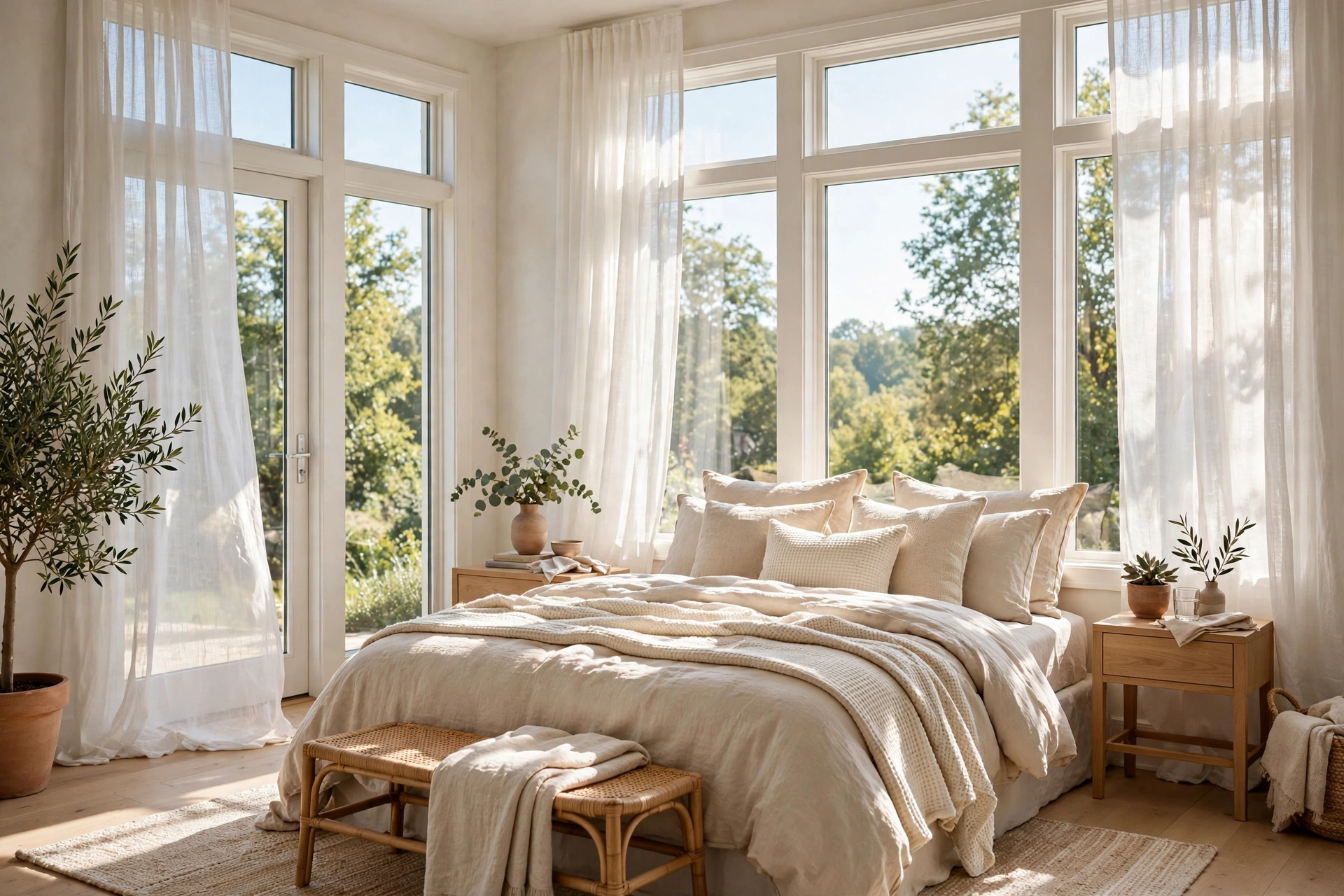
Swap blackout curtains for light-filtering sheers during the day, or use double rods so you can have both. Trim outdoor bushes that block windows. Clean your windows — it makes a bigger difference than you’d think.
Add Mirrors Strategically
A large mirror on the wall adjacent to the window (not opposite, which can create glare) bounces light deeper into the room. Mirrored closet doors serve double duty.
Brighten the Surfaces
Paint Lighter
Choose paint with a Light Reflectance Value (LRV) above 70. White ceilings are essential — a dark ceiling absorbs light and makes the room feel cave-like.
Lighten Textiles and Furniture
Dark bedding, rugs, and furniture absorb light. You don’t need to replace everything — a light duvet cover and a pale area rug can transform the feel.
Layer Artificial Lighting
A dark bedroom needs three types of daytime lighting: bright overhead (consider a daylight-mimicking LED fixture), task lighting near seating areas, and accent lighting to eliminate dark corners. Smart bulbs that shift from cool daylight to warm evening tones are ideal.
Measure Your Progress
Use a free lux meter app on your phone. Aim for at least 300 lux for comfortable daytime use. Measure before and after each change — you’ll be surprised which fixes make the biggest difference.
Diagnose First: Why Is Your Bedroom Dark?
Fixes work best when they target the actual cause. Walk through these five factors before spending money — the culprit is usually one dominant issue plus a couple of minor ones.
Orientation. North-facing bedrooms (in the northern hemisphere) receive no direct sun, ever — only cool, indirect light. South-facing rooms get the most. If your bedroom faces north, accept that artificial lighting will always do heavy lifting, and prioritize it rather than fighting for daylight that is not coming.
🛒 Shop This Look:
Window size and count. One small window cannot light a 200-square-foot room no matter what you do to it. Older homes and basement bedrooms often have undersized windows. Note the ratio: if window glass covers less than about 10% of the floor area, the room is structurally light-starved.
Exterior obstructions. Walk outside and look at the window from the yard. Overgrown shrubs, a neighboring building, a deep porch overhang, or a fence close to the glass can each cut daylight dramatically. Trimming a single overgrown bush has transformed more dark bedrooms than any paint color.
Interior light thieves. Dark wall paint, dark flooring, heavy furniture, and dark bedding each absorb light instead of bouncing it. A room with white walls but a dark wood floor, espresso furniture, and navy bedding can still feel dim — surfaces matter as much as windows.
Time-of-day patterns. Notice when the room is darkest. Morning-dark but afternoon-bright (east blocked, west open) suggests an obstruction on one side. Dark all day points to orientation or window size. This tells you whether to invest in window fixes or lighting.
Window Treatments That Maximize Daylight
Window treatments are the highest-leverage fix because they control 100% of your natural light at the source.
- Sheers instead of blackout (for daytime). Light-filtering sheers diffuse sunlight while preserving privacy — you get glow without glare. Keep blackout curtains for sleep, but open them fully every morning; curtains pushed to the sides still block 10–15% of the window if the rod is too short.
- Extend the curtain rod. Mount the rod 4–6 inches beyond the window frame on each side and 4–6 inches above it. When open, curtains stack against wall instead of glass, exposing the full window. This one change can add 20–30% more effective glass.
- Top-down, bottom-up shades. These lower from the top, letting daylight in at ceiling level — where it bounces deepest into the room — while keeping the lower window covered for privacy. Ideal for street-facing bedrooms.
- Light-colored treatments only. Dark curtains absorb the light hitting them; white or cream sheers transmit and diffuse it. Even the liner matters — replace dark liners with light-filtering ones.
- Remove valances and heavy pelmets. Anything covering the top 6–12 inches of the window blocks the highest-angle daylight, which is the light that reaches farthest into the room.
- Consider window film. Privacy film with high visible-light transmission gives daytime privacy without curtains at all — maximum glass, zero fabric blocking light. Apply to the lower sash and leave the upper sash clear.
Your Daytime Lighting Plan: Think in Lumens
Stop shopping by watts or “brightness vibes” — lumens are the actual measure of light output, and every bulb lists them. A comfortable daytime bedroom needs roughly 2,000–4,000 total lumens depending on size and darkness.
Layer one: overhead. A flush-mount or semi-flush LED fixture delivering 1,500–2,500 lumens is your daylight substitute. Choose 4000–5000K color temperature for daytime use — this “daylight” range tricks your brain into feeling like natural light. If the fixture is on a dimmer, you can warm it down in the evening.
Layer two: task. Reading chair, vanity, desk — each activity spot needs its own 400–800 lumen source. A dark corner with a chair and no lamp is a dead zone; a chair with a floor lamp becomes a destination.
Layer three: accent. LED strips behind the headboard, a small lamp on the dresser, uplights in dark corners. Accent light eliminates the cave effect where corners disappear into shadow. Even 200–400 lumens per accent point changes the room’s feel.
Smart bulbs earn their keep here. Bulbs that shift from cool daylight (5000K) during the day to warm (2700K) at night give you two rooms in one. Schedule the shift automatically so you never think about it.
🛒 Shop This Look:
Placement rules: bounce light off walls and ceilings rather than pointing it down — a torchiere floor lamp washing the ceiling brightens a room more than a brighter downward pendant. Keep fixtures out of direct sightlines to avoid glare, which makes rooms feel darker by contrast.
Renter-Friendly Brightening (No Paint Allowed)
- Mirrors, correctly placed. The existing advice stands — adjacent to the window, not opposite — and bigger is better. A full-length leaning mirror beside the window doubles the perceived window. Mirrored closet doors are the highest-impact renter mirror because of their sheer size.
- Light textiles everywhere. White or cream duvet cover, pale throw at the foot of the bed, light rug. Textiles cover more surface area than walls in a furnished bedroom — changing them changes the room’s reflectance dramatically.
- Peel-and-stick upgrades. Removable light-colored wallpaper on one wall, peel-and-stick tile on a dark accent wall — both come off cleanly at move-out and both bounce far more light than dark paint.
- The light shelf trick. A white floating shelf mounted just above eye level on the window wall bounces incoming daylight up onto the ceiling, pushing light deeper into the room. It sounds odd; it works remarkably well in side-lit rooms.
- Swap dark furniture gradually. You do not need to replace everything — start with the largest dark surface. A light duvet over a dark bed, a pale runner over dark floors, a white shade on a dark lamp base. Each swap raises the room’s average reflectance.
Structural Limits: When to Accept the Darkness
Some bedrooms cannot be made bright, and knowing the limit saves wasted money. Basement bedrooms with small egress windows, rooms facing a windowless wall three feet away, and north-facing rooms in high latitudes have hard daylight ceilings. In these rooms, the goal shifts: not a sunlit room, but a pleasantly, evenly lit room that never feels like a cave.
Maximize what exists — clear obstructions, sheer treatments, light surfaces — then build the artificial lighting plan as the primary system rather than a supplement. A well-layered 3,000-lumen lighting plan in a basement bedroom feels better than a half-hearted attempt to harvest daylight that is not there.
One honest note: if daytime darkness is affecting your mood or sleep through the winter months, a light therapy lamp used in the morning is a widely available option many people find helpful. That is a wellness decision, not a decor one — but it belongs in the conversation about dark bedrooms.
FAQs
What LRV should bedroom paint be? Light Reflectance Value runs 0–100. For a dark bedroom, aim for LRV 70+ on walls and 85+ on the ceiling. Most paint brands list LRV on the color chip or website — check before buying, since two “white” paints can differ by 10+ LRV points.
Do mirrors really double the light? No — that is an exaggeration. A well-placed mirror redirects existing light deeper into the room and doubles the perceived window, which reads as much brighter. But a mirror cannot create light that is not entering; in a truly windowless-feeling room, mirrors help less than an additional lamp.
Should I use daylight bulbs all day? For daytime use in a dark room, yes — 4000–5000K supports alertness and reads as natural light. Shift to 2700K warm light in the evening; cool light at night can interfere with winding down.
Will a skylight or solar tube fix it? A tubular skylight (solar tube) can transform a dark bedroom for a moderate installation cost and works even on cloudy days. It is the single most effective structural fix — but it requires roof access and professional installation, so it is an owner decision, not a renter one.
How do I know if my fixes are working? The lux meter method from the original article is genuinely useful: measure at the bed, the chair, and the darkest corner before and after each change. Daylight on an overcast day outdoors is around 10,000 lux; your target indoors is 300+ lux at activity spots. Numbers beat impressions.
🛒 Shop This Look:



