
As an Amazon Associate, I earn from qualifying purchases. This means I may earn a commission if you purchase through links on this page — at no extra cost to you.
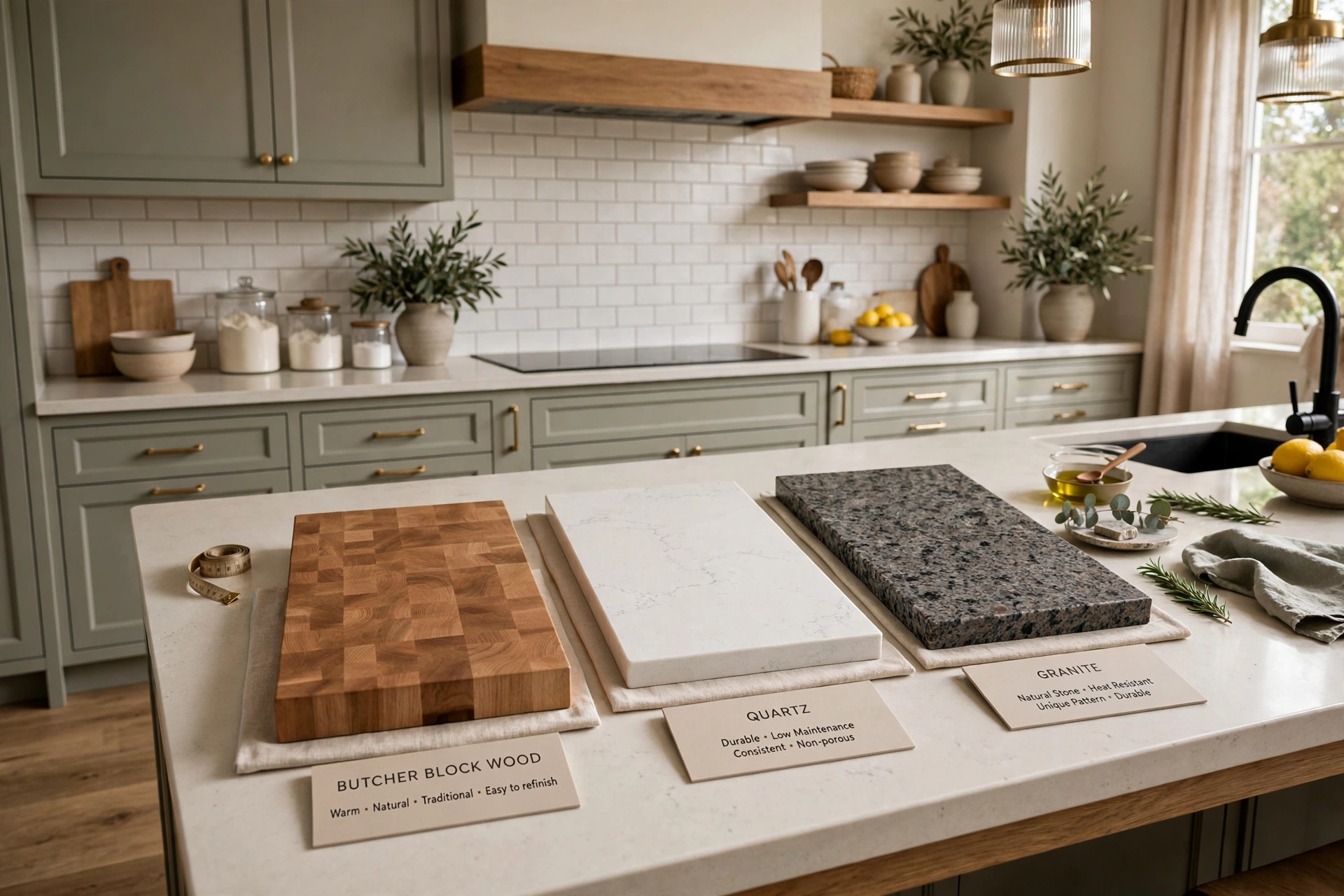
Butcher block offers warmth and affordability ($30–$80/sq ft installed) but requires regular oiling and is prone to scratches and water damage. Quartz provides the best durability with zero maintenance ($50–$120/sq ft) and comes in the widest range of patterns. Granite delivers natural uniqueness and heat resistance ($40–$100/sq ft) but needs periodic sealing. For most homeowners in 2026, quartz wins on practicality, while butcher block wins on charm and budget. Related: Marble vs Marble-Look Quartz Countertops: Can You Tell.
Quick Comparison Table
Here’s how they stack up:
- Price (installed): Butcher block $30–$80 → Granite $40–$100 → Quartz $50–$120 per sq ft
- Maintenance: Quartz (none) > Granite (seal yearly) > Butcher block (oil monthly)
- Durability: Quartz > Granite > Butcher block
- Heat resistance: Granite > Quartz > Butcher block
- Repairability: Butcher block (sand out damage) > Granite > Quartz
Butcher Block: Warm, Affordable, High-Maintenance
Pros
- Beautiful natural warmth that softens modern kitchens
- Most affordable of the three
- Can be sanded and refinished (damage isn’t permanent)
- Knife-friendly surface (won’t dull blades like stone)
- DIY-friendly installation possible
Cons
- Requires mineral oil treatment every 2–4 weeks
- Susceptible to water damage, warping, and staining
- Scratches and dents easily
- Not ideal around sinks without excellent sealing
- Can harbor bacteria if not maintained
Best for: Budget renovations, farmhouse/cottage styles, islands (as an accent), and homeowners who enjoy maintenance rituals.
Quartz: The Practical Champion
Pros
- Virtually indestructible for daily use
- Zero maintenance — no sealing ever
- Non-porous (won’t stain or harbor bacteria)
- Huge range of colors and patterns, including convincing marble looks
- Consistent appearance (no surprises like natural stone)
Cons
- Most expensive of the three
- Not as heat-resistant as granite (use trivets)
- Can look “too perfect” — lacks natural variation
- Not ideal for outdoor use (UV can discolor)
- Heavy — requires professional installation and sturdy cabinets
Best for: Busy families, anyone who wants zero maintenance, modern and transitional kitchens, and resale value.
Granite: Natural Beauty with Some Upkeep
Pros
- Each slab is unique — no two kitchens look alike
- Excellent heat resistance (place hot pots directly)
- Very hard and scratch-resistant
- Mid-range pricing with high-end look
- Proven track record (decades of use)
Cons
- Requires sealing every 1–2 years
- Can stain if not sealed (especially light colors)
- Natural variation means the sample may differ from your slab
- Seams are visible on large counters
- Can feel dated depending on the pattern (busy granites from the 2000s)
Best for: Traditional kitchens, cooks who want heat resistance, and anyone who loves natural stone character.
Which Should You Choose?
Choose butcher block if: Budget is tight, you love the warm look, and you don’t mind monthly oiling.
Choose quartz if: You want the easiest ownership experience and are willing to pay for it.
Choose granite if: You cook frequently with hot pots, love natural stone, and don’t mind occasional sealing.
Consider mixing: Many designers use quartz on perimeter counters and butcher block on the island — best of both worlds.
Installation: What Actually Happens (and What Can Go Wrong)
The material is only half the decision — the other half is what it takes to get it into your kitchen. The three materials diverge sharply here. Related: What Are the Standard Kitchen Countertop Heights.
Butcher Block
This is the only one of the three a skilled DIYer can realistically install. Wood cuts with standard tools, seams can be glued and sanded nearly invisible, and a single strong person can maneuver most sections. The critical steps amateurs skip: sealing all six sides (including cutouts and the underside) before installation, because unsealed wood near a dishwasher or sink will warp; and leaving a small expansion gap at walls, since wood moves with humidity. Professional installation is still worth it for complex layouts with many seams or integrated sinks.
Quartz and Granite
Both require professional templating and installation — full stop. The process: after your cabinets are set and level, a fabricator laser-templates the exact layout, cuts the slabs off-site with water jets, then delivers and seams them in your kitchen. Plan for the realities:
- Weight: stone runs about 20 pounds per square foot. Your cabinets must be level, securely anchored, and structurally sound — shimming a heavy slab on wobbly cabinets is asking for cracked seams later.
- Seams: slabs max out around 10 feet, so longer runs will have seams. Ask where the fabricator plans them — good fabricators hide seams near sinks and cooktops, away from the eye’s natural landing spots.
- Timeline: templating to installation typically takes one to three weeks. You will be without counters during part of this — plan your temporary kitchen.
- Sink cutouts: undermount sinks require the fabricator to cut and polish the opening. Decide on your exact sink model before templating; changing it later means re-cutting or replacing the slab.
Edge Profiles and Sink Choices That Change the Look
Two decisions that cost little but transform the result:
- Edge profiles: a simple eased (slightly rounded) edge is timeless, cheapest, and easiest to clean — crumbs have nowhere to hide. Ogee and dupont edges look traditional but cost more and can feel dated. Mitered edges create the thick, waterfall look popular in modern kitchens. For butcher block, a softly rounded edge prevents splinters and wear.
- Sink mounting: undermount sinks (standard with stone) create a seamless wipe-down surface — the single biggest daily-use upgrade over a drop-in. With butcher block, undermounts are risky around the cutout’s exposed wood; a drop-in or apron-front sink with a well-sealed rim is safer. If you love the undermount look with wood, budget for marine-grade sealing around the cutout and accept higher maintenance there.
Realistic Care Calendars
Forget “low maintenance” as a vague claim — here is what each material actually asks of you.
Butcher Block: Monthly Attention
- Daily: wipe up water and spills promptly; never let water pool. Use cutting boards for heavy chopping if you want to preserve the surface (or chop directly if you embrace the patina).
- Every 2–4 weeks: apply food-safe mineral oil to all surfaces, more often near the sink. The wood should never look dry or pale.
- Every 6–12 months: light sanding and re-oiling, or apply a beeswax/mineral oil conditioner for extra protection.
- As needed: sand out stains, burns, and deep cuts — this is the material’s superpower. Start with fine grit and work with the grain.
Granite: Yearly Attention
- Daily: wipe with a damp cloth and mild dish soap. Avoid acidic cleaners and harsh chemicals that degrade sealer.
- Yearly (or every two years): test the seal by dripping water on the surface — if it beads, the seal holds; if it soaks in and darkens the stone, reseal. Resealing is a straightforward DIY job: clean, apply sealer, buff.
- Ongoing: use trivets rarely needed (granite handles heat), but cutting boards always — granite will destroy knife edges.
Quartz: Almost Nothing
- Daily: wipe with damp cloth and mild soap. That is genuinely it for routine care.
- Ongoing: always use trivets — sustained heat above around 300°F can damage the resin. Avoid harsh chemicals like bleach and oven cleaner.
- Never needed: sealing, oiling, waxing, or special treatments. The non-porous surface does the work.
Resale Value and Long-Term Thinking
- Quartz currently photographs best and matches buyer expectations in most markets — it is the safest resale choice in a mid-range to upscale kitchen.
- Granite still reads as premium, but busy or speckled patterns can date a kitchen to the 2000s. If resale matters, choose quieter, honed or leathered granites in neutral tones.
- Butcher block is polarizing at resale: design-savvy buyers love it, traditional buyers see maintenance. It shines brightest on islands (as an accent) rather than across the whole kitchen.
- Lifespan reality: stone counters can last the life of the house; butcher block lasts decades with care and can be refinished multiple times. The cabinets underneath usually fail first.
Choose the material whose maintenance rhythm fits your actual life, not your aspirational one. The “best” countertop is the one you will care for as it needs — a neglected butcher block looks worse than a well-kept laminate, while a quartz counter forgives the busiest household.
Health, Safety, and Environmental Considerations
- Food safety: quartz and sealed granite are non-porous and inhospitable to bacteria with normal cleaning. Butcher block is safe for direct food contact if maintained — the oiled surface is naturally resistant, but deep cuts and dried-out wood can harbor bacteria. Use separate boards for raw meat regardless of countertop material, and never let the wood stay wet.
- Radon in granite: some granites emit trace radon. The levels in installed countertops test far below concern thresholds in the overwhelming majority of cases — this is a widely discussed but practically negligible issue. If it worries you, the stone supplier can share test data for your specific slab.
- Quartz and silica dust: the health concern with quartz is occupational — fabrication workers cutting engineered stone without proper dust control face silicosis risk. As a homeowner, this affects your choice of fabricator (ask about their dust controls and wet-cutting practices) rather than the installed counter, which is inert and safe.
- Butcher block finishes: use food-safe mineral oil or purpose-made board creams, not cooking oils (olive, coconut) which turn rancid. For the area around the sink, a food-safe waterproof finish offers more protection than oil alone — at the cost of needing complete sanding if you ever want to return to an oil finish.
- Sustainability angles: butcher block from certified sustainable forestry is the lowest-impact choice and fully biodegradable at end of life. Granite is natural but quarried and shipped heavy. Quartz is manufactured — some brands now incorporate recycled content. None is perfect; buy once and keep it for decades is the greenest move of all.
Questions to Ask Your Fabricator or Supplier
- Where will the seams fall, and can I approve the layout before cutting?
- How do you support overhangs over 10 inches (corbels, steel brackets, or plywood substrate)?
- What is the lead time from template to install, and what do I need to have ready (sink, faucet, cooktop on site)?
- For granite: which sealer do you recommend, and will you do the first application?
- For butcher block: is the wood sealed on all sides before install, and what oil do you recommend for maintenance?
- What does the warranty cover — and does DIY maintenance (like resealing granite myself) void any of it?
The fabricator relationship matters as much as the material. A great fabricator makes mid-range stone look perfect; a careless one ruins premium slabs with bad seams and lippage. Check reviews specifically mentioning seam quality and templating accuracy — those are the two things you cannot fix after install day.
— Ella Knight
🛒 Shop This Look:
🛒 Shop This Look:
- Kitchen Ideas Hub
- Countertop Decor
- Butcher Block Guide
🛒 Shop This Look:




1 thought on “Butcher Block vs Quartz vs Granite: Complete Countertop Guide”
Comments are closed.