
As an Amazon Associate, I earn from qualifying purchases. This means I may earn a commission if you purchase through links on this page — at no extra cost to you.
By Ella Knight
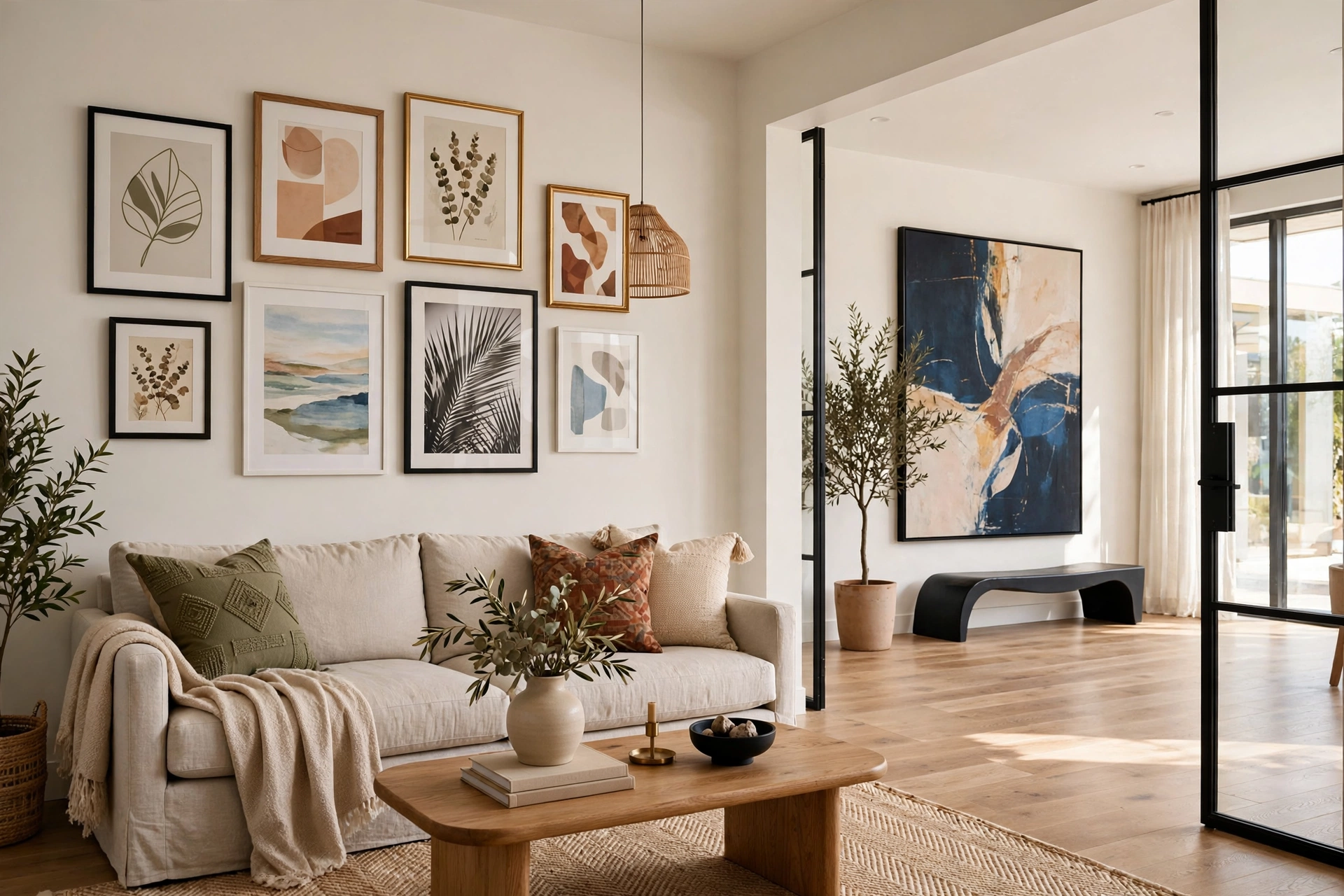
Choose a gallery wall when you want visual interest, have multiple pieces to display, or need to fill a large wall. Choose a single statement piece when you prefer minimalism, have one stunning artwork, or want a calm focal point. Gallery walls suit eclectic and maximalist styles; statement pieces suit modern minimalist spaces.
When a Gallery Wall Wins
- You have many small art pieces or photos to display
- The wall is large and one piece would look lost
- You enjoy an eclectic, collected-over-time aesthetic
- You want to tell a visual story across multiple frames
- You’re working with a tight budget (small prints are cheaper)
When a Statement Piece Wins
- You own one artwork you truly love
- Your style leans minimalist or Scandinavian
- The room is already visually busy
- You want a calm, restful atmosphere (bedrooms)
- The wall is small — one piece has more impact
Room-by-Room Recommendations
Living Room
Gallery wall for large walls; statement piece above the fireplace or sofa in smaller living rooms.
Bedroom
Statement piece usually works better — bedrooms benefit from visual calm.
Hallway
Gallery wall — hallways are perfect for a linear arrangement of smaller pieces.
Home Office
Either works. Gallery wall for inspiration; statement piece for video call backgrounds.
Can You Combine Both?
Absolutely. Use a large statement piece as the anchor, then add 2-3 smaller frames around it. This hybrid approach gives you the impact of a statement piece with the personality of a gallery wall.
The True Cost Comparison
Budget often decides this question before taste does, so let’s talk real numbers. A gallery wall is one of the cheapest ways to fill a large wall well. Small art prints and printable downloads run roughly $3–15 each; basic frames in standard sizes run about $8–20 each at discount and big-box stores. A respectable 8-piece gallery wall therefore lands somewhere around $100–250 all-in — and you can build it gradually, a frame or two per month, which spreads the cost painlessly.
A single statement piece is harder to price because the range is enormous. A large ready-made canvas from a home store might run $80–200; a large framed print from an art retailer, $150–400; an original painting from a local artist, $300 well into four figures. Custom framing a large piece alone can cost $150–300, which surprises a lot of first-time buyers — always price the framing before you fall in love with an unframed oversized print.
🛒 Shop This Look:
But the honest comparison isn’t just upfront cost. Gallery walls have a hidden advantage: they’re expandable and forgiving. Bought a print you no longer love? Swap one $12 frame’s contents. A statement piece is all-or-nothing — if your taste changes, you’re replacing the entire investment. Over five years of evolving taste, the gallery wall usually costs less in practice, because it absorbs change one piece at a time.
The budget winner for most people is actually the hybrid: one moderately sized anchor piece (say 16×20) surrounded by smaller, cheaper frames. You get the impact of a statement with the wallet-friendly flexibility of a gallery, typically for $120–300 total. It’s the best of both worlds unless you’re committed to strict minimalism.
Which Is Easier to Live With Long-Term?
The question nobody asks before hanging art is: how will I feel about this in three years? Gallery walls and statement pieces age very differently. A gallery wall is a living display — you can rotate pieces seasonally, swap in new finds from travels, and let it evolve as your taste does. That evolvability is its superpower against visual fatigue. When you’re tired of one print, you change one print, not the whole wall.
A statement piece is more like a marriage: wonderful when it’s right, awkward when it isn’t. The piece you loved at purchase can start to feel like visual background noise — or worse, like something you’re stuck with because it was expensive. Psychologists call this hedonic adaptation, and large single artworks are particularly susceptible because there’s nothing else on the wall competing for your attention. If you choose a statement piece, choose one with layers — detail, texture, or complexity that rewards repeated looking over years.
Moving is the other long-term factor. Gallery walls are a mover’s friend: small frames pack easily, and the arrangement can be completely reinvented for a new wall. A single oversized piece is fragile, awkward to transport, and may not fit the proportions of your next home’s walls. If you rent or expect to move within a few years, the gallery wall is the lower-risk commitment by a wide margin.
There’s also the dusting factor, unglamorous but real. Eight frames mean eight glass surfaces to dust and eight chances for crooked hanging after a door slams. One statement piece means one surface and one level check. If low maintenance genuinely matters to you — and there’s no shame in that — factor it in.
A Decision Checklist: 7 Questions to Ask Yourself
Still torn? Work through these questions honestly — your answers will point clearly in one direction.
1. How big is the wall? Measure it. If the empty wall is wider than about 6 feet, a single piece needs to be very large (and expensive) to avoid looking lost. Big wall? Lean gallery. Small wall or narrow nook? Lean statement.
2. What’s already in the room? Count the visual activity: patterned rugs, busy bookshelves, bold furniture. An already-busy room usually wants the calm of one statement piece. A sparse, quiet room can handle — and often needs — the energy of a gallery wall.
3. Do you own the art already? If you have a drawer full of prints and photos waiting for walls, the universe is telling you something. If you own exactly one piece you love, honor it with the spotlight.
🛒 Shop This Look:
4. How often do you redecorate? Frequent redecorators should choose the gallery wall’s flexibility. If you hang things once and leave them for a decade, a timeless statement piece is the lower-effort choice.
5. What’s your tolerance for imperfection? Gallery walls — especially salon style — forgive slightly crooked frames and evolving arrangements. Statement pieces demand precision: one crooked large frame ruins the whole effect. Be honest about your hanging skills and patience.
6. Who uses this room? Bedrooms and meditation corners favor the calm of a single piece. Living rooms, hallways, and creative workspaces thrive on the gallery wall’s energy and storytelling.
7. What does your gut say? After all the analysis, notice which option you’re hoping the checklist recommends. That instinct is data too — you’ll be living with this wall every day, and genuine enthusiasm beats optimal logic.
What If You Can’t Decide? Start Here
If the checklist left you genuinely torn, there’s a practical path forward that doesn’t require committing to either camp on day one. Start with the hybrid approach and let the wall tell you what it wants.
Begin with one anchor piece you love — not the biggest you can afford, but the piece you’d keep if you could only keep one. Hang it alone, centered where the arrangement will go, at 57 inches to center. Live with it for a week. Pay attention to how the wall feels: does the single piece feel complete and calming, or does the surrounding emptiness feel like it’s asking for company? Your honest reaction after a week of actually living with it is more reliable than any amount of pre-planning.
If the wall feels like it wants company, add slowly. One or two smaller pieces at a time, using paper templates so you’re not committing to holes. This gradual build has a hidden benefit: it teaches you your own taste. You’ll discover whether you reach for matching frames (a grid person) or eclectic mixes (a salon person) by observing what you actually buy and love.
There’s also the seasonal compromise that committed minimalists and maximalists both overlook: a picture ledge. Mount one ledge and you can have a single statement piece leaning on it in winter and a layered cluster of small frames in summer, swapping in minutes with zero new holes. It’s the lowest-commitment way to test-drive both aesthetics in your actual space.
And remember that “forever” is not required. Art arrangements are not tattoos. A gallery wall can be edited down to a single piece; a statement piece can gain companions. The goal isn’t to make the perfect permanent choice — it’s to make a good choice now and give yourself permission to evolve. The walls you love most in five years will probably be the ones you allowed to change.
The Bottom Line
There is no universally right answer — only the right answer for your wall, your room, and your life right now. Big empty wall, eclectic taste, evolving collection, modest budget: build the gallery wall. Small wall, calm room, one beloved piece, low-maintenance priority: hang the statement. And if you’re still unsure, choose the hybrid: one anchor piece with a few smaller companions. It delivers most of the gallery wall’s personality with most of the statement piece’s calm, and it leaves every future option open. The worst choice isn’t gallery or statement — it’s the bare wall you keep meaning to deal with someday.
🛒 Shop This Look:



