
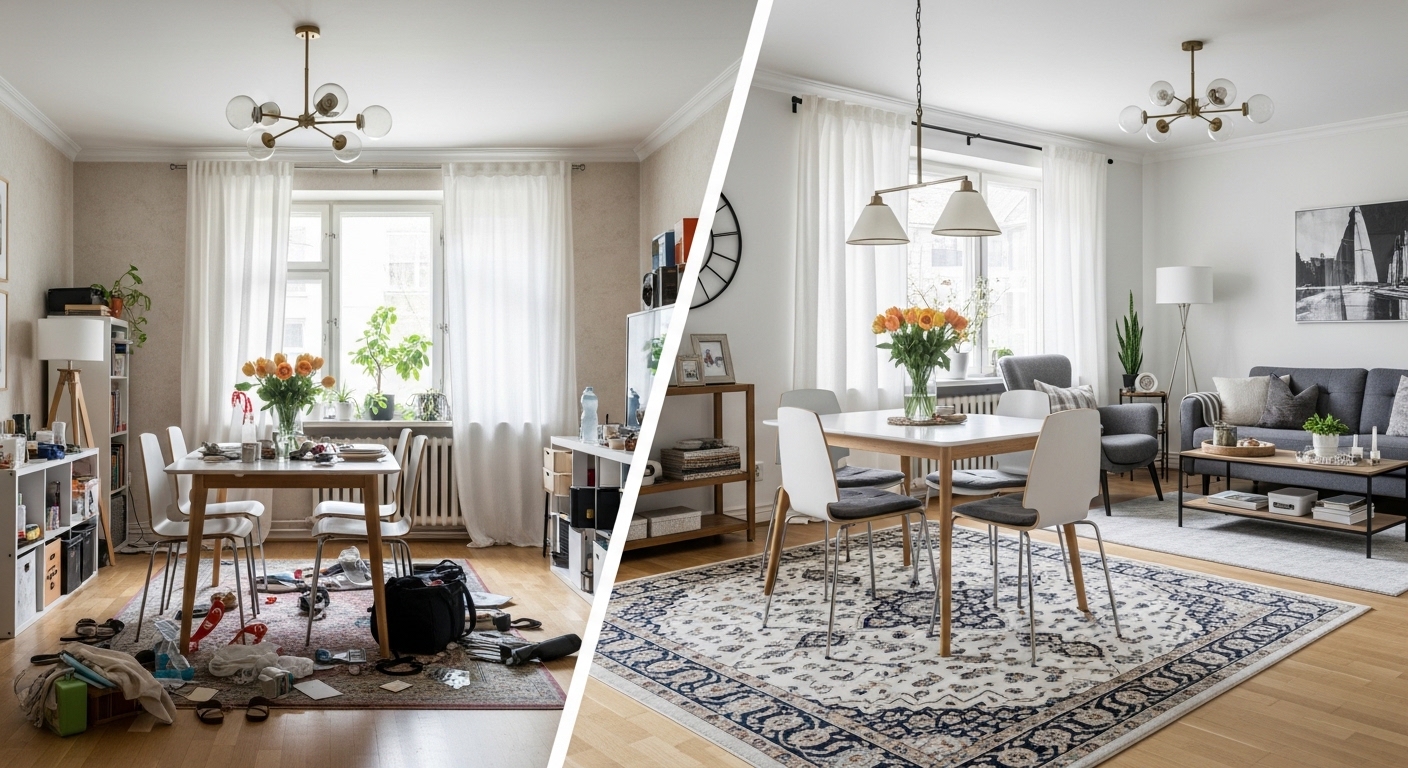
The holidays do not ask your dining room to become a different room. They ask it to do its usual job a little better, for a few more people, for a longer meal than usual. Guests do not walk in and judge your chairs or whether your table matches a theme. They notice whether they can sit down without shuffling furniture, reach their glass without stretching, and see the people across the table. That is the whole job of a guest-ready dining room, and it is mostly about arrangement, not shopping. This guide keeps the focus on what you already own, and the welcome starts before the dining room: our Thanksgiving Entryway ideas show how a clear, warm arrival sets the tone for the meal that follows.
Start with the room you already have
Before you move a chair, sit in every seat at the table, one after another, as a guest would. From each seat, look for the same three things: can you see the people you would be talking with, can you reach your glass and your plate without stretching, and can you get up without asking someone else to push their chair in? A seat that fails any of those tests is not really a guest seat yet.
Most dining rooms already have enough room for the meal; the problem is that the room is still arranged for everyday life. Clear the post, the basket, and the bag from the chairs and the sideboard first, pull the table a little away from the wall if you can, and leave space behind each chair so people can sit down without a shuffle. If the room still feels stuck, the HomeisDecor Services page explains how a custom room plan can be put together for your own space.
Clear a path before you set the table
Holiday decorating often starts with adding things, but a guest-ready dining room starts with taking things away. Clear the walkway from the door to the table, and from the table to the kitchen, because guests will use both routes during the meal. Walk each route carrying something in both hands, as if you were bringing in a hot dish. If you have to slow down, turn sideways, or ask someone to move a chair, the path is still too tight. Move the extra chair, the plant, or the basket that blocks the way, and keep the serving route clear even when the table is full.
Give everyone a real seat at the table
Count the people who will sit down at the busiest moment, then count the chairs. A dining chair pulled in from another room is a perfectly good guest seat, as long as it has a back, a firm seat, and room for the person sitting on it to pull it out. A stool or a bench can work for a short time, but they are tiring over a long meal, so keep them as extra seats, not as the main seat for an older guest.
Place extra chairs where they can join the table, not where they are out of the way. A chair tucked in a corner faces the wall, not the conversation, so bring it to the table and give it the same space as every other seat. Keep the head of the table for the person who will be serving, and check that nobody has to sit with a door swinging behind them.
Set the table for the meal, not for a photograph
A guest-ready table is a working table. It needs room for plates, glasses, serving dishes, and elbows, and it needs to stay comfortable when the food arrives. Keep the centre low and simple, so people can see each other across it, and leave space for the dishes that will actually be passed around. A tall arrangement or a wide runner that leaves no room for a plate can make the table look full before anyone has sat down.
Choose one calm centrepiece, such as a low bowl of greenery, a few candles, or a simple cloth runner with a small arrangement at its centre, and let the food and the people do the rest. Put a glass and a plate at every seat before guests arrive, and check that each place has room for a side plate and a glass without crowding the person beside it. Then sit down yourself and try to pass a dish across the table; if you have to lift it over candles, move them to the sideboard.
The first-seating scan
Imagine the first ten minutes of the meal, from a guest’s point of view. Guests arrive, find their seat, put down a drink, and look around the table. In those ten minutes, they form a clear impression of the dining room. They notice five things, in roughly this order: a clear path to the table, a real seat with room to sit down, a place set and ready for them, warm light over the table, and a sideboard that is clear enough to help, not cluttered enough to get in the way.
Start with the path and the seat. Guests need to reach the table without pausing to work out where to go, and they need to be able to sit down within a minute of arriving, in a seat that faces the table and is close enough to the conversation. The place setting follows quickly: a cleared plate, a glass, and a little space for elbows lets guests settle, instead of shifting things around to make room for themselves. Warm light is the fourth thing guests notice, often without realising it, and a clear sideboard is the fifth, because it shows the room is ready for the meal, not just dressed for a photograph.
Make the sideboard and buffet work for the meal
A sideboard or buffet is the hardest-working piece of furniture in a holiday dining room, because it holds the food, the spare plates, and the things you need during the meal. Clear it before guests arrive, and give it one job at a time: drinks at one end, serving dishes in the middle, and spare plates and cutlery at the other end. That way, guests can help themselves without reaching across the table, and the person serving does not have to carry everything back and forth to the kitchen. Our Holiday Kitchen ideas show how a clear, guest-ready kitchen makes that serving route easier.
Keep only the serving pieces on the sideboard, and move the everyday clutter somewhere else for the evening. A jug of water, a few spare glasses, and a cloth for spills are useful; a pile of post and a vase that blocks the way are not. Leave a clear space at one end for empty plates, so the table can be cleared without a pile building up beside the person serving.
Warm light over the table, not just more light
Holiday meals are mostly evening meals, so lighting deserves as much thought as seating. The aim is warm, layered light at different heights, not one bright overhead light switched on and left on. Let the light over the table do the main work, add a lamp on the sideboard or a candle on the table for a softer glow, and check the room after dark, before guests arrive. Look for dark corners where a guest might feel cut off from the table, and for bright spots where a bare bulb shines straight into someone’s eyes. A lower lamp or a candle moved to the sideboard can make the whole room feel settled.
Guest-ready dining-room fixes by spot
You do not need a whole weekend to make the dining room ready for guests. The work is mostly rearranging, so start with the spot that bothers you most and stop when the room passes the first-seating scan.
| Spot | What to focus on | A simple fix that helps most |
|---|---|---|
| Table | A clear, working surface | Clear the centre, keep it low, and leave room for plates, glasses, and serving dishes. |
| Extra seats | A real seat for everyone | Bring in a chair with a back, give it the same space as the other seats, and check the path behind it. |
| Sideboard/Buffet | A clear serving surface | Clear one end for drinks, one end for spare plates, and keep the middle free for serving dishes. |
| Lighting | Warm light over the table | Use the light over the table, add a lamp or a candle on the sideboard, and check the room after dark. |
Keep the flow easy between rooms
Guests will not stay at the table for the whole evening, so keep the route to the living room clear, so people can drift back for a drink and a conversation after the meal, and keep the route to the kitchen clear, so the person serving does not have to squeeze past chairs with a hot dish. Our Holiday Living Room ideas show how the same thinking — a clear path, a real seat, and warm light — makes the room next door feel ready too.
A room that is ready, not redecorated
A guest-ready dining room does not need new furniture, a new colour scheme, or a new theme. It needs a clear path, a seat for everyone, a table set for the meal, a sideboard that helps, and warm light over the table. Arrange those five things first, and let the room do what it already does well. When guests sit down, they will not be thinking about your decorating; they will be thinking about the conversation, the food, and the people around the table.