
As an Amazon Associate, I earn from qualifying purchases. This means I may earn a commission if you purchase through links on this page — at no extra cost to you.
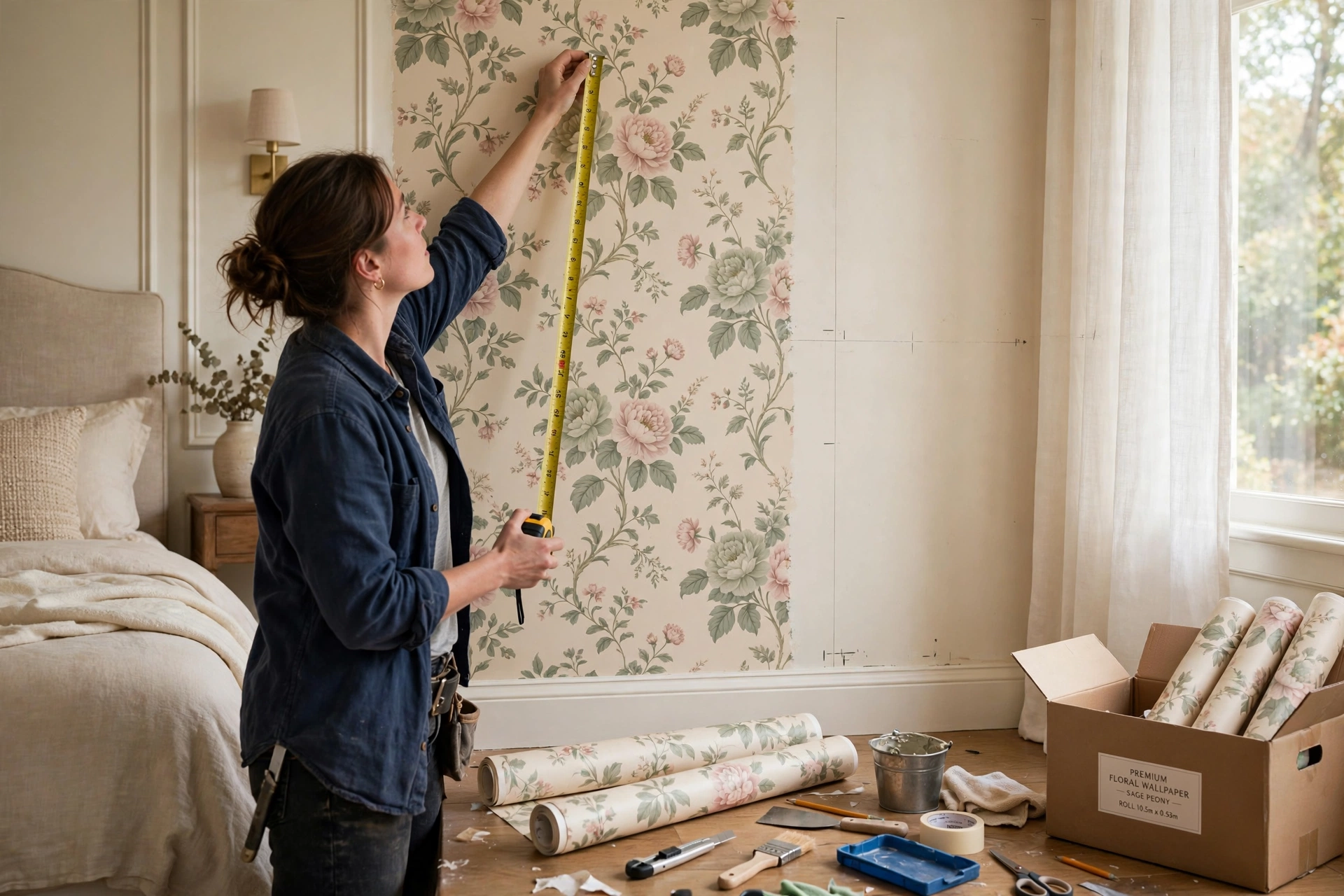
To calculate how much wallpaper you need, measure each wall’s width × height in feet, add the totals, subtract large openings (doors, windows), then divide by one roll’s coverage (about 28 sq ft for US single rolls, 56 sq ft for double rolls). Always round up and add 10–15% extra for pattern matching and mistakes.
The Basic Formula
Step 1: Wall width (ft) × wall height (ft) = wall square footage. Do this for every wall.
Step 2: Add all walls together.
Step 3: Subtract 20 sq ft per door, 15 sq ft per standard window.
Step 4: Divide by roll coverage.
Step 5: Round up, then add 10–15% for pattern repeat waste.
Worked Example
Bedroom with two 12-ft walls and two 10-ft walls, 8-ft ceilings, one door, one window:
Walls: (12×8) × 2 + (10×8) × 2 = 192 + 160 = 352 sq ft
Minus openings: 352 − 20 − 15 = 317 sq ft
Double rolls (56 sq ft each): 317 ÷ 56 = 5.7 → 6 rolls
Plus 15%: 6 × 1.15 = 6.9 → 7 double rolls.
Large patterns waste more. A 24-inch repeat can waste 25%+ versus a 12-inch repeat, because every strip must start at the same point in the pattern. Check the repeat size on the label and add extra accordingly: small repeat (under 12″) +10%, large repeat (over 18″) +20–25%.
Peel-and-Stick Rolls
Peel-and-stick rolls are narrower (usually 18–24 inches wide) with about 25–30 sq ft per roll. The math is the same, but you’ll need more rolls — and because you can’t return opened rolls easily, the 15% buffer matters even more.
Quick Reference
- Powder room: 2–3 single rolls
- Bedroom accent wall: 3–5 single rolls
- Full small bedroom: 8–12 single rolls
- Dining room: 10–14 single rolls
Measuring Tricky Walls: Sloped Ceilings, Stairwells, and Niches
The basic formula handles rectangles. Real rooms have slopes, stairs, and odd corners — here’s how to measure the ones that trip people up.
🛒 Shop This Look:
Sloped ceilings and attic rooms
Measure the wall at its tallest point and its shortest point, then use the average height × the wall width. This slightly overestimates, which is what you want — the overage covers the angled cuts. For knee walls under eaves, measure each wall section separately rather than trying to compute the slope geometry. Order one extra roll beyond your calculation for sloped rooms; the triangular offcuts waste more paper than you’d expect.
Stairwells
Stairwells defeat standard measuring because the wall height changes along the run. Break the wall into rectangles: measure the rectangular section below the stairs’ lowest point as one rectangle, then measure the triangular section above as a triangle (base × height ÷ 2). Add them together. In practice, most people over-order by 20% for stairwells rather than computing precisely — the awkward angles and long drops make waste unavoidable, and running short mid-stairwell is a special kind of misery.
Niches, alcoves, and bump-outs
Measure each face of a niche separately — the back wall, both sides, and the top and bottom if you’re papering them. Niches look small but their total surface area surprises people; a 3-foot-wide alcove with 1-foot-deep sides adds roughly 15–20 square feet. For bump-outs (like a chimney breast), measure the front face plus both returns. Draw a quick unfolded sketch of the niche on paper and label each face with its measurements — it’s much harder to miss a surface when you can see the net.
Walls with wainscoting or chair rails
If you’re papering only above the wainscoting, measure from the top of the rail to the ceiling — don’t include the wainscot height. But check: is the rail level all the way around? In older homes it often isn’t, which means your “rectangle” is actually a trapezoid. Measure the height at both ends of each wall and use the taller measurement; the paper gets trimmed at the rail, and trimming is easier than stretching.
Reading the Wallpaper Label: What the Symbols Mean
Every roll carries the information you need to calculate correctly — if you know how to read it. Here’s the label decoded.
Roll dimensions and coverage
US single rolls are typically about 20.5 inches wide × 16.5 feet long (roughly 28 sq ft of coverage); double rolls double the length. European rolls are wider (about 21 inches) but shorter (about 33 feet). Peel-and-stick rolls vary wildly — always check the listed coverage rather than assuming. The coverage figure on the label is the usable number for your math, not the raw dimensions.
Pattern repeat and match type
The label lists the pattern repeat (the vertical distance before the pattern starts over — e.g., 12″, 21″, 24″) and the match type. Straight match: every strip aligns at the same height — simplest, least waste. Half-drop match: every other strip is offset by half the repeat — creates dynamic patterns but wastes the most paper, since each strip’s starting point shifts. Random match: no alignment needed — stripes, textures, and grasscloths — virtually zero pattern waste. A half-drop match with a 24-inch repeat can easily waste 25–30% of each roll; that’s not a defect, it’s geometry, and your order quantity must reflect it.
Batch and dye lot numbers
Wallpaper is printed in batches, and colors shift slightly between them — two rolls from different dye lots can show a visible line at the seam. The label shows a batch or dye lot number: order all rolls from the same lot, and if you need more later, bring the number to the retailer. This is the single most common cause of “the new rolls don’t match” complaints, and it’s entirely preventable.
🛒 Shop This Look:
Ordering Smart: Dye Lots, Returns, and When to Hire a Pro
Order everything at once
Always order your full quantity — plus the 10–15% overage — in a single order, and confirm with the retailer that all rolls come from the same dye lot before they ship. Splitting an order across two shipments risks two different lots. Keep one unopened roll after the job; if a section gets damaged years later, that roll is your perfect-match repair stock. Store it upright in a dry closet, not a damp basement or hot attic.
Understand the return policy before you buy
Return policies vary enormously: some retailers accept unopened rolls within 30 days, others treat wallpaper as final sale (especially special-order and European papers). Peel-and-stick is often non-returnable once opened. Know the policy before you order, and never open all your rolls at once — open one, verify the color and lot match in your room’s light, then proceed. Discovering a color problem after opening six rolls is an expensive lesson.
When the math says “hire an installer”
DIY wallpapering is very doable on straightforward walls. Call a professional when: the room has stairwells or ceilings over 10 feet (long drops are genuinely hard to handle solo), the paper is expensive (a $200 roll deserves professional hands — one ruined strip costs more than the labor would have), the walls need significant repair first, or the paper is grasscloth or delicate hand-printed stock that shows every handling mark. Get quotes per roll or per square foot, and ask installers about their experience with your specific paper type — hanging peel-and-stick and hanging traditional paste-the-wall paper are different skills.
Accent Walls vs. Full Rooms: How the Math Changes
Most wallpaper projects aren’t full rooms — they’re a single accent wall. The calculation gets simpler, but there are a few traps specific to partial coverage.
Measure only what you’re papering, then add the buffer anyway. An accent wall is just one wall’s width × height, minus any openings. The temptation is to skip the 10–15% overage “because it’s just one wall” — don’t. Pattern matching on a single wall wastes proportionally more, not less, because you have fewer strips over which to absorb the repeat offset. A 12-foot accent wall with a large-repeat pattern can easily need an extra roll beyond the raw math.
Center the pattern, not the strips. On an accent wall, the pattern’s placement matters more because the whole wall is a focal point. Plan your strips so a full pattern motif lands at the wall’s center (usually at eye level behind the bed or sofa), with cut-off motifs falling at the edges where furniture or corners hide them. This may mean starting with a partial strip — which uses more paper than starting with a full one. Factor in one extra strip’s worth when centering matters.
Don’t forget the returns. If your accent wall wraps slightly around a corner or into an alcove, those returns count. Measure them — even a 6-inch return on each side of a 12-foot wall adds meaningful square footage once pattern waste is included.
The “one more wall” trap. The most common mid-project change is deciding to paper a second wall after seeing how good the first looks. If there’s any chance you’ll expand, order the extra rolls now, from the same dye lot. Ordering more later risks a lot mismatch — and a mismatched second wall next to a perfect first wall is worse than no second wall at all.
🛒 Shop This Look:



