
As an Amazon Associate, I earn from qualifying purchases. This means I may earn a commission if you purchase through links on this page — at no extra cost to you.
Peel-and-stick wallpaper is the most renter-friendly way to transform a room without paint, nails, or permanent commitment. It applies like a giant sticker, removes cleanly without damaging walls, and comes in hundreds of patterns from subtle textures to bold botanicals. For renters and commitment-phobes, it’s the closest thing to a consequence-free room makeover.
But not all peel-and-stick is equal. Adhesion varies wildly between brands, some patterns stretch during application, and bathroom humidity kills cheap options. This guide covers everything: choosing the right type for your space, application techniques that prevent bubbles, removal without damage, and the best options for renters, bathrooms, and small spaces.
Peel-and-Stick vs. Traditional Wallpaper
Peel-and-stick has adhesive backing. You peel off the liner and smooth it onto the wall. No paste, no water, no professional installer. Removal is clean — peel it off and the wall is undamaged. Downsides: less forgiving during application (repositioning weakens adhesive), limited pattern repeat sizes, and generally less durable than traditional.
Traditional wallpaper requires paste (either pre-pasted or paste-the-wall). It’s more durable, has larger pattern repeats, and professional installation gives flawless results. Downsides: removal is labor-intensive, often damages paint underneath, and DIY application has a steep learning curve.
Verdict: Renters and DIY beginners should choose peel-and-stick. Homeowners planning to keep wallpaper 5+ years should consider traditional for durability and pattern quality.
Best Peel-and-Stick Wallpaper by Use Case
For Renters
Prioritize clean removal and wall safety. Look for brands explicitly marketed as “renter-friendly” with residue-free removal claims. Test a small piece behind furniture first — leave it for 48 hours, then remove to check for paint damage.
What to look for: Thicker vinyl (less likely to tear during removal), repositionable adhesive (forgiving during application), and explicit “damage-free removal” guarantees.
What to avoid: Ultra-thin options that tear easily, brands with no removal information, and anything applied over fresh paint (wait 30 days after painting).
For Bathrooms
Humidity is the enemy. Standard peel-and-stick can peel at edges in steamy bathrooms. Look for vinyl specifically rated for high-moisture areas, or consider traditional vinyl wallpaper professionally installed.
Best approach: Use peel-and-stick on walls away from direct shower spray. For shower surrounds, tile is still the answer — no wallpaper handles constant direct water.
Application tip: Run the bathroom fan during and after showers. Seal edges with a thin bead of clear silicone caulk for extra moisture protection.
For Small Spaces
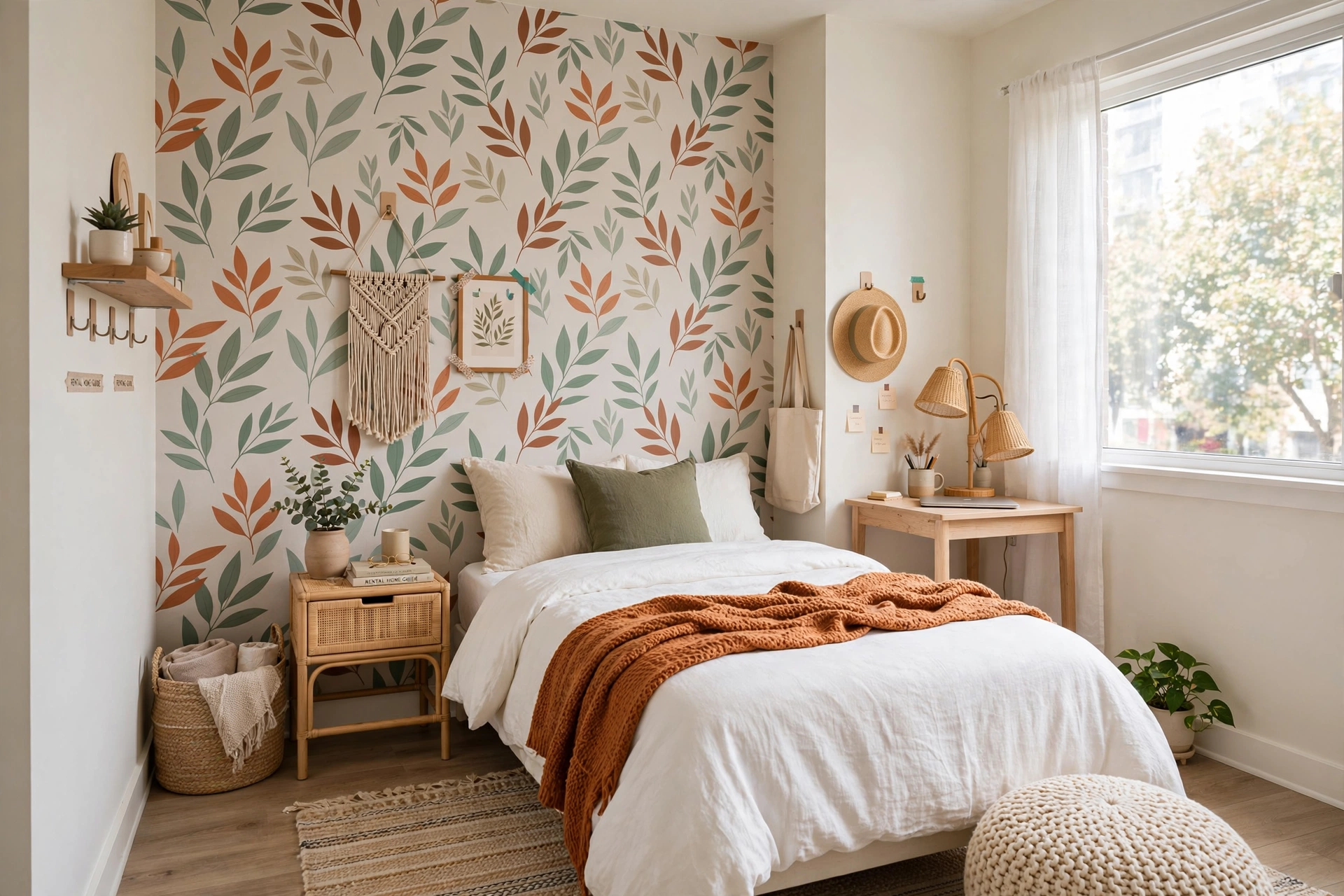
Small rooms benefit most from wallpaper — a single accent wall transforms the entire space for minimal cost and effort.
🛒 Shop This Look:
Pattern strategy: Large-scale patterns can overwhelm tiny rooms; small to medium-scale patterns add interest without crowding. Vertical stripes or patterns draw the eye up, making low ceilings feel higher. Light backgrounds keep small spaces airy.
Cost advantage: A powder room or small bedroom accent wall needs just 1–2 rolls. This is the most budget-friendly way to experiment with bold patterns.
How to Apply Peel-and-Stick Without Bubbles
Preparation
- Clean the wall. Wipe with a damp cloth and mild cleaner. Let dry completely. Dust and grease prevent adhesion.
- Measure carefully. Measure wall height and add 2 inches for trimming. Measure width and divide by the wallpaper roll width to determine how many strips you need.
- Start plumb. Use a level to draw a vertical pencil line where your first strip will go. Walls are rarely perfectly straight — don’t trust the corner.
Application Technique
- Peel 12 inches. Don’t peel the entire backing at once. Peel the top 12 inches, align to your plumb line, and smooth onto the wall.
- Smooth downward. Use a plastic smoother or credit card wrapped in cloth. Work from center outward, pushing air bubbles toward the edges.
- Peel as you go. Slowly peel backing downward while smoothing. This controlled approach prevents the wallpaper from sticking to itself.
- Trim excess. Use a sharp utility knife and metal straightedge to trim top and bottom. Change blades frequently — dull blades tear.
Dealing with Bubbles
Small bubbles often disappear within 24–48 hours as adhesive cures. For persistent bubbles: prick with a pin, press flat, and smooth. For large bubbles, carefully peel back to the bubble, re-smooth, and press.
Pattern Matching
Align patterns at eye level first — this is where mismatches are most visible. Most peel-and-stick has a pattern repeat marked on the packaging. Plan your cuts so patterns align at seams. This wastes some wallpaper but looks dramatically better.
How to Remove Without Damaging Walls
- Start at a corner. Peel slowly at a 45-degree angle, not straight out from the wall.
- Go slow. Rushing causes tearing and increases the chance of pulling paint. Patience is the entire technique.
- Use heat for stubborn spots. A hair dryer on low heat softens adhesive. Warm the area for 30 seconds, then peel.
- Clean residue. Any sticky residue removes with warm soapy water or Goo Gone. Test cleaning products in an inconspicuous area first.
When paint comes off: This usually means the paint wasn’t fully cured before wallpaper application, or the wall wasn’t primed. Touch up with matching paint. To prevent: always prime walls before wallpapering, and wait 30 days after painting.
Wallpaper in Every Room
Living Room Accent Wall
One wallpapered wall behind the sofa creates a focal point without overwhelming. Bold patterns work here — the large wall can handle visual weight. Pair with solid-colored furniture to let the wallpaper shine.
Bedroom
Wallpaper behind the headboard acts as a giant headboard alternative. Calming patterns in muted tones promote rest. Avoid high-contrast geometrics that feel energizing — save those for living areas.
Home Office
A wallpapered wall behind your desk creates a professional video call backdrop. Subtle textures (grasscloth-look, linen) read as sophisticated on camera. Avoid busy patterns that distract.
Powder Room
Small powder rooms are the #1 place designers use bold wallpaper. The small space means low cost and low commitment, but high impact. Go wild — dark florals, dramatic geometrics, metallic prints all work in jewel-box powder rooms.
Cost Breakdown
- Peel-and-stick: $30–$80 per roll (covers ~28 sq ft). A 10×8 accent wall needs 2–3 rolls: $60–$240.
- Traditional wallpaper: $40–$200+ per roll. Professional installation: $300–$800 per room.
- Tools: Smoother, utility knife, level — under $30 total if you don’t own them.
Peel-and-stick DIY is dramatically cheaper than traditional + professional install. A DIY accent wall costs under $250; the same wall professionally papered with traditional wallpaper runs $500–$1,000.
Common Mistakes to Avoid
- Skipping wall prep. Dirty or textured walls cause adhesion failure. Clean and smooth first.
- Not ordering enough. Order 10–15% extra for pattern matching waste and mistakes. Running out mid-project with a different dye lot is a disaster.
- Starting in the corner. Corners are rarely straight. Start with a plumb line on the most visible wall.
- Applying over fresh paint. Wait 30 days. Fresh paint + adhesive = peeled paint on removal.
- Choosing the wrong scale. Tiny patterns disappear on large walls; huge patterns overwhelm small walls. Consider the wall size when choosing pattern scale.
Best Peel-and-Stick Wallpaper Brands
Brand matters more with peel-and-stick than with almost any other decor product — adhesion quality and print fidelity vary enormously. Here are the names worth knowing, organized by what they do best.
Tempaper
One of the original peel-and-stick brands, known for designer collaborations and a huge pattern library from modern geometrics to classic botanicals. Their vinyl is on the thicker side, which makes it forgiving to install and clean to remove. Pricing sits in the mid-range, typically around $100–$130 per double roll.
🛒 Shop This Look:
Chasing Paper
A designer-focused brand with a curated, trend-forward catalog — think hand-drawn florals, playful murals, and Scandi-inspired prints. Slightly pricier than mass-market options, but the print quality and color accuracy are consistently strong. Good for statement walls where the pattern is the whole point.
Spoonflower
The customizer’s choice: thousands of independent artist designs you can’t find anywhere else, plus the ability to upload your own artwork. Their peel-and-stick is a woven fabric rather than vinyl, which installs with less stretch but needs a smooth wall. The trade-off is removability — fabric options can be trickier to remove cleanly than premium vinyl, so test a swatch first.
RoomMates and WallPops
The budget-friendly entry point, widely available at big-box stores. Patterns skew playful and kid-friendly. Quality is serviceable for short-term projects like dorm rooms or kids’ rooms, but the thinner material tears more easily during removal — budget for that limitation.
Graham & Brown
A heritage wallpaper house that entered the peel-and-stick market with premium designs and heavier-weight materials. Their murals and metallic prints are among the best-looking in the category. Prices run higher, but for a powder room or dining room feature wall, the visual payoff justifies it.
Buying tip: Whatever brand you choose, order all rolls for a project at once. Dye lots vary between print runs, and a second order months later may not match.
Frequently Asked Questions
Will peel-and-stick damage my walls?
Quality peel-and-stick removes cleanly from properly prepared walls (primed, fully cured paint). Damage occurs when applied over fresh paint, unprimed drywall, or flat/matte paint (which is more porous). Test first.
How long does peel-and-stick last?
2–5 years in normal conditions. High-humidity bathrooms shorten lifespan. Higher-quality thicker vinyl lasts longer than thin budget options.
Can I apply it over textured walls?
Light orange-peel texture is usually fine. Heavy knockdown or popcorn texture prevents proper adhesion — the wallpaper won’t make full contact. Smooth the wall first or choose a different wall.
Can I reposition it if I make a mistake?
Yes, carefully, within the first few minutes. Peel back gently and reposition. But each repositioning weakens the adhesive slightly. Get it right the first or second time.
By Ella Knight
🛒 Shop This Look:




2 thoughts on “Peel and Stick Wallpaper Ideas for Renters & Small Spaces (2026)”
Comments are closed.