
As an Amazon Associate, I earn from qualifying purchases. This means I may earn a commission if you purchase through links on this page — at no extra cost to you.
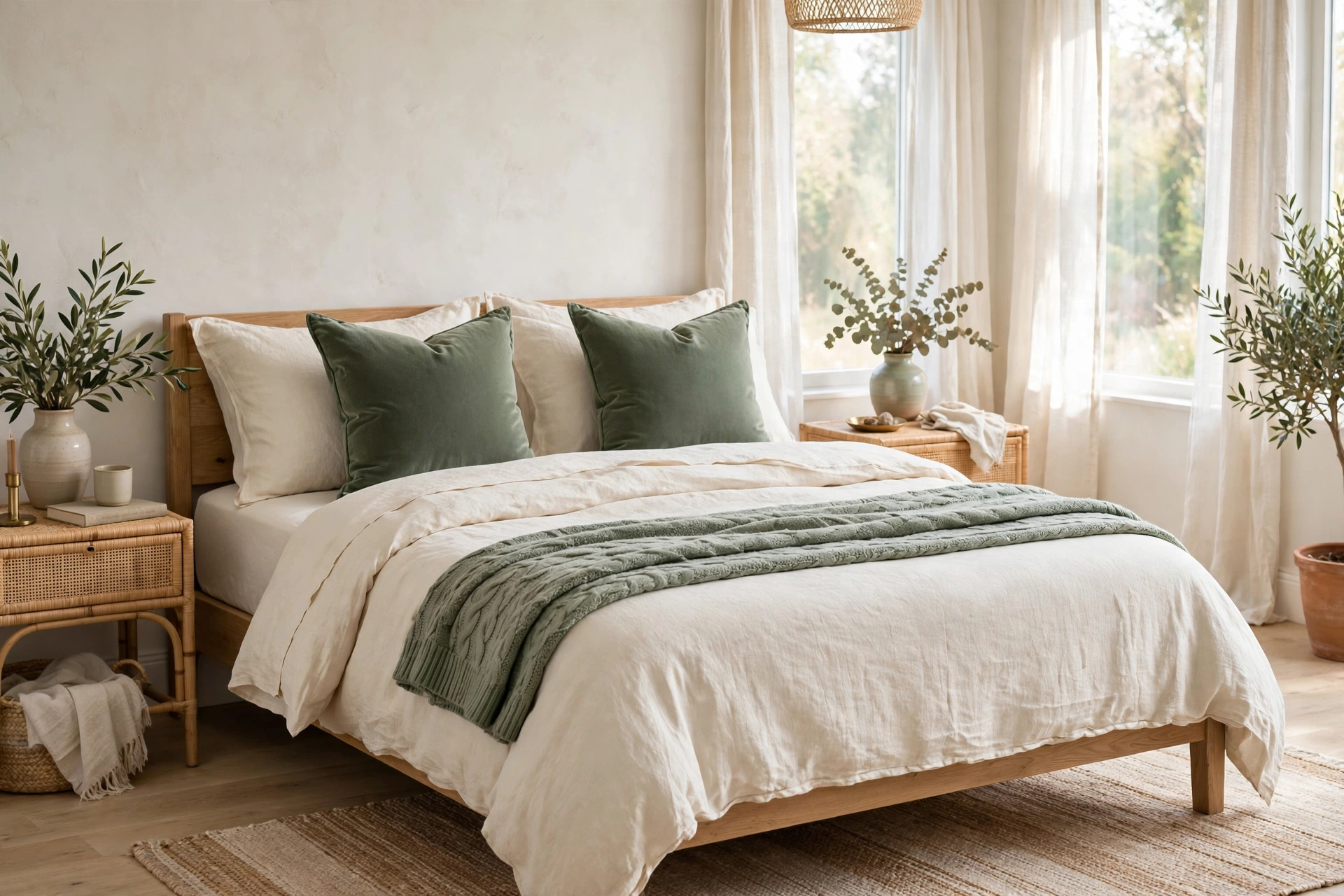
To style a bed like a designer, follow the 5-layer formula: start with crisp fitted and flat sheets, add a duvet or comforter pulled up to the top third, fold a throw blanket across the foot, place sleeping pillows upright against the headboard, and finish with 2–3 decorative pillows in front. Use odd numbers for decorative pillows, vary textures (linen, velvet, knit), and stick to a cohesive color palette with one accent color. The whole process takes under 10 minutes.
Layer 1: The Sheets
Start with a fitted sheet pulled taut — wrinkles here show through everything above. Add a flat sheet, and for the designer look, fold it back over the duvet about 12 inches from the top. This creates a clean band of contrasting fabric.
Layer 2: The Duvet or Comforter
Pull your duvet up to about two-thirds of the bed, then fold the top third back over itself. This “tri-fold” creates depth and shows off your sheets. For a more relaxed look, let the duvet sit slightly rumpled rather than perfectly smooth.
Layer 3: The Throw Blanket
Fold a throw into thirds lengthwise and drape it across the foot of the bed, or fold it into a neat rectangle placed at an angle. This adds color, texture, and a lived-in feel. Choose a texture that contrasts with your duvet — chunky knit over smooth cotton, for example.
Layer 4: Sleeping Pillows
Stand your sleeping pillows upright against the headboard (not flat). If you have a tall headboard, stack two per side. Pillowcases should be crisp — this is where wrinkled cases are most visible.
🛒 Shop This Look:
Layer 5: Decorative Pillows
Place 2–3 decorative pillows in front of the sleeping pillows. The designer formula: one large lumbar or Euro pillow centered, flanked by two smaller accent pillows. Or go asymmetrical with a cluster of three different sizes on one side. Vary textures but keep colors coordinated.
Color and Pattern Rules
Pick a base neutral (white, cream, gray), add one main color, and one accent. If your bedding is patterned, keep pillows solid, and vice versa. The 60-30-10 rule works for beds too: 60% dominant color, 30% secondary, 10% accent.
What You’ll Need: The Bedding Shopping List
You don’t need an entirely new bedding set to use this formula — but knowing what each layer ideally includes helps you spot what’s missing. Here’s the complete list for a queen or king bed.
- Fitted sheet and flat sheet: One set is enough, but two sets let you rotate on laundry day. Percale reads crisp and tailored; sateen reads soft and lustrous. White or cream sheets are the most versatile base because they work under any duvet color.
- Duvet cover (or comforter): A duvet cover is the designer favorite because it’s washable and swappable — change the whole room’s look by changing one cover. Size up: a king duvet on a queen bed gives you the generous drape you see in styled photos.
- Duvet insert: If your duvet looks flat, the insert is the problem, not the styling. A lofty down or down-alternative insert fills the cover properly. Look for baffle-box construction, which keeps the fill evenly distributed instead of shifting to the edges.
- Throw blanket: One textured throw in a contrasting material — chunky knit, waffle weave, or faux fur. This single piece does more visual work than any other layer, so choose it deliberately.
- Sleeping pillows: Two for a queen, and either two or four (two stacks of two) for a king. Medium-firm pillows hold their upright shape best against the headboard.
- Decorative pillows: Two to three, in sizes that step down from your sleeping pillows: Euro squares (26×26) behind, standard shams in the middle, and one lumbar or small accent pillow in front.
- Optional: a bed skirt or coverlet: If your bed frame or box spring shows, a tailored bed skirt or a thin coverlet layered under the duvet hides it and adds a finished look.
Three Designer Looks You Can Copy
The five-layer formula is a framework, not a single look. Here are three distinct styles built on the same layers — pick the one that matches your room.
The Relaxed Linen Look
White or natural washed-linen sheets and duvet, a chunky knit throw in oatmeal or clay folded across the foot, sleeping pillows slightly rumpled rather than crisp, and two linen Euro pillows plus one small lumbar in front. Nothing is perfectly smooth — the wrinkles are the point. Best for: casual, coastal, Scandinavian, and modern farmhouse bedrooms.
The Tailored Hotel Look
Crisp white percale sheets with a sharp 12-inch fold over the duvet, a white or ivory duvet pulled smooth and tucked at the foot, a folded throw in a solid accent color placed in a precise rectangle at the foot, sleeping pillows upright and plump, and three Euro pillows in matching shams across the back with two smaller accent pillows in front. Symmetry and crispness are everything. Best for: traditional, transitional, and minimalist bedrooms.
The Moody Layered Look
Charcoal, deep green, or navy sheets and duvet, a faux-fur or velvet throw draped loosely across the foot, sleeping pillows in dark shams, and an asymmetrical cluster of three decorative pillows in mixed textures (velvet, boucle, leather) on one side. Rich texture replaces bright color as the visual interest. Best for: modern, eclectic, and dramatic bedrooms — especially rooms with dark walls.
🛒 Shop This Look:
How to Style a Bed Without a Headboard
No headboard? The layering formula still works — you just need to create the visual anchor the headboard normally provides.
- Use Euro pillows as the backdrop. Three Euro pillows (26×26) in matching shams across the back of the bed create a soft headboard effect. This is the simplest fix and works with any bed frame.
- Hang art or a textile above the bed. One large piece of art, a woven wall hanging, or even a curtain panel hung high and wide behind the bed gives the eye the anchor it’s looking for. Center it about 6–8 inches above where the pillows top out.
- Try a painted or wallpapered accent. An arch painted on the wall behind the bed, or a wallpapered panel, defines the sleeping zone without any furniture. This works especially well in rentals where you can’t mount a headboard.
- Stack sleeping pillows higher. Without a headboard, flat pillows make the bed look unfinished. Stand sleeping pillows fully upright and add the Euro layer behind them for height — the pillow stack becomes the headboard.
Common Bed Styling Mistakes
- Too many decorative pillows. More than five decorative pillows on a queen (six on a king) crosses from styled to fussy — and you have to find somewhere to put them every night. If removing pillows feels like a chore, you have too many.
- All pillows the same size. A row of identical pillows looks flat and institutional. The stepped sizes — Euro, standard, lumbar — create the depth that makes styled beds look professional.
- Throw blanket covering the whole bed. A throw spread flat over the duvet just looks like a second duvet. Fold it into thirds and place it across the foot or at an angle — the folded edge and contrasting texture are what make it read as a deliberate layer.
- Ignoring the bed skirt zone. A beautiful top with a visible metal frame and box spring underneath looks unfinished. A $25–$40 tailored bed skirt (approximate) solves it instantly, or choose a platform bed that doesn’t need one.
- Clashing undertones. Cream sheets with a bright-white duvet, or a warm beige throw on cool gray bedding, creates subtle visual discord. Check undertones in natural daylight: hold the fabrics together near a window before committing.
Frequently Asked Questions
How many pillows should be on a bed?
For sleeping: two on a queen, two to four on a king. For decoration: two to three on a queen, three to five on a king. The total that looks styled without being fussy is five to seven pillows on a queen and seven to nine on a king — and that includes the ones you sleep on.
Should the throw blanket match the decorative pillows?
They should coordinate, not match exactly. Pick up one color from the pillows in the throw, or use the throw to introduce the accent color that the pillows then echo. Exact matching sets look like they came from a bedding-in-a-bag package — close coordination looks designed.
How do I keep decorative pillows from sliding off?
Place a non-slip rug pad cut to size between the duvet and the pillow layer — the same trick keeps throws from sliding. Karate-chopping the top edge of a pillow (pressing a crease into the center) also helps it sit upright instead of slumping.
What’s the easiest upgrade if my bedding is old but I can’t replace it all?
Replace the throw blanket and pillow covers only. A new textured throw and two fresh pillow covers in a current color cost far less than a full bedding set (often under $75 total, approximate) and change the bed’s look as dramatically as new sheets would.
Maintenance tip: re-fluff and re-stack your pillows weekly when you change the sheets — it takes two minutes and keeps the bed looking styled instead of slowly collapsing. Wash the throw blanket monthly (or as its care label directs) so it stays fresh as the most-touched layer. A styled bed you maintain for two minutes a week looks better than a perfectly styled bed you never touch up.
🛒 Shop This Look:



