
As an Amazon Associate, I earn from qualifying purchases. This means I may earn a commission if you purchase through links on this page — at no extra cost to you.
From “stile” to “toe kick,” kitchen cabinet terminology can be confusing. This glossary defines 30 essential cabinet terms every homeowner should know before renovating, painting, or shopping for cabinets. Understanding these terms helps you communicate with contractors, compare quotes accurately, and make informed decisions. Related: Small Space Glossary: 20 Terms Explained.
Door & Drawer Terms
Stile: Vertical frame piece on a cabinet door.
Rail: Horizontal frame piece on a cabinet door.
Panel: Center section of a door, either raised or recessed.
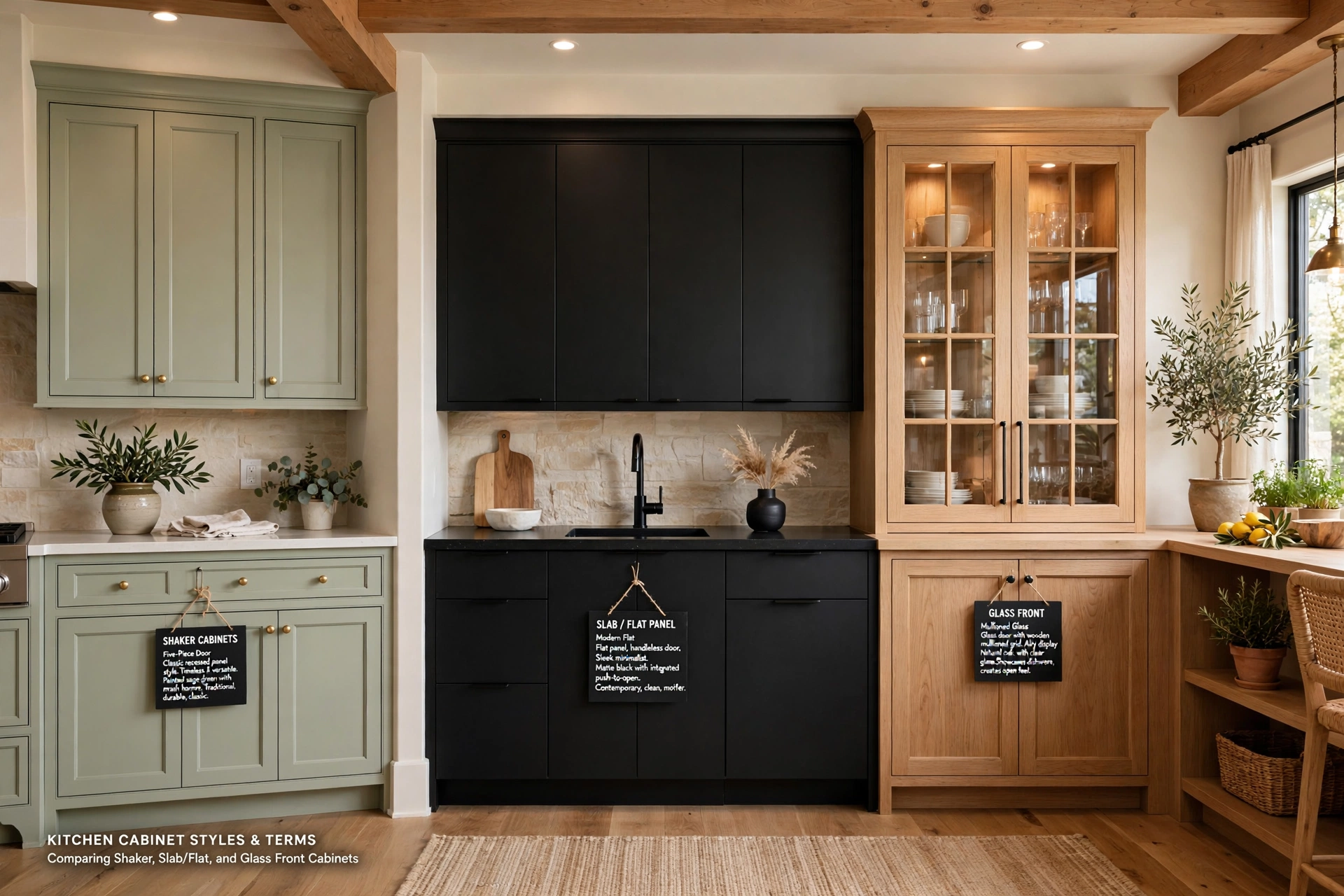
Shaker: Door style with flat recessed panel and square frame.
Slab: Flat, frameless door — modern style.
Inset: Doors sit flush inside the frame (high-end look).
Overlay: Doors sit on top of the frame; partial or full overlay refers to coverage.
Dovetail: Interlocking joint used in quality drawer boxes.
Construction Terms
Carcass: The cabinet box itself, without doors.
Face frame: Wood frame on the front of the cabinet box.
Frameless: European-style construction without face frame.
MDF: Medium-density fiberboard — smooth, paintable, affordable.
Plywood: Layered wood — stronger and more moisture-resistant than MDF.
Particle board: Compressed wood chips — cheapest, least durable.
Finish Terms
Thermofoil: Vinyl film heat-sealed over MDF.
Lacquer: Fast-drying, hard finish — professional spray application.
Glaze: Semi-transparent coating applied over paint for depth.
Distressing: Intentional wear marks for rustic look.
Hardware Terms
Cup pull: Half-moon shaped drawer handle.
Bar pull: Straight horizontal handle.
Knob: Round handle, usually for doors.
Soft-close: Hinges/drawer slides that prevent slamming.
Center-to-center: Measurement between screw holes on pulls.
Layout Terms
Toe kick: Recessed area at the bottom of base cabinets.
Soffit: Boxed area above cabinets (often removed in updates).
Valance: Decorative board under wall cabinets.
Crown molding: Trim where cabinets meet ceiling.
More Cabinet Terms Worth Knowing
Overlay types: Standard overlay leaves part of the face frame visible; full overlay covers nearly the entire frame for a near-frameless look; inset (already covered above) sits flush inside. Drawer glide: The hardware that lets a drawer slide — side-mount (visible, economical), undermount (hidden, smoother, usually soft-close), and center-mount (old-school, single track). Pull-out: Any shelf or organizer that slides out of the cabinet — pull-out trash, pull-out spice rack, pull-out pantry. Lazy Susan: Rotating tray inside a corner cabinet so nothing gets lost in the back. Blind corner: The awkward cabinet space where two cabinet runs meet in a corner; pull-out solutions exist specifically for it.
Filler: A narrow strip of matching material used to fill gaps between cabinets and walls — essential when walls aren’t perfectly straight (they never are). Scribe: The technique of trimming a filler or molding to follow an uneven wall. Light rail: Molding under wall cabinets that hides under-cabinet lighting. Island: Freestanding cabinet unit, often with seating. Peninsula: Like an island but attached to a wall or cabinet run on one end. Apron: The front panel of a farmhouse sink or the skirt under a table-style island.
Terms You’ll Hear When Buying or Comparing Quotes
RTA (ready to assemble): Flat-packed cabinets you assemble yourself — the most budget-friendly option. Stock: Pre-made cabinets in standard sizes, available quickly. Semi-custom: Stock construction with customizable sizes, finishes, and options — the middle ground most renovators choose. Custom: Built to your exact specifications by a cabinetmaker — highest cost, longest lead time, perfect fit.
Lead time: How long from order to delivery — stock ships in days, semi-custom takes weeks, custom takes months. Always confirm lead times before scheduling your contractor. Upcharge: Additional cost for upgrades like soft-close, premium finishes, or organizational accessories — ask for these to be itemized so you can compare quotes fairly. Box construction: What the carcass is made of (see plywood vs. particle board above) — one of the biggest quality and price differentiators between cabinet lines. Finish warranty: The manufacturer’s guarantee on the finish — read what it covers, because “lifetime warranty” often excludes normal wear.
How to Use These Terms With Contractors and Cabinet Sellers
Knowing the vocabulary changes the conversation. Instead of “I want the nice drawers,” you can ask for “dovetail drawer boxes with undermount soft-close glides” — and get an accurate quote instead of a guess. When comparing quotes, make sure each one specifies the same things: box construction material, door style and overlay type, hardware brand and type, and finish. A quote that’s missing these details isn’t comparable to one that includes them.
Ask direct questions: “Is this full overlay or standard?” “Are the drawer boxes dovetail or doweled?” “What’s the lead time, and what happens if it’s delayed?” Write down the answers. Cabinet salespeople deal with informed buyers differently — specific questions signal that vague answers won’t fly, and you’ll get straighter information as a result. Keep this glossary bookmarked on your phone for showroom visits; even professionals mix up terms occasionally, and a quick check beats a costly misunderstanding. Related: Bedroom Decor Glossary: 25 Terms Explained.
Cabinet Door Style Terms, Continued
Raised panel: A door with a center panel that rises above the frame — traditional and formal. The opposite of the flat shaker look. Recessed panel: The center panel sits below the frame surface — includes shaker as the most famous example. Beadboard: A door (or wall treatment) with narrow vertical grooves, giving a cottage or farmhouse feel. Cathedral arch: A door with an arched top rail — very traditional, very 1990s; rarely specified in current designs. Mullion: The thin dividers in a glass-front door that create a multi-pane look — decorative on most modern cabinets (the glass is one piece behind them).
Glass-front: Any door with a glass insert instead of a solid panel — used to display dishware or break up a run of solid doors. Open shelving: No doors at all — just shelves. Beautiful for display, demanding in practice (everything is visible, everything collects grease). Five-piece drawer front: A drawer front built like a small door, with stiles, rails, and a panel — used to match door styling on larger drawers. Slab drawer front: A flat, one-piece drawer front — the modern standard. Edge profile: The shape routed into the edge of a door or drawer front (eased, bullnose, ogee) — a small detail that changes how traditional or modern a door reads.
Installation Terms Worth Knowing
Level and plumb: Level means horizontal; plumb means vertical. Cabinets must be both — an unlevel cabinet run means countertops won’t sit right and doors won’t hang true. Shimming: Inserting thin wedges behind or under cabinets to compensate for uneven walls and floors. Every installation needs shimming; walls are never straight. Blocking: Wood framing added inside walls to give cabinets something solid to anchor to — critical for heavy wall cabinets and islands. If your contractor mentions adding blocking, that’s a sign of thorough work.
Cleat: A horizontal support board screwed to the wall that upper cabinets hang from or rest on during installation. Anchoring: Securing cabinets to wall studs (not just drywall) — the reason installers hunt for studs obsessively. A wall cabinet full of dishes anchored only to drywall is a collapse waiting to happen. Reveal: The small, intentional gap between a door/drawer edge and the frame — consistent reveals are the visible mark of a quality installation. Scribe molding: Flexible trim used where cabinets meet uneven walls or ceilings, hiding the gaps that shimming alone can’t close.
Measuring and Ordering Terms
Linear foot: A common pricing unit for cabinets and countertops — one foot of cabinet run, regardless of depth. Useful for rough budgeting, but always get itemized quotes for real comparisons. Standard dimensions: Base cabinets are typically 34.5″ high (36″ with countertop) and 24″ deep; wall cabinets are typically 12″ deep and 30–42″ high. Knowing the standards helps you spot when a quote deviates — and deviations cost money. Countertop overhang: The countertop typically extends about 1–1.5″ past the cabinet face (more where there’s seating). Too little looks wrong; too much needs support brackets.
Toe kick height: The standard recessed base is about 3.5″ high and 3″ deep — enough for your toes when standing at the counter. Work triangle (covered in our kitchen design glossary): the sink-stove-fridge relationship that still guides layout planning. Shop drawings: Detailed technical drawings from the cabinet maker showing exact dimensions and configurations — review these line by line before approving production, because what gets built is what’s on the drawings, not what you discussed verbally.
Cabinet Materials and Sustainability Terms
CARB2 / TSCA Title VI: The US formaldehyde emission standard for composite wood products (MDF, particle board, plywood). Cabinets meeting this standard emit minimal formaldehyde — worth confirming, since cabinets fill your kitchen with a lot of composite material. NAF (no added formaldehyde): A stricter designation than CARB2 — composite panels made without formaldehyde-based resins. The best choice for chemically sensitive households.
FSC-certified: Wood from responsibly managed forests — relevant for solid-wood cabinet lines making environmental claims. Bamboo plywood: A rapidly renewable alternative to hardwood plywood, harder than many domestic hardwoods and distinctive looking. Reclaimed wood: Lumber salvaged from old buildings — each piece has unique character, but expect color variation and a higher price. Low-VOC finish: Cabinet finishes formulated to emit fewer volatile organic compounds — increasingly standard, but worth specifying for kitchens where you cook and gather daily. When comparing “green” cabinet claims, ask which specific certification backs them — vague eco-language without a standard behind it is marketing, not information.
🛒 Shop This Look:
🛒 Shop This Look:
🛒 Shop This Look:




1 thought on “Kitchen Cabinet Glossary: 30 Terms Explained”
Comments are closed.