
As an Amazon Associate, I earn from qualifying purchases. This means I may earn a commission if you purchase through links on this page — at no extra cost to you.
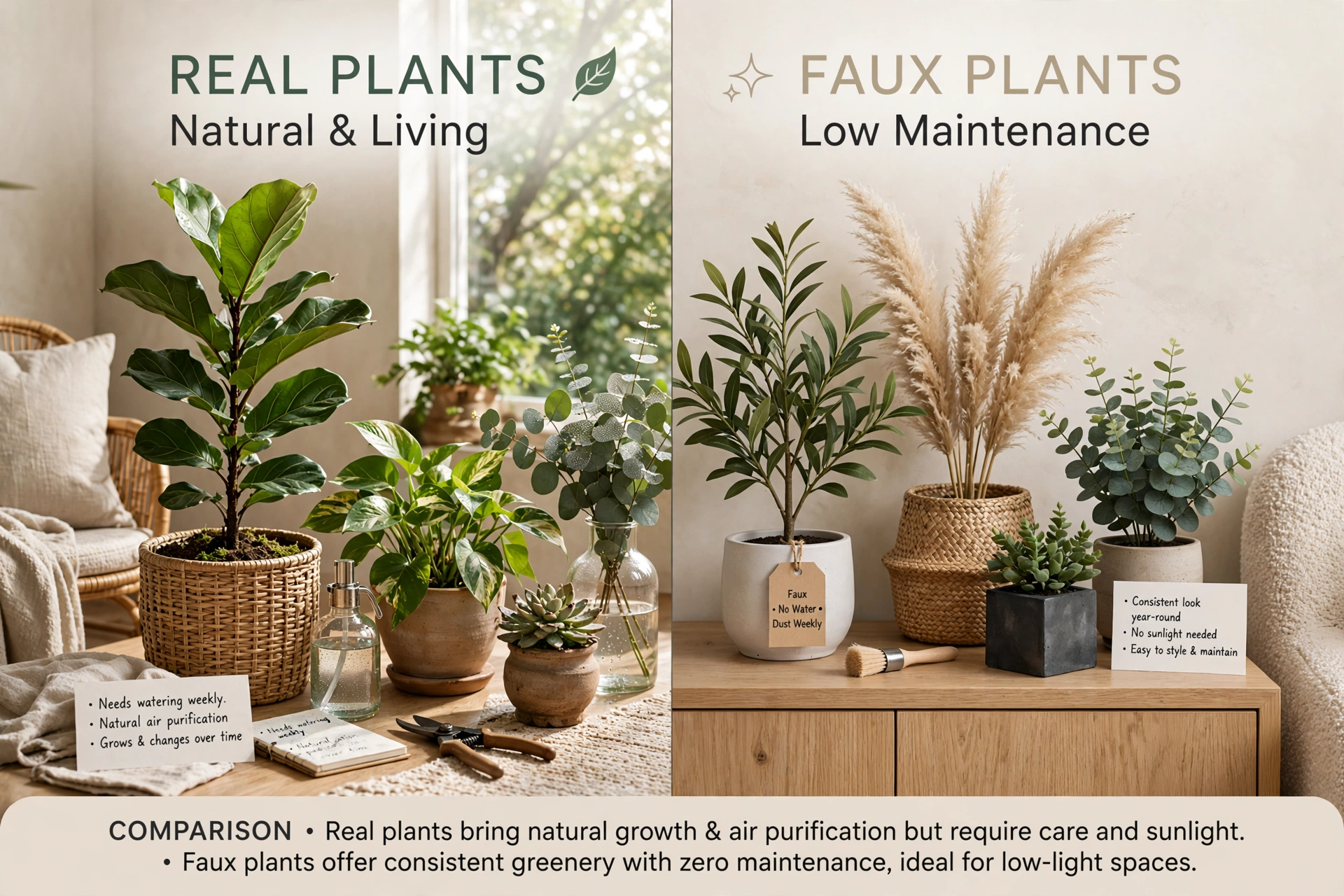
Neither real nor faux plants win outright — the right choice depends on your light, your schedule, your pets, and how long you plan to keep the arrangement. Real plants bring life, air-fresh appeal, and genuine texture, while quality faux plants offer zero-maintenance greenery that looks good forever. Here’s an honest comparison to help you decide room by room.
Cost Over Time
Real plants are usually cheaper to buy. A small potted plant costs a few dollars, and cuttings from friends are free. But the real cost accumulates: pots, soil, fertilizer, grow lights if your space is dark, and replacements when plants die. Over five years, a collection of real plants can quietly cost more than you expect — especially if you keep replacing casualties.
Faux plants cost more upfront. A convincing faux fiddle-leaf fig or monstera runs noticeably more than a real one, because realism costs money in manufacturing. But after that one purchase, the cost is essentially zero — no water, no fertilizer, no replacements. Over a five-year horizon, a good faux plant is often the cheaper option, particularly for large statement plants.
Bottom line: Real plants win on entry price; faux plants win on total cost of ownership for large plants and dark rooms where real plants need constant replacing.
Best for a large, low-maintenance statement plant in a dark corner or other spot where a real plant would struggle.
Maintenance
This is the biggest practical difference. Real plants need watering on schedule, the right light, occasional repotting, pest checks, and pruning. Travel gets complicated — someone has to water them. Some species are forgiving, but every real plant is a small ongoing responsibility.
Faux plants need dusting every few weeks — a damp cloth or a quick rinse in the shower keeps them looking fresh. That’s it. No watering schedule, no plant sitter, no guilt. For busy households, frequent travelers, and anyone who has killed a succulent (it happens), faux plants remove the maintenance burden entirely.
Bottom line: Faux plants win decisively on maintenance. Real plants reward the effort with growth and change; faux plants reward you with free time.
Realism
A thriving real plant has no competition on looks — the texture of leaves, the way light passes through them, new growth unfolding, subtle imperfections. Visitors notice real plants; they register as alive. Cheap faux plants, on the other hand, are obvious from across the room: shiny plastic leaves, uniform color, visible seams.
But high-quality faux plants have closed the gap dramatically. Modern silk and molded plants use varied leaf shapes, matte finishes, and natural color variation that can fool the eye from a few feet away. The trick is buying quality — budget faux plants almost always look fake, while mid-range and premium ones hold up well in photos and everyday viewing.
Bottom line: Real plants win on realism at any budget. Faux plants can look genuinely convincing, but only if you invest in quality — and even then, never touch-test them in bright close-up spots.
Pet and Child Safety
Many popular real houseplants are toxic to cats, dogs, and curious toddlers — pothos, philodendron, lilies, monstera, and dieffenbachia among them. Even non-toxic plants can cause stomach upset if chewed, and fertilizers and pesticides add another layer of concern. If you have pets that nibble, every real plant needs a toxicity check first.
Faux plants eliminate the toxicity question entirely. There’s nothing to chew that can poison anyone. The trade-offs: small detachable parts on cheap faux plants can be choking hazards for toddlers, and some very cheap plastics have strong chemical odors when new. Air them out before placing and check for loose parts.
Bottom line: Faux plants win for households with plant-chewing pets or very young children. Real plants are fine if you choose verified non-toxic species and place them out of reach.
Best Rooms for Each
Where real plants shine
- Living rooms with good light: The showcase spot — a thriving real plant adds genuine life to the room you use most.
- Kitchens: Herbs and small greens do double duty as decor and cooking ingredients.
- Home offices: Caring for a plant breaks up the workday, and real greenery genuinely improves how a workspace feels.
- Sunny entryways: A real plant makes an entrance feel welcoming and alive.
Where faux plants make more sense
- Bathrooms without windows: No light, high humidity — most real plants struggle; faux plants thrive.
- Dark hallways and corners: If you can’t keep a plant alive there, don’t fight it — a good faux plant fills the visual gap.
- High shelves and tall bookcases: Watering up there is a hassle and spills are a risk; faux is the practical choice.
- Rental and staging situations: Faux plants travel well, need no care, and look good on day one.
- Above cabinets and in kids’ rooms: Out-of-reach spots where watering is awkward and pet access is uncontrolled.
The Verdict by Scenario
- You love gardening and have good light: Go real. The care is part of the pleasure, and nothing looks better.
- You’re busy or travel often: Go faux for the hard-to-reach and dark spots; keep one or two easy real plants (like snake plants or ZZ plants) where they’re simple to maintain.
- You have pets that chew: Go faux in accessible spots, or real but strictly non-toxic species placed high.
- You’re decorating on a budget: Start real — small plants are cheap and you can propagate. Upgrade to a statement faux plant for the one dark corner where nothing survives.
- You want a big dramatic plant in a dark room: Go faux. A quality faux fiddle-leaf fig is cheaper over five years than repeatedly replacing real ones.
- You’re staging a home to sell: Go faux. Zero maintenance during showings and they photograph beautifully.
The smartest approach for most homes is a mix: real plants where the light and your schedule allow, and quality faux plants where real ones would only suffer. Decorated thoughtfully, no one will be able to tell — or care — which is which.
Best for a big, dramatic faux statement plant in a dark room where a real fiddle-leaf fig would not survive.
Best Real Plants for Beginners, by Light Level
If you’re leaning toward real plants, matching the plant to your light is the difference between a thriving collection and a windowsill of casualties. For low light (a few feet from a north-facing window, or a room with no direct sun), snake plants, pothos, and ZZ plants are nearly indestructible — they tolerate neglect, low water, and dim corners. For medium light (bright indirect light near an east or west window), try philodendrons, spider plants, and peace lilies; they grow faster and look lusher but still forgive a missed watering. For bright direct light (a sunny south-facing window), succulents, jade plants, and fiddle-leaf figs thrive — though fiddle-leaf figs have a well-earned reputation for drama, so start with succulents if you’re new.
Costa Farms Snake Plant, Mother-in-Law’s Tongue Live Plant in Decorative Pot, 2-3 Feet Tall
Best for beginners in low light — a nearly indestructible real plant that tolerates neglect, low water, and dim corners.
Costa Farms ZZ Live Plant in Decorative Pot, Easy to Maintain Indoor Houseplant, 2-3 Feet Tall
Best for beginners in low light — an easy-to-maintain real plant that tolerates neglect, low water, and dim corners.
A few honest caveats: real plants need a drainage plan (a pot with holes plus a saucer, or you’ll get root rot), they’ll need repotting as they grow, and they don’t love being moved around — find their spot and let them settle. If you travel frequently, self-watering pots or a plant-sitter arrangement matter more than which species you pick.
Best for real plants that need a drainage plan — and for frequent travellers, for whom self-watering pots matter more than the species picked.
How to Make Faux Plants Look Convincing
Cheap-looking faux plants fail in predictable ways, and each has a fix. The pot problem: Most faux plants arrive in flimsy plastic nursery pots. Repot into a real ceramic, terracotta, or woven basket planter with some decorative moss or stones on top, and the whole thing instantly looks more legitimate. The too-perfect problem: Real plants are asymmetrical. Bend and fluff the stems and leaves so they don’t all point the same direction, and vary the heights. The dust problem: Nothing betrays a faux plant faster than a layer of dust. Wipe leaves with a damp cloth every month or two — it takes minutes and makes a huge difference.
Best for finishing a repotted faux plant — add decorative moss on top of the planter so the whole thing instantly looks more legitimate.
The placement problem: Faux plants look most convincing in spots where real plants would plausibly survive but are inconvenient — high shelves, dark corners, the top of a wardrobe. A faux fern in a pitch-black hallway raises no eyebrows; a faux fiddle-leaf fig in a sun-drenched window next to thriving real plants invites comparison. And size matters: one large, high-quality faux statement plant almost always looks better than five small cheap ones. If your budget is limited, buy fewer, better pieces.
Pets, Kids, and Placement Safety
This is where the real-versus-faux decision gets practical rather than aesthetic. Many popular real houseplants — pothos, philodendrons, peace lilies, snake plants, ZZ plants — are toxic to cats and dogs if chewed. If you have curious pets, you either need to commit to pet-safe species (spider plants, parlor palms, Boston ferns, calatheas) and high placement, or go faux. Note that faux isn’t automatically pet-safe either: a determined chewer can ingest plastic leaves, so observe your pet’s habits before deciding.
For households with toddlers, heavy real plants in ceramic pots are a tipping hazard — wall-mounted planters, high shelves, or lightweight faux arrangements are safer. Real soil also invites digging little hands. There’s no universal right answer here; the right choice is the one that fits your household’s actual inhabitants, not an idealized version of them.
The Hybrid Approach: Mixing Real and Faux
The smartest answer to the real-versus-faux debate is often “both.” Use real plants where they’ll thrive and where you want the genuine benefits — a pothos on a bright shelf, herbs in a sunny kitchen window, a snake plant in the bedroom where you spend hours breathing the air. Use faux where real plants would struggle or create hassle — the dark hallway, the high shelf you can’t reach to water, the vacation home you visit monthly, the office desk you abandon every weekend.
The hybrid approach also solves the budget equation elegantly: spend your real-plant budget on a few specimens in ideal spots (where cheap plants thrive and look great), and spend your faux budget on one or two large, high-quality statement pieces for impossible spots (where real plants would die expensively). Nobody audits your home for botanical purity — they just see greenery that looks good everywhere. Mix confidently, place strategically, and maintain both types (yes, faux plants need dusting) for a home that looks alive in every corner.
🛒 Shop This Look:
🛒 Shop This Look:
- Living Room Ideas Hub
- DIY Guide
- Indoor Plants Decor
🛒 Shop This Look:



