
As an Amazon Associate, I earn from qualifying purchases. This means I may earn a commission if you purchase through links on this page — at no extra cost to you.
Wallpaper durability is decided by three things: what the face material is, how well it was installed, and what the room does to it. Of the three, the face material matters most, and it matters more than the format. A peel-and-stick vinyl and a pasted vinyl share a wear layer and behave similarly; a peel-and-stick paper shares traditional paper’s weaknesses plus an adhesive that can weaken in heat and humidity. Choose the material for the room first, and the format second, and most wallpaper disappointments never happen.
This guide compares five wallpaper types on the durability traits that actually determine how long they last: moisture resistance, scuff resistance, seam stability, fading, and cleaning. It then maps each type to the rooms it suits, explains what shortens or extends wallpaper life regardless of material, and answers the questions people ask before committing a wall to paper.
The Five Types at a Glance
Pasted vinyl. A vinyl wear layer over a paper or fabric backing, installed with paste. The durability benchmark for residential wallpaper: scrubbable, moisture-resistant, with the most secure seams. The default choice for wet rooms and high-traffic walls.
Peel-and-stick vinyl. The same vinyl wear layer with a pressure-sensitive adhesive backing instead of paste. Nearly the same wear properties as pasted vinyl in dry rooms, with easier installation and clean removal on primed walls. Its weakness is the adhesive, which can soften in sustained heat and humidity.
Paste-the-wall non-woven. A backing of blended synthetic and natural fibers that does not expand when pasted, so seams stay tight over time. Strong and tear-resistant in dry rooms, breathable enough to reduce trapped-moisture problems, but not scrubbable like vinyl and unsuited to steamy rooms.
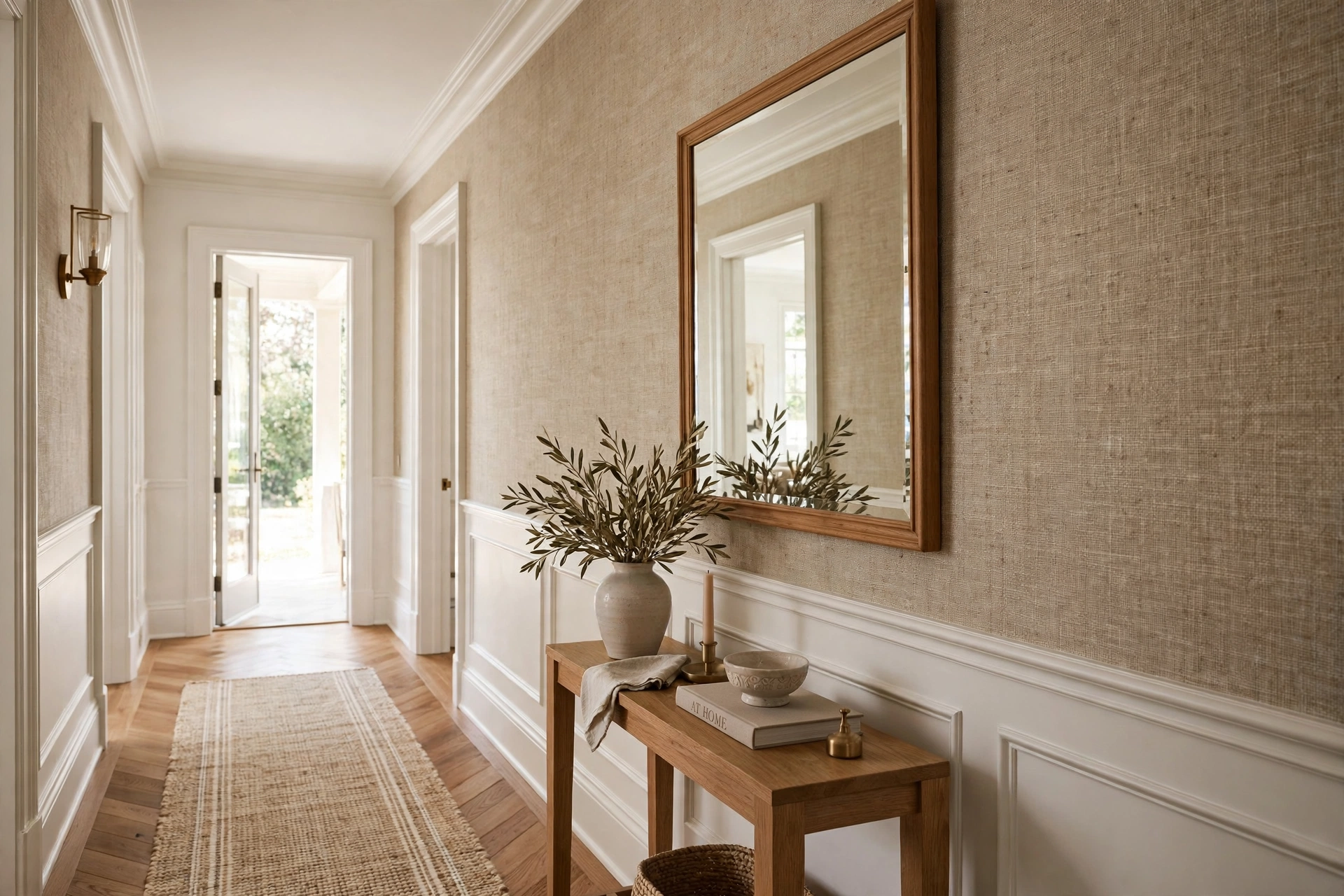
Grasscloth and natural fiber. Woven from sisal, jute, seagrass, or similar materials. The texture hides minor wear and scuffs well, but the fibers stain easily, cannot be scrubbed, and seams remain visible by the nature of the material. Durability is highly location-dependent: fine in a dry bedroom, risky anywhere near water or cooking.
Uncoated paper, including budget peel-and-stick paper. Printed paper with no protective coating. The least durable common option: it fades faster in sunlight, cannot be washed, scuffs easily, and in peel-and-stick form adds an adhesive that weakens in heat and humidity. Its place is low-traffic, low-moisture rooms where its matte, authentic look is the priority.
How Each Material Wears
Vinyl, pasted or peel-and-stick. Vinyl’s non-porous surface means stains sit on top rather than soaking in, so most marks wipe off with a damp cloth. It resists moisture, handles scrubbing, and holds color well in sun, which is why it is consistently the recommended face material for kitchens, bathrooms, hallways, and high-traffic areas. The difference between pasted and peel-and-stick vinyl is not the wear layer but the bond: paste gives the most secure seams, while pressure-sensitive adhesive gives easier removal at the cost of some heat and humidity sensitivity.
Non-woven. Dimensional stability is non-woven’s signature advantage: because it does not expand when pasted, seams stay tight and the paper does not bubble as it dries. It resists tearing, breathes, and handles light cleaning. Its limits are water and abrasion — it is not scrubbable, and it should never face direct water or steam. In a dry room with stable temperatures, it is a strong, long-lived choice; in a steamy room, it is the wrong material regardless of how well it is installed.
Grasscloth and natural fiber. Texture is both the appeal and the weakness. The woven surface hides small scuffs and gives a room a tactile, organic quality no printed paper matches. But the fibers absorb stains, cannot be scrubbed clean, and show seams as a natural part of the look — panels do not blend invisibly the way printed vinyl does. Sun fades natural fibers unevenly, and any nearby moisture source shortens their life sharply. Choose grasscloth for the way it looks in a dry room, not for durability, and accept the seams as part of the aesthetic.
Uncoated paper. Paper’s matte finish is genuinely beautiful, and that is its main argument. On durability, it loses on nearly every axis: it fades fastest in sunlight, moisture damages the surface and can reactivate paste, and scuffs show immediately. Budget peel-and-stick products are frequently thin paper, which is why the peel-and-stick category’s durability reputation suffers — the problem is the cheapest paper products, not the format. A quality paper in a formal dining room or a ceiling can last well precisely because those locations ask so little of it.
🛒 Shop This Look:
Room-by-Room Guidance
Bathrooms. Vinyl only, and only with working ventilation. Steam is wallpaper’s enemy, and non-vinyl materials in bathrooms show edge curl and adhesive failure. A bathroom with no exhaust fan is not a wallpaper candidate at all — fix ventilation first, then consider paper. Even with vinyl, keep wallpaper out of the shower enclosure itself, and seal edges carefully.
Kitchens. Vinyl for any wall near cooking activity, because grease in the air settles on every surface and only scrubbable vinyl cleans fully. Keep wallpaper away from direct splatter zones behind the stove regardless of material — that area belongs to tile or a solid splashback.
Hallways and entryways. High-traffic, high-contact walls. Vinyl or scrubbable non-woven. These walls take scuffs from bags, shoes, and shoulders, so washability matters more than any other property here.
Bedrooms and living rooms. Any material works. This is where paper, grasscloth, and delicate prints earn their place — low moisture, low contact, and stable temperatures let less-durable materials last their full potential lifespan.
Sun-exposed walls. Fading is a material-plus-ink issue. Vinyl with quality lightfast inks resists fading best; uncoated paper fades fastest. For walls receiving direct sun for hours daily, check the manufacturer’s lightfastness information before buying, and consider UV-filtering window film as protection for any wallpaper investment.
What Determines How Long Wallpaper Lasts
Material sets the ceiling; these factors determine whether a given installation reaches it.
Installation quality. Seam tightness, full adhesive coverage, and proper resting time for pasted papers decide whether edges stay down for years or lift within a season. A large share of premature wallpaper failure is installation failure, not material failure — insufficient paste at a seam, a panel hung over a dusty wall, or paper stretched during hanging that later contracts and opens seams.
Wall preparation. Clean, primed, smooth walls hold wallpaper far longer than dusty or glossy ones. Wallpaper primer specifically matters: it regulates adhesion so the paper bonds firmly but remains removable, and it seals the wall surface so paste does not soak unevenly into bare plaster or drywall.
🛒 Shop This Look:
Humidity and ventilation. Chronic dampness weakens paste and feeds mold behind any wallpaper type. Bathrooms without fans, kitchens without hoods, and exterior walls with condensation issues all shorten wallpaper life regardless of material. Ventilation is not a nice-to-have for wallpapered rooms; it is part of the installation.
Sun exposure. Ultraviolet light breaks down inks and can embrittle some materials over years. Walls facing the strongest sun age wallpaper fastest, and the effect is cumulative — a wall that looks fine after one summer can show clear fading after several.
Cleaning habits. Vinyl that gets wiped down when splattered lasts; vinyl left grimy does not, because grime bakes into the wear layer over time. Conversely, scrubbing non-washable paper destroys it. Matching the cleaning method to the material is essential, and it is a common source of avoidable damage.
Ink and print quality. Lightfastness indicates fade resistance, and higher-quality printing holds color longer than budget prints, particularly in sun-exposed spots. This is one of the genuine differences between price tiers: the premium typically buys a thicker wear layer, better inks, and a more stable substrate. The exception is delicate luxury materials such as silk and hand-painted paper, which cost more and last less — there you are paying for beauty, not durability.
Put together, the longevity ranking is consistent: quality vinyl lasts longest, especially in demanding rooms; non-woven follows in dry rooms; grasscloth and paper last well only where conditions are gentle, and budget paper has the shortest service life. These are relative rankings, not guarantees — installation and environment move individual results substantially in either direction.
Cleaning and Maintaining Wallpaper by Material
Vinyl, solid or coated. The easiest. Wipe with a damp sponge and mild dish soap for marks, then rinse with a clean damp cloth. Address stains promptly, and avoid abrasive pads and harsh solvents, which dull the wear layer.
Non-woven. Light wiping with a barely damp cloth, tested in an inconspicuous spot first. Never saturate — excess water can reach the paste layer and loosen the bond.
Paper and grasscloth. Dry methods only. Dust with a soft brush attachment on low vacuum suction, or wipe gently with a dry cloth. For spots on grasscloth, a barely damp cloth blotted — never rubbed — sometimes works, but assume any moisture is a risk and test first.
General maintenance. Dust walls annually, since airborne grime accumulates invisibly and eventually dulls every wallpaper type. Keep bathroom and kitchen wallpaper wiped down more often. Re-check seams yearly: a tiny lifted edge caught early can be re-glued with seam adhesive in seconds, while a neglected one keeps peeling and gathers dust under the lifted edge.
Peel-and-Stick Adhesive: What to Know
Peel-and-stick wallpaper uses pressure-sensitive adhesive rather than paste, which changes both installation and longevity. The adhesive bonds on contact and reaches full strength over roughly one to three days, which is why repeated repositioning weakens the bond — each lift costs adhesion. Heat is the main enemy: walls in direct sun or near heat sources can soften the adhesive over time, leading to edge curl. On the plus side, removal is clean on properly primed walls, making peel-and-stick the lowest-commitment way to try wallpaper. For best results, apply it to smooth, primed, dust-free walls at room temperature, smooth from the center outward to push out air, and avoid stretching the material during application — stretched vinyl slowly contracts back, opening seams.
🛒 Shop This Look:
Signs It Is Time to Replace
Seam lifting that keeps returning after re-gluing means the adhesive has failed and the paper will not re-bond permanently. Fading with visible pattern ghosts where pictures hung is irreversible color shift. Yellowing from aged paste or smoke exposure that cleaning does not remove, bubbling from moisture behind the paper, stains that do not respond to appropriate cleaning for the material, and brittleness or cracking when touched all signal that the material has aged past its service life. Bubbling deserves a special note: investigate the moisture source before replacing, or the new paper will fail the same way.
Wallpaper Durability FAQs
Does more expensive wallpaper always last longer? Not always, but price correlates with durability more honestly in wallpaper than in many decor categories — the premium typically buys a thicker wear layer, better inks, and a more stable substrate. The exception is delicate luxury materials, which cost more and last less.
Can wallpaper survive in a bathroom with a shower? Vinyl can, with conditions: an exhaust fan run during and for a while after every shower, no wallpaper inside the shower enclosure itself, and sealed edges. Without ventilation, no wallpaper type is advisable.
Why do seams open up? The usual causes are insufficient paste at the seam during installation, wall movement as a building settles, or humidity cycling that expands and contracts the substrate. Re-glue promptly with seam adhesive before dust gets under the lifted edge.
Is peel-and-stick less durable than pasted wallpaper? The adhesive is the difference, not necessarily the durability. Quality peel-and-stick vinyl performs comparably to pasted vinyl in dry rooms; its weaknesses show in heat and humidity, where the pressure-sensitive adhesive can soften. In bathrooms or hot climates, pasted wallpaper is the safer choice.
How do I make wallpaper last as long as possible? Choose the right material for the room, prep and prime walls properly, ensure good installation, ventilate moisture-prone rooms, clean appropriately for the material, and catch small seam issues early. Durability is mostly decisions, not luck.
Paint Colors & Wallpaper Ideas



