
As an Amazon Associate, I earn from qualifying purchases. This means I may earn a commission if you purchase through links on this page — at no extra cost to you.
Multifunctional furniture serves two or more purposes in one piece — a sofa that becomes a bed, a table that becomes a desk, an ottoman that stores blankets. It’s the foundation of small space living, letting one room do the work of two or three.
Why It Matters
In a 500-square-foot apartment, a regular sofa, bed, desk, and dining table consume 100+ square feet. Multifunctional versions of the same pieces use half that. The math is simple: fewer pieces, each doing more.
10 Best Multifunctional Pieces
Sleeper sofa: Seating by day, bed by night.
Murphy bed: Bedroom becomes office when folded.
Storage ottoman: Seat, footrest, and blanket storage.
Drop-leaf table: Console, desk, or dining table.
Loft bed: Sleep above, live below.
Nesting tables: One table or three.
Daybed: Sofa and guest bed in one.
Expandable dining table: Seats 2 or 10.
Storage bench: Seating plus hidden storage.
Wall bed with sofa: The ultimate combo piece.
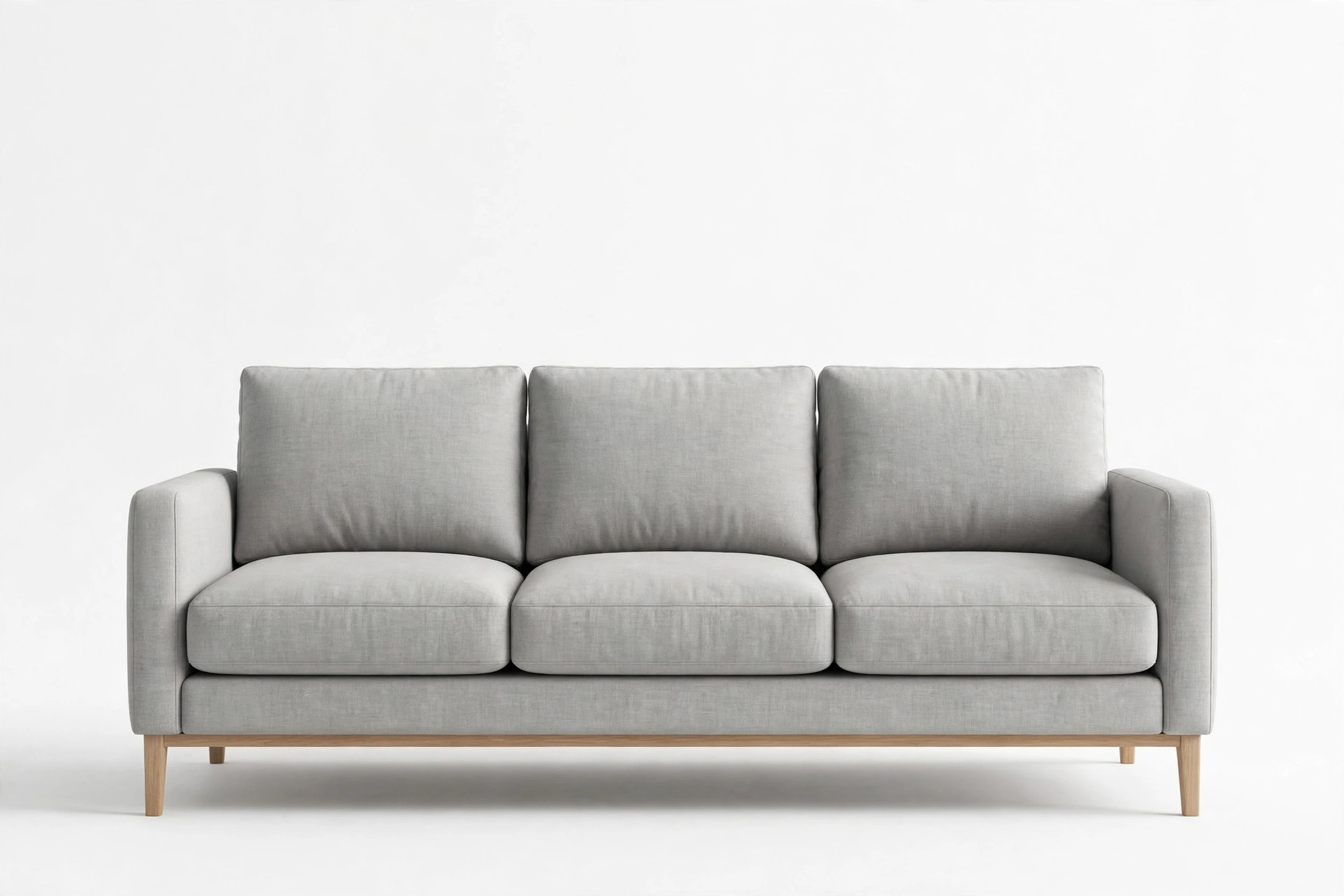
Best for seating by day and sleeping by night in a small living room.
What to Look For
Prioritize ease of transformation (under 30 seconds), comfort in both modes, and build quality — moving parts wear faster than static furniture.
Multifunctional Furniture for Every Room
Living room: The sleeper sofa is the classic, but look beyond it — storage ottomans swallow blankets and remotes, nesting tables expand for guests and tuck away daily, and a lift-top coffee table becomes a dining or work surface in studios. A daybed against the wall serves as deep seating by day and a guest bed by night, often more comfortable than a budget sleeper sofa.
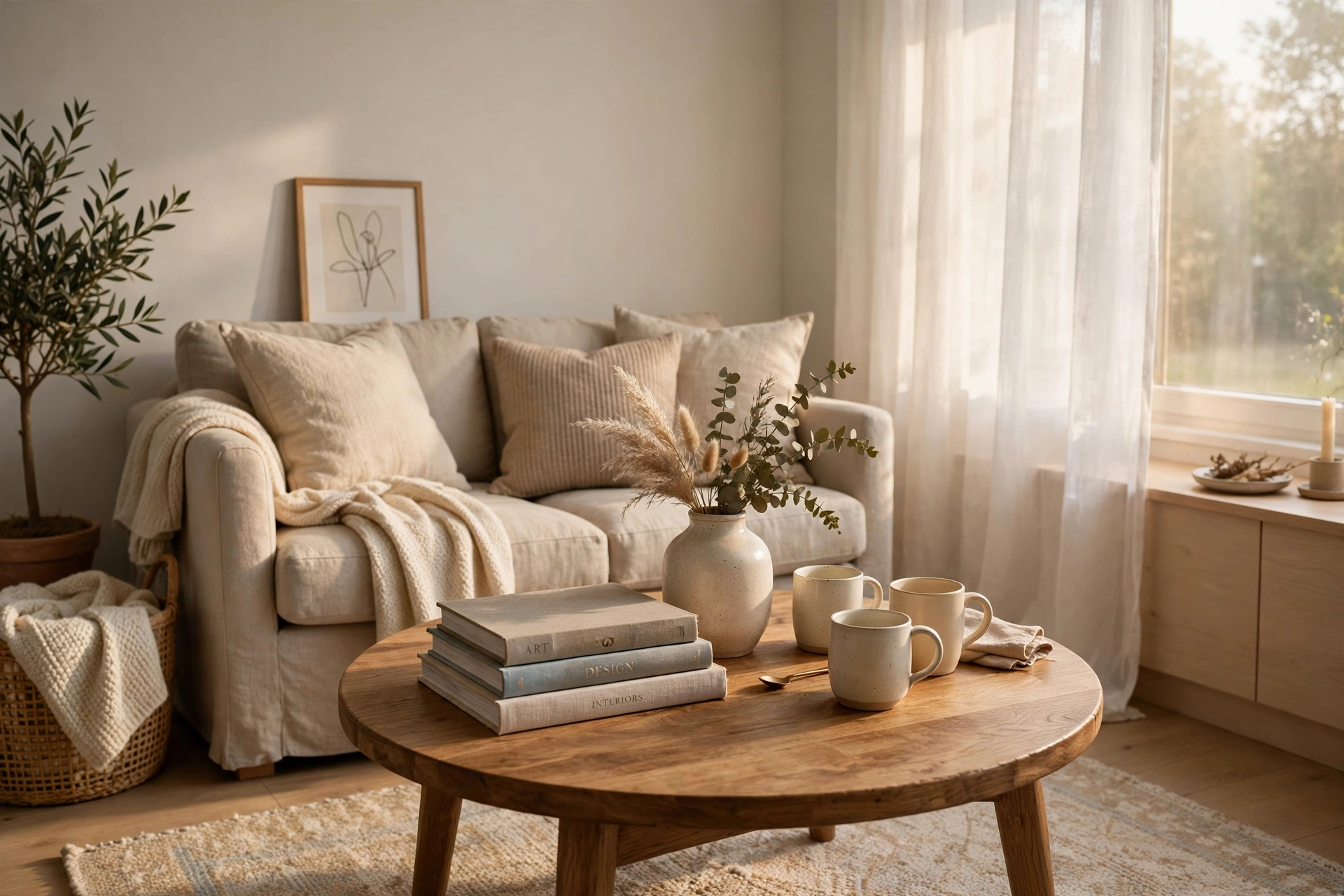
Best for a living room that needs extra surface for guests, then tucks away daily.
Best for a studio living room — a coffee table that becomes a dining or work surface.
Bedroom: Storage beds with built-in drawers eliminate the need for a dresser in small rooms. A Murphy bed with an integrated sofa or desk is the ultimate small-apartment move — bedroom by night, office or lounge by day. Even simpler: a bed with a tall upholstered headboard that doubles as a backrest turns the bed into a reading sofa without any mechanism at all.
Home office / guest room: This is where multifunctional furniture earns its keep. A Murphy bed plus a real desk means the room works as an office 365 days a year and a guest room on demand. Folding desks, wall-mounted drop-leaf tables, and convertible console-to-dining tables let one room serve two full-time functions. Dining area: Extendable tables are the obvious pick, but also consider storage benches (seating plus hidden storage for linens or games) and bar carts that serve as side tables, coffee stations, or extra prep space.
Entryway and small spaces: Hall trees combine coat storage, seating, and shoe organization in one footprint. Storage benches at the foot of the bed or in the entryway hide clutter while providing seating. Even a simple ottoman with storage can be a footrest, extra seat, side table (with a tray on top), and blanket chest in one.
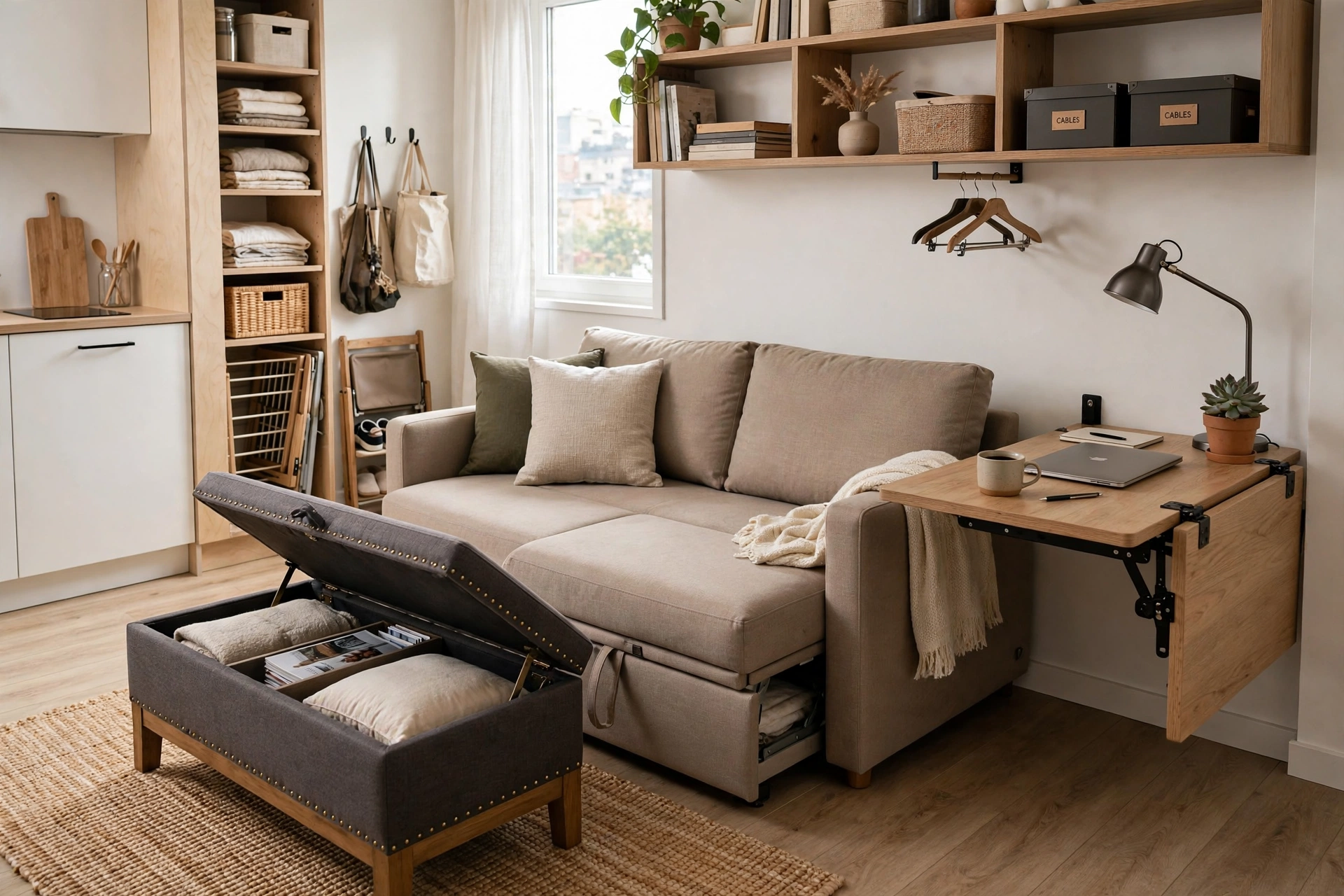
Best for an entryway or the foot of the bed — seating plus hidden storage.
What to Check Before You Buy
Multifunctional furniture has moving parts, and moving parts are where quality shows — or fails. Test the mechanism in person if possible. A Murphy bed or sleeper sofa should transform smoothly in under 30 seconds without wrestling. If it takes two people and a prayer in the showroom, imagine it at 11 p.m. when guests are waiting. Check weight limits on loft beds, sleeper mechanisms, and convertible tables — they’re engineered for specific loads, and exceeding them wears mechanisms fast.
Evaluate comfort in both modes. This is the most-skipped step and the biggest source of regret. Sit on the sofa as a sofa. Lie on the bed as a bed. A sleeper sofa with a bar-in-your-back mattress or a desk-bed with an uncomfortable chair fails at half its job. For sleeper sofas specifically, look for a real mattress (at least 4–5 inches) rather than a thin fold-out pad, or consider European-style click-clack sofas whose backs fold flat — simpler mechanism, often more comfortable. Inspect the build: solid wood or quality plywood frames, metal mechanisms (not plastic), and smooth, finished edges on moving parts. Wobble the piece — quality multifunctional furniture feels rock-solid in every configuration, not just its “main” one.
Small-Space Layout Strategies
The furniture is only half the equation — how you arrange it determines whether multifunctional pieces actually save space or just complicate it. Plan for the transformed state, not just the compact one. A Murphy bed needs clear floor space when it’s down; a drop-leaf table needs room for chairs when extended. Measure both configurations and make sure the room works in each — the most common mistake is buying a piece whose “open” state doesn’t fit the room.
Zone with rugs and lighting rather than walls. In a studio, a rug under the living area and a different rug (or no rug) in the sleeping zone tells your brain these are different places, even when one piece of furniture serves both. Keep transformation paths clear. Don’t place the piece where unfolding it requires moving three other things — if conversion is a chore, you’ll stop doing it, and the “multifunctional” piece becomes a single-function piece you overpaid for. Think vertically: wall beds, fold-down desks, and loft beds all exploit vertical space that static furniture wastes. In rooms under 500 square feet, the walls are your most underused asset.
Durability and Maintenance
Moving parts wear faster than static furniture — that’s physics, not a flaw — so maintenance matters more here. Tighten bolts and screws every six months; the daily transformation cycle loosens hardware over time, and a wobbly mechanism wears exponentially faster than a tight one. Keep moving parts clean and, where the manufacturer recommends it, lightly lubricated. Vacuum inside storage compartments regularly — crumbs and dust migrate into mechanisms.
Buy with the long view: a well-made Murphy bed or sleeper sofa lasts 10–15 years; a cheap one lasts 2–3 before the mechanism groans and the comfort gives out. The price difference amortized over a decade usually favors quality — and replacement is far more disruptive in a small space where the piece is load-bearing to your daily routine. Check the warranty specifically on the mechanism, not just the frame; that’s the part most likely to fail, and coverage terms reveal how much the manufacturer trusts it.
Multifunctional Furniture FAQs
Is a Murphy bed comfortable for every night? Yes, if you buy a good one with a real mattress. Modern wall beds use standard mattresses (not thin pads), so sleep quality matches a regular bed. The mechanism quality matters more than the concept — test it before committing.
What’s the best multifunctional piece for a first apartment? A storage ottoman or storage bench. They’re inexpensive, genuinely useful from day one (seating + storage + surface), and they move with you to every future home. Bigger investments like Murphy beds make sense once you’re settled.
Best for a first apartment — seating, a footrest, and blanket storage in one piece.
Do multifunctional pieces look cheap? Cheap ones do; good ones don’t. The category has matured enormously — today’s wall beds, convertible tables, and sleeper sofas come in styles from Scandinavian to traditional. As with all furniture, material quality and design integrity determine the look, not the category.
Multifunctional Furniture for Kids’ Rooms
Kids’ rooms are the natural habitat of multifunctional furniture, because children’s needs change fast and their rooms are often the smallest in the house. Loft beds with desks underneath are the single best space-saver for school-age kids — sleep above, homework below, in the footprint of one bed. Look for sturdy construction with guardrails and a weight rating that accommodates a growing teenager, not just a small child. Trundle beds handle the sleepover years elegantly: a second bed that vanishes under the first, no assembly required at midnight.
Best for a guest room or kids’ room — a sofa by day and a guest bed, with a trundle for sleepovers.
Storage beds with drawers swallow the toy overflow that defeats every other organizing system. Desks with hutch storage or fold-down designs adapt as homework loads grow. And think ahead: the best kids’ multifunctional pieces are ones that work for teenagers too — a loft bed that’s cool at eight and still functional at sixteen saves you buying twice. Avoid anything with a mechanism a child must operate daily unless you’ve tested that a child can actually operate it; the “30-second transformation” rule matters doubly when the user is ten.
A Renter’s Guide to Multifunctional Furniture
Renters benefit most from multifunctional furniture but face unique constraints. Favor freestanding over wall-mounted: a Murphy bed that bolts to the wall needs landlord permission and patching when you leave; a freestanding convertible sofa, storage ottoman, or folding table moves with you. If you do mount anything (a fold-down desk, a wall-mounted drop-leaf table), use proper anchors and budget for professional patching at move-out — it’s cheaper than losing a deposit.
Choose pieces that survive moves. Solid, simple mechanisms travel better than complex ones — every disassembly and reassembly is a chance for something to loosen or break. Keep all hardware in labeled bags taped to the piece. Measure twice for two apartments: buy for your current space, but favor pieces with a reasonable chance of fitting the next one — standard-ish dimensions beat hyper-custom fits. And document the condition of anything wall-adjacent with photos at move-in; a Murphy bed’s wall bracket is exactly the kind of thing that sparks deposit disputes.
Styling Multifunctional Pieces So They Don’t Look Utilitarian
The knock on multifunctional furniture is that it looks like it belongs in a dormitory. The fix is styling it like intentional design, not camping equipment. Dress the bed as a sofa by day: arrange pillows along the back like a sofa back, add a throw across one arm, and the daybed-or-Murphy-bed reads as a lounge, not a bedroom compromise. Choose finishes that match your decor rather than defaulting to the “office furniture” look — wood tones, upholstered finishes, and real hardware close the visual gap between multifunctional and conventional.
Hide the mechanism, celebrate the function. The best multifunctional design doesn’t advertise its trick — it just looks like good furniture that happens to do more. And keep the transformation area styled for both states: the floor space where the Murphy bed lands should look intentional when the bed is up (a rug, not a void) and work when it’s down. When both configurations look designed, the piece stops being a compromise and starts being the smartest thing in the room.
🛒 Shop This Look:
🛒 Shop This Look:
🛒 Shop This Look:



