
As an Amazon Associate, I earn from qualifying purchases. This means I may earn a commission if you purchase through links on this page — at no extra cost to you.
“Washable” is the most abused word in kitchen rug marketing. It can mean a rug that goes through a washing machine, a rug that survives a hose-down outside, or a rug that merely tolerates a damp cloth — and the listing rarely says which. A kitchen rug lives in the hardest spot in the house: cooking splashes, sink water, crumbs, pet traffic, and chair legs, every day. Buying the wrong kind of “washable” leaves you with a soggy mat that smells faintly of old cooking oil and cannot be fixed. This guide explains what washable actually means, which construction survives a kitchen, and how to size, place, and care for a rug so it stays good.
What “Washable” Actually Means
There are four different things hiding behind the word, and they are not interchangeable.
Machine-washable, two-piece systems. The rug is two parts: a thin printed top layer and a separate non-slip pad. The top layer peels off and goes in the washing machine; the pad stays behind or gets washed separately. This is the most practical kitchen system, because the part that gets dirty is the part that washes, and the rug is light and quick to dry. The catch is the pad: it needs its own cleaning, and if the pad wears out, the top layer slides.
Machine-washable, single-piece rugs. The whole rug goes in the machine. This works best for smaller rugs and runners — a large, heavy rug may not fit a domestic machine, and a soaked rug is heavy to carry and slow to dry. Check the weight and your machine capacity before you buy big.
Rinseable or hose-off rugs. Usually flat, rubber- or vinyl-backed mats made for wet areas. You take them outside and rinse them. They are genuinely easy to clean, but they look and feel more like a mat than a rug, and they suit a sink zone better than a dining area.
Wipe-clean only. Some rugs marketed as “easy care” or “washable” really mean you can sponge a spill off the surface. That is not the same as washing, and in a kitchen it is not enough — grease and food smells soak in over time even if the surface looks clean. If the care label does not mention a machine or a rinse, treat it as wipe-clean and judge it accordingly.
Before buying, read the care instructions as carefully as the pattern. Look for what the backing is made of, whether the pad is included or separate, what pile height it has, and whether the edges are bound or serged — unbound edges fray in the wash. A rug that hides its care instructions is telling you something.
Materials: What Survives a Kitchen
Polyester and polypropylene. The workhorses of washable kitchen rugs. They resist stains, dry relatively quickly, and generally survive repeated washing without losing their shape. Polypropylene in particular handles moisture well, which is why it shows up in indoor-outdoor rugs. The trade-off is feel: they do not have the softness of natural fibres, and cheaper ones can look flat.
Cotton. Soft, natural, and genuinely machine-washable in many cases, but cotton absorbs water and dries slowly. A cotton rug by the sink will stay damp longer after a wash or a spill, and damp cotton in a warm kitchen is where smells start. Cotton works better in a low-splash spot, like a dining area, than right at the sink.
Wool. Lovely underfoot and naturally stain-resistant to a point, but a poor kitchen choice for washing. Wool felts and shrinks in hot water and agitation, and most wool rugs need careful or professional cleaning. If a wool rug is labelled washable, read the exact instructions — gentle, cold, and flat-drying is a different commitment from throwing it in with the towels.
Jute, sisal, and other plant fibres. Beautiful, but not washable in any meaningful sense. They absorb water, stain, and can develop mildew in a damp kitchen. Keep them out of the sink and stove zones entirely; if you love the look, use them in a dry dining area and accept that spills will be a problem.
Backing matters as much as fibre. A rubber or latex backing grips the floor but can degrade with repeated hot washes and can discolour some floors over time. A separate pad system avoids that problem and lets you replace the grip without replacing the rug. Whatever the system, the backing or pad must be washed or rinsed too — a clean top layer on a dirty pad still smells.
🛒 Shop This Look:
Sizing by Kitchen Layout
Most kitchen rug regret is a sizing mistake, not a quality mistake. A rug that is too small looks like a doormat and slides around; a rug that is too big curls at the edges, blocks doors, and traps water under it.
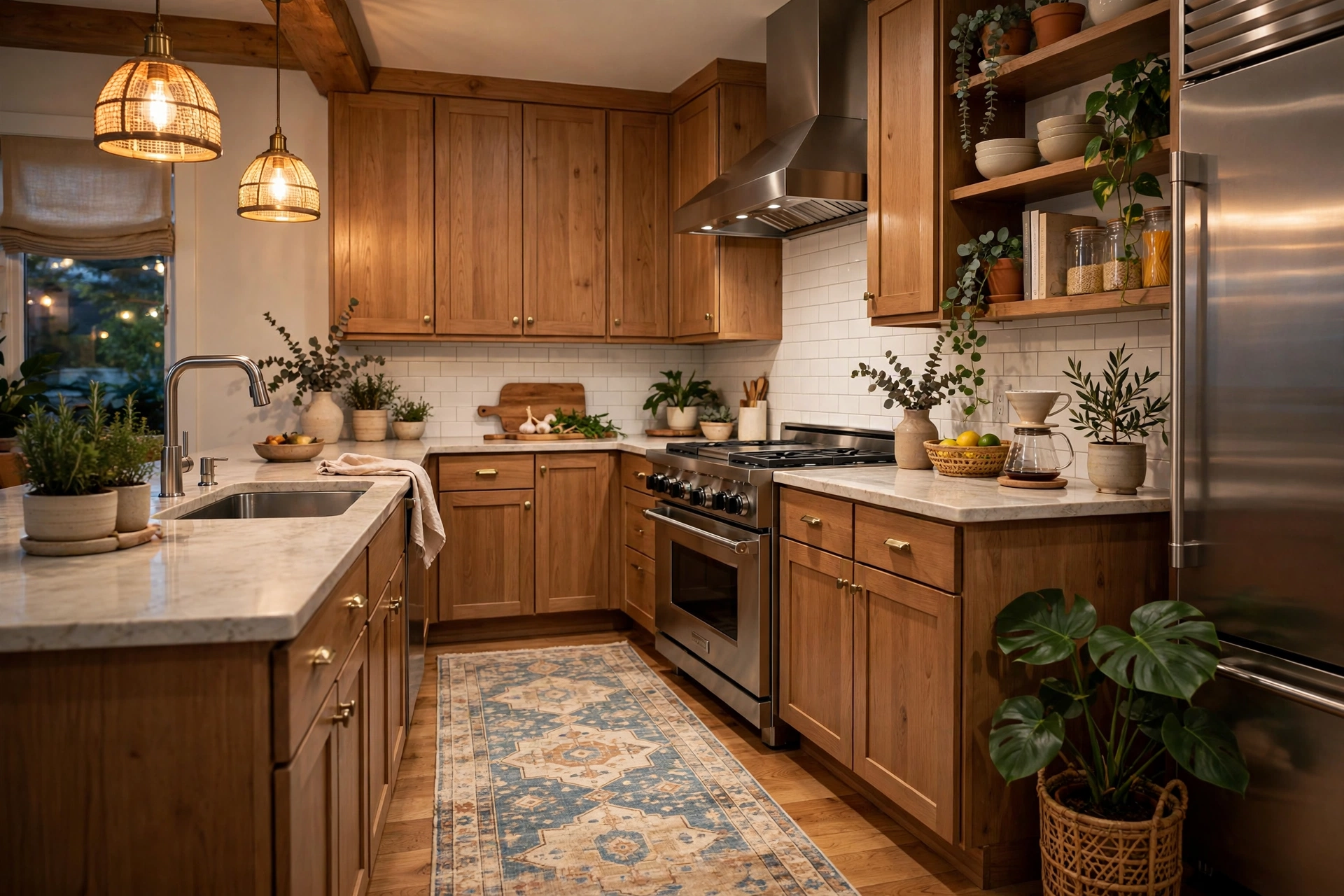
The sink zone. This is where most kitchen rugs live, and a runner is usually the right shape: long enough to cover the standing area in front of the sink and dishwasher, narrow enough to leave floor visible on both sides. As a working guide, the runner should be at least as long as the sink run and around two feet wide — wide enough to stand on comfortably, narrow enough not to reach the cabinet doors. If your sink is in an island, measure the island side, not the whole kitchen.
The stove zone. A small rug in front of the stove catches splashes, but it must sit flat and grip well — a curling corner near a hot stove is a trip hazard. Keep it clear of the oven door swing, and choose a low pile so the door does not catch on it.
Galley kitchens. One long runner down the middle usually beats two small rugs, which slide and gap. Leave a few inches of floor showing on each side so the runner reads as a deliberate strip, not wall-to-wall carpet.
Eat-in kitchens and dining areas. This is where people go wrong most often: a rug under a table must be big enough that chairs stay on it when pulled out. Measure with the chairs pulled out, not pushed in — if chair legs catch the rug edge every time someone sits down, the rug will curl, slide, and wear out fast. If the table area is too big for a washable rug you can actually launder, a wipe-clean mat under the table plus a washable runner at the sink is a better split.
Doors and transitions. Check every door swing, including the dishwasher and fridge doors, against the rug thickness. A thick rug that blocks a door will be kicked, folded, and eventually thrown away. Low pile — generally under half an inch — is the safe choice anywhere a door, chair, or trolley crosses it.
For the placement question that comes up most — whether a rug belongs under the table or in front of the sink — the honest answer is that it depends on where the mess happens in your kitchen, covered in the guide to whether kitchen rugs go under the table or in front of the sink.
Pile Height and Kitchen Reality
Low pile wins in kitchens, and it is not close. Short, dense pile traps less food, vacuums clean faster, dries faster after washing, and does not catch chair legs or door bottoms. Plush, high-pile rugs feel wonderful in a bedroom and become crumb traps in a kitchen within a week.
Pattern is a practical choice too, not just a decorative one. A busy pattern or a mid-tone colour hides crumbs and light stains between washes, which means the rug looks presentable for longer. A solid pale rug in front of the sink shows every splash and needs washing twice as often to look the same. That is not a reason to avoid pale rugs, but it is a reason to know what you are signing up for.
A Washing Routine That Keeps It Alive
The rug’s lifespan is decided by how you wash it, not just by what it is made of. A few habits make the difference between a rug that lasts years and one that falls apart in months.
Shake it out and vacuum it first, before it ever goes in the machine — washing a rug full of crumbs grinds the grit into the fibres. Spot-treat stains promptly rather than waiting for wash day; dried grease and tomato set harder with every day they sit. When you do machine-wash, use a gentle, cool cycle unless the label clearly allows more, and skip the fabric softener, which coats fibres and reduces grip on backed rugs.
Drying matters more than washing. Air-dry flat if you can; high dryer heat is what kills rubber backings, shrinks cotton, and sets wrinkles into rug pads. Most importantly, do not put a damp rug back on the floor. A rug that is even slightly damp underneath traps moisture against tile or wood, and that is where smells and mildew start. Let both the rug and the pad dry fully, and wipe the floor underneath while you are at it.
How often to wash depends on the spot: a sink-zone runner in a busy kitchen may need a wash every week or two, while a dining-area rug may go a month. Judge by smell and feel, not by the calendar — if it smells faintly of cooking even when clean-looking, it is overdue.
🛒 Shop This Look:
What Ruins Washable Rugs
Heat. Hot water and high dryer heat degrade backings, shrink natural fibres, and set stains. Cool and gentle is the default unless the label says otherwise.
Harsh bleach. It weakens fibres, yellows whites, and damages backings. For stains, a gentle spot treatment beats a bleach soak almost every time.
Putting it back damp. The most common slow killer. A damp rug on a hard floor grows mildew underneath, and by the time you notice the smell, the backing may be ruined.
Never washing the pad. In two-piece systems, the pad collects everything the top layer lets through. Wash or rinse it on the same schedule as the top, and replace it when it stops gripping — a sliding rug is a falling hazard, not just an annoyance.
Wrong size. A rug that curls, slides, or blocks a door will be kicked and folded daily, and no amount of washing fixes mechanical wear from being walked on wrong.
Mistakes to Avoid
Buying for the pattern alone. A beautiful rug in the wrong material or size is a short-lived rug. Check construction, backing, pile, and care instructions before you fall for a print.
Assuming “washable” means machine-washable. Read the label. Wipe-clean is not washable, and hose-off is not machine-washable.
One rug for the whole kitchen. Different zones need different rugs. A sink runner, a stove mat, and a dining rug can be three different products, and that is fine.
Ignoring the floor underneath. Rubber backings can discolour wood and some vinyl over time. If you have a floor you care about, use a separate pad and check underneath every few months.
Frequently Asked Questions
Can I put a washable rug in the washing machine with other laundry? Wash it on its own or with similar items, on a gentle cycle. A rug in a mixed load sheds fibres onto everything else and can unbalance the machine when wet.
How do I stop a kitchen rug sliding on tile? Use a proper non-slip pad or a rug with an intact rubber backing, and make sure both the floor and the pad are clean — dust under a pad kills grip. Replace a worn pad rather than living with a sliding rug.
Will a washable rug work on underfloor heating? Check the manufacturer’s guidance for your specific rug and floor system. As a general rule, low-pile rugs with breathable pads are safer than thick, rubber-backed ones, which can trap heat.
What if my rug smells even after washing? The smell is usually in the pad or backing, not the top layer. Wash or replace the pad, dry everything fully, and clean the floor underneath before relaying.
🛒 Shop This Look:
For the rest of the kitchen, see kitchen countertop decor ideas for the surfaces above the rug, navy blue kitchen cabinets for colour pairings, whether kitchen rugs go under the table or in front of the sink for placement, and the kitchen ideas hub for the full collection.



