
As an Amazon Associate, I earn from qualifying purchases. This means I may earn a commission if you purchase through links on this page — at no extra cost to you.
A fruit basket is the smallest piece of styling in a kitchen and one of the most used. It sits on the counter where everyone reaches for it, it changes every few days as fruit comes and goes, and it is judged by two standards at once: it has to look good, and it has to keep fruit in good condition. Most fruit baskets fail one of those two tests. The beautiful ones hide fruit where it bruises or ripens too fast; the practical ones look like a warehouse bin. Getting both right is mostly a matter of size, material, and placement, decided in that order, before you ever think about styling.
Size first: measure the counter, not the basket
Start with the counter, not the basket. Measure the spot where the basket will live — its width, its depth, and the height under any cabinets above it — and leave a hand’s width of clearance on every side, because a basket crammed against a wall or a backsplash is hard to reach into and harder to clean around. A basket that overhangs the counter edge is a knock-over waiting to happen, especially in a kitchen with children or pets. A basket that is too small for your household’s fruit will overflow, and overflowing fruit bruises, which defeats the purpose.
Household size sets the basket size more than counter size does. A single person or a couple can live happily with a modest bowl that holds a few days of fruit. A family that eats fruit daily needs a larger basket or a two-tier design, because a small basket refilled twice a day is not a system, it is a chore. If your counter is small and your household is large, a tiered stand earns its footprint by using vertical space — but only if the tiers are shallow enough that fruit on the lower tier stays reachable and visible. Deep tiers hide fruit, and hidden fruit rots.
Material: what each one does well and badly
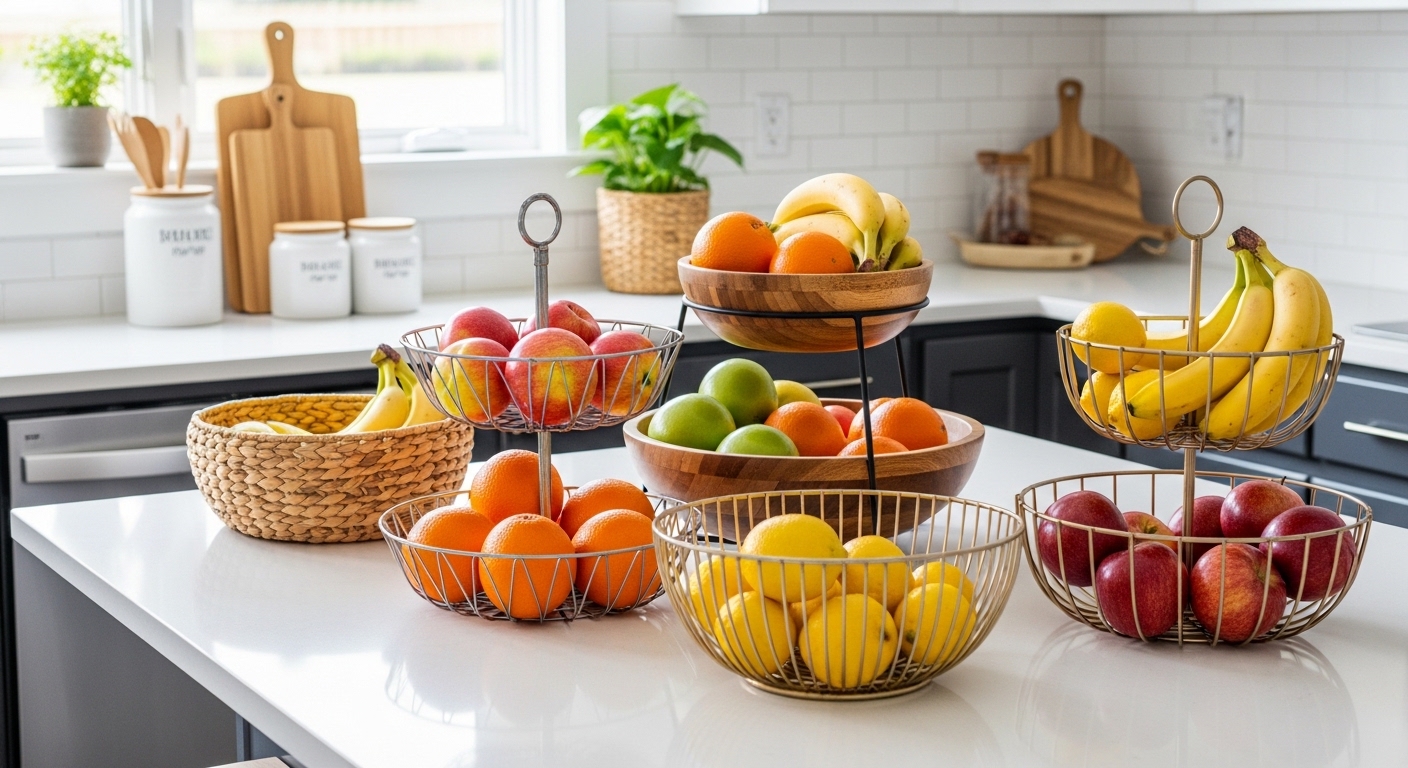
Woven baskets — seagrass, rattan, wicker — are warm, light, and forgiving on countertops, and they suit kitchens that lean natural or rustic. Their weakness is cleaning: woven fibers trap juice and moisture, and a woven basket that has held leaky fruit will stain and smell unless it is lined. Use a washable liner or a small plate inside, and wipe spills promptly rather than letting them soak in. Woven baskets also snag on rough produce like pineapple, so they suit smooth-skinned fruit best.
Wooden bowls and trays are sturdy, beautiful, and kind to fruit — wood does not chill fruit the way metal does, and it does not trap moisture the way woven fiber can. Their weakness is water: a wooden bowl left wet, or holding washed fruit that has not dried, will stain and eventually warp. Dry fruit before it goes in, and oil a wooden bowl occasionally to keep the surface sealed. Metal baskets and stands are airy, which helps fruit breathe, and they clean easily, but they chill fruit in a cold kitchen and can dent soft fruit if the wires are thin. Ceramic bowls are heavy, stable, and easy to clean, and their weight is a genuine advantage in a busy kitchen — a ceramic bowl does not slide or tip easily. Glass looks clean and shows fruit beautifully, but it shows every smudge and fingerprint, and it traps moisture underneath fruit, so it needs a liner or frequent wiping.
One tier or two, open or covered
Single-tier bowls and baskets are the most honest design: everything is visible, everything is reachable, and nothing hides. They suit households that eat fruit quickly and counters with room to spare. Two-tier stands suit small counters and large households, but only if both tiers are genuinely usable — a lower tier so deep or dark that fruit disappears into it is worse than no second tier at all. Test a tiered stand by reaching for fruit on the lower tier without moving the upper one; if you cannot, the design is decoration, not storage.
Covered baskets and fruit keepers have a real job: they protect fruit from flies in warm weather and from dust in kitchens near open windows. But a cover that must be lifted with both hands discourages snacking, which is the opposite of what a fruit basket is for. If you need a cover, choose one that lifts or swings with one hand. And never store fruit in a sealed container on the counter — fruit needs air, and sealed fruit ripens unevenly and spoils faster. Breathable is the rule for counter storage.
🛒 Shop This Look:
Fruit care: the basket is part of ripening
How you arrange fruit in a basket affects how it ripens. Bananas release a gas that speeds ripening in nearby fruit, which is useful when you want an avocado ready tomorrow and a problem when you want apples to last the week. Keep bananas in their own spot, or accept that everything nearby will ripen faster. Heavy fruit belongs on the bottom, soft fruit on top — a pile with apples on top of berries crushes the berries, and a pile with citrus on top of bananas bruises both. Arrange with weight in mind, not just color.
Wash fruit when you eat it, not when you store it. Washed fruit stored damp grows mold faster, especially berries, and a damp basket breeds the same problem in everything it holds. Keep berries in the refrigerator and bring out only what you will eat, rather than displaying them in a counter basket where they soften within a day. Stone fruit, citrus, apples, and bananas belong on the counter; berries, grapes, and cut fruit belong in the refrigerator. A basket that holds only counter-appropriate fruit stays beautiful longer, because nothing in it is quietly spoiling.
Placement: light, heat, and traffic
Where the basket sits matters as much as what it is made of. Direct sunlight ripens fruit fast and unevenly — the sunny side softens while the shaded side stays hard — so keep the basket out of a direct sunbeam, even if that spot looks beautiful in a photograph. Heat is the other enemy: a basket next to the stove, above a dishwasher, or beside a kettle will ripen fruit in hours rather than days. The best spot is a cool, shaded stretch of counter away from heat sources, with air circulating around it rather than trapped against a wall.
Traffic matters too. A basket on the main prep stretch gets knocked, splashed, and crowded by cutting boards, while a basket on a quieter stretch — near the breakfast area, or at the end of a counter run — stays beautiful and stays reachable. If your kitchen has an island, the island’s far end is often the best fruit spot: visible, reachable, and out of the prep zone. Avoid placing a basket right beside the sink, where splashes keep it wet, and avoid the narrow gap between stove and refrigerator, where heat and crowding combine.
Styling that survives real use
Styling a fruit basket is mostly restraint. One kind of fruit, or two that share a color family, looks calmer and more intentional than a rainbow pile that reads as clutter. Odd numbers help — three oranges, five lemons — because the eye reads a small group as a display rather than a stockpile. Height variation comes from the fruit itself: a tall pineapple or a bunch of bananas gives a low bowl a peak, while a flat tray needs low, even fruit to avoid looking top-heavy.
Seasonal styling keeps a basket from going stale. Citrus in winter, stone fruit in summer, apples and pears in autumn — following the season means fruit looks its best, tastes its best, and costs less, all at once. A few leaves or a sprig of herbs tucked beside the fruit adds a finished look without adding clutter, but keep greenery out of direct contact with fruit that will be eaten unwashed. And resist the urge to fill every gap: a basket with breathing room looks abundant, while a basket crammed to the rim looks like storage, not styling.
🛒 Shop This Look:
Small kitchens and rented kitchens
Small kitchens reward a basket that earns its footprint. A wall-mounted or hanging fruit basket frees counter space entirely, but only if it hangs where fruit stays reachable and does not swing into cabinet doors. A compact tiered stand uses vertical space well, as long as both tiers stay usable. A small ceramic bowl on a quiet counter stretch can hold a few days of fruit for one or two people and takes up less room than a toaster. The mistake in small kitchens is a large basket bought for a large household that does not exist — it dominates the counter and holds fruit that spoils before it is eaten.
Renters face the same choices with one extra constraint: avoid anything that marks the counter or wall. A heavy ceramic bowl needs no mounting and leaves no trace. A hanging basket needs a hook, which needs permission or a removable adhesive rated for the weight — test the adhesive with the basket empty before trusting it with fruit, because a falling basket breaks fruit, bowls, and floors in one moment. Peel-and-stick options exist for small baskets, but they fail most often under weight and humidity, so keep rented fruit storage on the counter unless you are certain of the mounting.
Cleaning and maintenance
A fruit basket needs regular cleaning, because fruit leaks, however carefully you arrange it. Woven baskets should be shaken out and wiped with a damp cloth, and lined to catch juice before it soaks in. Wooden bowls should be wiped dry after cleaning and oiled occasionally to keep the surface sealed. Metal stands can be washed fully, but dry them promptly to avoid water spots and rust at joints. Ceramic and glass can go in the dishwasher if they fit, but hand-washing preserves glazes and avoids chips. Whatever the material, clean the basket when you refill it, not when it visibly needs it — by the time a basket visibly needs cleaning, fruit has already been sitting in residue.
Replace a basket when it stops cleaning well. A woven basket that smells after washing, a wooden bowl that has warped or cracked, a metal stand with rust at the joints, or a ceramic bowl with a chip that harbors bacteria have all finished their useful life. A fruit basket is a food container before it is a decoration, and hygiene outranks sentiment. Keep the replacement the same size or smaller, unless your household has genuinely grown.
What not to put in a fruit basket
Some things do not belong in a counter fruit basket, however beautiful they look. Berries soften within a day on the counter and belong in the refrigerator. Cut fruit spoils quickly and attracts flies. Potatoes and onions need dark, cool, dry storage, not a sunny counter — and onions make nearby fruit taste of onion. Garlic belongs in a dry, ventilated spot, not piled with fruit. And decorative fake fruit, however convincing, defeats the purpose: a basket that looks full but holds nothing edible is a decoration pretending to be storage, and guests will reach for it.
🛒 Shop This Look:
Mistakes that ruin a fruit basket
The most common mistakes are all care mistakes. Storing washed fruit damp, piling heavy fruit on soft fruit, keeping bananas against everything, placing the basket in sun or beside the stove, and choosing a basket too large for the household so fruit spoils before it is eaten. Each one alone is survivable, but together they produce a basket that looks beautiful on day one and embarrassing by day four. The fix is rarely a new basket. It is usually one habit corrected: drying fruit before storing, separating bananas, moving the basket out of the sun.
The second family of mistakes is about size and material. A woven basket without a liner holding juicy fruit, a metal stand with thin wires denting soft fruit, a glass bowl trapping moisture, a tiered stand whose lower tier hides fruit — each one is a design choice that fights the job. Match the material to your fruit and your cleaning habits, match the size to your household, and let styling be the last decision rather than the first.
A starter plan, in order
Work in this order. First, measure your counter spot and leave clearance on every side. Second, size the basket to your household, not to your counter. Third, choose a material you will actually clean — ceramic or metal for low maintenance, wood or woven for warmth if you will maintain them. Fourth, place the basket away from sun, stove, and sink, in a spot with air and light but not heat. Fifth, keep bananas separate, heavy fruit below, soft fruit above, and berries in the refrigerator. Sixth, style with restraint: one or two color families, seasonal fruit, breathing room. Follow that order and the basket stays beautiful because the fruit stays good, which is the only styling that lasts.
For the wider kitchen picture, browse the kitchen ideas hub.