
As an Amazon Associate, I earn from qualifying purchases. This means I may earn a commission if you purchase through links on this page — at no extra cost to you.
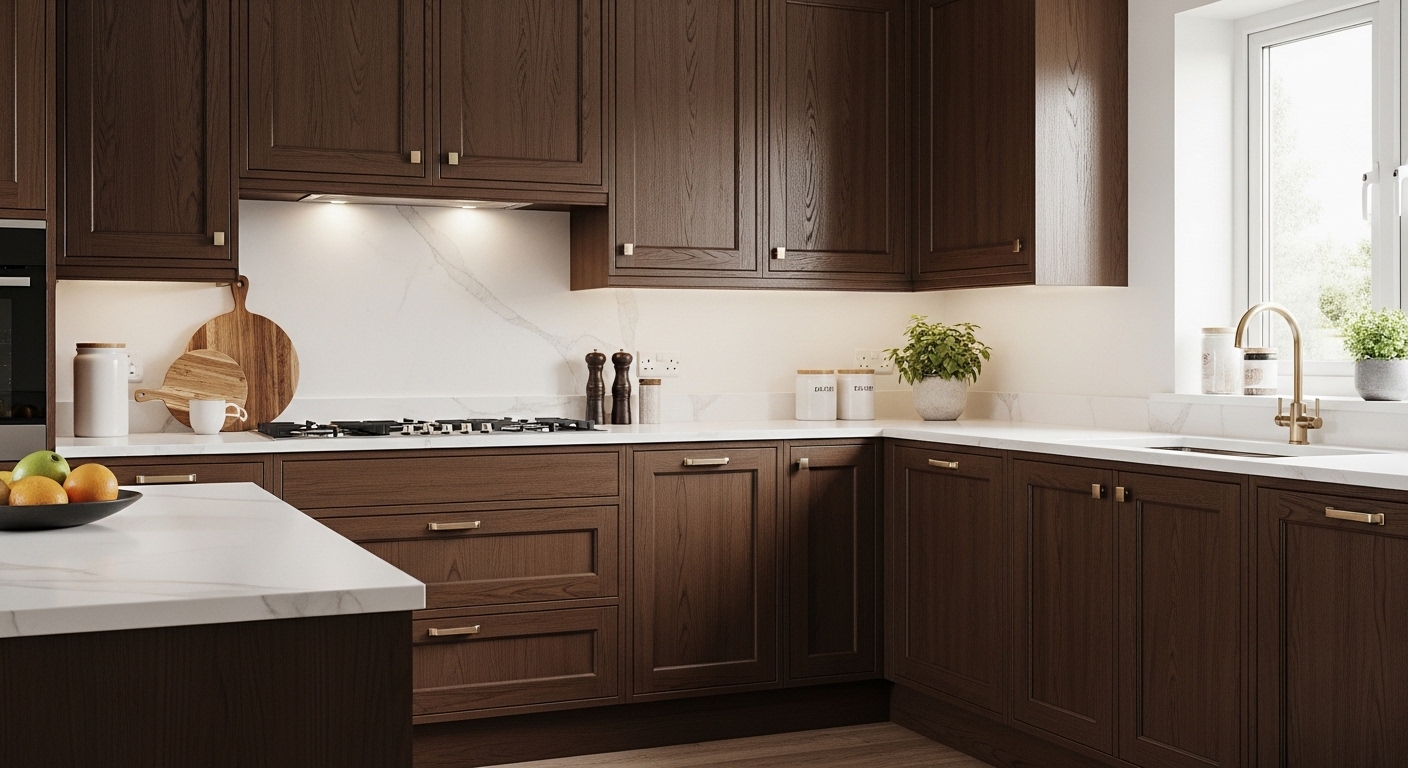
Run your hand along a walnut cabinet door and you understand dark brown kitchens immediately. A dark brown kitchen does not shout; it absorbs. It takes the morning light and gives it back warmer, deeper, slower. Espresso, walnut, mahogany, dark oak — each brown has its own temperature, and choosing between them is less about matching a trend than about deciding how you want your kitchen to feel at 7am. Get the brown right and the kitchen feels rich and grounded. Get it wrong and the room feels dark, heavy, and smaller than it is. The difference is rarely the brown itself. It is light, contrast, and the surfaces around it.
Know your brown’s temperature
Dark browns are not interchangeable. Espresso is nearly black with a cool edge, and it suits modern kitchens and gray stone. Walnut is warm and mid-dark, the most forgiving dark brown, and it suits almost any kitchen that can carry dark cabinets. Mahogany leans red, which reads luxurious with brass and marble but can clash with cool gray floors. Dark oak leans golden and shows grain strongly, which suits rustic and transitional kitchens but can look busy next to a patterned backsplash. Name the temperature before you choose the color, because everything else — counters, hardware, walls — answers to it.
Test the brown against your fixed surfaces, not against a paint chip. Hold a large sample against your floor first: a warm walnut over a cool gray tile floor will fight all day, while an espresso over the same floor sits quietly. Then against your countertop, if it is staying. White counters tolerate any dark brown, but a warm granite with gold veining will clash with a red-leaning mahogany, and a cool marble will fight a golden oak. If your floor and countertop lean in opposite directions, choose the brown that sits between them — walnut is often that middle ground — rather than matching one and fighting the other.
Light is the price of dark cabinets
Dark cabinets absorb light, and that is both their charm and their cost. A bright kitchen with generous windows and light floors can carry dark brown cabinets easily, because daylight replaces what the cabinets absorb. A dim kitchen, or one with dark floors as well, will feel smaller and gloomier with dark cabinets unless you compensate deliberately. Compensation is straightforward: lighter counters, lighter backsplash, lighter walls, and good artificial lighting, especially under-cabinet lighting that throws light onto work surfaces rather than into the room generally.
Test in your light before you commit. Look at a large sample in morning light, evening light, and under your kitchen’s bulbs at night, because dark browns shift more than light colors across those conditions. A walnut that looks rich at noon can turn nearly black under cool LEDs, and an espresso that looks sleek under warm bulbs can look flat in daylight. Under-cabinet lighting deserves special attention: it lights the countertop and the lower cabinet fronts directly, so it reveals undertone clashes that ceiling light hides. Turn it on during your swatch check.
🛒 Shop This Look:
Counters that lift dark cabinets
Counters do the most work in a dark brown kitchen, because they are the largest light surface left. Light quartz or white marble brightens the room and gives dark cabinets a clean edge to sit against — the safest pairing when you are unsure. Butcher block warms dark brown further, which suits a cool espresso but can push a warm walnut into overly golden territory. Light granite with warm veining suits warm browns; cool gray stone suits cool ones. Dark counters with dark cabinets can work in a large, bright kitchen, but in an average one they merge into a dark mass that shrinks the room, so use them only if your walls and backsplash are light.
Backsplash follows the same logic. A light subway tile, handmade-look tile, or pale stone backsplash lifts dark cabinets and keeps the kitchen bright. A busy patterned backsplash can work, but its background should be light and its pattern should share the cabinets’ temperature — warm pattern with warm brown, cool pattern with cool brown. A dark backsplash with dark cabinets is the combination most likely to make a kitchen feel like a cave, and it should be reserved for very bright rooms with light counters.
Hardware, walls, and floors around dark brown
Hardware warms or cools dark brown more than most people expect. Brass and gold-toned hardware warm dark cabinets and suit traditional and transitional kitchens — brass on walnut is one of the most reliable pairings in kitchen design. Chrome and nickel cool dark brown slightly and suit modern rooms, especially with espresso. Black hardware disappears against dark cabinets, which can be the point if you want the wood to lead, but it can also make the kitchen feel flat if nothing else adds definition. As always, one metal repeated reads as a plan; three metals read as indecision, and indecision shows more against dark cabinets because there is less color to distract from it.
Walls should mostly get out of the way. Warm white walls suit warm browns; crisper whites suit cool ones. A soft sage or muted blue can give dark cabinets something to play against without competing. Floors need care: wood floors warm dark cabinets naturally and are the easiest pairing, as long as undertones agree — a cool gray tile floor under warm walnut is the most common clash in dark kitchens. If your floor is fixed and cool, answer it with a cooler brown rather than fighting it with a warm one. Rugs can soften a clash but cannot fix one.
Two-tone and the island as a release valve
Two-tone cabinets are a release valve for dark kitchens. Dark lowers with light uppers keep the room grounded without closing it in, and the split is especially useful in kitchens that are not generously lit. The lighter upper should share the dark brown’s temperature family, or the split reads as two kitchens rather than one design. Reversing the split — dark uppers, light lowers — can work in a very bright kitchen, but in an average one it makes the room feel top-heavy.
Islands are the safer place to experiment. A dark brown kitchen with a light island — white, cream, or butcher block — gains a bright focal point and a work surface that stays visible in dim light. A light kitchen with a dark brown island gains depth without committing every cabinet to darkness. Either way, the island color should sit quietly next to the perimeter cabinets, sharing an undertone or at least not fighting one, or the kitchen splits into two rooms that happen to share a floor.
🛒 Shop This Look:
Small and dark kitchens
Small kitchens can carry dark brown cabinets, but only with discipline. Keep counters, backsplash, and walls light, ration dark cabinets to lowers or to one wall, and let lighting do the rest. Covering a small kitchen entirely in dark brown, with dark counters and a dark backsplash, shrinks it visually in every direction, because the eye finds no light surface to rest on. If you love dark brown and your kitchen is small, the island or the lower cabinets are where the love should live, with light everywhere else.
Open shelving changes the equation in a useful way. A run of open shelves in a light wood or white breaks up a dark cabinet wall and gives the eye somewhere to rest, which matters more in small rooms. But open shelving demands tidiness, because everything on it is visible against the dark background. If your household will not maintain open shelves, closed light uppers are the kinder choice, and the darkness can live in lowers and hardware instead.
Keeping dark cabinets looking rich
Dark cabinets show dust, fingerprints, and water spots faster than light ones, especially near handles and around the sink. That is the honest trade for a rich kitchen: you will wipe more often, but you will also notice mess sooner. A soft cloth with mild dish soap handles most cleaning; avoid abrasive pads on dark finishes, because they leave visible scuffs that light cabinets hide. Pay attention to cabinet fronts near the stove, which collect grease, and to lower doors, which collect scuffs from feet and pets.
Scratches show more on dark cabinets than on light ones, because they reveal lighter wood or primer beneath. Touch-up markers matched to your cabinet color are worth keeping on hand, and they work best when used promptly, before a scratch collects dirt. Sunlight can fade dark browns over years on cabinets facing a bright window; a slightly deeper brown hides fading better than a mid-tone one. Water is the other enemy: wipe up splashes near the sink rather than letting them sit, because standing water dulls finishes and, over time, damages edges.
Mistakes that darken a dark kitchen
The most common mistakes are all light mistakes. Dark cabinets with dark counters, a dark backsplash, dark floors, and dim lighting produce a kitchen that feels like a cave, and the fix is rarely a new cabinet color — it is usually one surface lightened, or lighting improved. The second family of mistakes is undertone mistakes: warm walnut over cool gray tile, red mahogany against cool marble, hardware in three metals. Each one alone is survivable, but together they produce a kitchen that feels muddy rather than rich.
The third mistake is ignoring the room’s actual light. Choosing dark brown in a bright showroom and installing it in a north-facing kitchen, or skipping the evening-light test, produces the same result: cabinets that looked rich in the store and look black at home. Test a large sample in your light, under your bulbs, on a board you can move. It costs an afternoon and saves a repaint.
🛒 Shop This Look:
A starter plan, in order
Work in this order. First, name your brown’s temperature and check it against your floor and countertop undertones. Second, judge your light honestly — bright kitchens can carry dark cabinets freely, dim ones need compensation planned in advance. Third, choose light counters and a light backsplash to lift the room. Fourth, pick one hardware metal and repeat it. Fifth, decide walls to frame the cabinets rather than compete with them. Sixth, plan under-cabinet lighting before you judge the result. Follow that order and dark brown stops being a risk and becomes the richest choice in the room.
For related cabinet directions, see the guides on elegant kitchens, beige cabinets, and navy blue cabinets. And for the wider kitchen picture, browse the kitchen ideas hub.