
As an Amazon Associate, I earn from qualifying purchases. This means I may earn a commission if you purchase through links on this page — at no extra cost to you.
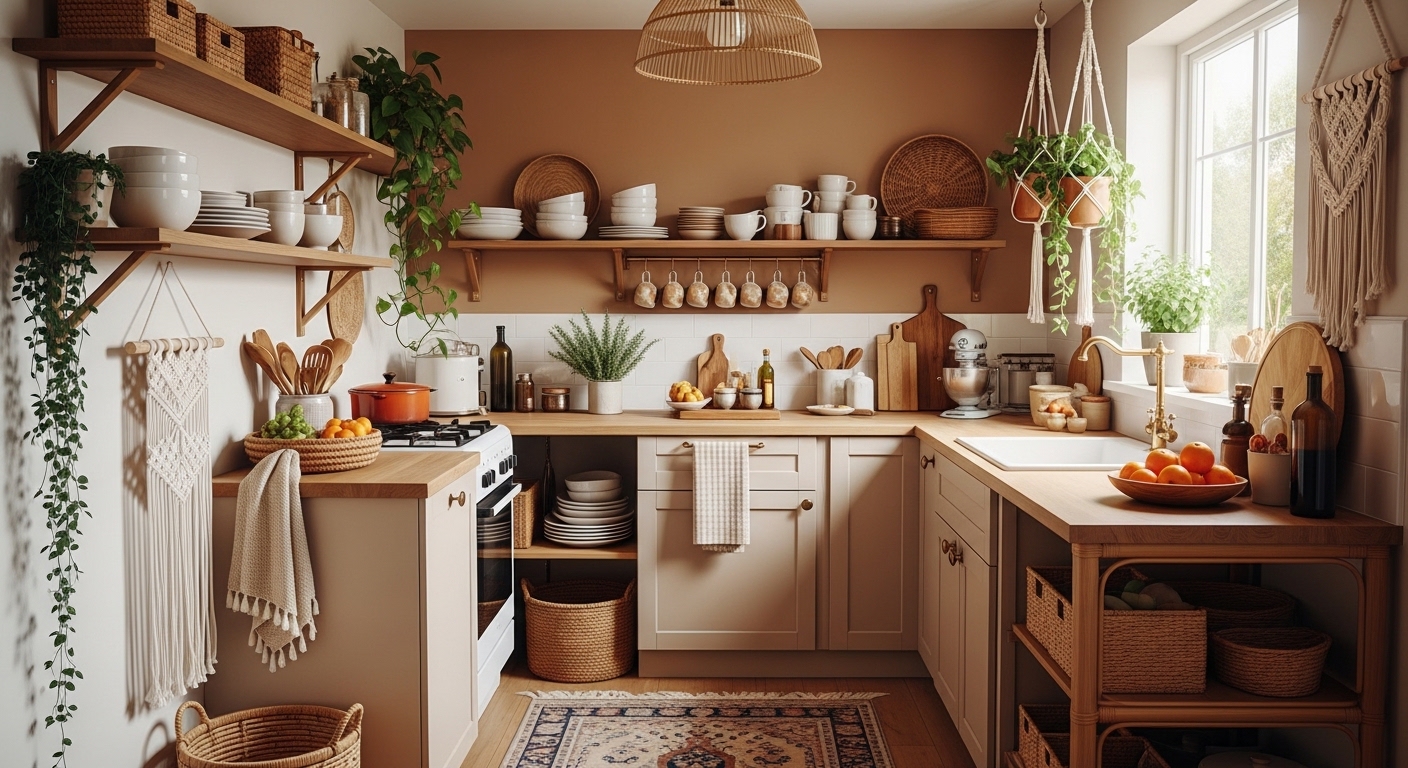
Boho in a small kitchen is a balancing act. The style is layered, warm, and collected — rattan, plants, pattern, wood, textiles — and a small room has very little slack for layering before it tips into clutter. The kitchens that get it right do not have less boho. They have more discipline about where each layer goes.
This guide starts with the constraint — the small room itself — and then works through color, shelving, materials, plants, and storage, with the renter-friendly moves that let you layer without permanent changes. The goal is a kitchen that feels collected over time, not crowded in one weekend.
The small room comes first
Before any decor decision, map what must stay clear: the work counter, the path to the stove and sink, the refrigerator door’s swing, and at least one stretch of empty counter for setting things down. Every boho layer must respect those clearances. A basket that blocks a drawer or a plant that crowds the prep space will annoy you daily, however good it looks in a photo.
Measure the wall space you actually have, not the wall space you wish you had. Small kitchens often have one usable wall stretch and a few awkward gaps — above the refrigerator, beside a window, at the end of a counter. Those gaps are where boho layering works best, because small, intentional groupings suit them better than large statements.
Light is your ally here. A small kitchen with good daylight can carry deeper color and busier pattern than a dim one, because light keeps the layers readable. In a dim kitchen, keep the base palette light and let pattern and texture arrive in smaller doses, so the room does not close in.
Color and pattern in small doses
Boho color in a small kitchen works best as a warm base with pattern in controlled places. Warm white or pale plaster walls, wood tones, and one or two warm accents — terracotta, ochre, deep green — give the room its warmth without shrinking it. Dark, saturated color on every wall will make a small kitchen feel smaller, however cozy it looks in a large room.
Pattern belongs where it can be appreciated up close: a backsplash band, a runner, a set of textiles, a single patterned blind. Pattern on every surface at once competes with itself, and in a small room that competition is the whole view. One patterned surface, repeated in a smaller echo elsewhere — a tile pattern echoed in a towel, for example — reads as intentional rather than accidental.
For wall-specific boho guidance, see these boho wall decor ideas, which cover the same layering principles at wall scale.
🛒 Shop This Look:
Open shelving that looks collected, not messy
Open shelving is the signature boho move, and the one most likely to go wrong in a small kitchen. The difference between collected and messy is editing: fewer items, grouped by material, with gaps between groupings. A shelf of wooden boards, ceramic bowls, and glass jars in one warm family reads as a collection. A shelf of everything you own reads as overflow.
Keep the shelf count low. One or two open shelves, well edited, beat four crowded ones. Reserve the remaining storage for closed cabinets, where the visual noise lives behind doors. The boho look comes from what you choose to show, not from showing everything.
What you show should earn its place twice: it should look good and be used. Everyday bowls, a wooden board collection, glass jars of staples, and a few plants all qualify. Decorative objects with no kitchen use should be rare on kitchen shelves — one or two, not a display.
Natural materials that survive a kitchen
Rattan, wood, linen, and clay are the boho material palette, but not every natural material survives kitchen conditions equally. Sealed wood and glazed ceramic wipe clean and handle steam well. Raw rattan and unsealed baskets absorb moisture and grease near the stove, so keep them on the calmer walls and away from direct cooking zones.
Linen and cotton textiles suit kitchens when they are washable — towels, runners, and seat pads that go in the laundry. Decorative textiles that cannot be washed will collect cooking film and look tired within months. In a kitchen, washability is not a compromise; it is what keeps the boho look alive.
Clay and ceramic are the workhorses. Handmade-look bowls, mugs, and planters carry the boho texture without any special care, and they improve with use rather than degrading. A few good ceramic pieces do more for the look than a shelf of fragile decor.
Plants in a small kitchen
Plants are the fastest way to make a small kitchen feel boho, and the easiest to overdo. Two or three plants — a trailing plant on a high shelf, herbs by the window, one larger plant in a floor corner if space allows — give the room its living layer. Ten small plants on every surface turn the kitchen into a greenhouse and steal counter space you need.
Herbs earn their place twice over, as decor and as cooking ingredients, and they suit the light conditions of most kitchen windows. Choose herbs you actually cook with, and keep them where you reach them while cooking rather than where they merely photograph well.
Hanging planters help in truly tight kitchens, because they use air space rather than counter space. Hang them where they will not drip onto work surfaces or get bumped by cabinet doors, and use planters with drainage trays — a plant that drips onto a counter below will not stay charming for long.
🛒 Shop This Look:
Storage that looks like decor
In a small boho kitchen, storage should do double duty. Woven baskets hold produce, linens, and pantry overflow while reading as decor. Glass jars of staples look intentional on a shelf and keep food visible and fresh. Hooks on a wall rail hold mugs, tools, and towels where they are reachable and good-looking.
The trick is consistency of material. Baskets in one or two natural tones, jars in one glass style, hooks in one finish — the storage reads as a set, and a set reads as decor. Mixed materials in every container read as clutter, even when the containers themselves are attractive.
Doors and corners deserve attention too. The inside of a cabinet door can hold a spice rack or measuring tools; an awkward corner can hold a tall basket or a leaning shelf. Small kitchens reward using the spaces that larger kitchens ignore.
Dining nooks and eat-in corners
Many small kitchens include a dining nook, and boho layering suits it better than anywhere else in the room, because the nook is for lingering rather than working. A small table, two chairs or a bench, a textile runner, and one piece of wall art can carry more pattern and warmth than the work zones can, because nothing there needs to stay clear for cooking.
Bench seating is the small-nook advantage: a bench against the wall seats more people than chairs in the same footprint, and the space beneath it holds baskets for linens or rarely used items. A cushion in a washable, warm-toned fabric makes the bench inviting without adding a cleaning burden.
Lighting makes the nook. A single pendant hung low over the table, warm in tone, turns the corner into a destination in the evening, even when the rest of the kitchen is dark. It is a small change with an outsized effect: the nook stops being leftover space and becomes the room’s warmest spot.
Keep the nook’s layers contained. Pattern on the table runner and the wall art is enough; pattern on the chairs, the cushions, and the floor as well turns the corner into a separate room that fights the kitchen. The nook should feel like the kitchen’s softest corner, not like a different style moved in.
Renters: layering without damage
Rented kitchens suit boho layering well, because so much of the style is removable. Freestanding shelves, leaning ladders, adhesive hooks, removable backsplash panels, and textiles all layer without drilling or painting. Test adhesives on a hidden spot first, and respect weight limits — a shelf of ceramics needs real fixing, not adhesive strips.
What renters should avoid is any layer that damages the fixed elements: unsealed wood against a steamy wall, adhesive on fresh paint, or heavy items hung from weak fixings. The goal is a kitchen that looks collected and leaves no trace when you move out.
Mistakes that turn boho into clutter
The most common mistake is too many small objects. A small kitchen with dozens of tiny decorative items on every surface reads as a shop, not a room. Remove half of what you think you need, live with the room for a week, and add back only what you miss.
Another mistake is blocking light. A tall shelf across a window, or dark, heavy textiles on the brightest wall, dims the whole room. The brightest wall should stay the lightest in decor, so daylight can keep the layers readable.
A third mistake is themed overload: every object signaling boho at once — patterned everything, fringed everything, rattan everything. Boho works when some things are plain. Plain walls, plain counters, and plain cabinets give the patterned and textured pieces room to be noticed.
A starter plan, in order
Begin by mapping clearances and usable wall space, then fix the warm base palette, then choose one patterned surface, then add one or two edited open shelves, then plants, then textiles and storage baskets. Working in this order keeps each layer deliberate: nothing arrives before the space for it exists.
For the broader set of kitchen guides on this site, browse the kitchen ideas hub.
🛒 Shop This Look:



