
As an Amazon Associate, I earn from qualifying purchases. This means I may earn a commission if you purchase through links on this page — at no extra cost to you.
Choosing a kitchen wash basin looks simple until you stand in front of the options. Undermount, top-mount, farmhouse, single bowl, double bowl, stainless, granite composite, fireclay, copper: every choice changes how the sink feels to use, how easy it is to clean, and what it demands from your countertop and cabinets. This guide works through those decisions in the order that matters, so you can pick a basin that suits the way you actually cook and wash up, rather than the one that photographed best.
Start with how you use the sink
Before looking at materials or styles, spend a few days noticing what your sink actually does. Do you wash large pots and baking trays, or mostly plates and glasses? Do you soak things, or rinse and stack? Is there usually one person at the sink, or two? A household that regularly washes roasting trays needs a wide, deep single bowl, because a divided sink will make every large item awkward. A household that soaks dishes while cooking needs either a double bowl or a single bowl large enough to hold a soaking pile on one side and still leave room to rinse. A household that runs a dishwasher for most things and uses the sink mainly for rinsing needs far less sink than the showroom suggests.
Also notice your countertop space. A very large sink eats counter, and counter is where food preparation happens. The right sink is the smallest one that comfortably holds your largest regular item, with a little room to spare. Measure that item, a roasting tray or a stockpot, and carry the measurement with you when you shop. It will keep you honest when a salesperson shows you something bigger.
Basin types: what each one really means
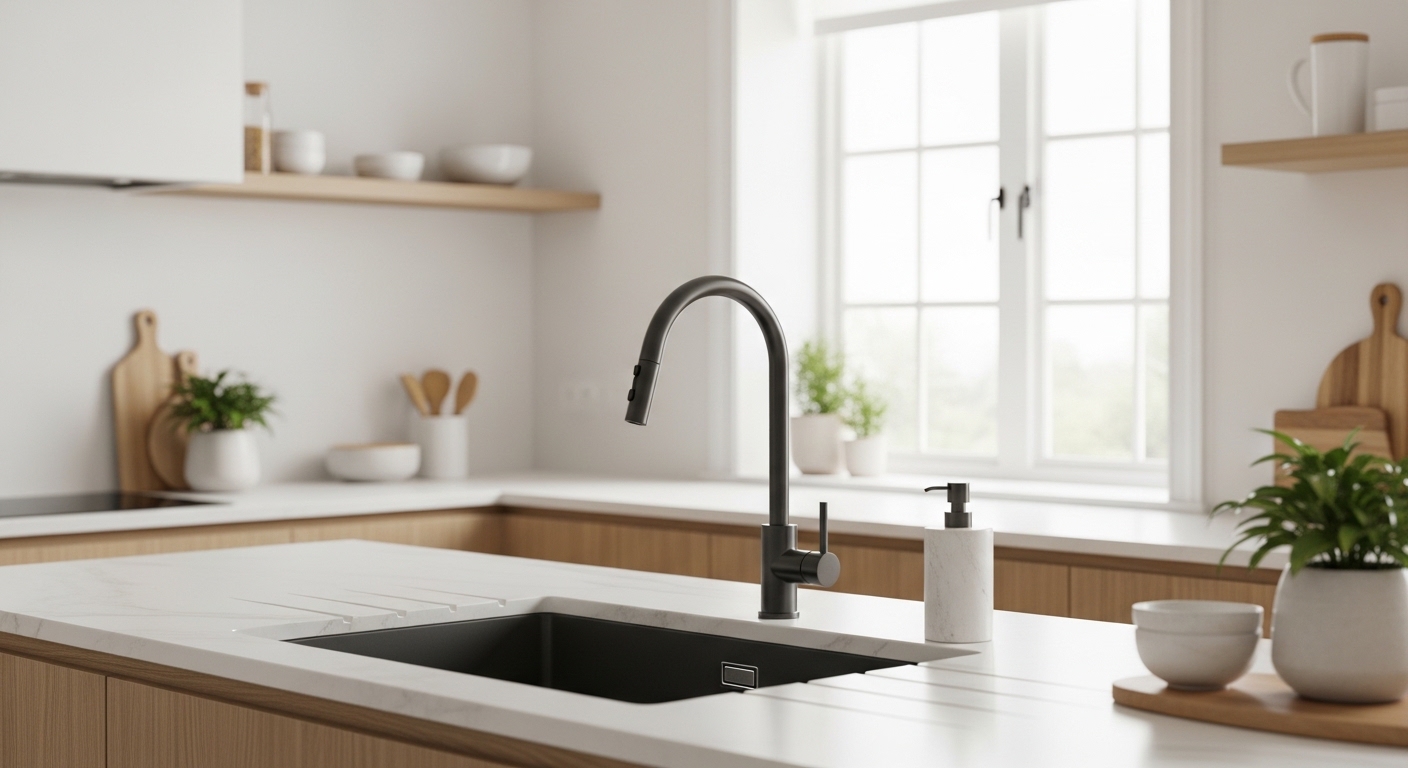
An undermount basin is fixed beneath the countertop, so the counter edge flows straight into the bowl and crumbs can be wiped directly in. It looks clean and it is genuinely easier to keep the counter tidy, but it needs a solid-surface countertop, stone, quartz, or solid wood, because laminate edges do not support it well and can swell if water gets in. Installation costs more, because the basin must be supported from below and sealed properly, and replacing it later means disturbing the countertop.
A top-mount, or drop-in, basin sits in a hole cut in the countertop with a rim resting on top. It works with any countertop material, including laminate, it is simpler and cheaper to install, and it is much easier to replace later. The rim creates a small lip that catches crumbs and needs wiping, which is a minor daily annoyance rather than a real problem. For a budget kitchen or a laminate countertop, top-mount is usually the sensible choice, and it is not a compromise to be embarrassed about.
A farmhouse, or apron-front, basin has a deep bowl and an exposed front panel that replaces part of the cabinet front. It is comfortable to use because you stand closer to the bowl without a cabinet edge pressing into you, and the depth handles large pots well. It needs a cabinet that can be cut or built to accept it, and the exposed front needs wiping, since it catches splashes. An integrated basin, where bowl and countertop are one molded piece, gives the cleanest look of all and has no seams to clean, but it limits your countertop material choices and makes future replacement a whole-countertop job. A vessel basin, which sits on top of the counter, looks striking but raises the working height and splashes more, so it suits a secondary prep sink better than a main kitchen sink.
Materials: honest trade-offs
Stainless steel is the workhorse for a reason. It tolerates heat, it does not stain easily, it is light enough to install without special support, and it suits almost any kitchen. Thicker steel dents less and sounds quieter; thinner steel is cheaper but noisier and more prone to showing dents and water marks. A brushed finish hides scratches better than a polished one, and that matters in a sink that will see pots and cutlery every day. Stainless steel will scratch over time, and that is normal wear, not a defect.
Granite composite, made from stone particles bound in resin, is heavier, quieter, and more resistant to scratches and chips than stainless steel, and it comes in colors that blend with darker countertops. It needs a sturdy cabinet to carry its weight, and very hot pots should not sit directly on it for long, since extreme heat can mark the surface. Fireclay, a glazed ceramic, gives a classic farmhouse look with a smooth, hard surface that resists stains well, but it is heavy, it can chip if a heavy pot is dropped on an edge, and it usually costs more. Copper looks warm and develops a living patina that changes over time, which is either its charm or its problem depending on your taste; it needs gentler cleaning and it is not the right choice if you want a surface that stays looking exactly as it did on day one. Ceramic and porcelain basins share fireclay’s strengths and weaknesses in a lighter form, and they chip more easily than steel or composite.
🛒 Shop This Look:
Size, depth, and single versus double
Size is decided by two things: the cabinet underneath and the largest item you wash. A standard base cabinet is wide enough for most single bowls, but a very wide basin may need a wider cabinet or a cabinet with its sides modified, so check the cabinet before falling for a basin. Depth matters for comfort: a very deep bowl means reaching further down, which strains the back during long washing sessions, while a shallow bowl splashes more. A depth that lets you work without bending deeply and without splashing the counter is the right depth, and that varies with your height, so stand at a display sink and mime washing a large pot before deciding.
Single versus double is the oldest sink argument, and the honest answer is that it depends on the soaking habit. A double bowl lets you soak on one side and rinse on the other, which suits households that wash by hand. A single large bowl handles big items better and gives more usable space for the same overall width. A low divider, sometimes called a one-and-three-quarter bowl, splits the difference: a large main bowl with a smaller side bowl for rinsing or a garbage disposal. If you run a dishwasher for most loads, a single bowl is usually the better use of space, because the second bowl will mostly sit empty.
Faucet pairing and countertop compatibility
The faucet and the basin must be planned together, not bought separately. A tall faucet over a shallow basin will splash; a short faucet over a deep farmhouse basin will make filling tall pots awkward. Check the faucet’s reach: the spout should land over the drain or the center of the bowl, not so close to the back edge that water runs down the backsplash. If you want a pull-down sprayer, check that it clears the backsplash and any shelf behind the sink. A single-handle faucet is easier to use with wet or soapy hands than separate hot and cold taps, and a wall-mounted faucet frees counter space but needs plumbing in the wall, which is a bigger job in an existing kitchen.
Countertop compatibility decides which basin types are even possible. Laminate works with top-mount basins and not comfortably with undermount ones. Stone and quartz work with any type but need proper support for heavy basins, especially fireclay and granite composite. Solid wood works with undermount and top-mount, but the wood around the sink must be sealed well and resealed over time, because standing water is wood’s enemy. If you are keeping your existing countertop, that decision is already made for you, and it narrows the basin choice usefully.
Cleaning and living with the basin
Every basin material has a cleaning routine, and the one you will actually follow matters more than the one on the care sheet. Stainless steel needs a wipe after use to avoid water marks, and a periodic deeper clean to keep it bright; abrasive pads will scratch it, so soft cloths and non-abrasive cleaners are the rule. Granite composite needs little more than wiping, but light colors can stain if coffee or strong-colored liquids sit for long. Fireclay and ceramic wipe clean easily but show chips, and a chipped edge on a light basin is hard to hide. Copper needs the gentlest care of all, and harsh cleaners will strip its patina unevenly.
Drainage and accessories change daily life more than most people expect. A basin with the drain set to one side leaves a flat area for stacking, while a center drain suits a single large bowl. A grid or rack on the basin floor protects the surface from pots and keeps dishes off standing water, but it also needs cleaning itself. A cutting board that fits over the bowl adds counter space in a small kitchen, and a colander insert turns the sink into a prep station. Buy accessories after the basin, not before, because sizes vary and a board that does not fit is useless.
🛒 Shop This Look:
Small kitchens and tight cabinets
In a small kitchen, the basin should be chosen for the cabinet you have, not the cabinet you wish you had. A compact single bowl, or a small double bowl with a slim divider, will usually serve better than a large basin that eats the only counter beside the stove. Corner sinks save counter in some layouts but make the plumbing and the working position awkward, so they are worth considering only when the layout genuinely leaves no straight run. If the cabinet under the sink is narrow, check the basin’s overall width including any rim or apron, not just the bowl width, because the rim is what has to fit the hole.
Storage under the sink shrinks when the basin is deep, because the bowl and the plumbing take space that a shallower basin would leave free. If you store cleaning supplies under the sink, a shallower bowl or a basin with an offset drain leaves more usable cabinet space. A pull-out tray or a door-mounted rack inside the cabinet recovers some of that space, but only if the plumbing layout leaves room for it. Measure the cabinet interior, including the position of the drain and supply pipes, before ordering anything that depends on under-sink storage.
Renters and budget realities
Renters usually cannot change the basin, but they can change how it works. A basin rack protects a worn surface and improves drainage. A new faucet aerator changes the water flow and feel without plumbing work. A sink caddy, a cutting board that fits over the bowl, and a good drying rack all improve a mediocre sink without touching the installation. If a replacement is allowed, a top-mount basin in the same size as the old one is the least disruptive swap, because it uses the existing hole and plumbing.
On a budget, spend on the basin and the faucet together rather than on one at the expense of the other, because a good basin with a poor faucet still frustrates daily, and a good faucet cannot rescue a basin that is the wrong size. Stainless steel in a medium thickness is the best value for most kitchens, and a simple top-mount installation keeps labor costs down. Save money by keeping the plumbing position unchanged: moving a drain or supply line is where a simple swap becomes an expensive job.
Mistakes to avoid
The most common mistake is choosing by looks alone, without measuring the largest item you wash or the cabinet underneath. The second is ignoring the faucet, which is half the sink’s function. The third is choosing a material for its showroom appearance without accepting its care routine: copper that will patina, fireclay that can chip, light composite that can stain. The fourth is going too big and losing the counter beside the sink, which is where food preparation actually happens. The fifth is forgetting the plumbing: a deep basin in a shallow cabinet, or a basin whose drain position does not line up with the existing waste pipe, turns a simple job into a difficult one.
Avoid all of these by working in order: notice how you use the sink, measure your largest item and your cabinet, choose the basin type your countertop allows, choose the material whose care routine you will actually follow, pair the faucet, and only then choose the color and finish. A basin chosen that way will not be the most dramatic object in the kitchen, but it will be the one you never think about, which is exactly what a good sink should be.
🛒 Shop This Look:
Choosing checklist
Run through this list before you order. What is the largest item you wash regularly, and does it fit the bowl with room to spare? Does the basin type suit your countertop material? Does the cabinet underneath fit the basin’s full width and depth, including any apron? Does the faucet reach the center of the bowl without splashing? Can you stand at the sink and work without bending deeply or stretching? Does the material’s cleaning routine match what you will actually do? Is the plumbing position workable without moving pipes? If every answer is yes, the basin is right for your kitchen, whatever the showroom trends say. For the rest of the kitchen, the kitchen ideas hub collects further planning guides by room and job.