
As an Amazon Associate, I earn from qualifying purchases. This means I may earn a commission if you purchase through links on this page — at no extra cost to you.
Picture your kitchen decades from now. The appliances will have changed, the paint may have changed twice, and whatever was fashionable the year you remodeled will read as a timestamp. The kitchens that still look right after all that time share certain qualities: natural materials, calm proportions, and restraint. They were not built around a trend. They were built around how a kitchen actually works.
That is the real test of timeless design. It is not about spending more, and it is not about choosing all white. It is about making decisions that do not depend on a trend cycle to look good. This guide walks through those decisions in the order that matters: layout and proportion first, then materials, then color, then the details that either hold the room together or date it.
What ages well, and what does not
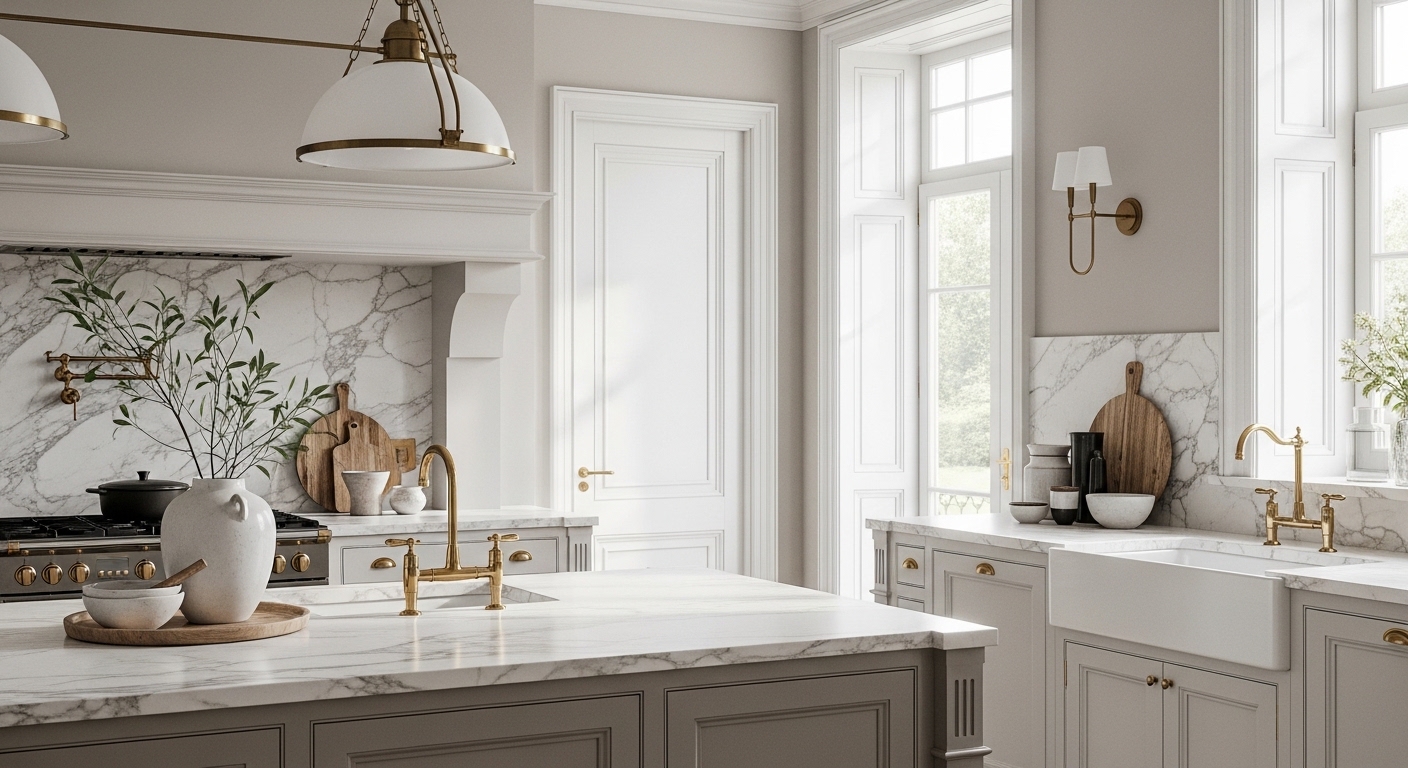
Materials age well when they look better with a little wear. Solid wood, natural stone, handmade-look tile, and simple metal hardware all belong in this group. A wooden counter edge that darkens slightly over years reads as character. A stone surface with natural veining never looks like a copy of something else, because it is not one.
What dates fast is anything that exists mainly to signal a particular year. Boldly patterned trend tiles, themed cabinet pulls shaped like objects, appliance colors chosen for novelty, and backsplashes built around a single loud motif all carry an expiry date. They are not bad choices in themselves, but they ask the whole room to stay fashionable, and rooms rarely manage that.
A useful question for every choice is whether you would still like it if you saw it in someone else’s kitchen with no context at all. If the answer depends on knowing it is current, it is a trend choice. If the answer is yes regardless, it is a timeless one.
Proportions and layout before decoration
Timeless kitchens are planned from the room outward, not from a catalog page inward. Start with how you move through the space: the path between sink, stove, and refrigerator should feel short and unobstructed, and the main work counter should sit where daylight reaches it when possible. A beautiful kitchen that forces awkward steps around an island will feel wrong no matter how good its finishes look.
Cabinet proportions matter more than cabinet style. Tall cabinets that run to the ceiling look settled and intentional, while a gap above wall cabinets collects dust and visually shortens the room. Drawers under counters hold more, and hold it more accessibly, than deep base cabinets with doors. These are practical choices, but they are also what make a kitchen look considered rather than assembled.
Sight lines deserve attention too. Standing at the kitchen entrance, what do you see first? In a timeless kitchen, the eye lands on something calm: a window, a stretch of counter, a simple run of cabinets. If the first thing you see is a busy mosaic or a wall of small objects, the room will feel restless even when it is tidy.
🛒 Shop This Look:
A palette that holds over time
Timeless palettes are narrow. Pick one neutral family for the large surfaces — warm white, soft grey, warm wood tones, or a muted greige — and let everything else support it. The discipline is in the undertones: a warm white cabinet next to a cool white counter can look mismatched even when both colors are individually pleasant, because the eye reads the clash before it reads either color.
Test paint and stone samples in the kitchen itself, at different times of day, and next to the fixed elements you are keeping: the floor, the window trim, the appliances. A color that looks perfect on a small chip under shop lighting can shift noticeably beside warm wood or under evening lamps. Live with the samples for a few days before committing, and look at them in the morning light, which is the least forgiving.
One accent is usually enough. A single deeper tone — on an island, on a range hood surround, or in a backsplash band — gives the room a focal point without turning it into a color statement. Two or three competing accents pull the eye in several directions at once, and the room starts to feel like a collection of ideas rather than one room.
Cabinets and hardware: quiet framing
Simple cabinet fronts age best. Flat or lightly framed doors, with clean lines and no applied ornament, suit almost any house and almost any era. Heavily detailed doors lock the kitchen into a particular historical revival, and when that revival fades, the whole room fades with it.
Hardware is where many kitchens accidentally date themselves. Classic shapes — simple bars, plain knobs, cup pulls — have been in use for decades and will be in use for decades more. Novelty shapes, mixed-metal experiments on every drawer, and oversized statement pulls tend to read as period pieces within a few years. Choose hardware that feels good in the hand and quiet to the eye, and keep one finish through the room rather than mixing several.
If your budget forces a choice, spend on cabinet construction and hinges before spending on door style. Doors can be repainted and hardware can be swapped in an afternoon. Boxes that sag, drawers that stick, and hinges that fail make the whole kitchen feel tired, and no finish choice rescues that.
Counters and backsplashes that do not fight the room
Natural stone and solid-surface counters with soft, irregular veining hold up visually because they do not repeat. A busy, high-contrast pattern on a large counter surface can dominate the room and tire the eye; a quieter stone lets the cabinets, the light, and the objects on the counter do the talking.
For backsplashes, the timeless move is restraint: a simple subway, square, or slab format in a color pulled from the counter or the cabinets, with grout close in tone to the tile. Contrasting grout outlines every tile and turns the wall into a grid, which is a strong look that dates quickly. Tone-on-tone grout keeps the wall calm and lets the room breathe.
Maintenance is part of timelessness too. A surface that stains easily or needs constant sealing will look worn in the wrong way within a couple of years, and a worn-looking kitchen reads as dated regardless of its style. Choose materials whose care routine you will actually follow, and be honest about how much upkeep you enjoy doing.
🛒 Shop This Look:
Lighting that flatters the room
Good kitchen lighting comes in layers. Overhead light for work, under-cabinet light for counters, and one warmer, softer source for the hours when the kitchen is a gathering place rather than a workshop. A kitchen lit by a single harsh ceiling fixture looks flat at every hour of the day, and no finish choice compensates for that.
Pendant lights over an island or table should hang low enough to feel connected to the surface below, but high enough that nobody has to duck or peer around them. As a rule of thumb, the bottom of a pendant sits roughly at eye level or a little above when you are standing — low enough to pool light on the work surface, high enough to keep sight lines open across the room.
Light color matters as much as light placement. Very cool white light makes wood look grey and food look unappetizing; very warm light can yellow white cabinets. A middle, warm-neutral light suits most kitchens, and dimmers let the same room shift from cooking light to evening light without any change to the decor.
Appliances that do not date the room
Appliance finishes cycle through fashion faster than almost anything else in a kitchen. Panel-ready appliances, which take the same fronts as your cabinets, sidestep the cycle entirely — the refrigerator and dishwasher simply disappear into the cabinetry. Where panel-ready is not practical, classic stainless or simple white and black finishes have the longest track record.
Resist the urge to buy an appliance in a novelty color as the room’s centerpiece. It is the single most expensive item to replace when the novelty fades, and it anchors the whole room to one year. If you love color, put it in things that are cheap to change: a kettle, a stand mixer, a set of towels, a vase on the counter.
Small kitchens and rented kitchens
Timelessness works at small scale too, and arguably matters more there, because a small room shows every clash. Keep the palette narrow, keep the hardware quiet, and let one good material — a wooden board, a stone sill, a simple tile — carry the character instead of many small decorative gestures competing for attention.
Renters can borrow the same principles without permanent changes. Removable backsplash panels, a freestanding wooden island or cart, simple hardware swapped and stored for move-out, and good lighting all make a rental kitchen feel considered without touching the fixed elements. The test is the same: would this still look right if you saw it in another kitchen, in another year?
Mistakes that make a kitchen look dated fast
The fastest way to date a kitchen is to stack trends: a trendy tile plus trendy hardware plus a trendy appliance color plus a themed light fixture. Any one of those might have been fine alone. Together they announce a year.
Another common mistake is choosing everything from a single showroom display. A room assembled from one display looks like a display, not a kitchen that grew over time. Mix one or two older or simpler elements in — a wooden stool, a plain ceramic bowl, a linen towel — and the room gains the collected quality that timeless kitchens share.
Finally, do not let a single bold element carry the whole room. A dramatic range hood, an oversized island, or a loud backsplash can work, but only when everything around it is calm enough to support it. Boldness needs quiet around it, or it reads as noise.
A starter plan, in order
Begin with layout and proportions, then fix the palette’s undertone family, then choose cabinets and counters in that palette, then lighting, then hardware, then the removable color and decor. Working in this order prevents the most common regret: falling in love with a single item and building a room around it that nothing else supports.
For a deeper look at how restrained, modern kitchens handle the same choices, see this guide to minimalist modern kitchen ideas. And for the broader set of kitchen guides on this site, browse the kitchen ideas hub.
🛒 Shop This Look: