
As an Amazon Associate, I earn from qualifying purchases. This means I may earn a commission if you purchase through links on this page — at no extra cost to you.
A Mediterranean coffee table does not look Mediterranean because someone bought a set of matching accessories. It looks Mediterranean because the tabletop feels sun-warmed, a little worn, and collected over time — terracotta against pale plaster, olive green next to bleached wood, a flash of deep blue that reads like the sea rather than a paint sample. The styling is loose on purpose. Nothing is lined up with a ruler, nothing is too precious to touch, and there is always one empty patch of table left for an actual coffee cup.
This guide builds that feeling on purpose instead of hoping it appears. It covers the table itself first, then the palette, then the pieces in the order that matters: a tray to anchor the arrangement, ceramics for color, textiles for warmth, greenery for life, and books and candlelight for the evenings. It also covers the part most styling advice skips — how the table still works on an ordinary Tuesday, when someone needs to put down a mug, a laptop, or a plate.
Start With the Table Itself
The table sets the rules for everything on it. A heavy travertine or stone top can carry weighty ceramics and a thick stack of books without looking burdened; a slim wooden table with turned legs wants lighter pieces and more breathing room. Glass tops are the hardest to style well, because every object is visible from below as well as above — keep groupings tighter and avoid anything with a messy underside, like an open basket.
Shape matters as much as material. A rectangular table takes a long tray or a row of three groupings; a round table wants one central arrangement with room around it, because the eye reads a circle as a single composition. A square table sits between the two: one anchor grouping slightly off-center, plus one smaller piece, reads better than four equal corners. As a rule of thumb, the styling should cover roughly half to two-thirds of the surface. Less than that and the table looks bare; more and there is nowhere to set anything down.
Height is the other constraint people forget. The tallest object on the table — usually a vase of branches or a candlestick — should sit below the eye line of someone seated on the sofa, so conversation can pass over it. If you have to lean around a vase to see the person across from you, the vase is too tall or belongs on a side table instead.
The Mediterranean Palette: Dose Discipline
The Mediterranean palette is really four color families: warm terracotta, muted olive, deep azure, and sandy neutrals. The mistake is using all four at full strength at once, which turns a tabletop into a souvenir shop. Pick one family to lead and let the others appear as accents.
Terracotta leading looks like this: a large terracotta bowl or vase as the anchor, olive branches for greenery, and a single blue accent — a small glazed dish, a book spine — rather than blue everywhere. Azure leading reverses it: blue ceramics dominate, terracotta appears once, in a small pot or a candle holder. Olive leading is the quietest version and suits rooms that already have a lot of color elsewhere; the table stays green, cream, and wood, with warmth coming from texture rather than hue.
Sandy neutrals do the quiet work in all three versions. A linen runner, a pale tray, or unglazed ceramic gives the eye somewhere to rest between strong colors. Without a neutral, saturated pieces compete with each other; with one, each colored piece reads more clearly. This is also why white walls and pale sofas suit Mediterranean styling so well — the room itself supplies the neutral, and the table can afford to be bolder.
🛒 Shop This Look:
The Tray Anchor
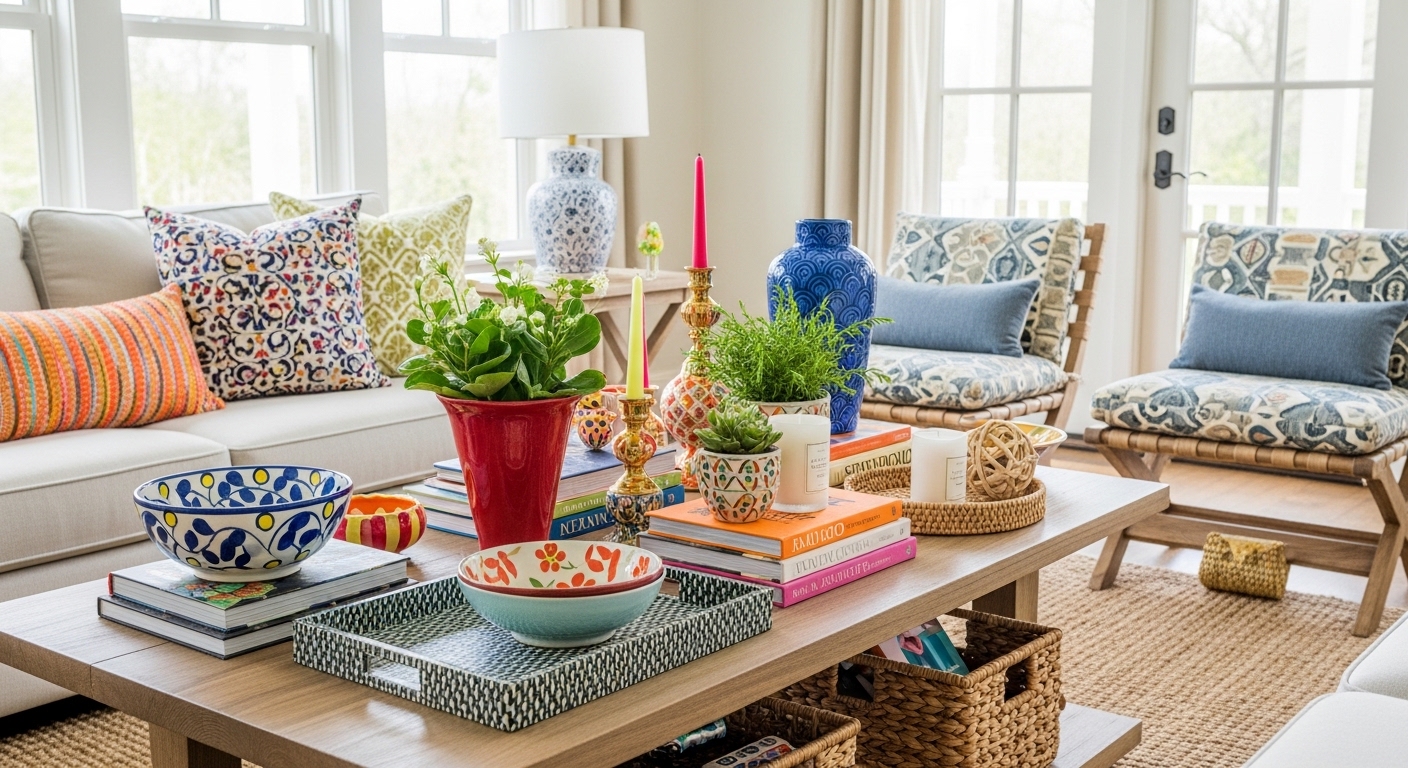
Almost every good Mediterranean tabletop starts with a tray. The tray does three jobs: it gathers small objects into one intentional group, it protects the table surface from rings and scratches, and it can be lifted off in one motion when the table needs to be cleared for dinner or a board game.
Choose the tray by the table, not by the objects. A round woven tray softens a rectangular wooden table; a long wooden tray suits a stone top; a metal tray with handles reads more formal and pairs well with glass candle holders. The tray should be large enough to hold its group with a little space around each piece — a crammed tray looks like storage, not styling. As a guide, leave at least a finger’s width between objects inside the tray.
Build the tray in three heights: something low and flat (a stack of books or a folded linen napkin), something mid-height (a bowl, a small plant, a candle cluster), and something tall (a bud vase with a single stem, a slim candlestick). Three heights keep the eye moving without any one piece dominating. If the tray sits on a round table, keep the tallest piece near the center so the arrangement reads evenly from every seat.
Ceramics and Vessels
Ceramics carry the Mediterranean story more than any other object, because the region’s craft traditions are ceramic traditions: glazed bowls, hand-painted tiles, amphora shapes, rough earthenware. You do not need authentic imports. What matters is the finish — matte or softly glazed, slightly irregular, in one of the palette families — rather than the origin label.
Group ceramics in odd numbers and mixed sizes. Three bowls of different diameters nested near each other read as a collection; three identical bowls in a row read as a shop display. Mix one patterned piece with plain ones: a single hand-painted bowl next to two unglazed ones lets the pattern breathe, while three patterned pieces side by side turn busy. If a piece is genuinely beautiful, give it space — a striking vase earns an empty patch of table around it, not a crowd of neighbors.
Scale is where ceramic styling usually goes wrong. A bowl that looks generous on a shop shelf can disappear on a large table, and a dramatic vase can overwhelm a small one. Before committing, set the piece on the table and sit on the sofa: it should be visible and pleasing from seating height, not just from standing. Small tables want small ceramics — a bud vase, a tiny olive dish — while large tables can take a statement bowl as the anchor.
Textiles and Texture
Mediterranean rooms are textile-rich rooms, and the tabletop should echo that. A woven runner under the tray, a folded throw draped over one corner of an ottoman-style table, or a linen napkin tucked under a bowl all add the softness that hard surfaces — stone, wood, glass — cannot supply on their own.
Keep textiles to one or two per table. A runner plus a throw is plenty; a runner plus a throw plus three napkins plus a tablecloth turns the table into a fabric shop. Natural fibers read most convincingly: linen, cotton, jute, wool. Anything shiny or synthetic fights the sun-warmed, matte feeling the rest of the styling builds.
Texture also comes from the objects themselves. A rough terracotta pot next to a smooth glazed bowl, a woven basket beside polished wood, a nubby linen runner under a sleek tray — these contrasts are what make the arrangement feel collected rather than purchased as a set. If everything on the table has the same finish, add one contrasting texture before adding another object.
🛒 Shop This Look:
Greenery and Flowers
Nothing says Mediterranean faster than an olive branch in a simple vase. Olive branches are forgiving indoors: they last well in water, they tolerate a dry room, and their silvery green suits every version of the palette. Eucalyptus is the easy substitute where olive branches are hard to find, with a similar muted tone and a scent that suits the room without dominating it.
Fresh flowers work best when they are simple and seasonal rather than arranged and formal. A bunch of wildflowers in a glass jar, a few stems of lavender in a small pot, or a single bold bloom in a bud vase all suit the loose Mediterranean feeling better than a dense florist bouquet. Change the water every couple of days and trim stems at an angle; a drooping arrangement undermines the whole table faster than any styling mistake.
Plants on the table need the same practical thinking as plants anywhere: a pot without drainage will stain the surface, and a trailing plant will shed onto books and trays. Use a saucer or a cachepot, wipe leaves occasionally, and keep plants away from the spot where cups actually land. If the table sits in direct sun, remember that water in a glass vase acts as a lens — move glass vases out of harsh midday sun or accept bleached rings on wood.
Books, Candles, and Evening Light
Books are the easiest styling object because they are also useful. A stack of two or three large-format books — travel, art, cooking — gives the tray height, gives guests something to open, and gives smaller objects a platform. Stack them largest at the bottom, spines facing outward, and top the stack with one small object: a candle, a tiny dish, a smooth stone. A stack of more than four books stops looking like reading material and starts looking like a barricade.
Candles supply the evening version of Mediterranean warmth. Glass hurricanes protect flames from drafts and look intentional; open tapers in slim holders read more formal. Standard candle safety applies: never leave a burning candle unattended, keep flames away from curtains and dried branches, and put candles on a heat-proof surface rather than directly on wood or a runner. Scented candles are a choice, not a requirement — one subtle scent suits the room better than three competing ones.
Evening light changes the table completely. A low lamp on a nearby side table, candles on the coffee table itself, and dimmed overhead lights turn the same arrangement from daytime-casual to evening-warm without moving a single object. If the table is the room’s evening gathering spot, plan the candle placement for the evening view, not just the daytime one.
Keeping the Table Usable Every Day
A styled table that nobody can use is a failed table. Reserve one clear zone — roughly the size of a dinner plate per regular seat, or one open corner on a small table — and treat it as permanently empty. When guests arrive, the tray can shift or lift off; when they leave, it returns. This is the real job of the tray: it makes clearing the table a one-motion task instead of a fifteen-minute rearrangement.
Choose surfaces and objects that survive real life. Coasters under glasses protect wood and stone alike, and they are easier to replace than a refinished tabletop. Anything fragile and irreplaceable — a family heirloom vase, a delicate antique bowl — belongs on a shelf or a side table, not on the surface where elbows and board games live. Households with small children or large dogs should favor heavier, lower objects that cannot be easily toppled, and skip tall candlesticks on the coffee table entirely.
Cleaning is part of styling. Dust ceramics weekly, wipe trays, shake out runners, and rotate the arrangement occasionally so the same side does not fade in the sun. A table that is cleaned and slightly rearranged every week or two always looks more intentional than one that is perfectly styled once and then left to gather dust.
Small Rooms and Renters
Small tables need the same principles at a smaller scale: one tray, three objects at most, one color family leading. A tiny table with a single beautiful bowl and a candle is a complete Mediterranean arrangement; a tiny table crowded with seven small objects is clutter. If the table is also a work surface or dining surface, the tray-and-lift approach matters even more — everything lives on the tray, and the tray lives on a shelf when the table is working.
Renters can get the full effect without changing anything permanent. A runner, a tray, ceramics, and branches are all portable and all leave with you. Avoid anything that marks the table — unprotected candle wax, wet terracotta without a saucer, metal objects that scratch — because the deposit depends on the tabletop surviving your tenancy as well as your styling.
Mistakes That Flatten the Look
The most common mistake is buying a matching set. A boxed collection of Mediterranean-style accessories — same glaze, same pattern, same size — reads as a theme display, not a collected room. Mix sources, eras, and finishes; the palette and the tray supply the cohesion, not identical objects.
The second mistake is overfilling. Every beautiful object added past the point of balance subtracts from the objects already there. If adding a piece means removing breathing room around two others, the table was already finished. Step back to the sofa and judge from there — the seated view is the one that counts, not the standing-over-the-table view.
The third mistake is styling for photographs instead of for living. A table arranged for a single camera angle falls apart the moment someone sits down, because real rooms are seen from every side. Walk around the table after styling it. If the back view is a tangle of cords, labels, and unfinished backs, turn the pieces or replace them — a good arrangement reads from all four sides.
🛒 Shop This Look:
A Starter Plan
Start with what the table already has. Clear everything off, clean the surface, and live with the empty table for a day — the empty surface shows you the table’s real size and shape better than any measuring tape. Then add in order: tray first, anchor ceramic second, greenery third, books and candles fourth, textiles last. Stop after each step and sit on the sofa. The table is done when adding one more piece would mean removing breathing room, not when every idea on this page has been used.
Build the collection slowly. One good bowl this month, a tray next month, branches whenever they are available. Mediterranean rooms look collected because they are collected; a table assembled over a season always beats a table assembled in one shopping trip. Keep a short list of what the table still needs — a taller vase, a second linen napkin — and buy only from that list, so impulse purchases do not crowd out the pieces that would actually complete the arrangement.
For more tabletop ideas in the same family, see Italian coffee table styling, which builds an elegant tabletop around the espresso ritual, and the living room ideas hub for the rooms these tables live in.