
As an Amazon Associate, I earn from qualifying purchases. This means I may earn a commission if you purchase through links on this page — at no extra cost to you.
Round tables change how people talk. No head of the table, no corners to hide behind: everyone equidistant, everyone included. A round coffee table makes a living room feel like a gathering rather than a showroom, and it forgives awkward layouts that would trip up a rectangular table. But the circle shape brings its own problems. A round table has no ends to zone, no corners to anchor, and a centerpiece that can easily look stranded in the middle of a curve. This guide solves those problems in order: size, clearance, the tray, groupings, visual weight, materials, sightlines, storage, and the mistakes that make a round table look like it is floating.
Size rules for a circle
Size a round table by diameter, and judge it against the sofa, not the room. A good rule of thumb is a diameter roughly half the length of the sofa it serves: a long sofa can carry a larger circle, while a loveseat needs a smaller one or the table will dominate the seating group. Height follows the same rule as any coffee table: level with the seat cushions or an inch or two lower, so setting down a cup feels natural. Check clearance all the way around, since people walk around a round table on every side rather than just past its ends. A generous stride of open floor on each side keeps the table from feeling wedged in, and it matters more with a circle because there is no long side to hug a wall.
Rug size trips up round tables more than any other shape. The front legs of the sofa and chairs should all sit on the rug, and the rug should extend well beyond the table’s edge on every side. A rug barely larger than the table makes the whole group look like an island, while a generously sized rug grounds the circle and ties the seating together. If the rug is round too, center it under the table; if it is rectangular, center the table on it and let the rug’s corners frame the group.
The tray problem, solved
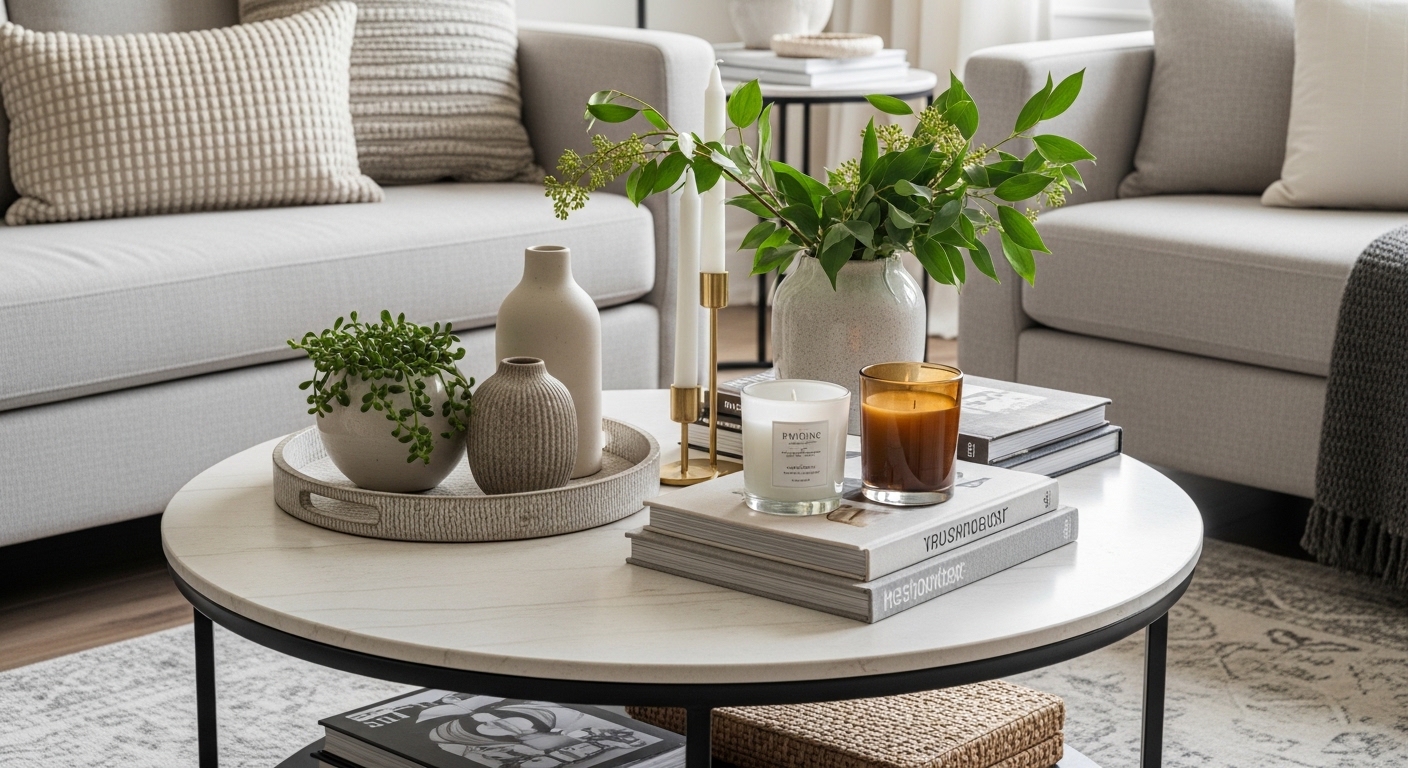
A round table needs an anchor, and the tray is the simplest one, but the tray shape matters. A round tray echoes the table and can look like a bullseye, a circle inside a circle with nothing to break it up. A rectangular or oval tray on a round table often works better, because the straight edge contrasts with the curve and gives the arrangement a direction. Either shape should cover no more than half the tabletop, leaving open surface for cups and books. Inside the tray, work in threes: one tall thing, one low thing, and one flat thing. A tall vase or candlestick gives height, a low bowl or short book stack gives weight, and a flat object like a folded cloth grounds the group. If the tray looks busy, remove one item before adding anything else.
🛒 Shop This Look:
Groupings in odd numbers, at three heights
Round tables reward odd-numbered groupings because the eye reads them as intentional rather than paired off. Three objects of different heights beat two matching ones and beat four scattered ones. Think in three heights: tall, medium, and low. A tall element might be a vase of stems or a candlestick. A medium element might be a book stack or a lidded box. A low element might be a bowl, a coaster stack, or a flat tray. Place the tallest element slightly off-center rather than dead center: a perfectly centered tall object on a round table reads like a monument, while an off-center one reads like a room. Keep the total height of the tallest element below seated eye level across the table, so people opposite each other can talk without leaning around it.
Distance between groups matters too. On a large round table, two small groups beat one sprawling one: a tray group on one side and a book stack on the other, with open surface between them. On a small round table, one group is the whole arrangement, and adding a second group just creates clutter. Let the table’s diameter decide.
Visual weight without symmetry
A round table cannot lean on symmetry the way a rectangular table can, so balance comes from visual weight instead. A dark, heavy object on one side balances a taller, lighter object on the other. A dense book stack balances an airy vase of stems. A brass bowl balances a wooden tray. The test is simple: squint at the table from the sofa. If one side looks obviously heavier than the other, shift something until the blur feels even. Color helps here: repeating one accent color twice, a rust book spine and a rust candle, for example, ties two sides together without matching them.
Empty space is part of the balance, not the absence of it. A round table with its entire surface covered looks anxious, however beautiful the objects are. Leave at least a third of the surface open, permanently, for cups, glasses, and whatever appears without warning.
Materials that suit the circle
Certain materials flatter a round table. Wood warms the curve and suits traditional and rustic rooms. Marble and travertine give a round table presence in a formal room, though they need coasters and prompt wiping, since acidic drinks mark stone. Glass tops keep a small room feeling open, but they show every fingerprint and need a tray to give the arrangement visual weight. Metal frames, brass or blackened iron, add definition to the edge, which helps a round table read as intentional rather than vague. Mix no more than two dominant materials on the table itself: wood plus brass, marble plus wood, glass plus metal. More than two and the table starts competing with itself.
Sightlines and conversation
A round table’s greatest strength is conversation, and the arrangement should protect it. Keep the center low and the tall elements at the edges of the group, so sightlines cross the table freely. Avoid a centerpiece so wide that it becomes a barrier: on a round table, width blocks more conversation than height does, because there is no way to talk around a wide object except to lean past it. Test the arrangement by sitting in every seat and checking that you can see every other seat’s face. If any seat is blocked, the centerpiece needs to shrink or move.
🛒 Shop This Look:
Storage: the lower shelf and the basket
Round tables with a lower shelf have a built-in advantage: books, throws, and baskets live below the surface instead of on it. Use the shelf for the overflow that would otherwise colonize the tabletop: a folded throw, a basket of magazines, a spare book stack. A seagrass or woven basket on the shelf adds texture and hides clutter in one move. Tables without a shelf need a different answer: a lidded box on the tabletop corrals remote controls and small odds and ends, and a side table nearby takes whatever does not fit. The goal is the same either way: the tabletop holds the arrangement and the open space, and everything else has a home elsewhere.
Pairing the round table with seating shapes
The seating around a round table changes how the table should sit. With a curved sofa, center the table on the curve’s arc so every seat has the same reach; a table pushed toward one end of a curved sofa leaves the far seat stretching. With a sectional, place the table in the crook of the L rather than centered on the longest side, so both wings of the sectional can reach it without anyone leaning across a corner. With two chairs opposite a sofa, center the table between all four seats and check that each chair has a clear path to it without squeezing past a table edge. Swivel chairs pair especially well with round tables, since both are built for turning toward conversation, but they need extra clearance to rotate, so measure the chair’s full swing before finalizing placement. In every case, sit in each seat and set down an imaginary cup: if any seat requires a stretch or a stand, the table is misplaced for that seat, however good it looks from the doorway.
Small rooms, open plans, and rented rooms
Round tables shine in small rooms because they have no corners to bump into and no sharp edges in tight walkways. Choose a smaller diameter and a pedestal base rather than four legs, since a pedestal leaves more foot room and makes the table easier to walk around. In open-plan rooms, a round table softens the boundary between seating and dining zones, especially when the rug defines the seating group clearly. Renters lose nothing with a round table: it is movable by definition, so invest in the tray and the books rather than anything fixed. If the room already has many rectangular shapes, a sofa, a rug, a bookshelf, a round table breaks the grid in a way that makes the whole room feel less rigid.
Mistakes that make a round table look like it is floating
Five mistakes show up again and again. First, a rug too small for the group, which strands the table on an island. Second, a centerpiece dead center and too tall, which turns the table into a monument. Third, a table pushed against the sofa, which kills the walkway and makes the circle feel wedged. Fourth, a matching set of objects all the same height, which reads flat from every seat. Fifth, a table so full that nobody dares set a cup down, which defeats the purpose of the most social shape there is. Each mistake has the same fix: step back, check the whole seating group from the doorway, and remove one thing before adding anything new.
🛒 Shop This Look:
A starter plan for one weekend
Saturday, clear the table completely and clean it. Measure the diameter against the sofa and check the height against the seat cushions; note honestly whether the table itself works, since styling cannot fix a table that is badly sized for its sofa. Check the rug: do the front legs of all the seating sit on it, and does it extend well beyond the table on every side? Place the tray first, off-center, then the book stack, then the tall element, stepping back after each addition to check sightlines from every seat. Add one accent color in exactly two places. Live with the arrangement for a day of real use: coffee, reading, an evening of conversation with people on all sides. Sunday, remove whatever got in the way and keep what earned its place. That is the method: size, tray, three heights, open space, and conversation first.
For further reading, the same shape-first method meets other palettes in the Irish coffee table guide, the Scottish coffee table guide, and the Mediterranean coffee table guide, plus the living room ideas hub for the room-level guides.



